Best Books for Teens: A Reading List for Ages 11 to 17
Most teens who "don't read" simply haven't met the right book yet, and the right one is usually something like this: sci-fi like Ender's Game and Scythe, mysteries like Enola Holmes, verse novels like Long Way Down, fantasy like The Hobbit, and true stories like Bomb. Below you'll find a clean, family-friendly teen reading list sorted by age, by interest and by type, including the middle school favorites, the best series to binge and the fantasy picks teens ask for most. Every book is a real, easy-to-find title, and you can print the list free to check off and rate.
What parents want to know about this list
- Covers ages 11 to 17, from 6th grade up
- No books built around a love story
- Heavy themes like war or the Holocaust are flagged
- Most picks start a series, so one good book leads to more
- Audiobooks, e-books and graphic novels all count
| If your teen likes | Start with |
|---|---|
| Space and video games | Ender's Game, Skyward |
| Thrillers and true crime | Chasing Lincoln's Killer, Bomb |
| Puzzles and mysteries | Enola Holmes, The Westing Game |
| Dragons and quests | The Hobbit, Eragon |
| Sports | The Crossover, Ghost, Booked |
| Big questions | The Giver, Scythe, Fahrenheit 451 |
| Not reading much at all | Long Way Down, New Kid, Hatchet |
📚 Printable Reading Log: make this log in 10 seconds
Set the name and goal, preview it, then print it free.
Free printables for this page
Ready-made, one-page PDFs from Printable Reading Log. Print as is, or change the columns in the maker above. See all free printable reading logs.
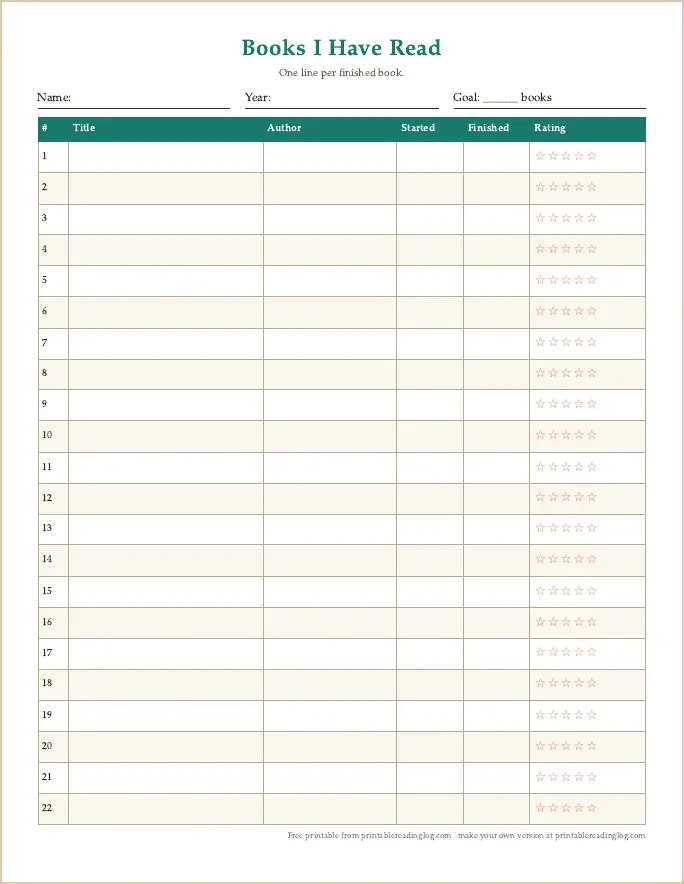
Book Log (books read)
A clean list of every book you finish: title, author, dates started and finished, and a five-star rating.
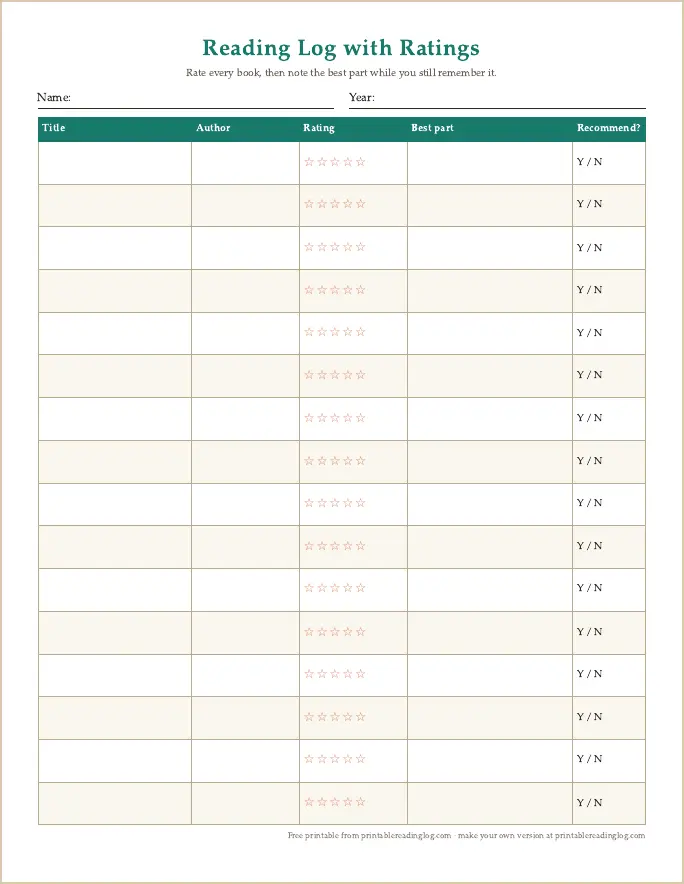
Reading Log with Star Ratings
Title, author, a five-star rating, the best part in a few words, and a would-you-recommend box.
Letting your teen choose the first four rows
Think of the list on this page as a menu, not homework. The best way to use it is to let your teen scan the tables, pick three or four titles that sound good, and write those into the first rows of the printable list. Leave the rest of the rows blank for books they find on their own, from a friend, a teacher or a library display. A list that is partly theirs gets used. A list handed down from a parent tends to live in a drawer.
If you build your own sheet in our maker, the High school preset is the closest fit. Switch on the title, author, star rating and recommend Y/N columns, and add the short to-read list at the bottom of the page so there is always a next pick waiting. If your teen likes something more visual, the Bookshelf layout gives them book spines to color in as they finish. Then print it, fold it, and keep it in the book they are reading so it doubles as a bookmark.
Every book below is clean and age-appropriate, and none of them is built around a romance. Some deal with serious subjects like war, racism, violence or the Holocaust, because teens are ready to read about the real world. I note those so you can decide what fits your teen, and you know your own kid better than any list does.
Best books for 11- to 12-year-olds
Sixth grade is the bridge between big chapter books and more grown-up stories. Kids this age want fast plots, characters close to their own age, and a reason to keep turning pages. These are the books that show up again and again in middle school classrooms and libraries.
| Book | Author | Why it works |
|---|---|---|
| Wonder | R.J. Palacio | A boy with a facial difference starts school, told from several points of view |
| Holes | Louis Sachar | A desert camp where boys dig holes all day, and a mystery about why (Newbery Medal) |
| Hatchet | Gary Paulsen | A 13-year-old survives alone in the wilderness after a plane crash |
| Number the Stars | Lois Lowry | A gentle first look at World War II as a girl helps her Jewish friend escape (Newbery Medal) |
| The Lightning Thief | Rick Riordan | A funny narrator finds out he's the son of a Greek god |
| Restart | Gordon Korman | A school bully loses his memory and gets a second chance |
| Front Desk | Kelly Yang | A girl runs the front desk of the motel her family manages |
| Escape from Mr. Lemoncello's Library | Chris Grabenstein | A puzzle-filled library escape game |
If your 11-year-old loved Holes, try The Westing Game next for another clever puzzle. If they loved The Lightning Thief, at least nine more books in that world are waiting for them. One heads-up: Where the Red Fern Grows is another classic for this age, but its sad ending hits hard, so it's a good one to talk about afterward.
Best books for 13- to 14-year-olds
Seventh and eighth graders are ready for bigger questions: what's fair, what happened in history, and what makes a good society. This is also the age when sci-fi and dystopian stories really take off. Many of these are classroom staples, so your teen may meet a few of them in school anyway.
| Book | Author | Why it works |
|---|---|---|
| The Giver | Lois Lowry | A perfect-seeming community hides what everyone has forgotten (Newbery Medal) |
| Ender's Game | Orson Scott Card | A gifted boy trains at a space battle school |
| Skyward | Brandon Sanderson | A girl fights to become a starfighter pilot |
| The City of Ember | Jeanne DuPrau | An underground city whose lights are failing |
| Refugee | Alan Gratz | Three kids from three different times flee danger |
| The Westing Game | Ellen Raskin | Sixteen heirs race to solve a millionaire's puzzle (Newbery Medal) |
| The Wednesday Wars | Gary D. Schmidt | A seventh grader reads Shakespeare with his teacher in 1967 |
| A Night Divided | Jennifer A. Nielsen | A girl cut off by the Berlin Wall plans an escape |
Ender's Game includes violence that is central to its story, and Refugee and A Long Walk to Water by Linda Sue Park deal with war. They are powerful books and worth talking about at the dinner table. For a younger 13-year-old who wants space adventure with less weight, Skyward is a great first pick.
Best books for 15 and up
Older teens can handle longer books, heavier history and the classics they will keep hearing about. This is a good time to mix one school-style classic with a modern page-turner, so reading doesn't start to feel like an assignment.
| Book | Author | Why it works |
|---|---|---|
| Scythe | Neal Shusterman | In a world without natural death, two teens train to end lives |
| The Martian (Classroom Edition) | Andy Weir | An astronaut stranded on Mars survives with science; this edition removes the swearing |
| Fahrenheit 451 | Ray Bradbury | A fireman whose job is burning books starts to read them |
| Animal Farm | George Orwell | Farm animals take over, and power slowly changes them |
| Frankenstein | Mary Shelley | A young scientist creates life, then abandons it |
| Lord of the Flies | William Golding | Stranded boys try to govern themselves, and it goes badly |
| Night | Elie Wiesel | A teen's memoir of surviving Auschwitz, short and very intense |
Night is a Holocaust memoir, and many schools teach it in 9th or 10th grade with a teacher guiding the discussion. Scythe and Lord of the Flies include violence that drives the story. If your teen wants to keep going with classics, our printable checklist of 100 books to read before you die is a fun long-term list to chip away at, and many classics have film versions that make a good reward, which is the idea behind the read the book before the movie tracker.
Fantasy with dragons and quests instead of a love story
A lot of popular young adult fantasy centers on a love story. The books here don't. Each one has a quest, a mystery or a clever set of spell rules at its heart, which makes them easy to hand to a 12-year-old or a 17-year-old. Fantasy has battles and danger, of course, and I flag the darker ones.
For a classic start, The Hobbit by J.R.R. Tolkien is still the best doorway. Bilbo joins thirteen dwarves and a wizard on a quest to a dragon's mountain, and teens who love it can move on to The Fellowship of the Ring. A Wizard of Earthsea by Ursula K. Le Guin is short but deep, about a proud young wizard who unleashes a shadow. The Book of Three by Lloyd Alexander follows an assistant pig-keeper who stumbles into a war.
For big quests, Eragon by Christopher Paolini is about a farm boy who finds a dragon egg. The Ruins of Gorlan, the first Ranger's Apprentice book by John Flanagan, trains a boy with a secretive order of scouts. The Thief by Megan Whalen Turner and The False Prince by Jennifer A. Nielsen are both full of twists and schemes. Dealing with Dragons by Patricia C. Wrede is light and funny, about a princess who runs off to keep house for a dragon.
For something set closer to the present day, try The Screaming Staircase, the first Lockwood & Co. book by Jonathan Stroud, about teen ghost hunters in a haunted London. It's spooky, not gory. Inkheart by Cornelia Funke, Akata Witch by Nnedi Okorafor, Fablehaven by Brandon Mull and Amari and the Night Brothers by B.B. Alston are all teen favorites. Mistborn: The Final Empire by Brandon Sanderson and Sabriel by Garth Nix have darker moments and more violence, so they fit older teens best.
A few tips help with long fantasy books. Use the map at the front, because it really helps. Keep a list of characters on a bookmark when the cast gets big. Give a slow book about 50 pages before deciding, since epic fantasy often starts gently and then takes off. And if the first chapters drag, the audiobook can carry a reader into the story before they switch back to print.
Book series worth binge-reading
A good series is the easiest way to keep a teen reading for weeks. Once they love the characters, they want the next book right away, and you no longer have to find the next pick. Book counts below are for the main series; several also have spin-offs or graphic novel versions.
| Series | Author | Books | Good for |
|---|---|---|---|
| Percy Jackson and the Olympians | Rick Riordan | 5 | Ages 12 to 14, myths and humor |
| The Heroes of Olympus | Rick Riordan | 5 | Fans who finished Percy Jackson |
| The Chronicles of Narnia | C.S. Lewis | 7 | Younger teens, classic fantasy |
| Lockwood & Co. | Jonathan Stroud | 5 | Spooky mysteries, ages 12 to 16 |
| Arc of a Scythe | Neal Shusterman | 3 | Older teens, big questions |
| The Reckoners | Brandon Sanderson | 3 | Superhero story flipped upside down |
| Artemis Fowl | Eoin Colfer | 8 | A boy genius versus fairy police |
| The Mysterious Benedict Society | Trenton Lee Stewart | 4 | Puzzles, ages 10 to 13 |
Should teens read a series in order? Almost always, yes. Most series carry one big story across the books. A few, like Enola Holmes and Lockwood & Co., have a case in each book, but the characters still grow from one to the next. Narnia is the classic debate: it is often numbered with The Magician's Nephew first, but many readers prefer publication order, which begins with the four Pevensie children and the wardrobe.
Long series and library holds don't always line up. Write "on hold" in the notes column next to the title so nobody forgets to pick up book three, and our guide to tracking library books and due dates has more ways to keep borrowed books from going missing.
True stories teens actually like
Some teens who say they don't like reading just don't like made-up stories. Nonfiction written like a thriller can change that fast. Bomb by Steve Sheinkin tells the race to build and steal the atomic bomb, with scientists and spies, and it won the Sibert Medal for informational books. Chasing Lincoln's Killer by James L. Swanson follows the 12-day manhunt for John Wilkes Booth and reads like an action movie.
March: Book One by John Lewis, Andrew Aydin and Nate Powell is Congressman John Lewis's memoir of the civil rights movement, told as a graphic novel. I Will Always Write Back by Caitlin Alifirenka and Martin Ganda, with Liz Welch, follows a pen pal friendship between a girl in Pennsylvania and a boy in Zimbabwe. Younger teens often like the young readers' editions of Hidden Figures by Margot Lee Shetterly, I Am Malala by Malala Yousafzai with Patricia McCormick, and The Boys in the Boat by Daniel James Brown.
Books for teens who say they don't like reading
Reluctant readers usually want three things: short chapters, a fast start, and a main character a lot like them. Long Way Down by Jason Reynolds is written in verse, and many teens finish it in one afternoon. Booked and The Crossover by Kwame Alexander mix poems with soccer and basketball. Ghost by Jason Reynolds is short, funny and about a boy on a track team. Hatchet puts survival action on page one.
Graphic novels are real reading, too. New Kid by Jerry Craft was the first graphic novel to win the Newbery Medal, and El Deafo by Cece Bell is a funny true story about growing up with a hearing aid. If your teen mostly reads comics, we've written up why comics and graphic novels earn a row for parents who are unsure.
Format matters as much as the book. An audiobook while following along in print gets a reluctant reader through a longer story, and the audiobook log is made for tracking listening time. If your teen reads mostly on a phone, the teen e-book reading log covers that too. For more ideas aimed at this group, see the reading log for reluctant readers.
The first-page test in the library aisle
Read the first page together, or ask them to read it alone in the library aisle. If it grabs them, great. If not, put it back and try another. Nobody needs to finish a book they dislike, and giving teens permission to quit is one of the fastest ways to keep them reading.
Use the five finger check when you are not sure about difficulty. Have your teen read one page and count the words they don't know. Five or more on a single page means the book may be better saved for later or read together. Before handing over a book about war or hard history, read the back cover or a review written for parents so you know what's coming. For younger siblings too, our notes on matching a book to a child's level and interests go deeper.
You can also say something like, "Pick any two from this list, and one book of your own choice." That keeps some structure while leaving real choice in your teen's hands. If they want to read with friends, a small group can share one title a month, and our page on setting up a young readers' club carries over to teens with a few tweaks.
Fitting a book to a teen's busy season
A teen's reading time changes a lot over a year. A soccer season, a part-time job, exam weeks or a school musical can shrink free time to almost nothing, and the wrong book during a packed month is often the one that gets abandoned. Matching the size and pace of the book to the season does more than any amount of reminding.
During a heavy stretch, short and fast books are the safest bet. Long Way Down can be read in an afternoon, and Booked, The Crossover and Ghost move quickly enough to fit into ten or fifteen minutes before bed. Graphic novels like New Kid and El Deafo work well on bus rides to away games. For a teen who works weekend shifts, an audiobook of Chasing Lincoln's Killer or Bomb can fill a commute and still count as a finished book on the list.
Save the big commitments for quieter months. The Hobbit, Mistborn and Ender's Game reward long, unbroken sessions, and so do the first books of the bigger series, such as Percy Jackson or The Heroes of Olympus, because a teen who loves book one will want book two within days. Winter break and the first weeks of summer are natural times to start these. Classics like Frankenstein also go better with time to read a few chapters at once, since the older style takes a while to settle into.
A 16- or 17-year-old juggling advanced classes may already be reading a lot for school. In that case, the list works best as pure pleasure reading: a page-turner like Scythe or The Martian (Classroom Edition) rather than another classic. Counting assigned books on the list too, and marking them with an "S" for school, can show a busy teen how much they are actually reading, which is often more than they think.
Starting a conversation about the book without quizzing
Teens tend to shut down when a parent asks "So what was it about?" A specific, open question about a moment or an idea usually goes further, and it shows you have some sense of the book. Here are openers that suit several books already on this list.
For The Giver, try asking whether the community's rules would be worth it if they really did keep everyone safe. Most teens have a strong opinion, and the conversation tends to drift toward their own school or town. For Wonder, ask which narrator they trusted most, since the book switches points of view and each character sees the same events differently. Holes invites a lighter question: which of the two storylines did they want to get back to more, the camp or the past?
Animal Farm and Lord of the Flies both open up talk about power and fairness. A simple question like "At what point did things start to go wrong?" lets a teen point to a chapter without feeling tested. With Scythe, ask whether they would want to live in a world without natural death, and why or why not. Teens who loved Ender's Game often want to talk about whether Ender was treated fairly by the adults around him.
True stories need a slightly different approach. With Bomb, ask which person in the story they would most want to talk to, scientist or spy. With March: Book One or I Will Always Write Back, ask what surprised them most. For Night or Number the Stars, it is often better to wait and let your teen bring it up, then mostly listen. A teacher who covers these in class can be a good partner, and a quick question about what was discussed at school can open the door gently.
Car rides make an easy setting for any of these. Sitting side by side, with no eye contact required, many teens talk more freely than they would across a table.
Reading the list back after a semester
A printed list with a few months of stars and recommend marks is worth a second look, ideally with your teen at the end of a term. The patterns on it make choosing the next books much easier than starting fresh from the tables above.
Look first at the fives. If the highest-rated books on the list are Skyward, Ender's Game and Scythe, your teen is a science fiction reader at heart, and the rest of the Arc of a Scythe series or The Reckoners is an obvious next step. If the fives are Bomb, Chasing Lincoln's Killer and Refugee, the pull is toward real events and urgent stakes, and Hidden Figures or The Boys in the Boat in their young readers' editions are natural follow-ups.
Then look at the stopped books. If two or three classics were dropped at the same point, that does not mean your teen dislikes classics. It may mean the older language is the barrier, and an audiobook alongside the print, or a shorter classic like Animal Farm, could carry them through. If several long fantasy books were dropped early, shorter fantasy like A Wizard of Earthsea or Dealing with Dragons may suit them better for now.
Finally, count the rows your teen added themselves versus the rows that came from this list. A growing share of their own picks is a very good sign. It means the list has done its job, and they are finding books on their own.
A filled-in teen reading list
A real first month on a printed list is rarely tidy, and this one isn't either. One book was dropped, one was an audiobook, and one came from a friend.
| Title | Author | Done | Stars | Recommend? |
|---|---|---|---|---|
| Skyward | Brandon Sanderson | Yes | 5 | Y |
| Chasing Lincoln's Killer (audiobook) | James L. Swanson | Yes | 4 | Y |
| Frankenstein | Mary Shelley | Stopped at ch. 5 | ||
| Long Way Down | Jason Reynolds | Yes | 5 | Y |
The stopped book still belongs on the list. It tells you something about what your teen enjoys, and they may come back to it in a year. For a more detailed rating page, the reading log with star rating gives each book a little more room. For nightly reading that school asks for, pair this list with the reading log for high school or the reading log for middle school.
Winter break is a perfect time to start a new series or a long fantasy book. Line up the first two books before the break so your teen isn't stuck waiting, and keep the goal small, like one book over the break. The teen winter break reading challenge shows how to keep it low-pressure. The PDF on this page works as is, or your teen can make a version with their own title, something like "My 2027 Reading List," and pick the color theme themselves.
What parents of 11- to 17-year-olds ask us
What are the best books for teens right now?
Popular picks include Ender's Game by Orson Scott Card, Scythe by Neal Shusterman, Long Way Down by Jason Reynolds, the Enola Holmes mysteries by Nancy Springer, Bomb by Steve Sheinkin and Fahrenheit 451 by Ray Bradbury.
Are these books okay for a 13-year-old?
Most are. Every pick is clean and none is built around a romance. Some deal with violence, war or the Holocaust, which I flag, so start with the 11 to 14 sections and save books like Night and Scythe for a little later if you prefer.
What are good books for teens who don't like to read?
Try short, fast books such as Long Way Down, Booked or The Crossover, the graphic novel New Kid, the true thriller Chasing Lincoln's Killer, or Hatchet. Audiobooks count too.
What are clean fantasy books for teens?
The Hobbit, The Book of Three, Dealing with Dragons, The False Prince, Ranger's Apprentice, Lockwood & Co., Fablehaven and Keeper of the Lost Cities by Shannon Messenger are all popular with families looking for clean fantasy.
What is a good book series for a 13-year-old?
Percy Jackson, Lockwood & Co., Fablehaven, The Inheritance Cycle, The Reckoners and Skyward all have exciting first books and plenty more to keep going.
What books should teens read before graduation?
Many teens read Fahrenheit 451, Frankenstein, Lord of the Flies, Animal Farm and Night in school. Add a few modern books they choose themselves so reading stays fun after the last assignment.
Do graphic novels count as real reading for teens?
Yes. They build vocabulary and comprehension, and New Kid by Jerry Craft won the Newbery Medal. March: Book One is a strong nonfiction graphic novel for older teens.
My teen stopped Frankenstein at chapter five. Should it stay on the list?
Yes. Write where they stopped in the notes and leave the stars blank. A dropped classic at 15 often reads very differently at 17, and the row reminds them it's waiting.