Reading Log by Minutes: Free Printable Minute Tracker
A reading log by minutes tracks how long you read each day instead of how many pages or books. You jot down the date, the title, and the number of minutes you read, then total it up over the week or month. It's the fairest way to track reading when book lengths vary a lot, which is why schools and parents love it. The quickest way to make one is a free reading log maker that builds a clean minute tracker in seconds.
Ready to make yours? Open the free tool, choose the by-minutes layout, set a daily goal like 20 minutes, and print. No sign-up, no cost, nothing to install.
What Is a Reading Log by Minutes?
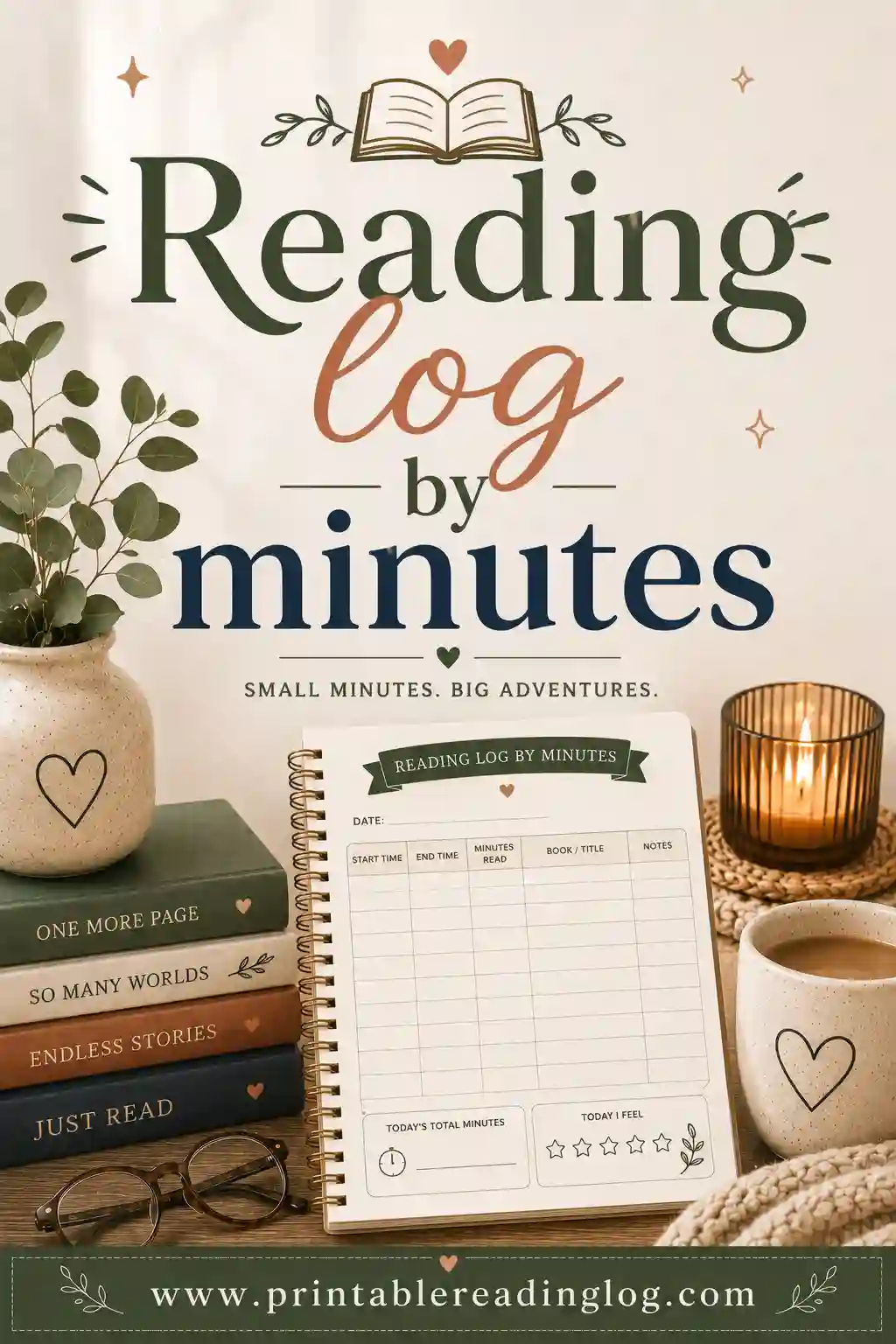
A reading log by minutes records reading time, not page counts or finished books. Each row holds the date, what you read, and how many minutes you spent. At the bottom, you usually total the week or the month so you can see your reading time at a glance.
This format answers one simple question: how much time am I actually spending with a book? That's a more honest measure for a lot of readers than pages, because pages don't account for difficulty, picture-heavy books, or slow, careful reading.
A typical minute log has columns for:
- Date — to track daily reading and spot streaks.
- Title — what you read that day.
- Minutes — the heart of the log.
- A running or weekly total — minutes add up fast and feel motivating.
- A signature line — common for school and reading-challenge logs.
You can keep it lean or add a star rating and notes. Building your own lets you decide.
Why Track Reading by Minutes Instead of Pages?
Minutes and pages both work, but minutes have some real advantages, especially for kids and mixed reading. Here's why so many people choose them.
It's fair across different books
A 10-page picture book and 10 pages of dense text are nowhere near the same effort. Minutes level the field. Twenty minutes is twenty minutes whether your child is reading a thin board book or a thick chapter book.
It matches how schools set goals
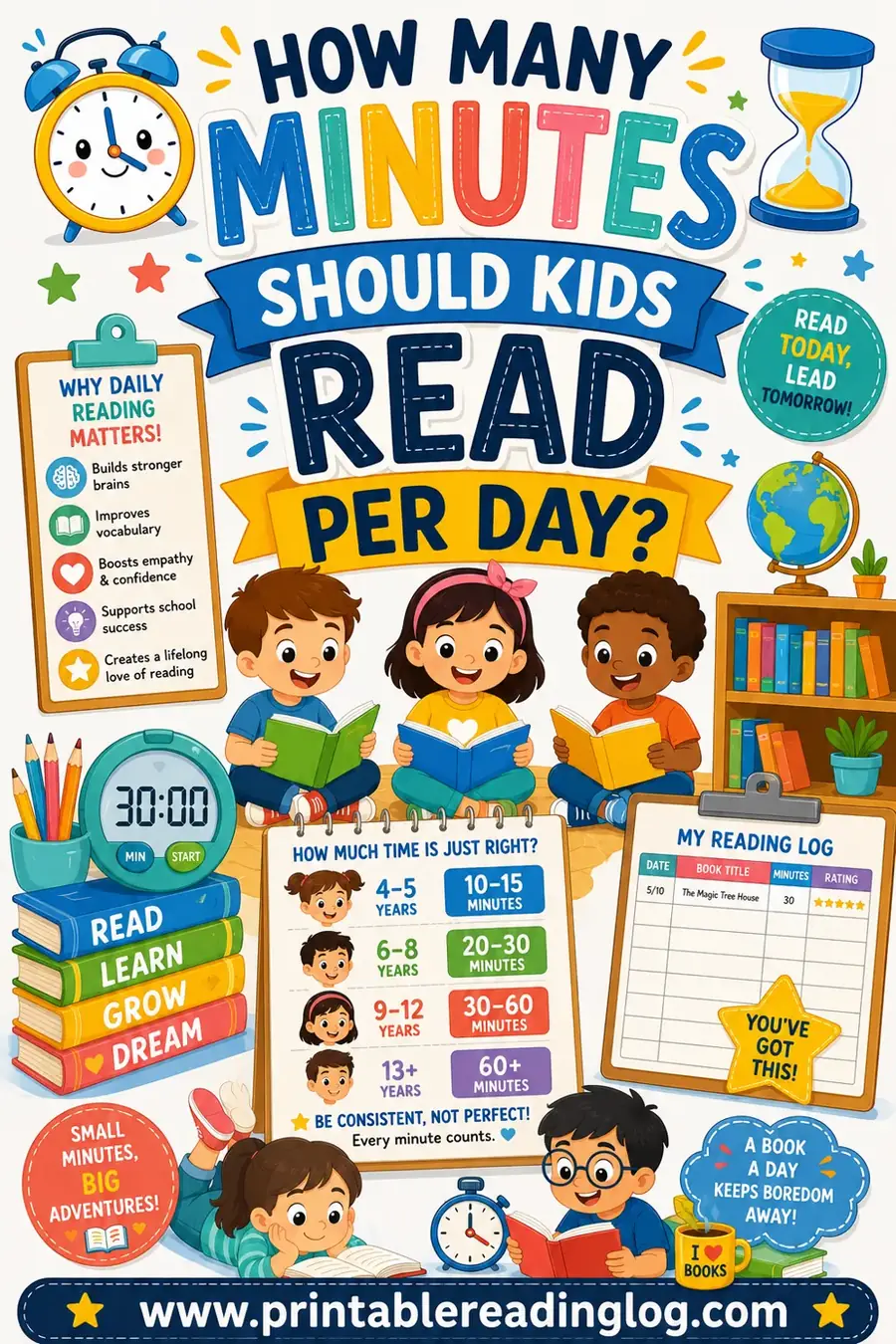
Most teachers ask for a reading time, not a page count, "read 20 minutes a night." A minute log lines up perfectly with that homework and makes it easy to prove the time was put in. See our guide on how many minutes kids should read per day for the common targets.
It rewards effort, not speed
Page-based tracking can quietly pressure a reader to rush. Minute-based tracking rewards showing up and reading, whether you breeze through a chapter or savor a tough page. That's a healthier mindset, especially for young or reluctant readers.
How Many Minutes Should You Read a Day?
There's no single answer, but here are the goals most teachers and reading experts point to. Use these as a starting point and adjust to fit the reader.
| Reader | Daily goal | Notes |
|---|---|---|
| Preschool (read-aloud) | 15–20 min | Shared reading counts; keep it playful |
| Early readers (K–2) | 15–20 min | The classic "20 minutes a night" homework |
| Older kids (3–5) | 20–30 min | Move toward independent reading |
| Teens | 30+ min | Often built around assigned reading |
| Adults | 15–30 min | Even 15 minutes a day adds up to many books a year |
These are goals, not rules. A tired five-year-old who reads ten good minutes did great. Consistency beats hitting an exact number, the log is there to encourage the habit, not to grade it.
What 20 minutes a day adds up to
Small daily reading really compounds. Here's the proof.
| Daily minutes | Per week | Per year |
|---|---|---|
| 15 min | ~1.75 hrs | ~91 hours |
| 20 min | ~2.3 hrs | ~122 hours |
| 30 min | ~3.5 hrs | ~182 hours |
Over a school year, 20 minutes a night turns into well over a million words read for many kids. A minute log makes that invisible growth visible, one row at a time.
How to Make a Reading Log by Minutes in 4 Steps
You can have your minute tracker printed in just a few minutes.
- Open the reading log maker. It loads right in your browser.
- Choose the by-minutes layout. This sets up a minutes column and a total.
- Add your details. Set a daily goal, the number of rows, a title like "Reading Minutes — October," and a name line for kids.
- Print it. Stick it where you read so logging is effortless.
Done. To reuse it, print on cardstock or use a sheet protector and a dry-erase marker.
Reading Log by Minutes for Different Readers
The minute format adapts well to almost anyone. Here's how to shape it.
For young kids
Keep the daily goal small and clear, like 15 or 20 minutes, and add a sticker or color-in box for each day they hit it. A parent signature line reassures teachers the time was real. Minutes work better than pages here, since picture-book page counts are all over the place.
For reluctant readers
A minute goal feels gentler than a page or book goal. "Just read for ten minutes" is far less intimidating than "finish three chapters." Start tiny, celebrate the streak, and let the minutes creep up naturally over time.
For adults
Use a minute log to protect a daily habit. A column for what you read plus a weekly total turns "I want to read more" into a visible, satisfying routine. Pair it with a daily reading log layout if you like one row per day.
For families
Run a shared minute log on the fridge with a row per person each day. Totaling everyone's minutes at week's end makes a fun, low-pressure family reading habit, no competition required.
Tips to Make Minute Tracking Easy
A few habits keep a minute log from becoming a chore.
- Use a simple timer. A kitchen timer or phone timer set for 20 minutes removes all the guesswork. When it dings, log the time.
- Round to the nearest five. You don't need precision. "About 20 minutes" is perfectly fine and keeps logging quick.
- Log right after reading. Fill in the row while the book's still open, not from memory at the end of the week.
- Total weekly, not daily. A weekly total feels rewarding and shows progress without making every single day feel like a test.
- Count read-alouds. For young kids, time you spend reading to them counts. It's still reading time, and it still builds the habit.
For more on locking in the routine, see how many minutes kids should read per day.
Turning Minutes Into a Lasting Habit
A minute log does more than record time, it can quietly build a reading routine that lasts. The trick is to anchor your reading to something you already do every day. Read right after dinner, right before bed, or during your morning coffee, and the timer becomes part of the routine instead of one more thing to remember.
Start smaller than feels necessary. A goal of ten minutes is almost impossible to skip, and most nights you'll read longer once you've started. The hardest part of reading is opening the book, so a tiny goal lowers that barrier to almost nothing. The log then rewards you for showing up, which is the real habit you're building.
Watch for the natural lift, too. Many readers find that a few weeks of logging 15 minutes a night naturally creeps up to 25 or 30, simply because they got pulled into a good book. When that happens, let the minutes column reflect it. Seeing your daily time grow on its own is one of the most encouraging things a minute log can show you.
If a streak breaks, don't scrap the page. A reading habit isn't ruined by one missed night any more than a fitness habit is ruined by one skipped walk. Start the next row, keep the total moving, and let the log carry you forward instead of guilt-tripping you backward.
Printing and Reuse Tips
- Print on cardstock for a fridge or binder log that survives daily handling.
- Laminate or use a sheet protector to reuse the same sheet each week with a dry-erase marker.
- Print a test page to check the margins and column widths before running a stack.
- Go black and white to save ink; kids can decorate their own log as a bonus.
Frequently Asked Questions
What is a reading log by minutes?
It's a tracker that records how long you read each day instead of pages or books. Each row holds the date, the title, and the minutes read, with a weekly or monthly total at the bottom. It's the fairest format when book lengths vary, and the free tool builds one instantly.
Is it better to track minutes or pages?
It depends on the reader. Minutes are fairer across different book types and match how schools set goals ("read 20 minutes a night"). Pages suit readers who want to chip away at a long book. If you'd rather count pages, see our reading log by pages guide.
How many minutes should my child read each day?
For most early readers, 15 to 20 minutes a day is the standard goal; older kids move toward 20 to 30. These are targets, not hard rules, consistency matters more than hitting an exact number. Read-aloud time counts too for younger kids.
How do I track reading minutes accurately?
Use a simple timer set for your goal, then round to the nearest five minutes when you log it. Fill in the row right after reading rather than from memory. You don't need to be precise, "about 20 minutes" is plenty good enough.
Can I make a reading log by minutes for free?
Yes. The reading log maker is free with no sign-up and no watermark. Pick the by-minutes layout, set your goal, and print as many copies as you need for yourself, your kids, or a classroom.
Do audiobooks count as reading minutes?
For building a reading habit, yes, audiobook minutes can absolutely count, especially for younger or struggling readers who benefit from hearing fluent reading. If you're tracking for a specific school requirement, just check whether the teacher wants print reading only.
Ready to Build Your Minute Reading Log?
Tracking by minutes is the simplest, fairest way to build a reading habit, especially for kids and mixed reading. Open the free reading log maker, pick the by-minutes layout, and print a clean sheet today. Set a small daily goal, log your minutes, and watch the time add up to real progress. Happy reading.