1000 Books Before Kindergarten Reading Log
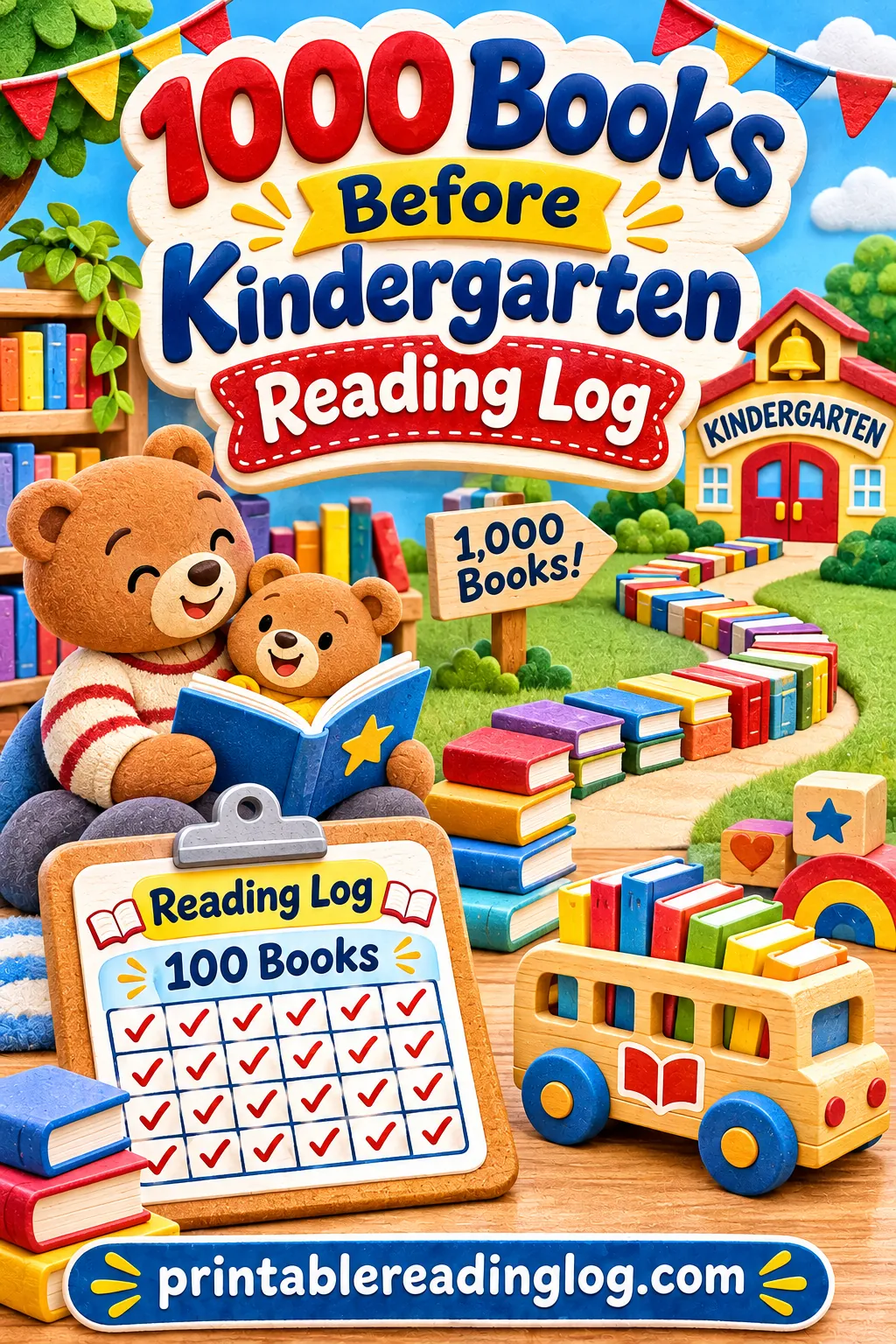
The easiest way to track 1000 books before kindergarten is to count in hundreds: print ten pages, each with a 100-square grid, and color one square every time you finish a book with your child. When a page is full, you've read 100 books. When ten pages are full, you're done.
You can print those pages for free with the printable reading log maker on this site. Pick the Picture books preset, set the goal to 1,000 books, turn on the 100-square goal tracker, and print. The rest of this guide covers the math, the counting rules, the routines that make it easy, and what to do when you fall behind.
Joining a 1000 Books Before Kindergarten program is exciting, and then you get home and wonder how you're supposed to keep count of a thousand anything with a toddler on your lap. The answer is a system that takes about three seconds per book. That's what this log is for.
▶ Open this reading log ready to print
What 1000 Books Before Kindergarten Means
1000 Books Before Kindergarten is a reading goal for babies, toddlers and preschoolers: read 1,000 books together with your child before they start kindergarten. Many public libraries run it as a free program, often with a sign-up sheet, small prizes at milestones and a celebration when a child finishes. Families can also do it on their own at home without joining anything.
The idea is simple. Reading aloud to young children every day helps them hear lots of words, enjoy stories and feel close to the grown-ups who read with them. Counting gives families a fun goal to work toward, and the milestones give small celebrations along the way.
A few things that surprise new families:
- Every book counts, including repeats. Most programs count the same book read again as another book. If your toddler wants the same story five nights in a row, that's five books.
- Anyone can read. Parents, grandparents, older siblings, babysitters, daycare teachers and library storytime readers all count in most programs.
- Board books, picture books and short books all count. It's not about length. A tiny board book read together is a book.
- There's no penalty for a slow start. You can begin at birth, at age two or at age four. You just need a slightly faster pace if you start later.
Every library sets its own rules, so check yours. Some ask you to count library storytime books, some give a log of their own, and some have specific milestone prizes. You can still use your own printed log at home and copy the totals onto the library's sheet when you visit.
The Math: How Many Books a Day?
A thousand sounds huge. Broken down, it's gentle. Here's how the pace changes depending on when you start.
| Starting age | Time until kindergarten (about) | Books per year | Books per week (about) | Books per day (about) |
|---|---|---|---|---|
| Birth | 5 years | 200 | 4 | Less than 1 |
| 1 year | 4 years | 250 | 5 | Less than 1 |
| 2 years | 3 years | 334 | 6 to 7 | 1 |
| 3 years | 2 years | 500 | 10 | 1 to 2 |
| 4 years | 1 year | 1,000 | 19 to 20 | About 3 |
Look at that last row. Even if you start the year before kindergarten, three books a day gets you there. Three books is one at breakfast, one after nap and one at bedtime. Many families already read that much without thinking of it as a goal.
And if you start at birth, one book every night at bedtime is more than enough. You'll probably pass 1,000 well before kindergarten and keep going.
Why counting in tens and hundreds helps
Trying to write down 1,000 book titles would be a chore. Most parents give up somewhere around book 60. Counting by coloring a square is so quick that it stays a habit.
- A square per book takes three seconds. Your child can color it, which turns counting into part of the fun.
- A row of ten is a natural mini-milestone. Kids love finishing a row.
- A page of 100 is a big milestone and a good time for a library visit or a small celebration.
- Ten pages make the whole journey, and they stack into a little book you can keep.
If you want to remember favorite titles too, you can add a few title rows under the grid. More on that below.
How to Make the 1000-Book Log in the Free Tool
Here are the exact settings to build this log in the free reading log maker. The tool doesn't open pre-filled from a link, so follow these steps once, save the PDF and print ten copies.
- Start with a preset. Choose Picture books. It's set up for little readers and short books. (The Kids preset also works if you'd like a slightly different look.)
- Reader name. Type your child's first name, such as "Maya's 1000 Books." Kids love seeing their name at the top.
- Reading goal. Type 1,000 books before kindergarten, or a page goal such as Books 1 to 100. If you prefer, print each page with its own range (Books 101 to 200, and so on) so the stack stays in order.
- Log style. Choose Kid-friendly. The bigger, friendlier layout is easier for small hands to color.
- What are you logging? Choose Books.
- Color theme. Pick any you like. Sunshine and Mint are cheerful. Classic prints best in black and white.
- Columns. For a grid-first log, keep columns short: Title and Date finished are plenty. Add Star rating with the Smiley rating style if your child likes to "rate" books with a happy or sad face.
- Rows per page. Keep it low, about 5 to 8 rows, so the grid has room. These rows are for "favorite books this page," not every single book.
- Goal-tracker bar. Turn it on and choose 100 squares. This is your main counter: one square per book.
- Challenge bar. Add a short line like "1000 Books Before Kindergarten: Page 1 of 10."
- Books I want to read next. Leave it on. It's a handy spot to jot down library holds or books your child keeps asking about.
- Month. Optional. You can leave it blank, since a page may take weeks or months to fill.
- Coloring strip (kids). Turn it on. A finished page gets a coloring reward.
- Paper and layout. Letter or A4, and Portrait.
- Click 🖨️ Print / Save PDF. Save the file and print ten copies, or print one at a time as you go.
That's it. Put the first page on the fridge or in a clipboard next to the book basket, with a crayon tied to it on a string. Out of sight is out of mind with a log like this.
Other layouts that work
The 100-square page isn't the only option. Different families like different setups.
| Layout | How to set it up in the tool | Best for |
|---|---|---|
| 100-square grid page (main recommendation) | Picture books preset, Books, goal tracker 100 squares, 5 to 8 rows | Most families. Fast and visual. |
| 50-square half-pages | Goal tracker 50 squares, 20 pages total | Kids who need milestones more often |
| Ten-square strips | Goal tracker 10 squares, cut into strips, glue into a notebook | Toddlers who love finishing something fast |
| Title list | Books, columns Title and Date finished, 20 to 25 rows | Parents who want a keepsake list of every book |
| Bookshelf log | What are you logging? Bookshelf, Kids preset | Kids who love coloring book spines |
| Monthly log | Monthly log preset, Books | Families who like to see each month's total |
Mixing works too. Use the 100-square grid as your counter and a short title list for favorites. If your little one likes coloring spines, take a look at the picture book log page for a different style.
Counting Rules That Keep It Simple
Before you color the first square, settle a few house rules. Writing them on a sticky note on the log saves second-guessing later. If your library has its own rules, follow those.
Repeats count. Reading a favorite book again is still reading. Little kids learn a lot from hearing the same story many times, and they love joining in on the words they know.
Any reader counts. Grandma on a video call, big brother on the couch, the daycare teacher at circle time and the librarian at storytime all count. Ask your child's caregiver to tell you roughly how many books they read each day, or keep a small tally card in the diaper bag.
Short books count. A board book with six pages is a book. A book of nursery rhymes can count as one book per sitting. Don't overthink it.
Unfinished books. If your toddler wanders off after three pages, decide what you'll do. Most families count a book when they've reached the end, or when the child clearly "finished" with it in their own way. Pick a rule that feels fair and move on.
Audiobooks and story apps. Some families count audiobooks a child listens to while looking at the pages. Others count only books read aloud by a person. Ask your library, or choose your own rule.
Books read in another language count. Reading in your home language is wonderful. Count every one.
Long books. If you read a longer chapter book aloud over several nights, some families count each chapter or each sitting as one, and others count the whole book once. Either is fine for a home log. Your library may have a preference.
The goal is a happy reading habit, not perfect accounting. If you forget to color a square or two, it's fine. If you're not sure whether something counted, color it.
Daily Routines That Make 1,000 Books Easy
The families who finish usually don't "find time" for reading. They attach books to things that already happen every day. Here are anchor points that work.
The everyday anchors
- Breakfast book. One short book while your child finishes breakfast. They're sitting still anyway.
- Before nap. A quiet book to wind down. This one becomes a cue that it's time to rest.
- Waiting book. Keep two small books in the diaper bag or car for waiting rooms, restaurants and lines.
- Bath time. Waterproof books in the tub count.
- Bedtime stack. Two or three books before lights out. Let your child choose one.
- Library storytime. A weekly storytime can add several books in one visit.
With just bedtime and one other anchor, most families read 10 to 15 books a week without trying.
Sample weekly rhythms by age
| Age | A realistic week | About how many books |
|---|---|---|
| Baby (0 to 12 months) | One board book at bedtime, a few cuddle-and-look books during the day | 7 to 14 |
| Young toddler (1 to 2) | Breakfast book, bedtime stack of two, library storytime once | 20 to 25 |
| Older toddler (2 to 3) | Bedtime stack of two, one quiet-time book, weekend library trip | 20 to 25 |
| Preschooler (3 to 4) | Bedtime stack of two or three, one daytime book, a sibling reading one book | 25 to 30 |
| Pre-K (4 to 5) | Two at bedtime, one with a grandparent or sibling, one picked by the child | 25 to 30 |
At 20 books a week, you'd finish 1,000 books in about a year. At 7 books a week, it takes about three years. Both are good.
When reading is hard
Some days the toddler won't sit still, the baby is teething or everyone is sick. That's normal. A few things that help:
- Read while they move. You can read aloud while your child plays nearby. They're still hearing the story.
- Let them hold the book. Turning pages and pointing at pictures counts as reading together.
- Tell the story instead. Some days you'll just talk about the pictures. That's still time with a book.
- Count tomorrow. If today is a zero, that's fine. Three books tomorrow gets you right back on track.
If you're looking for more ideas, the guide to the read-aloud log for parents has tips for building a read-aloud routine at any age.
What to Read: 1,000 Books Without Running Out
A thousand books doesn't mean a thousand different books. You'll repeat favorites often. But variety keeps it fun for both of you. Here's a mix of book types to rotate through, with a few classic examples that have been loved for generations.
Book types to keep in rotation
- Board books. Sturdy and chewable. Great from birth to about age two.
- Touch-and-feel and lift-the-flap books. Babies and toddlers love the surprise.
- Nursery rhyme collections. Short, rhythmic and easy to repeat. Mother Goose rhymes are a classic place to start.
- Concept books. Colors, shapes, numbers, opposites, animals and their sounds.
- Wordless picture books. You tell the story together using the pictures.
- Rhyming picture books. Kids learn to guess the rhyming word.
- Folk tales and fables. Old stories like The Three Little Pigs, Goldilocks and the Three Bears, The Little Red Hen and Aesop's fables. There are many retellings to choose from.
- Classic picture books in the public domain. Beatrix Potter's The Tale of Peter Rabbit is an early favorite for many families, and many old fairy tale collections are free to read.
- Award-winning picture books. Ask your librarian for Caldecott Medal and Caldecott Honor books, which recognize distinguished illustrations in American picture books. Many libraries keep a shelf or list of them.
- Nonfiction for little ones. Trucks, dinosaurs, bugs, the ocean, the weather. Real photos are a big hit.
- Books about everyday life. Going to the doctor, a new baby, starting preschool, bedtime, potty training.
- Song books. Books based on songs you already sing together.
- Books in your home language. Every language counts.
- Books your child picks. Even if you're not a fan of the cover, let them choose sometimes.
Library habits that keep the shelves fresh
- Borrow a stack every visit. Ten to fifteen books every week or two keeps things new.
- Use holds. Request favorites and new finds so they're waiting for you.
- Ask the children's librarian. They're very good at matching books to a child's current obsession, whether that's diggers, ducks or the moon.
- Keep a library bag. One bag for library books avoids lost-book worries.
- Write wishes on the log. The "Books I want to read next" box on the log is a great place to jot down titles your child asks for.
Want more help choosing? The guide on how to choose books for your child walks through picking books that match your child's age and interests.
Milestones and Celebrations Along the Way
Big goals need small wins. A child won't understand "1,000," but they'll understand a full page, a sticker, or a special trip. Here are milestone ideas for each page of your log.
| Milestone | Celebration idea |
|---|---|
| First 10 books (one row) | A sticker on the log and a high five |
| 100 books (page 1 full) | A trip to the library to pick out books, and choose the color theme for the next page |
| 200 books | A reading picnic on a blanket, indoors or outside |
| 300 books | Let your child "read" a favorite book to you from memory or pictures |
| 400 books | Build a reading fort and read in it |
| 500 books (halfway) | A special bookmark or a book of their very own |
| 600 books | A video call reading session with a grandparent or friend |
| 700 books | Pajama reading party with a flashlight |
| 800 books | Make a homemade book together: draw pictures and you write the words |
| 900 books | A countdown poster for the last 100 squares |
| 1,000 books | A certificate, a photo with the stack of finished pages and a library celebration if your library offers one |
Keep prizes small and book-focused. The point is to celebrate reading together, not to turn reading into a chore that earns rewards. Many libraries also give milestone prizes like stickers or a free book, so bring your log along when you visit.
Troubleshooting: Falling Behind, Lost Pages and More
Life with little kids is unpredictable. Here are the problems families run into most, with simple fixes.
| Problem | Simple fix |
|---|---|
| We forgot to log for weeks | Estimate. If you read about two books a night for three weeks, color about 40 squares. A fair estimate is better than giving up. |
| The log page got lost or torn | Print a fresh page from your saved PDF and color in the squares you remember. Keep finished pages in a folder or sheet protector. |
| We started late and feel behind | Check the math table. Three books a day from age four still finishes on time. And if you don't quite hit 1,000, every book still mattered. |
| My child scribbles all over the log | Give them their own coloring page and keep the counting grid up high. Or let them scribble. It's their log. |
| Two kids in the house | Print each child's log in a different color theme with their name at the top. If you read one book to both, color a square on both logs. |
| Daycare reads lots of books we can't count | Ask the teacher for a rough daily number, or give them a small strip log with 10 squares to fill in. |
| My child only wants the same book | That's normal and still counts. Offer a new book alongside the favorite, not instead of it. |
| I keep forgetting to color the square | Move the log to where you read most, like the bedside table, and keep a crayon clipped to it. |
| The library has its own log | Use both. Color at home, then copy the total onto the library's sheet when you visit. |
| We hit 1,000 early | Celebrate, then keep going. Some families start a second thousand or switch to a new kind of log. |
Keeping the log going over years
A five-year goal is long. A few habits help it last:
- One folder for all pages. A pocket folder or a binder with sheet protectors keeps finished pages safe.
- Date each page. Write the date you started and finished each page at the top. It's fun to see how the pace changed.
- Change the theme every page. New colors make the next page feel fresh. Let your child choose.
- Check in on birthdays. Each birthday, count finished pages and see how you're doing. Adjust the routine if needed.
- Hand it off. When a grandparent or babysitter is in charge for a day, show them where the log lives.
After 1,000: Keepsakes and Getting Ready for Kindergarten
Finishing is a big deal. Make the most of it.
Make a keepsake. Staple or bind the ten pages together with a cover your child decorates. Add a photo, their age when they finished, and a list of their all-time favorite books. It becomes a sweet record of their early years.
Write down favorites. Before you forget, list the books your child asked for most. You'll be surprised how much you'll want this list later, and it makes a lovely gift for younger cousins.
Celebrate at the library. If your library runs the program, bring the finished log. Many celebrate finishers with a certificate or a small gift. Ask what they offer.
Keep reading aloud. Reaching 1,000 isn't a finish line for reading together. Kindergartners still love being read to, even as they start reading on their own.
Switch to a new log. Once kindergarten starts, many families move to a log that counts minutes or books for school. The reading log for kindergarten page shows a format that fits this stage, and you can build it in the same free tool with the Kids preset.
Look at early reading milestones. If you're curious about what comes next, the guide to reading milestones by grade level gives a general picture. Every child develops at their own pace, so follow your child's teacher if you have questions.
A note on pressure
It's easy to turn a fun goal into a stressful one. If you notice reading starting to feel like a chore for you or your child, step back. Read fewer books with more cuddles. Skip counting for a while. The habit of sharing books is the real goal, and the number is just a fun way to notice it.
There's no test at the kindergarten door. A child who heard 600 books with a loving grown-up is just as ready as one who heard 1,000.
Starting today
You don't need to wait for a library sign-up or a special day. Here's how to start tonight:
- Open the reading log maker and choose the Picture books preset.
- Set What are you logging? to Books, type your child's name, and turn on the 100-square goal tracker.
- Print your first page and put it where you read most.
- Read a book together at bedtime.
- Let your child color the first square.
That's book one. Only 999 to go, and you'll be surprised how fast they add up.
▶ Open this reading log ready to print
Frequently Asked Questions
What is 1000 Books Before Kindergarten?
It's a reading goal to read 1,000 books with a child before they start kindergarten. Many public libraries run it as a free program with logs and milestone prizes. You can also do it at home on your own with a printable log.
Do repeated books count?
In most programs, yes. Reading the same book again counts as another book, because little kids learn from hearing favorite stories many times. If your library has a different rule, follow theirs.
How many books a day do we need to read?
It depends on when you start. From birth, less than one book a day is enough. If you start at age four, about three books a day gets you to 1,000 in a year.
What if we start late?
You can still do it, or come close. Starting at three means about 10 books a week, and starting at four means about 20 a week. Even if you don't reach 1,000, every book you share helps build the reading habit.
Do books read by daycare teachers or grandparents count?
Most programs count any book read to your child by anyone. Ask caregivers for a rough daily number, or give them a small strip log to fill in. Check your library's rules if you're turning in a log there.
What's the easiest way to count 1,000 books?
Use a page with a 100-square grid and color one square per book. Ten full pages make 1,000. It takes seconds per book and your child can help color, which makes counting part of the fun.
Can I make a 1000-book log for free?
Yes. The free reading log maker on this site lets you choose the Picture books preset, set the log to Books, add your child's name and turn on a 100-square goal tracker. Print or save it as a PDF and print ten pages.
Is it okay to count audiobooks?
That's up to you or your library. Some families count audiobooks a child follows along with in a picture book, and others count only books read aloud by a person. Pick one rule and stick with it.
What should we do after reaching 1,000 books?
Celebrate, make a keepsake of the finished pages and keep reading aloud. Many families start a kindergarten reading log next, or begin a second thousand just for fun.