Reading Chart Printable: Free Color-In Charts for Kids & Classrooms
A reading chart printable is a visual grid you print and color in, one square per day of reading, so progress shows up as a growing block of color instead of a list of entries. Where a reading log records details like titles and minutes, a chart is built to be seen: it lives on the fridge or the classroom wall, and anyone walking past can tell how the week is going in half a second. The quickest way to make one that fits your reader is the free reading log generator, which lets you set up a weekly or monthly chart with a goal bar and milestone stars, then print as many copies as you need.
Want to skip ahead? Open the free tool, tap the Weekly or Monthly preset, switch on the goal-tracker bar, and print. No sign-up, no fee, no watermark.
What Is a Reading Chart?
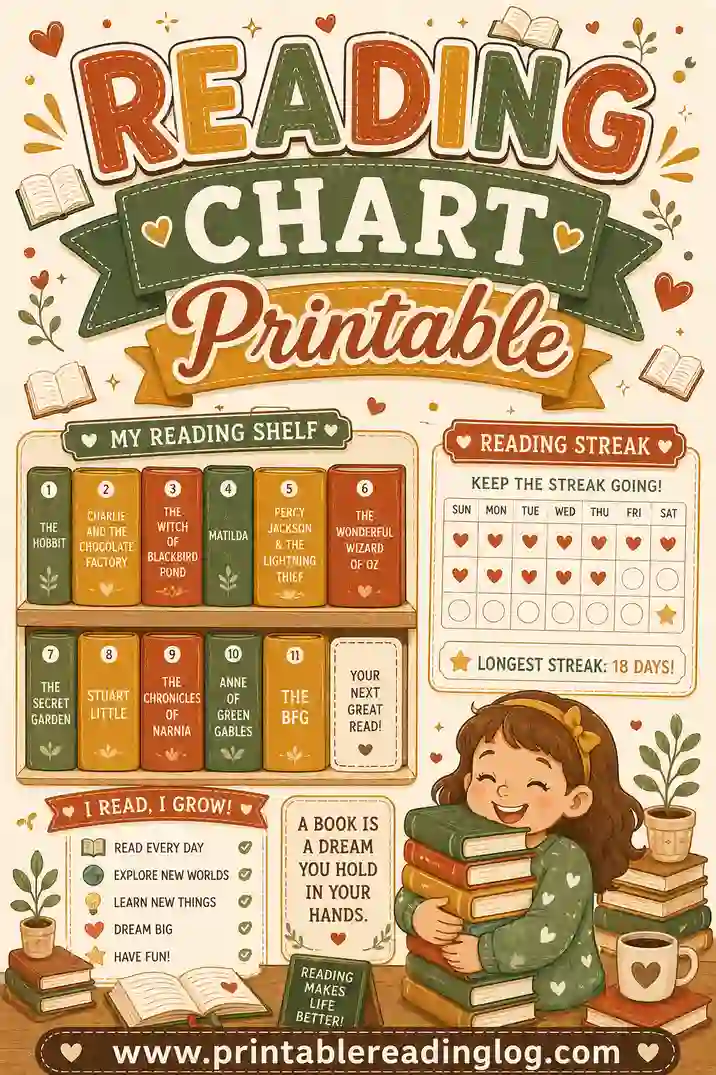
A reading chart is progress you can see from across the room. Instead of rows of handwriting, it's a grid: days along one side, squares to fill along the other. Read today? Color the square, add a sticker, or check the box. Miss a day? The blank square says so, gently.
That visual format is the whole point. A five-year-old who can't write "Frog and Toad" yet can absolutely color a square. A busy classroom can update thirty charts in ninety seconds. A tired parent can glance at the fridge and know whether tonight's reading happened.
A good chart has three parts:
- A grid of squares — one per day, or one per book or chapter.
- A goal marker — the number of squares that means "done," like 20 days this month.
- A reward moment — a star, a milestone line, or a final box worth celebrating.
Reading Chart vs. Reading Log: What's the Difference?
People use the words interchangeably, but they're different tools for different jobs. A log records details; a chart displays progress. Here's how they compare.
| Reading chart | Reading log | |
|---|---|---|
| Format | Grid of squares to color or check | Rows with columns to write in |
| Records | That reading happened | What was read, when, and how much |
| Best spot | Fridge, wall, classroom display | Folder, nightstand, backpack |
| Best for | Young kids, streaks, visible motivation | School homework, book lists, details |
| Effort per day | 5 seconds | 30–60 seconds |
If a teacher needs titles and a parent signature, that's a log, and our printable reading log guide covers it. If you want a kid to want to read tonight so they can color today's square, that's a chart. Plenty of families run both: a chart on the fridge for motivation, a log in the school folder for homework.
Types of Printable Reading Charts
The grid flexes into a few classic shapes. Pick the one that matches your goal.
| Chart type | How it works | Best for |
|---|---|---|
| Weekly chart | 7 squares, Monday to Sunday, fresh page each week | Young kids and short attention spans |
| Monthly chart | 31 numbered squares on one page | Building a month-long streak |
| Books chart | One square per book finished | Readers chasing a count, like 20 books |
| Chapter chart | One square per chapter of a big book | Working through a long read together |
| Class chart | One row per student, squares across | Teachers tracking a whole room |
The generator handles all of these. The Weekly preset gives you a page with the days pre-labeled Monday to Sunday, and the Monthly preset gives you 31 numbered rows with a month picker so the sheet shows the right month and year at the top.
The color-in square is the magic
Whatever type you pick, keep the "mark it done" action tiny and satisfying. Coloring a square, sticking a sticker, or filling a star takes seconds and gives an instant hit of progress. That little ritual, repeated nightly, is what turns a printable reading chart into a reading habit.
How to Make a Reading Chart Printable in 4 Steps
No spreadsheet, no design app. The whole build takes about a minute.
- Pick your timeframe. Tap the Weekly preset for a Monday-to-Sunday page, or the Monthly preset for a numbered 1–31 chart.
- Set the goal. Switch on the goal-tracker bar and set the target, like 20 days of reading this month. The printed bar fills toward milestone stars.
- Match it to your reader. Choose the kid-friendly style with big rows, gold stars, and an optional coloring strip, or the clean adult layout. Pick a color theme like Sky, Mint, or Sunshine.
- Print and post. Hang it at eye level, at kid height on the fridge or beside the classroom door, with a marker on a string next to it.
That last detail matters more than it sounds. A chart with a pen attached gets filled in. A chart that requires finding a pen gets skipped.
A Sample Weekly Reading Chart
Here's what a filled-in week looks like on a simple color-in chart. Each ✔ is a colored square.
| Mon | Tue | Wed | Thu | Fri | Sat | Sun | |
|---|---|---|---|---|---|---|---|
| Read 20 min | ✔ | ✔ | ✔ | — | ✔ | ✔ | ✔ |
| Goal: 5 days | ⭐ hit! |
Six squares out of seven, goal cleared on Friday, and one honest blank on Thursday. That's a great week, and the chart shows it without a single word of nagging. Keep the goal a notch below perfect, five days out of seven is plenty, so one busy evening doesn't sink the whole week.
Reading Charts for the Classroom
Teachers were using reading charts long before apps existed, because they work at scale. A few setups that hold up:
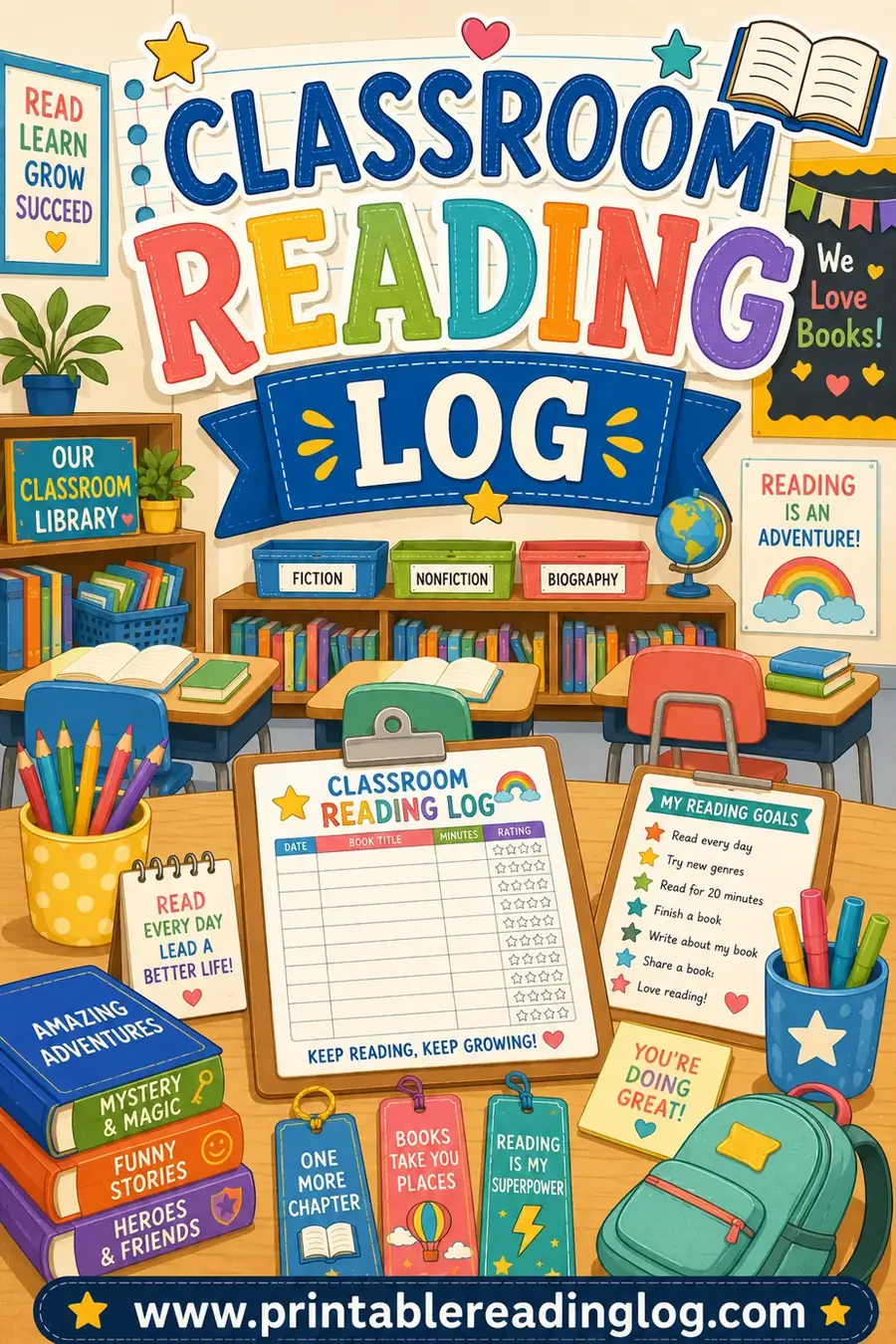
- One chart per student. Print a class set from one design using the Classroom preset, add each student's name in the Reader name field (or let them write it), and staple the charts inside their reading folders.
- A wall of charts. Post everyone's chart on a bulletin board. Kids color their square during morning routine, and the wall becomes a mosaic of progress by mid-month.
- A milestone bar. Turn on the challenge bar so each chart has milestone stars along the way, at 5, 10, and 15 days. Small checkpoints keep slower-starting readers in the game.
- Initials column for accountability. If home reading needs a parent's confirmation, add the initials column so a grown-up can initial each colored day.
For a full room setup, including how to handle the kids who lose every paper they touch, see the classroom reading log guide.
Reading Charts at Home
At home, the chart's job is simple: make reading visible and make skipping it slightly inconvenient to ignore.
- Fridge placement wins. The kitchen is the one room everyone walks through daily. Kid height, front and center.
- One chart per kid. Siblings sharing a chart leads to arguments. Separate charts lead to friendly rivalry, which is fine, and often helpful.
- Tie it to a bedtime anchor. Read, color the square, lights out. Attaching the chart to an existing routine beats relying on memory.
- Let the kid do the coloring. The square is their trophy. A parent filling it in drains all the fun out.
- Refresh it before it fades. When a weekly chart fills up, put the new one up the same night. A full chart with no successor is where streaks go to die.
Grown-ups, this works on you too. A monthly chart on the fridge with 20 color-in squares is a shockingly effective way to rebuild your own reading habit, no app required.
Make the Chart Worth Filling In
A chart motivates by itself for about two weeks. Then it needs a little fuel. Cheap, screen-free ideas that keep it going:
- Milestone stars. The tool's goal bar prints milestone markers automatically, so hitting square 10 feels like an event.
- Sticker upgrades. Regular days get a colored square; a finished book gets a special sticker.
- The full-chart reward. A completed chart earns a library trip, a new bookmark, or picking the family movie.
- A coloring strip for little ones. The kid style can add a coloring strip along the sheet, so younger readers shade part of a picture each day and finish the artwork when the chart is done.
- Read the last square together. Make the final square a shared read-aloud so the finish is a moment, not just a mark.
Notice what's not on the list: money and screens. The best rewards keep pointing back at books, so the chart builds a reader, not a negotiator.
Printing and Display Tips
A chart lives on a wall for weeks, so print it to survive.
- Cardstock for monthly charts. A month of marker and fridge magnets wrecks thin paper. Cardstock stays flat and crisp.
- Regular paper for weekly charts. They're replaced every seven days, so cheap paper is perfect.
- Landscape for wide grids. If your chart has many columns, flip to landscape orientation in the tool so the squares stay big enough for small hands.
- A sleeve makes it reusable. Slide the chart into a clear plastic sleeve, mark days with a dry-erase marker, and wipe it clean each month.
- Print the whole term at once. A stack of ready charts means a finished one is replaced the same day.
Common Reading Chart Mistakes
The chart format is nearly foolproof, but a few missteps can flatten it.
- Making the squares too small. A kindergartner needs a square big enough to color with a crayon. When in doubt, fewer rows and bigger boxes.
- Demanding a perfect streak. All-or-nothing charts collapse after the first missed day. Set the goal at 5 of 7 days and blanks lose their sting.
- Tracking too much on a chart. Titles, minutes, and opinions belong on a log. A chart tracks one thing: did reading happen?
- Hiding it in a folder. A chart is a display. If nobody sees it, use a reading log for kids instead.
- Letting a full chart sit. Celebrate it, then hang the next one immediately. Momentum is the whole product.
Frequently Asked Questions
What is a reading chart printable?
It's a printable grid where you color in or check one square for each day of reading (or each book finished), so progress is visible at a glance. It's built for display, on a fridge or classroom wall, rather than for recording details. You can make one free with the reading log generator in about a minute.
What's the difference between a reading chart and a reading log?
A chart shows that you read, with squares you color in; a log records what you read, with columns for titles, minutes, and notes. Charts win for young kids and visible motivation, logs win for school requirements and book lists. Many families use both.
Is the printable reading chart really free?
Yes. You build it in the free tool and print it yourself, with no sign-up, no watermark, and no copy limit, so one design can cover a whole classroom or a whole summer.
Should the chart be weekly or monthly?
Weekly for young kids, since a fresh page every seven days keeps things winnable, and monthly for older kids and adults who enjoy watching a longer streak build. The tool has a preset for each, with days or dates pre-labeled.
How do I make a reading chart for my classroom?
Use the Classroom preset, add the initials column if you need parent sign-off, turn on the challenge bar for milestone stars, and print one per student from the same design. The classroom reading log guide walks through the full setup.
What goes in each square?
Whatever marks the day as done: a colored square, a check, a sticker, or a smiley. Keep the action under five seconds. If you want to record minutes or titles too, pair the chart with a simple printable reading log.
Ready to Print Your Reading Chart?
Pick weekly or monthly, switch on the goal bar and milestone stars, and open the free reading log generator to print a color-in chart your reader will actually race to fill. It's free, there's no sign-up, and you can print a fresh chart every week all year long. Hang it where everyone can see it, hand over the crayon, and let today's square be the first one colored in. For more setups, see our guides on the reading log for kids and the printable reading log.