100 Books to Read Before You Die: A Printable Checklist of Classics and Favorites
Some books get handed from parent to child, teacher to student and friend to friend for generations, and this list collects 100 of them: old classics like The Odyssey and A Tale of Two Cities, children's books that are even better as a grown-up, gripping true stories, and a handful of modern favorites. This guide groups all 100 so you can pick by mood, suggests where to start, and shows how to track the list on a simple printed checklist. At one book a month it's about an eight-year adventure; at two a month, about four.
| Your pace | Books a year | Time to finish all 100 |
|---|---|---|
| One a month | 12 | About 8 years and 4 months |
| Two a month | 24 | About 4 years and 2 months |
| One a week | 52 | About 2 years |
| Mixed: short books fast, long ones slow | Varies | Usually quicker than you expect |
📚 Printable Reading Log: make this log in 10 seconds
Set the name and goal, preview it, then print it free.
Free printables for this page
Ready-made, one-page PDFs from Printable Reading Log. Print as is, or change the columns in the maker above. See all free printable reading logs.
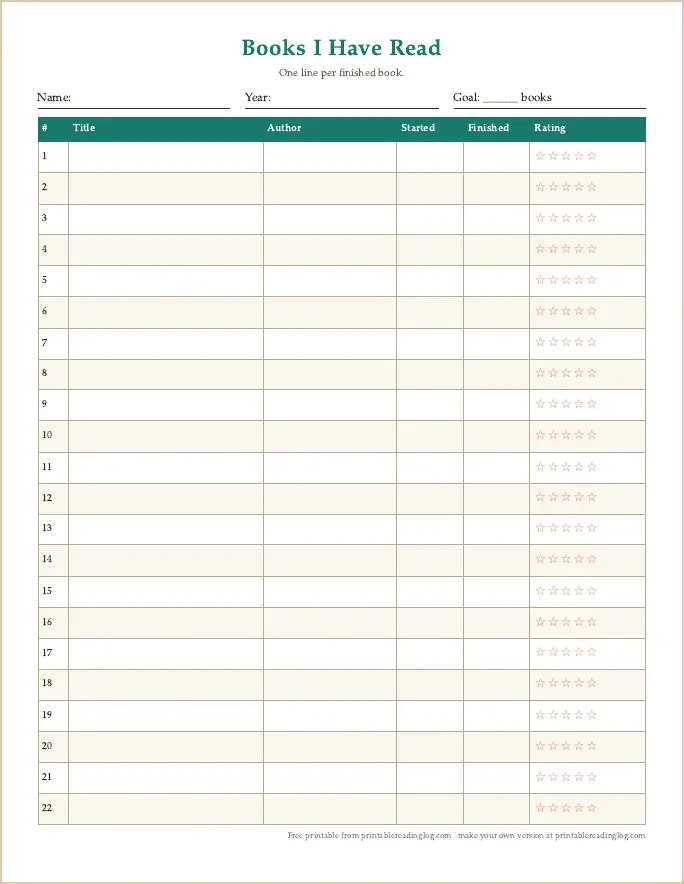
Book Log (books read)
A clean list of every book you finish: title, author, dates started and finished, and a five-star rating.
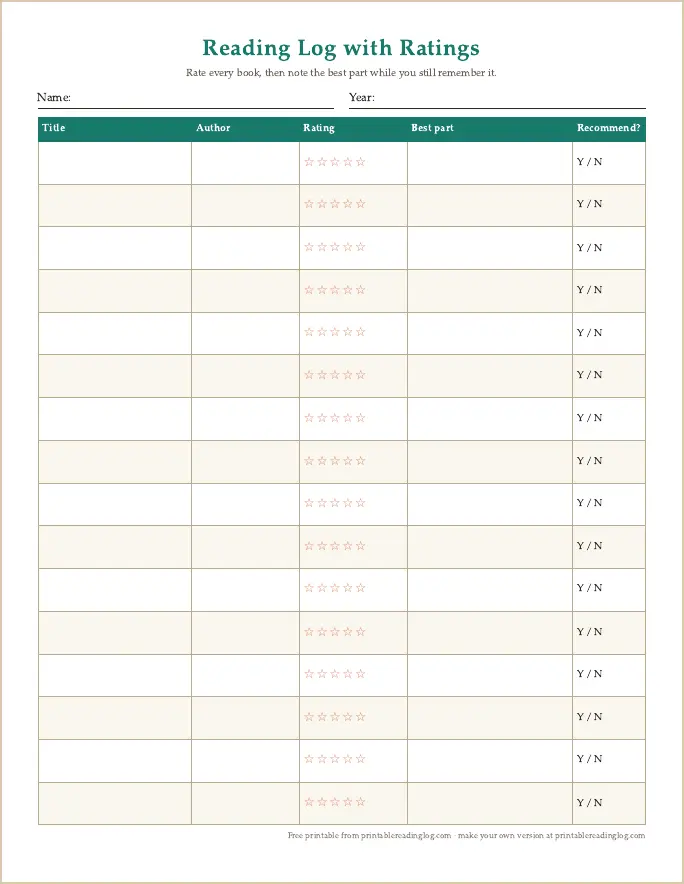
Reading Log with Star Ratings
Title, author, a five-star rating, the best part in a few words, and a would-you-recommend box.
You can read number 72 before number 1
Once your checklist is printed, the most important rule is simple: you don't have to read in order. The numbers are only there so you can tick boxes. Start with whatever sounds good tonight, and jump between groups as your mood changes. Moving from War and Peace to Charlotte's Web is not cheating. It's how most people actually finish a list like this.
Every book here is either widely taught, widely loved, or both. The list leans toward books you'll enjoy, not just books you feel you should read, and it mixes long and short, old and newer, so there's always an easy next pick. It's family-friendly too, with no explicit or adult-themed titles, so a teen can work through it alongside you. Library copies, e-books and audiobooks all earn a tick.
A few of these books deal with hard history, like slavery, war and the Holocaust. They're on the list because they matter, and they're often best read slowly, with time to think or talk afterward.
You also don't need to own a single book to begin. Make a short "next up" list of three titles from different groups, borrow whichever one the library has on the shelf, and keep the other two waiting. When one book ends, the next is already chosen, which is the simplest way to keep a long list from stalling. If you also track everyday reading outside this list, our reading log for adults shows layouts for minutes, pages and books that sit nicely beside a big checklist.
Timeless classics (1 to 25)
These are the big names, the books other books quote. Some are long, like Les Misérables and War and Peace, and some are short enough for a weekend, like A Christmas Carol and Strange Case of Dr Jekyll and Mr Hyde. If the older language feels slow at first, give it fifty pages. Most readers find their rhythm by then.
Charles Dickens gets three spots because he's so readable: A Christmas Carol is perfect for December, A Tale of Two Cities has one of the most famous endings in fiction, and Great Expectations follows an orphan named Pip into a mystery about who is helping him. Frederick Douglass's own account of his life, and Harriet Beecher Stowe's Uncle Tom's Cabin, are two of the most important American books about slavery. For pure adventure, The Count of Monte Cristo and Around the World in Eighty Days are hard to put down.
| # | Book | Author |
|---|---|---|
| 1 | The Odyssey | Homer |
| 2 | Don Quixote | Miguel de Cervantes |
| 3 | Hamlet | William Shakespeare |
| 4 | Macbeth | William Shakespeare |
| 5 | The Pilgrim's Progress | John Bunyan |
| 6 | Robinson Crusoe | Daniel Defoe |
| 7 | Gulliver's Travels | Jonathan Swift |
| 8 | Frankenstein | Mary Shelley |
| 9 | A Christmas Carol | Charles Dickens |
| 10 | A Tale of Two Cities | Charles Dickens |
| 11 | Great Expectations | Charles Dickens |
| 12 | Narrative of the Life of Frederick Douglass | Frederick Douglass |
| 13 | Uncle Tom's Cabin | Harriet Beecher Stowe |
| 14 | Walden | Henry David Thoreau |
| 15 | Moby-Dick | Herman Melville |
| 16 | Les Misérables | Victor Hugo |
| 17 | The Count of Monte Cristo | Alexandre Dumas |
| 18 | War and Peace | Leo Tolstoy |
| 19 | Little Women | Louisa May Alcott |
| 20 | The Adventures of Tom Sawyer | Mark Twain |
| 21 | Adventures of Huckleberry Finn | Mark Twain |
| 22 | Around the World in Eighty Days | Jules Verne |
| 23 | Strange Case of Dr Jekyll and Mr Hyde | Robert Louis Stevenson |
| 24 | The Adventures of Sherlock Holmes | Arthur Conan Doyle |
| 25 | Black Beauty | Anna Sewell |
Children's classics worth reading at any age (26 to 46)
Don't skip this section because it says "children." Many of these books are richer the second time, when you notice the jokes and the sadness you missed as a kid. The Wind in the Willows, Peter Pan and The Phantom Tollbooth are funnier than most people remember. Charlotte's Web is still the truest friendship story around.
They're also the secret to finishing the list. A book like The Secret Garden or Island of the Blue Dolphins takes an evening or two, which keeps your checklist moving between bigger classics. If you have kids, read them together and both of you get a box ticked. Our Newbery and Caldecott checklist is a great companion list if your family catches the bug.
| # | Book | Author |
|---|---|---|
| 26 | Alice's Adventures in Wonderland | Lewis Carroll |
| 27 | Heidi | Johanna Spyri |
| 28 | The Swiss Family Robinson | Johann David Wyss |
| 29 | The Jungle Book | Rudyard Kipling |
| 30 | The Wonderful Wizard of Oz | L. Frank Baum |
| 31 | Anne of Green Gables | L.M. Montgomery |
| 32 | The Wind in the Willows | Kenneth Grahame |
| 33 | Peter Pan | J.M. Barrie |
| 34 | The Secret Garden | Frances Hodgson Burnett |
| 35 | Little House in the Big Woods | Laura Ingalls Wilder |
| 36 | Mary Poppins | P.L. Travers |
| 37 | The Hobbit | J.R.R. Tolkien |
| 38 | The Chronicles of Narnia | C.S. Lewis |
| 39 | Charlotte's Web | E.B. White |
| 40 | The Phantom Tollbooth | Norton Juster |
| 41 | A Wrinkle in Time | Madeleine L'Engle |
| 42 | Island of the Blue Dolphins | Scott O'Dell |
| 43 | Where the Red Fern Grows | Wilson Rawls |
| 44 | My Side of the Mountain | Jean Craighead George |
| 45 | Mrs. Frisby and the Rats of NIMH | Robert C. O'Brien |
| 46 | Matilda | Roald Dahl |
Twentieth-century classics (47 to 65)
This group holds many of the books people remember from high school, and they read very differently as an adult. To Kill a Mockingbird, Animal Farm and Fahrenheit 451 feel sharper when you've lived a little. The Old Man and the Sea and The Little Prince are both short enough for one sitting and stay with you for years.
It also holds some of the most important true accounts of the century. The Diary of a Young Girl by Anne Frank, Night by Elie Wiesel and The Hiding Place by Corrie ten Boom all come from the Holocaust and are worth reading slowly. For lighter moments, And Then There Were None is a near-perfect mystery, and Watership Down is an adventure about rabbits that adults love as much as kids.
| # | Book | Author |
|---|---|---|
| 47 | The Call of the Wild | Jack London |
| 48 | The Lord of the Rings | J.R.R. Tolkien |
| 49 | Animal Farm | George Orwell |
| 50 | The Little Prince | Antoine de Saint-Exupéry |
| 51 | The Diary of a Young Girl | Anne Frank |
| 52 | To Kill a Mockingbird | Harper Lee |
| 53 | The Old Man and the Sea | Ernest Hemingway |
| 54 | Fahrenheit 451 | Ray Bradbury |
| 55 | Lord of the Flies | William Golding |
| 56 | Cry, the Beloved Country | Alan Paton |
| 57 | I, Robot | Isaac Asimov |
| 58 | A Raisin in the Sun | Lorraine Hansberry |
| 59 | Night | Elie Wiesel |
| 60 | The Chosen | Chaim Potok |
| 61 | Watership Down | Richard Adams |
| 62 | And Then There Were None | Agatha Christie |
| 63 | The Hiding Place | Corrie ten Boom (with John and Elizabeth Sherrill) |
| 64 | Roll of Thunder, Hear My Cry | Mildred D. Taylor |
| 65 | Dune | Frank Herbert |
Middle-grade and teen favorites (66 to 80)
These are modern classics written for younger readers, and they're some of the most loved books on the whole list. Holes has one of the most satisfying endings anywhere. The Westing Game is a puzzle you can try to solve. Hatchet is pure survival, and The Giver will start a conversation at any dinner table.
If you have a teenager, this is the perfect section to share. Pick one book, read it at the same time, and talk about it over breakfast. When they want more, our list of the best books for teens picks up where this one stops. A heads-up for sensitive readers: Bridge to Terabithia and A Monster Calls are both about loss, and both are beautiful.
| # | Book | Author |
|---|---|---|
| 66 | Tuck Everlasting | Natalie Babbitt |
| 67 | Bridge to Terabithia | Katherine Paterson |
| 68 | The Westing Game | Ellen Raskin |
| 69 | Hatchet | Gary Paulsen |
| 70 | Number the Stars | Lois Lowry |
| 71 | The Giver | Lois Lowry |
| 72 | Holes | Louis Sachar |
| 73 | Harry Potter and the Sorcerer's Stone | J.K. Rowling |
| 74 | Esperanza Rising | Pam Muñoz Ryan |
| 75 | Fever 1793 | Laurie Halse Anderson |
| 76 | Ender's Game | Orson Scott Card |
| 77 | Wonder | R.J. Palacio |
| 78 | A Monster Calls | Patrick Ness |
| 79 | Brown Girl Dreaming | Jacqueline Woodson |
| 80 | The Book Thief | Markus Zusak |
True stories everyone should read (81 to 95)
If novels aren't usually your thing, start here. These are real lives and real events told so well they read like adventures. Endurance follows a crew trapped in Antarctic ice. Kon-Tiki crosses the Pacific on a raft. The Boys in the Boat follows a college rowing crew to the 1936 Olympics, and Hidden Figures tells the story of the Black women mathematicians behind NASA's early space race.
Some are autobiographies in the subject's own words, like Helen Keller's The Story of My Life, Booker T. Washington's Up from Slavery and Nelson Mandela's Long Walk to Freedom. Cheaper by the Dozen is the one to pick when you want to laugh. Many of these are wonderful as audiobooks, and an audiobook log makes those listening hours count toward your list.
| # | Book | Author |
|---|---|---|
| 81 | The Autobiography of Benjamin Franklin | Benjamin Franklin |
| 82 | Up from Slavery | Booker T. Washington |
| 83 | The Story of My Life | Helen Keller |
| 84 | Cheaper by the Dozen | Frank B. Gilbreth Jr. and Ernestine Gilbreth Carey |
| 85 | Kon-Tiki | Thor Heyerdahl |
| 86 | Endurance: Shackleton's Incredible Voyage | Alfred Lansing |
| 87 | A Night to Remember | Walter Lord |
| 88 | Hiroshima | John Hersey |
| 89 | Silent Spring | Rachel Carson |
| 90 | Long Walk to Freedom | Nelson Mandela |
| 91 | 1776 | David McCullough |
| 92 | The Wright Brothers | David McCullough |
| 93 | The Boys in the Boat | Daniel James Brown |
| 94 | Hidden Figures | Margot Lee Shetterly |
| 95 | Educated | Tara Westover |
Modern favorites for grown-ups (96 to 100)
The last five are newer books that readers pass from hand to hand. Life of Pi puts a boy and a tiger in one lifeboat. The Alchemist is a short fable about following a dream. A Man Called Ove is funny and tender about a grumpy neighbor, and Peace Like a River is a story about a boy, his family and a long search, told with wonder and faith. A Short History of Nearly Everything makes science genuinely fun. Save one of these for a week when the older classics feel like hard work; a modern voice can be a welcome break before you pick up the next big one.
| # | Book | Author |
|---|---|---|
| 96 | Life of Pi | Yann Martel |
| 97 | The Alchemist | Paulo Coelho |
| 98 | A Man Called Ove | Fredrik Backman |
| 99 | Peace Like a River | Leif Enger |
| 100 | A Short History of Nearly Everything | Bill Bryson |
Where to start: six short books for a quick win
Don't start at number one. The Odyssey is wonderful, but it's a lot to face on day one. Start with something short that sounds fun and get a box ticked in your first week. That early win makes the next book easier to open.
Good first picks, all short, are A Christmas Carol, The Old Man and the Sea, Animal Farm, The Little Prince, Night and Strange Case of Dr Jekyll and Mr Hyde. A Christmas Carol is the obvious choice if you're starting in December. After that, try a simple rhythm: one big classic, then one lighter read, then repeat. A long book followed by a short one keeps you from stalling. If a classic feels heavy, try reading it in small daily bites, ten or fifteen pages with your morning coffee, and let a lighter book fill your evenings.
A sample first year on the list
"Read 12 books from the list in 2027" is a lovely New Year's goal: specific, doable and fun. Pick your first three on New Year's Day, Friday, January 1, 2027, and put the first one on your nightstand. Here's one way a first year could go, mixing short and long and following the seasons.
| Month | Book | Why then |
|---|---|---|
| January | The Old Man and the Sea | Short, quick win |
| February | Little Women | Cozy winter read |
| March | The Hobbit | Adventure as spring starts |
| April | Hidden Figures | A true story change of pace |
| May | Charlotte's Web | Light, fast, lovely |
| June | Kon-Tiki | Summer sea adventure |
| July | Around the World in Eighty Days | Travel season |
| August | Holes | Hot desert story for a hot month |
| September | To Kill a Mockingbird | Back-to-school classic |
| October | Frankenstein | Spooky season |
| November | The Boys in the Boat | Long evenings |
| December | A Christmas Carol | The perfect finish |
Swap anything you like. The point is variety. If you'd like help choosing a target that suits your pace, our guide on setting a reading goal walks through it, and our page on fitting more books into twelve months has practical ways to find extra minutes.
Five printed pages, one hundred boxes
A list of 100 is easier to finish when you can see it shrinking. Our maker can build a checklist with title, author, date finished and a star rating column, with up to 24 rows per page, so the whole list fits on five pages kept in a folder. Add the 100-square goal tracker to color as you go, and you'll see your progress from across the room. Type the titles into the reading log maker once, and keep the five sheets as paper copies or a PDF on your tablet.
Two columns are worth switching on. The first is the star rating, which turns your checklist into a record of your own taste; a reading log with star ratings shows a few ways to use it. The second is notes. One line per book, like "slow start, great ending" or "read with my daughter," makes the finished list a keepsake. If you'd like to write more than a line, keep a reading journal alongside it. Pair the big list with a yearly reading challenge log so each year has its own small target inside the long one.
Getting through Moby-Dick, War and Peace and the other long ones
Use the library. Nearly every book here is easy to borrow in print, e-book or audio, and keeping track of library books and due dates saves you a fine or two. Let audiobooks carry the long classics. War and Peace and Moby-Dick are much friendlier when someone reads them to you on a commute.
Read with someone. A friend, a spouse or a teen makes big books feel smaller, and a few friends working through the list together makes a natural book club; our book club reading log keeps everyone on track. Watch for movie versions too. Many of these books have films, and reading first makes the movie night more fun; the book-before-the-movie tracker is built for that.
Finally, give yourself permission to stop. If a book isn't working after fifty pages, set it aside and write "try again later" in the notes. You can come back in five years. The goal is a reading life you enjoy, not a test you pass. For more ways to mix things up, browse our reading challenge ideas, or print a spare page from the same maker (it's free, no account) for the books you add to your own version of the list.
Dana's first three months, row by row
Here is how one made-up but realistic reader, Dana, a nurse who works three twelve-hour shifts a week, got started. She printed the five checklist pages in late December, circled six titles she was curious about, and set herself a loose target of one book a month. She switched on the date-finished, star rating and notes columns and left everything else off so the rows stayed roomy.
Her January rows read like this. Number 53, The Old Man and the Sea, finished January 6, four stars, note: "read it in two evenings, the ending stayed with me." Number 9, A Christmas Carol, finished January 11, five stars, note: "late, but I didn't care." Number 49, Animal Farm, finished January 24, four stars, note: "funnier than I remembered from tenth grade." Three short books in one month felt great, and she said the three filled boxes on the first page were what got her to open the fourth book.
February went differently. She started number 16, Les Misérables, as an audiobook on her drive to the hospital and ignored it on days off. By the end of the month she was perhaps a third of the way through and had ticked nothing. Her note in the margin said "Les Mis: slow but good, don't quit." Rather than stall, she added a short paper book for her days off, number 39, Charlotte's Web, and finished it in one afternoon. That single tick kept February from looking empty.
March showed her what her own pattern was. Les Misérables finished March 19, five stars, note: "worth every commute." She also read number 72, Holes, on a rainy weekend. After three months she had six boxes ticked, which is double her target, but the sheet told her something more useful than the count: every finished book had been either short or listened to. Paper copies of long books were the ones that sat on her nightstand untouched. So for April she chose number 86, Endurance, as her next commute listen and number 50, The Little Prince, as her nightstand book, and she stopped trying to read long classics in print on shift weeks.
Your own first three months will look different, and that is the point of writing the date and one line for every book. By the end of a season the checklist is no longer only a to-do list; it is a record of when and how you actually read, and that record makes the next pick much easier.
How long each kind of book on this list tends to take
Page counts change between editions and translations, so treat these as rough guides rather than rules. The point is to plan your months so a long book never lands in a week when you have no time.
One-sitting books. The Little Prince, The Old Man and the Sea, A Christmas Carol, Strange Case of Dr Jekyll and Mr Hyde, Animal Farm and Night are all short enough for a long evening or a quiet weekend. Charlotte's Web, The Phantom Tollbooth, Tuck Everlasting and Number the Stars are similar. Keep two or three of these in reserve for busy months; a short book you can finish is better than a long one you cannot.
One-to-two-week books. Most of the children's and teen sections fall here, along with Frankenstein, Fahrenheit 451, To Kill a Mockingbird, And Then There Were None, The Hobbit, Kon-Tiki, Hidden Figures and A Man Called Ove. At twenty or thirty minutes a night, these fit comfortably into a month with room to spare.
Month-long or longer. War and Peace, Les Misérables, Moby-Dick, Don Quixote, The Count of Monte Cristo, The Lord of the Rings and Dune are the big ones. The Chronicles of Narnia counts as one entry but is really seven books, so most families spread it over a season. Give these a month or two each and pair every one with a short book from the first group so your checklist keeps moving while you work through the long read.
Slow-on-purpose books. Walden, Silent Spring, Long Walk to Freedom, The Diary of a Young Girl and Hiroshima are not necessarily long, but they reward slow reading. Many people read Walden a chapter at a time over several weeks. With the Holocaust and war accounts, it often helps to leave a few days before starting the next book, so you have time to think about what you have read.
Sharing the list with a teen without turning it into homework
A big list can feel like an assignment to a fourteen-year-old, so the way you introduce it matters. Instead of handing over all five pages, try something like: "I'm working through this list for fun. Want to pick one we both read this month? You choose." Let them choose from numbers 66 to 80 first, since those were written with their age in mind, and read the same book yourself.
Talk about the book in small pieces rather than with a quiz at the end. With Holes, ask which of the two timelines they liked more and when they first guessed the connection. With The Giver, ask whether the community's rules would be tempting if you had never known anything else. With Hatchet, ask what single object they would want if they were stranded, then see if they change their answer after the book. The Westing Game works well if you each keep a separate guess about the puzzle and compare at the halfway point.
When a teen is ready for the older classics, To Kill a Mockingbird, Animal Farm, Fahrenheit 451 and Lord of the Flies all lead naturally to dinner-table talk about fairness, power and courage. Let them disagree with you. The goal of reading together is the conversation, not a right answer. If your teen keeps a separate reading record for school, the high school reading log covers how assigned books and free picks can share one sheet, and the books you read together can earn a tick on both.
What your checklist tells you after the first year
At the end of twelve months, lay the five pages out on a table and look for patterns rather than just counting ticks. A few things are worth noticing.
If most of your ticks are in one group, you have learned what you enjoy, which is useful. Someone whose ticks cluster in the true stories might choose 1776 or The Wright Brothers next, while someone who loved the children's classics might plan a year of reading them aloud to a younger relative. Don't force yourself into a group you dislike, but do try one book from an empty group each year, since that is often where people find a surprise favorite.
Look at your star ratings next. If every book got four or five stars, you may be rating kindly, and that is fine to keep. If you have several one- or two-star books, check their notes. A pattern of "too slow" on the oldest classics suggests trying them as audiobooks next time. A pattern of "sad" on several books might mean pacing heavy books further apart.
Finally, compare your dates. Gaps of two or three months with nothing finished usually line up with something in life, like a move, a busy season at work or a new baby. Write that in the margin. Next year you can plan a stack of one-sitting books for that same season, so the list keeps going even when time is short.
Questions people ask before taking on all 100
What books should everyone read before they die?
Most lists include classics like The Odyssey, A Tale of Two Cities, Little Women, To Kill a Mockingbird, The Lord of the Rings and The Diary of a Young Girl, plus true stories and a few modern favorites.
How long does it take to read 100 books?
At one book a month, a little over eight years. At two a month, a little over four. The children's classics go fast, so most people move quicker than the chart.
Where should I start?
With a short book you're curious about, like The Old Man and the Sea, Animal Farm, The Little Prince or A Christmas Carol. An early win builds momentum.
Do I have to read them in order?
No. The numbers are only for checking off. Jump between groups and alternate long and short books.
Are children's books worth reading as an adult?
Yes. Books like Charlotte's Web, The Phantom Tollbooth and The Wind in the Willows are often richer the second time, and they keep the list moving.
If I listen to Les Misérables instead of reading it, can I tick the box?
Yes. For a 1,400-page classic, a narrator on the commute is often the only realistic route. Log it with the date you finished, the same as a print copy.
Is this list suitable for teens?
It's family-friendly, and the middle-grade and teen section, numbers 66 to 80, is where most teens like to begin. Some books cover hard history, so read those together if you can.
How do I keep track of the list?
Print a checklist with titles, a box to tick, the date and a star rating. Add one line about each book so the finished list becomes a record of your reading life.