Teacher Assigned a Break Reading Log? Plan 20 Minutes Around Travel and Parties
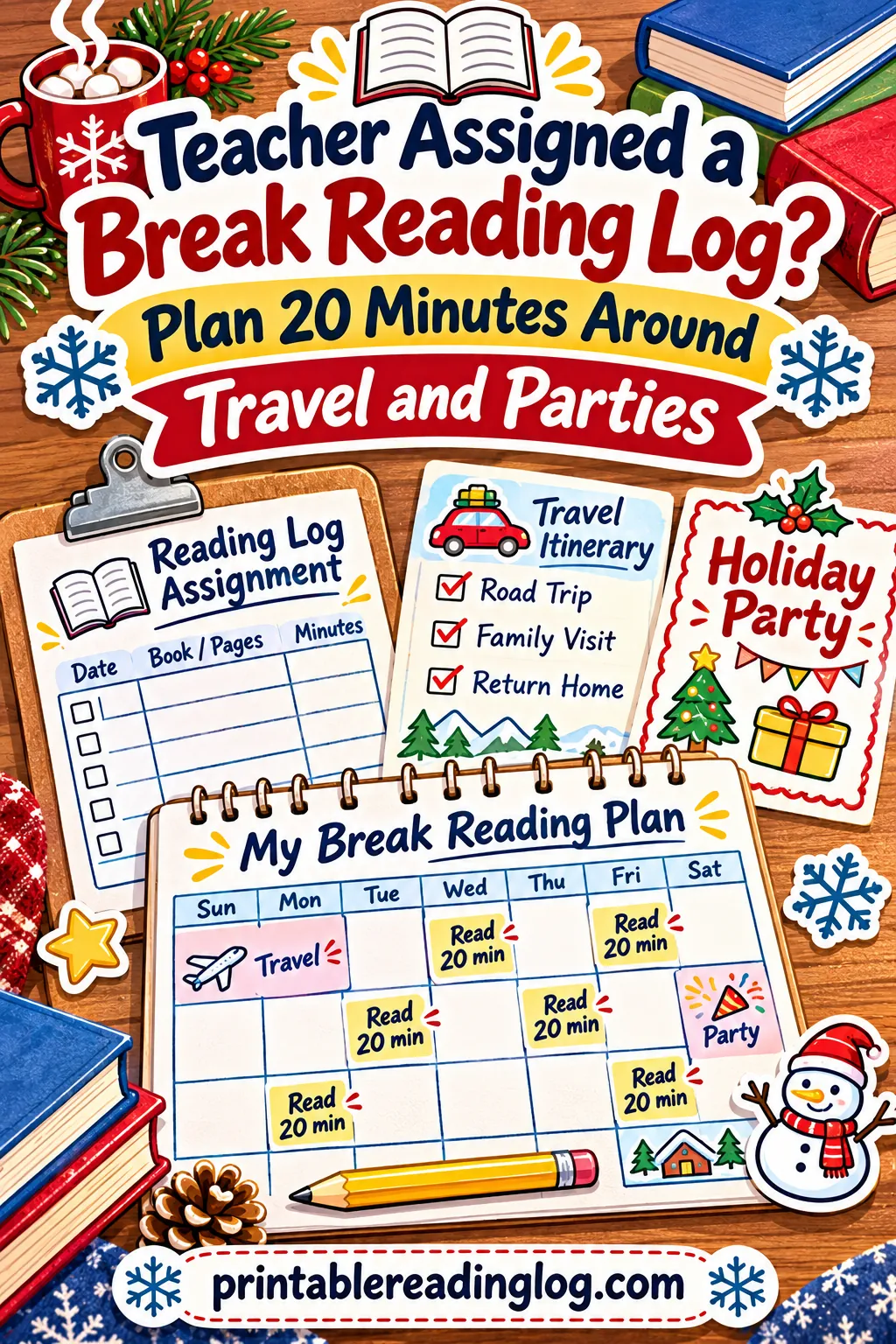
The easiest way to finish a winter break reading log assignment is to plan the whole break on one page before it starts: write every date, mark travel days and party nights, and give those busy days a 10-minute plan (or two 10-minute pieces) instead of hoping 20 minutes appears on its own. Once you can see the break laid out, the 20 minutes stops being a nightly battle and becomes one small, planned thing.
If you need a sheet of your own, our reading log builder can produce one that lines up with most teacher logs. The 🏫 Classroom preset already has Minutes and Initials columns; set 16 rows for a two-week break, and pencil in your dates. Below you'll find how to read the assignment, a day-by-day break plan with real numbers, busy-day rules, exact tool settings, how to sign the log honestly, and what to do when a day goes sideways.
📚 Printable Reading Log: make this log in 10 seconds
Set the name and goal, preview it, then print it free.
Free printables for this page
Ready-made, one-page PDFs from Printable Reading Log. Print as is, or change the columns in the maker above. See all free printable reading logs.
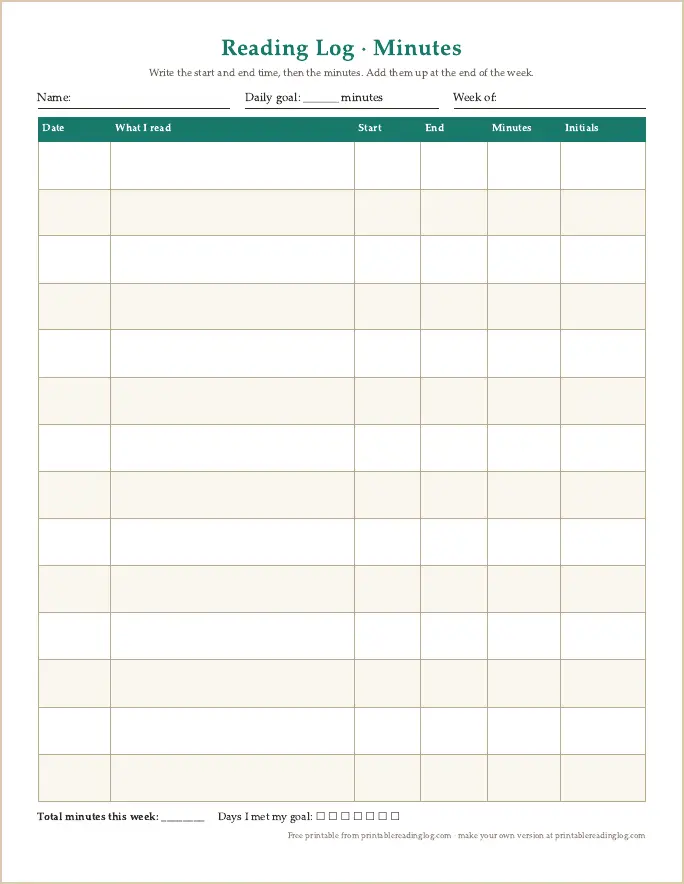
Reading Log by Minutes
A nightly minutes log with start and end times, minutes read, parent initials and a weekly total box.
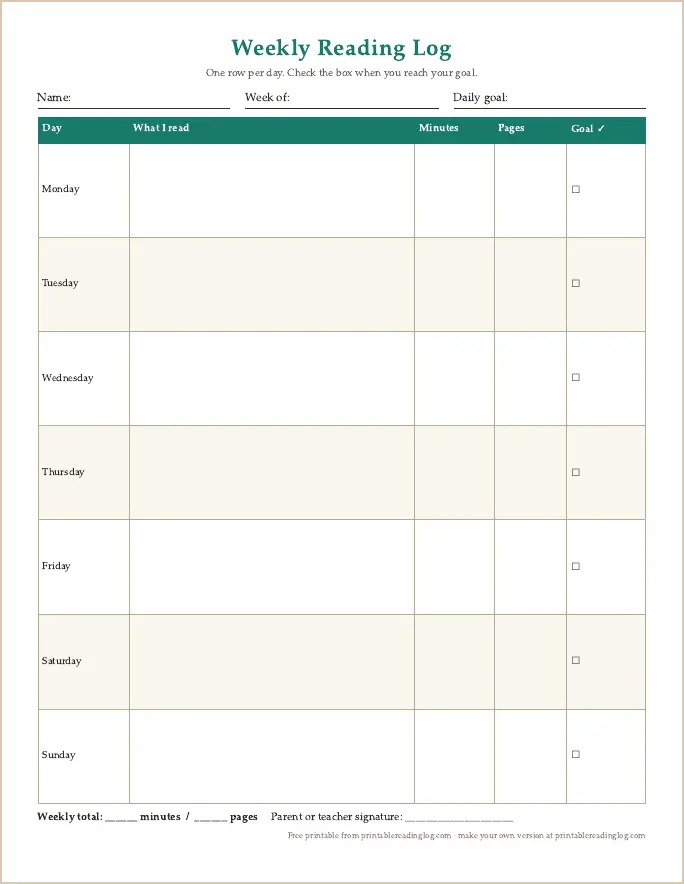
Weekly Reading Log
Monday to Sunday on one page: what you read, minutes, pages, a goal check box, and a weekly total and signature line.
Read the Assignment First: What Did the Teacher Actually Ask For?
Before you plan anything, read the sheet or email from the teacher carefully. Many parents skim it in the chaos of the last school day and then guess. A two-minute read now can save a lot of worry later, because break reading logs vary more than you might think.
What to look for in the teacher's note
The first thing to find is whether the goal is per night or a total. "Read 20 minutes every night" is a very different assignment from "read 200 minutes over break," and a total gives you much more room. Next, check which days count. Some logs cover every day of break; others cover weekdays only or skip the holidays themselves. Then look at signing: some teachers want a parent signature every day, some want initials, and some want one signature at the end.
Listening and read-alouds are the next question. Many teachers accept audiobook time, but some don't for a particular assignment, which matters if you'll be in the car a lot. Being read to, reading to a sibling, or reading to a grandparent often counts too, but it's worth confirming. Most break logs are free choice, though a few ask for a specific book or reading level. Finally, note what has to come back and when (the log alone, a short summary, a book report, or just the signed page on the first day back) and whether there's a reward or grade attached, which tells you how closely the teacher will look at it.
If any of this is unclear, send a short, friendly note before break starts. Teachers would much rather answer a question on the last school day than sort out confusion on the first day back.
Common types of break reading logs
| Type of assignment | What it usually looks like | How flexible it is |
|---|---|---|
| Nightly minutes | Read 20 minutes each night, parent initials each day | Least flexible; plan around every busy day |
| Total minutes | Read a set number of minutes over break, such as 200 or 300 | Very flexible; bank extra minutes on quiet days |
| Book count | Finish a set number of books | Flexible; good for picture books and early readers |
| Bingo or challenge card | Fill a set of squares, such as "read in a blanket fort" | Flexible and fun; often no minute count |
| Reading plus response | Read, then write a sentence or a short summary | Needs pencil time too, not just reading time |
| Optional log | Reading is encouraged, not required | Use it as a gentle routine, not a chore |
A lot of teachers send home a nightly log that parents initial once a day over break, since it keeps a short routine going while school is out. The plan below is built for that kind of log, which is the hardest to fit around holiday plans. If your teacher assigned a total or a book count, you'll have even more room to move things around.
Laying out December 19 to January 3 on one page
Treat the break like a calendar, not like a promise. Sit down for ten minutes on the last weekend before break (or the first morning of it) with your family calendar and the log.
Step 1: write every date
Write each date of break in the Date column. A typical winter break runs about two weeks plus the weekends around it. In 2026, if school lets out on Friday, December 18 and starts again on Monday, January 4, 2027, break runs from Saturday, December 19 through Sunday, January 3. That's 16 days. Your school's dates may be different, so use your own district calendar.
Step 2: sort each day into one of three types
Normal days are at home with nothing big planned, and they get the full 20 minutes. Busy days are travel days, party nights, late nights, days with guests and the holidays themselves; they get a 10-minute plan or two 10-minute pieces, depending on what the teacher requires. Bank days are the quiet ones, often the slow stretch after Christmas, when a child could read a bit longer if the assignment lets extra minutes count.
Write a small "B" next to busy days and a small star next to bank days, right on the log. Now the whole break is visible at a glance.
A sample 16-day plan
This is one family's plan for the 2026 break. They're driving to relatives on December 21, coming home on the 26th, and have a few parties and late nights. Swap in your own events.
| Date | Day | What's happening | Day type | Planned minutes |
|---|---|---|---|---|
| Dec 19 | Sat | First day of break | Normal | 20 |
| Dec 20 | Sun | Neighborhood party in the evening | Busy | 10 + 10 |
| Dec 21 | Mon | Five-hour drive to relatives | Busy | 20 in the car, if allowed |
| Dec 22 | Tue | Visiting | Normal | 20 |
| Dec 23 | Wed | Cousins' party, late night | Busy | 10 + 10 |
| Dec 24 | Thu | Christmas Eve | Busy | 10 + 10 |
| Dec 25 | Fri | Christmas Day | Busy | 10 + 10 |
| Dec 26 | Sat | Drive home | Busy | 20 in the car, if allowed |
| Dec 27 | Sun | Rest at home | Bank | 30 |
| Dec 28 | Mon | Quiet day | Bank | 30 |
| Dec 29 | Tue | Library trip | Normal | 20 |
| Dec 30 | Wed | Playdate | Normal | 20 |
| Dec 31 | Thu | New Year's Eve, late night | Busy | 10 + 10 |
| Jan 1 | Fri | Late morning, family lunch | Busy | 10 + 10 |
| Jan 2 | Sat | Normal Saturday | Normal | 20 |
| Jan 3 | Sun | Getting ready for school | Normal | 20 |
Add it up: 14 days at 20 minutes is 280 minutes, plus two bank days at 30 minutes is 60 more, for 340 minutes across 16 days. Every single day still meets a 20-minute nightly goal. The busy days don't skip reading; they just split it into two short pieces that fit around the plans.
What if the assignment is a total instead?
Say the teacher asked for 300 minutes over break. You have much more freedom. Using the same calendar, you could read just 10 minutes on each of the 8 busy days (80 minutes) and 30 minutes on the 2 bank days (60 minutes). That leaves 160 minutes for the 6 normal days, or about 27 minutes each, and you reach 300 exactly. Busy days drop to a single 10-minute piece, and nobody has to read at 10 p.m. after a party.
To check any total-minutes goal quickly, use this:
Minutes needed per day = total minutes ÷ days of break, rounded up.
| Teacher's total | 14-day break | 16-day break | 18-day break |
|---|---|---|---|
| 150 minutes | 11 a day | 10 a day | 9 a day |
| 200 minutes | 15 a day | 13 a day | 12 a day |
| 300 minutes | 22 a day | 19 a day | 17 a day |
| 400 minutes | 29 a day | 25 a day | 23 a day |
Then shift minutes from busy days to bank days so the total still adds up.
For what's typical at different ages, see our daily reading minutes by grade. If the whole break is minutes-based, a plain minutes log is the simplest backup sheet.
Busy-Day Rules: Where 10 Minutes Hides
The heart of this plan is the busy day. Most families don't miss reading because they don't care. They miss it because 8:30 p.m. arrives in the middle of a party, a long drive, or a house full of relatives, and the reading time they pictured simply isn't there.
So don't count on bedtime on busy days. Look for two 10-minute windows earlier in the day instead.
Ten-minute windows that exist on almost every day
- Before breakfast. Kids on break often wake before the grown-ups are ready. A book by the bed turns that time into reading time.
- While a grown-up gets ready. The 10 minutes it takes to shower or pack the car is a reading window.
- In the car. On short drives to a party or the store, an audiobook can count if the teacher allows it. An audiobook log keeps that listening time separate in case the teacher wants to see it.
- Waiting. Waiting rooms, lines, the airport gate, and the half hour before guests arrive.
- After lunch. A short quiet time after a big meal works well, especially for younger kids.
- Bath time for a sibling. While one child is in the bath, the other reads.
- In bed at a relative's house. Even a late bedtime can fit a short 10-minute read with a flashlight.
Busy-day plans by type of day
| Busy day | First 10 minutes | Second 10 minutes |
|---|---|---|
| Travel day by car | Audiobook in the car, if allowed | Short book at a rest stop or at the hotel |
| Travel day by plane | Book at the gate | Book or audiobook on the plane |
| Party night | Before getting dressed for the party | Short read in bed, or on the way if audiobooks count |
| Hosting guests | Before guests arrive | With a grandparent or cousin after dinner |
| Christmas Eve | Holiday picture book in the afternoon | A short story at bedtime |
| Christmas Day | Reading a brand-new book in pajamas | Quiet time after the big meal |
| New Year's Eve | Morning reading | Early evening, before the late night begins |
| Day after a late night | Late-morning reading in bed | After lunch |
Holiday reading is still reading
A brand-new book opened on Christmas morning, a picture book read aloud on Christmas Eve, or a comic from the stocking all count as reading for most assignments. If the teacher's rules allow free choice, let kids read whatever they're excited about that day. On busy days, the easiest book is the one they already want to read.
For the youngest kids, a holiday picture book is often the whole busy-day plan; our list of Christmas read-alouds for kindergarten has ideas. If you're also working with a younger sibling, a 10-minute read where the older child reads to the younger one can cover both kids at once. Many teachers count reading aloud to someone else. Write it in the Notes column so it's clear.
When one 10-minute piece is enough
If your teacher asked for a total, or said "most nights" rather than "every night," you may not need two pieces on the busiest days. One honest 10-minute read on Christmas Day is better than a forced 20 minutes that ends in tears. If the assignment truly requires 20 minutes every single day, use the split, or plan a bank day and ask the teacher whether extra minutes can make up a short day.
Printing a copy that lines up with the teacher's sheet
If the teacher sent home a printed log, use it. That's the one they'll grade. But a planning copy is still worth making, for three reasons: you can pencil in the plan before break starts, you have a backup if the teacher's sheet gets lost at Grandma's, and you have a clean page if the teacher's log doesn't have enough rows for all 16 days.
If the teacher just said "keep a log" with no sheet, the log you make is the assignment.
The log builder is free with no account, and it remembers your settings in that browser, so a fresh copy is quick to print if the first one goes missing.
The settings for a 16-day break
Start from the Classroom preset. It opens in minutes mode with date, title, minutes, initials and notes columns, which matches most school logs. For the reader name, something like Leo's Winter Break Reading makes it feel like the child's own page. In the goal line, copy the teacher's wording exactly, such as 20 minutes a night or 300 minutes over break, so there's no question about what was assigned.
Use the kid style for kindergarten through about third grade, and the adult style for older kids and middle schoolers, since it looks closer to a school worksheet. Sky suits winter; Classic looks plain and official. Add an author column only if the teacher's log has one, and a star rating if your child enjoys rating books. Set the rows to 16 for a December 19 to January 3 break, or match your own count (the maximum is 24). Turn on 16 goal squares, one per day, so your child can color a square each day the goal is met. Younger kids may like the coloring strip as well. Portrait on Letter or A4 fits a take-home folder.
Match the teacher's columns
Teacher logs come in many styles, so compare yours before printing:
| If the teacher's log has... | Turn on in the tool |
|---|---|
| Date, book, minutes, parent signature | Date, Title, Pages / Minutes, Initials (P/T) |
| A summary or "what happened" line | Notes |
| Pages instead of minutes | Switch the format to Pages |
| Author | Author |
| Start and finish dates for each book | Date started, Date finished |
| A rating or "did you like it?" | Star rating, or Recommend? (Y/N) |
| Books, not minutes | Switch the format to Books |
On the printed log, the Initials column is labeled Initials, which works for parent initials, and the Notes column is labeled Notes / Summary, which covers most "what did you read about?" lines.
Pencil in the plan before break starts
Before the first day of break, write every date in the Date column. Next to each busy day, write "B" and "10 + 10" in light pencil in the Minutes column. Next to bank days, write a star. When the day is done, write the real minutes in pen over the plan, and initial it.
This takes about five minutes, and it changes the whole feel of the assignment. Instead of a blank page that grows more stressful each day, the log becomes a plan you're checking off.
Keep the log where you'll see it
A log that's packed in a suitcase doesn't get filled in. At home, the fridge with a pencil on a string works well. On a trip, keep it in a folder with the child's books rather than in the luggage. Take a photo of the log each night after you initial it, so if it gets lost or ruined you have a record to copy onto a fresh printout. With several kids, give each a different color theme so nobody grabs the wrong sheet. Families on the road for most of break may prefer the holiday travel reading log.
For more ideas on keeping a log at home that doesn't feel like a chore, see this reading log for parents guide.
Signing the Log Honestly (Even When You Weren't There)
Signed logs make many parents a little nervous, especially over break. What if Grandma did the reading? What if you forgot to initial for three days? What if the reading happened in the car while you were driving?
A few simple habits keep it honest without any stress.
Initial the same day, every day
The easiest way to keep a signed log honest is to sign it the same day, ideally right after the reading. Pair it with something you already do every night, like brushing teeth. If you sign right away, you never have to guess later.
When someone else is in charge
Over break, kids often spend time with grandparents, babysitters, or the other parent, and the log can travel with them. Ask the adult who was there to initial, or write their name in the Notes column, then add your own initials when the log comes home. Most teachers are happy to see a grandparent's initials on a break log, since it shows reading happened around the family.
When you forgot
If a few days went by without initials, don't guess and don't make up minutes. Ask your child what they read and when. Use real clues: the bookmark, the photo you took, the last chapter they remember. Write in what you're confident about, and leave the rest blank. Then add a short note for the teacher. A missed day honestly marked is better than a full log that isn't true. Our page on catching up a forgotten reading log walks through this in more detail.
A note you can send with the log
If the break didn't go to plan, a two-line note helps. Something like this works:
"Over break, Sam read most days but missed a few around our travel days. We wrote in the days we were sure about. Thank you for the reading log; it helped keep a bit of routine."
Short, friendly and true. Teachers see lots of break logs and they understand holidays.
Avoiding Reading Fights When Routines Vanish
Parents often say reading fights get worse over break, not better. That makes sense. At school, reading time is built into the day. At home over the holidays, bedtimes slide, there are new toys, cousins, screens and treats, and 20 minutes of reading suddenly looks like the most boring option in the house.
A few habits take a lot of the fight out of it.
Give real choices
Kids push back less when they get to decide something. Offer two choices, both of which get the reading done:
- "Do you want to read before lunch or after lunch?"
- "Your new book or a comic?"
- "Read in your room or in the blanket fort?"
- "Two 10-minute reads or one 20-minute read today?"
The reading still happens. The child just feels like they had a say.
Use a timer, not a parent
A kitchen timer or a phone timer set to 10 or 20 minutes ends the "Is it done yet?" questions. When the timer rings, reading time is over, even in the middle of a page if they want. Most kids keep going once they're into the story, and that extra time counts too.
Read alongside them
On a break, kids notice when the grown-ups are on their phones while they're stuck reading. If you can, pick up your own book for those 20 minutes. A family "everybody reads" time after lunch, with the whole house quiet, often goes better than sending one child off alone.
Make the log the kid's job
Let your child fill in the date, the title and the minutes. Your only job is to initial. Coloring a goal square each day is a small reward that younger kids love. Older kids usually like seeing the total minutes add up.
Helpful words for common moments
- When your child refuses: "It's on the plan for today. You can pick the book and the spot."
- When they ask why: "Your teacher asked for it, and a little reading keeps your brain ready for school."
- When a party is about to start: "Let's do your 10 minutes now, so tonight is all fun."
- When they read extra: "Look how many minutes you have. Want to color two squares?"
- When the day fell apart: "Today got busy. We'll do two short reads tomorrow."
If your child truly hates reading, the log alone won't fix it. You'll find more ideas in this reading log for reluctant readers guide, including shorter goals and formats kids are more willing to try.
Variations by Grade and Family
Break logs look different depending on your child's age and how your family spends the holidays.
Kindergarten and 1st grade
Young kids are often assigned "read with your child" time, not independent reading. Being read to, reading picture books together, and looking at books with a grown-up usually count. Ten minutes can be two or three picture books. Keep the Kid-friendly style and the coloring strip, and let them color the goal square.
2nd and 3rd grade
Many kids at this age are moving into short chapter books and can read on their own for 15 to 20 minutes. Busy days split well into two 10-minute pieces. Let them write the title themselves, even if the spelling isn't perfect.
4th and 5th grade
Older elementary kids can often fill in the whole log on their own, including the Notes line. If the teacher wants a short summary, one sentence per day in the Notes column is usually enough. Longer chapter books can make the 20 minutes fly by.
Middle school
Middle schoolers may have a log with pages instead of minutes, or a longer reading goal. Use the Adult / clean style and switch the format to Pages if needed. They'll want less parent involvement, so agree on a check-in time, such as every evening at dinner, rather than standing over them.
More than one child
Make one log per child, in different color themes. If the kids are close in age, they can read at the same time, which makes planning easier. An older child reading aloud to a younger sibling may count for both, depending on the teachers' rules.
Two homes over break
If your child spends part of break with the other parent, send the log along in a folder with the books. Agree on who initials which days. A quick photo of the log at the handoff keeps everyone clear on where things stand.
Hosting the holidays
When your house is the one full of guests, the busy days stack up. Lean on morning reading before everyone wakes up, and invite a visiting grandparent or aunt to read with your child. Guests often love being asked.
Traveling far from home
If you're away for most of break, bring enough books for the whole trip, or download library e-books and audiobooks before you leave, if your teacher accepts those. Pack the log in a carry-on folder. If you're traveling with no room for books at all, ask the teacher before break whether reading signs, menus or travel guides on the trip can count for a day or two.
When the plan slips, and the night before school
Even with a plan, break doesn't always cooperate. These are the problems that come up most, with what to do about each.
| Problem | What to do |
|---|---|
| Missed one day | Do nothing special. Mark it honestly and move on; if the goal is a total, add 10 minutes to a bank day. |
| Missed several days | Restart today. Recalculate if it's a total: minutes left ÷ days left. Add a note for the teacher if needed. |
| Log left at a relative's house | Use your photos or memory to fill in a fresh printout, and add a note. |
| Child read a lot more on some days | Write the real minutes. Extra reading is great news. |
| Not sure if audiobooks count | Ask the teacher, or log them separately in the Notes column so the teacher can decide. |
| The book was too hard | Switch to an easier book. Reading time matters more than finishing one hard book. |
| Teacher's log only has 10 rows | Print a 16-row log and attach it, or write the extra days on the back. |
| Child sick over break | Rest comes first. Note it on the log, and read aloud to them if they feel up to it. Talk to your doctor about anything health-related, not the log. |
| Arguments every single night | Shrink the goal to 10 minutes for a few days if the teacher allows it, and focus on choices and timers. |
Catching up on a total-minutes goal
If you're behind on a total, don't try to do it all in one sitting on the last Sunday of break. Spread it out:
Minutes per day = minutes left ÷ days left, rounded up.
For example, say the goal is 300 minutes, it's the morning of December 29, and your child has 150 minutes logged. That's 150 minutes left over 6 days (December 29 through January 3), so 25 minutes a day gets you there. Only 5 more minutes a day than the original 20. That's very doable.
The day before school starts
Sit down with your child on the last evening and add up the minutes if the teacher wants a total. Fill in any missing titles while the books are still out, initial the last day, and sign at the bottom if there's a line for it. If the teacher asked for a summary or a favorite book, help your child write one or two sentences. Then put the log in the backpack folder that night, not the next morning, when everyone is looking for shoes.
If you'd like to understand why teachers assign these logs in the first place, and how well they work, see do reading logs actually work.
If the teacher left it optional and your kids would rather do something playful, a reading bingo card or the kids' winter break challenge keeps books in the picture without a minute count.
Questions about break logs from parents who've done one
How do I fit 20 minutes of reading into a busy holiday day?
Split it into two 10-minute pieces at times you already have, such as before breakfast, before a party, or in bed. Plan the pieces in the morning instead of hoping for time at bedtime. On travel days, a short book at a stop and an audiobook in the car can cover it, if the teacher accepts audiobooks.
Does reading on Christmas Day have to count on the log?
It depends on the teacher. Some break logs skip the holidays, and some include every day. Check the teacher's note, and if it includes every day, a new book or a holiday picture book in pajamas is an easy 10 minutes.
Can grandparents or other adults sign the reading log?
Usually, yes. Ask the adult who was there to initial, or note their name in the Notes column, and then add your own initials. If the teacher was specific about who signs, follow their rules.
What if we forgot to sign the log for a few days?
Don't guess. Ask your child what they read, use clues like bookmarks or photos, and fill in only what you're sure of. Add a short, honest note for the teacher. Teachers understand that holidays get busy.
Do audiobooks count for a winter break reading log assignment?
Many teachers accept listening time, but not all do for every assignment. Ask before break if you can. If you're not sure, log audiobook time in the Notes column so the teacher can decide.
What if my child's teacher log doesn't have enough rows for all of break?
Print a longer sheet of your own. The Classroom preset with 16 rows covers a two-week break plus weekends. Attach it to the teacher's sheet, or copy the extra days onto the back.
How can I make the reading log less of a fight over break?
Give choices about when, where and what to read, use a timer, and let your child fill in the log themselves. Reading alongside them helps too. If fights keep happening, ask the teacher whether a shorter daily goal is okay for a few days.
What should go back to school with the break reading log?
Whatever the teacher asked for, which is usually the signed log, sometimes with a total or a short summary. Add up the minutes the night before school, fill in any missing titles, and pack it in the backpack folder so it doesn't get left behind.