Winter Break Reading Challenge for Kids (Printable Log)
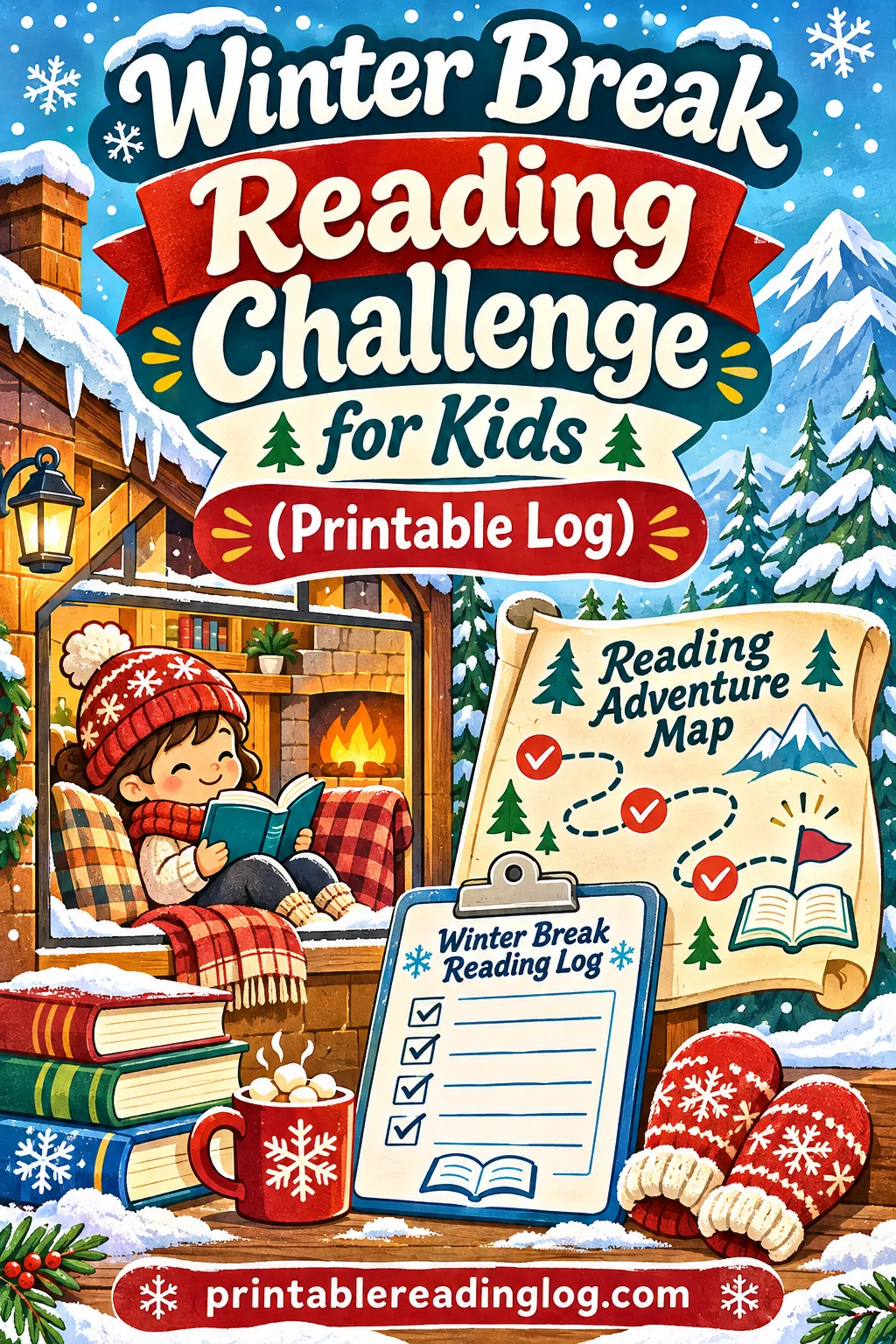
The easiest winter break reading challenge for kids is a snowball log: color one snowball for every 10 minutes of reading, aim for a set number of snowballs by the last day of break, and mix in a 16-square winter bingo card so it's about fun tasks, not just minutes. Add a small prize at the finish line and you've got a challenge that fits around travel, visitors and lazy pajama mornings.
You can print the whole thing in a couple of minutes with the free printable reading log maker. Pick the Kids preset, turn on the goal tracker squares, and each square becomes a snowball to color in. Below you'll find the snowball rules, challenge levels by age, a ready-made bingo card, a two-week daily prompt calendar, exact tool settings and fixes for the usual holiday hiccups.
▶ Open this reading log ready to print
How the Winter Break Reading Challenge Works
The whole challenge has three simple parts. Kids can do just the first part, or all three if they love a challenge.
- Snowballs for minutes. Every 10 minutes of reading earns one snowball. Kids color it in on their log. Reading to themselves, reading aloud to a sibling, listening to a parent read, and audiobooks all count.
- Winter bingo for variety. A 16-square bingo card gives kids fun tasks like "read under a blanket fort" or "read a book with snow on the cover." Each square they finish gets a sticker or an X.
- A finish line. Agree on a goal before break starts, like 50 snowballs or one bingo line, and plan a small celebration for when they hit it.
Why snowballs instead of a plain minute count? Because a total like "300 minutes" is hard for kids to picture, and it never feels finished. A page of snowballs fills up visibly, a little at a time, and coloring one in is its own small reward. It also turns a short 10-minute session into a real win, which matters on busy holiday days.
Pick a challenge level
Winter break is usually around two weeks long, but holidays, travel and family events take a big bite out of free time. Set a goal that a child can actually reach with a few skipped days. These levels assume about 12 reading days out of a two-week break.
| Level | Snowballs | Total reading time | Rough daily pace | Good fit for |
|---|---|---|---|---|
| Snowflake | 25 | About 4 hours | 20 minutes a day | Preschool, kindergarten, new readers |
| Snowman | 50 | About 8 hours | 40 minutes a day, or 20 minutes twice | Grades 1 to 3 |
| Snowstorm | 75 | About 12.5 hours | About an hour a day | Grades 3 to 5, eager readers |
| Blizzard | 100 | About 16.5 hours | 80 minutes a day or more | Middle schoolers and bookworms |
These are suggestions, not rules. If your child's school sent home a winter reading goal, use that instead. For more on daily time by age, the guide to how many minutes kids should read per day is a helpful starting point.
Tip: let your child choose the level. Kids who pick their own goal tend to care more about reaching it. If they finish early, they can "level up" to the next goal, which feels a lot better than falling short of a goal that was too big.
What counts as reading?
Keep the rules generous. The goal is a happy reader in January, not a perfect log. Here's a simple list to agree on before break starts:
- Picture books, chapter books, graphic novels and comics
- Magazines, joke books, recipe books and how-to books
- Being read to by a parent, grandparent or older sibling
- Reading aloud to a younger sibling, a pet or a stuffed animal
- Audiobooks, especially in the car
- Reading signs, menus and maps on a trip (a great one for little kids)
- Reading the instructions for a new game or building set
If your family wants screens to stay out of the challenge, say so up front. If an e-reader is your child's main way to read, it can absolutely count.
Winter Reading Bingo: 16 Challenge Squares
A bingo card is what makes a winter break reading challenge feel different from a regular homework log. Kids get choices, and every square is a small adventure. Print the card as a 4-by-4 grid, or write the squares into a reading bingo log.
Here's a ready-to-use card of 16 squares. Read across in rows of four:
| Column 1 | Column 2 | Column 3 | Column 4 |
|---|---|---|---|
| Read a book with snow on the cover | Read under a blanket fort | Read to a pet or a stuffed animal | Read by flashlight |
| Read a book about a winter holiday | Read with a warm drink nearby | Read a book a grandparent loved as a kid | Read in the car |
| Read a book with an animal that lives in the cold | Read a book that makes you laugh | Read aloud to someone younger | Read a book in pajamas, all morning |
| Read a book from the library | Read a poem out loud | Read a book about winter weather or ice | Reread a favorite book |
How to play
- One line wins a small prize. Any row, column or diagonal of four.
- Two lines earn a bigger treat, like choosing dinner one night.
- Blackout (all 16 squares) earns the grand prize, like a trip to the bookstore or library to pick a new book.
- Mix with snowballs. Time spent on bingo squares also counts toward snowballs, so kids never have to choose between the two.
Swap-in squares by age
Not every square fits every kid. Swap out the ones that don't work for your family with these:
For preschool and kindergarten:
- Point to five words you know on one page
- Find a book with a snowman in it
- Act out a story with toys
- Look at a book with no words and tell the story yourself
- Read a book with a grown-up before nap time
For grades 1 to 3:
- Read a book with a chapter in it
- Read a book with a map inside
- Read a comic or graphic novel
- Read a book that's part of a series
- Read for 20 minutes without stopping
For grades 4 to 6:
- Start a book over 150 pages
- Read a book by an author you've never tried
- Read a nonfiction book about space, oceans or weather
- Read a book that has been turned into a movie, then compare
- Read a Newbery Medal winner from the library
For middle school:
- Read a classic, such as Little Women or The Call of the Wild
- Read a book in a genre you usually skip
- Read a book narrated by more than one character
- Write a two-sentence review and share it with a friend
- Recommend a book to a younger kid and read the first chapter together
A snowball-only bingo for little kids
For very young readers, bingo squares with tasks can feel like too much. Try a "snowball bingo" instead: each square is simply "read one book" or "read 10 minutes." Kids still get the fun of lines and blackout without the extra rules.
A Two-Week Daily Challenge Calendar
Some kids love a daily surprise. This calendar gives one small prompt per day of break. Each prompt takes as little as 10 minutes, so even a busy holiday day can still earn a snowball. Skip any day you need to. Nothing here depends on the day before.
| Day | Daily prompt | Bonus idea |
|---|---|---|
| 1 | Pick your stack: choose 3 to 5 books for break | Make a bookmark from scrap paper |
| 2 | Read in the coziest spot in the house | Build a blanket nest first |
| 3 | Read a book with winter on the cover or in the title | Draw your favorite page |
| 4 | Read aloud to someone in the family | Use a different voice for each character |
| 5 | Read a funny book | Tell someone the funniest line |
| 6 | Read somewhere new (car, porch, kitchen table) | Take a photo of your reading spot |
| 7 | Read by flashlight or lamplight at bedtime | Stay up 10 extra minutes to read |
| 8 | Read a book about a real animal | Write down three facts you learned |
| 9 | Read with a grandparent, aunt, uncle or family friend | Ask what they loved to read as a kid |
| 10 | Read a poem or a book that rhymes | Read it twice, once fast and once slow |
| 11 | Read in your pajamas all morning | Have breakfast with a book |
| 12 | Read a book you've read before | Notice something you missed the first time |
| 13 | Read the first chapter of something new | Guess what happens next |
| 14 | Count your snowballs and celebrate | Pick a book for the first week of school |
Tip: write the day numbers on sticky notes and hide the next day's prompt somewhere in the house. Little kids love a "reading treasure hunt," and it gives the morning a fun start.
Holiday-week adjustments
The days right around big family holidays are usually the hardest. Plan for them:
- Travel days: audiobooks and car reading count. Pack two books per child in an easy-to-reach bag.
- Big family days: aim for just one snowball. Ten minutes before bed is enough.
- Visitors in the house: turn it into a shared activity. Ask a visiting grandparent or cousin to read one book aloud.
- Quiet days after the holidays: these are great for catching up. A long, lazy morning can fill a whole row of snowballs.
How to Make the Winter Log in the Free Tool
The free reading log maker builds the whole log for you, including squares that work as snowballs. It doesn't open pre-filled from a link, so here are the exact settings to pick once the page loads.
- Start with a preset: choose Kids. It sets up a friendly layout with a coloring strip and simple columns. (The Summer preset works too if you like its look, since a winter break challenge has the same shape as a summer one.)
- Reader name: your child's name, such as "Mia's Winter Break Challenge."
- Reading goal: write the level and number, like "Snowman: 50 snowballs by January 5."
- Log style: Kid-friendly. It gives bigger writing spaces and a playful look.
- What are you logging? Choose Minutes, since snowballs are counted in 10-minute chunks. For a child who'd rather count whole books, choose Books.
- Color theme: Sky gives a wintry blue look. Classic is best if you're printing in black and white and want kids to do all the coloring.
- Columns: turn on Date, Title, Pages/Minutes, Star rating and Initials (P/T). Keep it short so young kids can fill it in on their own. Older kids can add Author and Notes.
- Rating style: Smiley for young kids, Stars for older ones.
- Paper: Letter or A4, Portrait.
- Rows per page: about 12 to 15 rows, roughly one per day of break.
- Goal tracker: pick the square count that matches your level: 25 for Snowflake, 50 for Snowman, 100 for Blizzard. For the 75-snowball Snowstorm level, pick 100 and have your child cross out the last 25 before starting. Each square is one snowball, worth 10 minutes.
- Challenge bar: turn it on and write the bingo goal, like "One bingo line" or "Blackout."
- Books I want to read next: list the books from Day 1's "pick your stack."
- Month: pick December. If break runs into January, print a second page for January, or leave the month blank.
- Coloring strip: keep it on. It's a fun spot for little kids to color while you read aloud.
- Click 🖨️ Print / Save PDF. Print one log per child, and save the PDF so you can print extras for cousins or friends.
Turning squares into snowballs
The goal-tracker squares are plain boxes, so kids can decorate them however they like. A few ideas:
- Draw a small circle inside each square and color it white or light blue.
- Use round white or silver stickers as snowballs.
- Use cotton balls and glue for a 3D snowman look (great for the first row only, since it gets bulky).
- Color in rows of 10 with alternating blue and purple so counting is quick.
Printing for several kids
If you have kids at different levels, print each log separately with its own name, goal and square count. Using different color themes (Sky for one, Mint for another, Blush for a third) makes it easy to tell whose log is whose on the fridge. If you'd like a general log to use after break ends, the reading log for kids page has year-round layouts.
Winter Break Reading Ideas by Age
Kids at different ages need different kinds of challenges. Here's what tends to work best for each group.
Preschool and kindergarten
For the youngest readers, being read to is the main event. Count every story a grown-up reads aloud. Keep the goal small (the 25-snowball Snowflake level), and let them color the snowballs themselves right after each story. Picture books about snow, animals in winter and cozy bedtime stories are easy wins. Let them "read" wordless books by telling the story out loud, which counts too.
Good activities: a stuffed-animal read-aloud, a flashlight story at bedtime, and a "read a book, then go play in the snow" combo when the weather allows.
Grades 1 to 3
This is the age where independent reading starts to take off. Mix easy books they can read alone with harder books you read together. Short chapter books, early readers and comics are great for confidence. A goal of 50 snowballs over break works for many kids this age, but adjust for your child.
Good activities: reading aloud to a younger sibling, the 16-square bingo with swap-ins, and keeping a "book stack" on the nightstand that gets shorter every day.
Grades 3 to 5
Kids this age can usually manage longer stretches and love a visible challenge. The Snowstorm level (75 snowballs) or a full bingo blackout gives them something big to aim for. Series books shine over winter break, since finishing one book makes them want to start the next.
Good activities: reading a book series back to back, trying a Newbery Medal winner, and making a "winter reading report" to show their teacher when school starts.
Middle school
Older kids often say they're "too old" for coloring snowballs. Give them the same challenge with a more grown-up twist: let them pick between minutes and books, use a clean log style, and give them more freedom in what they read. Many middle schoolers respond well to a friendly competition with a sibling, a parent or a friend.
Good activities: a parent-and-kid "who reads more" challenge, reading a classic such as A Christmas Carol or The Call of the Wild, and writing short reviews to share in a group chat with friends.
Reluctant readers
For a child who doesn't love reading yet, shrink the challenge and widen the rules. Five-minute snowballs instead of ten, comics and joke books fully allowed, and audiobooks counted the same as print. Celebrate every single snowball. If reading is hard for your child, follow any guidance from their teacher or reading specialist, and keep break low-pressure. The goal is a good feeling about books, not a big number.
Rewards and Finish-Line Celebrations
A small reward at the end gives kids something to look forward to, but the best winter rewards are usually experiences, not things. They also tie reading to happy memories of break.
Milestone rewards along the way
Instead of one big prize at the very end, spread a few small ones across the log. Kids stay motivated when the next reward is never too far away.
| Milestone | Reward idea | Why it works |
|---|---|---|
| First 10 snowballs | Pick a sticker sheet or a fun bookmark | Quick early win builds momentum |
| Halfway point | Hot cocoa and a read-aloud in a blanket fort | Cozy and cheap, feels special |
| One bingo line | Choose a family board game or movie for the night | Social reward everyone enjoys |
| Two bingo lines | Stay up 20 minutes late to read | A reading reward for a reading win |
| Full goal reached | Library or bookstore trip to pick a new book | Keeps the momentum going into January |
| Bingo blackout | Plan a "reading party" with snacks and friends | Big celebration for a big effort |
Low-cost reward ideas
- Choose what's for dinner one night
- A "reading picnic" on the living room floor
- A homemade certificate signed by the whole family
- First pick of seats on the next car trip
- A special breakfast on the first day back at school
- A one-on-one outing with a parent, like a walk to see holiday lights
- An extra library visit to pick new books
For more ideas that keep kids reading after break is over, browse these reading incentive ideas.
A note on rewards
Rewards work best as a celebration, not a bribe. Talk about the books, not just the prize. Ask "What was your favorite book this break?" at the finish-line party. That question, more than any prize, helps kids see themselves as readers.
Fitting Reading Into a Busy Holiday Break
Winter break is full of good distractions: family, food, travel, new toys and late nights. A few simple habits keep reading in the mix without turning it into a fight.
Make reading the easy choice
- Put books everywhere. A basket by the couch, a stack in the car, one in each backpack. Kids read what's in reach.
- Set a daily "quiet reading" time. Right after lunch or right before bed works well. Everyone reads, including parents.
- Pair reading with treats. Hot cocoa, a warm blanket, or a snack that only comes out during reading time.
- Read together. Family read-alouds count for everyone's log, and they're often the moments kids remember most.
Travel days
Long drives and flights are actually great reading time if you plan ahead. Download a couple of audiobooks before you leave, since the whole car can listen and every passenger can color snowballs afterward. Pack paperbacks rather than heavy hardcovers, plus a book light for evening drives. Kids who get carsick may do better with audiobooks than print.
Visiting family
Grandparents, aunts and uncles are wonderful reading partners. Ask a relative to read a favorite book from their own childhood, which also checks off a bingo square. Some families pass a picture book around the table so everyone reads one page.
Screen time and new gifts
New games and gadgets can crowd out reading fast. One simple approach many families use: reading time comes before screen time each day. Even 20 minutes of reading first keeps the challenge alive without banning anything. Books about a new gift, like a building set's idea book or a game's strategy guide, can count too.
The last few days before school
Use the final days of break to ease back into a routine. Bring bedtimes back toward school-night hours, and turn reading into the calm activity before lights out. On the last day, count the snowballs, celebrate, and let your child pick one book to bring to school. If your child's school asks for winter reading proof, the finished log works perfectly.
Make it a family winter reading challenge
Kids read more when they see adults reading. Turn the winter break reading challenge into a family event:
- Everyone gets a log. Print a log for each family member, including parents. Adults can use the adult-clean style and a books goal.
- A shared family snowman. Draw a big snowman on poster paper. Every family member adds a paper snowball for every 10 minutes they read. Watch it grow all break.
- Family read-aloud. Pick one chapter book to read aloud together, a chapter each night. Classics such as The Wind in the Willows or Heidi work well for mixed ages.
- Swap books. Each person picks a book for someone else to try.
- End-of-break book talk. Everyone shares their favorite read of the break over a special dinner.
If you liked how a summer challenge went for your family, the summer reading log works the same way, so kids can carry the habit from winter all the way into summer.
Troubleshooting Common Winter Break Problems
| Problem | What's going on | Fix |
|---|---|---|
| Kids lose interest after a few days | Goal feels too far away | Add milestone rewards and celebrate every 10 snowballs |
| Busy holiday days wipe out reading | Schedule is packed | Aim for one 10-minute snowball on busy days, catch up later |
| Log gets lost in the holiday mess | No set spot for it | Tape it to the fridge or the back of a bedroom door |
| Siblings argue about who's winning | Different ages, different goals | Give each child their own level and celebrate personal goals, not rankings |
| Child says reading is boring | Book choice doesn't fit | Allow comics, joke books, magazines and audiobooks |
| Coloring snowballs is too slow for older kids | Activity feels babyish | Let them use a quick tally mark or check instead |
| Break ends before the goal is met | Goal was too big for a busy break | Celebrate what they did read and finish the goal over the first weekend back |
| Kids forget to log minutes | Logging isn't part of the routine | Log right after each reading time, before moving on |
| Travel means no printer | Log stayed at home | Save the PDF before you leave and print one at your destination, or keep a tally on paper |
Quick Start: Your Winter Break Plan in 10 Minutes
If you just want to start tonight, here's the short version:
- Talk with your child about the snowball idea and let them pick a level.
- Open the free reading log maker, choose the Kids preset, set Minutes, the Sky theme, and the goal tracker to match their level.
- Turn on the challenge bar and write their bingo goal.
- Print the log and a bingo card.
- Gather a stack of three to five books.
- Tape everything to the fridge.
- Read the first 10 minutes together and color the first snowball.
That's it. One cozy reading session tonight, and your winter break reading challenge is already underway. When you're ready to print, head to the reading log maker and make one log for every reader in the house.
▶ Open this reading log ready to print
Frequently Asked Questions
How long should kids read each day over winter break?
There's no single right number, and holidays make every day different. Many families aim for 20 to 40 minutes on regular days and 10 minutes on busy ones. If your child's school set a winter reading goal, follow that instead.
What is a snowball reading log?
It's a reading log where kids color in one snowball for every 10 minutes of reading. It turns minutes into something kids can see filling up, which makes a goal like 50 snowballs feel more fun than "500 minutes." You can make one with the goal-tracker squares in a printable reading log.
Do audiobooks count for a winter break reading challenge?
In most family challenges, yes. Audiobooks are especially helpful on car trips and busy days. If the challenge comes from your child's school, check their rules, since some teachers count only independent reading.
How do I make a winter reading bingo card?
Draw a 4-by-4 grid and write one fun task in each square, such as "read by flashlight" or "read a book with snow on the cover." Kids mark each square as they finish it and aim for a line or blackout. A reading bingo log template makes it quick.
What rewards work best for a holiday reading challenge?
Experiences tend to work better than things. A library trip, a reading picnic, choosing a family movie or staying up a little late to read are all simple and fun. Small milestone rewards along the way keep kids going.
Can a winter break reading challenge work for toddlers and preschoolers?
Yes. For little ones, count every story read aloud by a grown-up and keep the goal small, like 25 snowballs. Let them color the snowballs right after each story so they see their progress.
How do I keep older kids interested in a reading challenge?
Give them more choice and less coloring. Let them pick minutes or books, use a clean log style, and try a friendly competition with a parent or friend. A bingo card with grown-up squares, like reading a classic or a book in a new genre, also helps.
What if we miss days during winter break?
That's completely normal and expected over the holidays. The challenge levels assume a few skipped days, and the log has no penalty for gaps. Just pick up where you left off and celebrate whatever your child reads.