Forgot to Fill Out the Reading Log? How to Catch Up Honestly
If the reading log is blank and due tomorrow, sit down with your child, the books in their bag and a calendar, and rebuild the week together: write in only the reading you can both actually remember, leave true gaps blank, and add a short honest note for the teacher. It takes about ten minutes, and it beats guessing or filling every box with the same number.
After that, deal with the reason it happened. A plain weekly sheet from our reading log maker, kept where the reading actually happens, keeps the Sunday-night scramble from coming back. Below you'll find the evidence to gather, questions that jog a child's memory, notes you can copy, what to do when three weeks are missing, and the habits that stop it next time.
📚 Printable Reading Log: make this log in 10 seconds
Set the name and goal, preview it, then print it free.
Free printable for this page
Ready-made, one-page PDFs from Printable Reading Log. Print as is, or change the columns in the maker above. See all free printable reading logs.
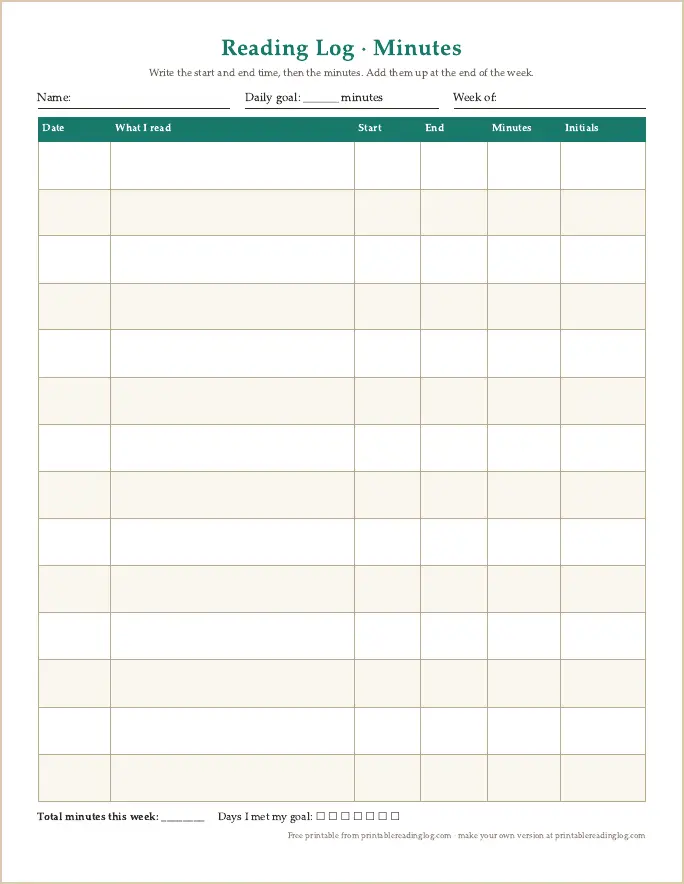
Reading Log by Minutes
A nightly minutes log with start and end times, minutes read, parent initials and a weekly total box.
Three ways to handle a blank log, and the one worth choosing
Forgotten reading logs are one of the most ordinary homework headaches there is. Sports, sick days, a busy work week, a sheet living in a folder nobody opens: it adds up quickly. Teachers know this, and most of them have heard every version of "we read, we just didn't write it down."
| Option | What it looks like | What it teaches your child |
|---|---|---|
| Make it up | Every day filled with 20 minutes and a random title | That the log is something you fake, not something you do |
| Leave it blank | An empty log, or nothing handed in | That a missed task is a dead end |
| Rebuild it honestly | Recall the real reading, write what you know, leave real gaps, add a note | That mistakes can be fixed without lying |
The honest rebuild takes a few more minutes than inventing numbers, and it's the one that keeps trust intact, yours with the teacher and your child's with you. It's also easier than it sounds, because once you start looking, most kids turn out to have read more than anyone remembered.
Emptying the backpack onto the kitchen table
Do this with your child, not for them. They remember things you don't, and it's their log. Start by collecting anything that might hold a clue about the week. The backpack is the obvious place: library books, classroom books, a book bag, leveled readers, the reading folder. Then check wherever books end up in your house, which for many families means the nightstand and the gaps between couch cushions.
Bookmarks are surprisingly useful, because where one sits tells you how far your child got. The family calendar, paper or phone, lets you place reading on the right day or explains why a day had none. A library receipt or the library app shows when a book came home, and many audiobook and e-reader apps list recently opened titles or listening time. Photos on your phone can help too, if you snapped your child reading or a stack at the library. Some teachers even mention in-class reading in the newsletter.
Lay the books out together on the table. Seeing them side by side jogs memory far better than trying to recall the week in the abstract.
Walking the week backward from yesterday
Begin with yesterday and work back, since recent days are clearer. For each day, ask small, concrete questions: "What did we do after school on Tuesday?" "Was that practice night? Did you read before or after?" "Which of these did you read in bed?" "Where's your bookmark in this one, and where was it last weekend?" "Did we read together, or did you read on your own?" "Did you listen to anything in the car?"
Tie each day to something memorable: a game, a visit, a favorite dinner, a rainy afternoon. "We read the dragon book the night we had pizza" is a far more reliable memory than "I think I read Wednesday."
Guessing minutes without inflating them
Kids are poor judges of time. One who read for 25 minutes might say "five," and one who read for five might say "an hour." Use anchors instead. If you know roughly how long a chapter takes your child, the bookmark gives you a reasonable figure; if you don't know, time one chapter tonight. A bedtime routine that always runs from getting into bed to lights out has a known length, and so does an audiobook on a familiar drive.
When you're unsure, round down. If a session was somewhere between 10 and 20 minutes, write 10. A slightly low honest number is better than a generous guess, and teachers can tell the difference.
Writing it in
Now fill in the rows. Put the real title, or "same" when it's the book from the day before, and the minutes or pages you settled on. Because you're writing on a different day than the reading happened, a small asterisk is a tidy way to flag that, and the note can explain it. Leave a day empty if there was no reading or neither of you can remember. Filling gaps just to make the page look full is exactly what a teacher notices.
Before you put the pencil down, decide where the next log will live and when it gets filled in. That decision matters more than the catch-up itself, and it's covered further down.
A rebuilt third-grade week, with one honest blank
Here's what an honest catch-up can look like. Notice the empty Wednesday and the conservative numbers.
| Day | Book | Minutes | How we know |
|---|---|---|---|
| Mon | Library chapter book, chapters 1 and 2 | 15 | Bookmark was at chapter 3 by Tuesday |
| Tue | Same book, chapter 3 | 10 | Read before soccer, short session |
| Wed | (none) | Late game, went straight to bed | |
| Thu | Classroom leveled reader | 10 | Book came home in the folder Thursday |
| Fri | Same chapter book, chapters 4 to 6 | 25 | Stayed up reading, remembered the cliffhanger |
| Sat | Read aloud with Grandpa | 20 | Visit was Saturday afternoon |
| Sun | Same chapter book, finished it | 20 | Told us the ending at dinner |
That's 100 minutes over six days. It isn't a perfect week, but it's a true one, and it's probably more than the parent would have guessed off the top of their head. If you want to see what a well-kept sheet looks like for comparison, our filled-in reading log examples show several.
When the week was messier than one child, one house
If your child splits the week between two homes, message the other parent with one simple question: "Which nights did they read at your place, and roughly how long?" Fill in your nights yourself and theirs from the answer. If you can't reach them in time, fill in your own days, leave theirs blank and say so in the note. Going forward, a log that travels in the backpack, or a photo of each home's page, keeps both sides in step.
With more than one child keeping a log, rebuild one week at a time, ideally at separate moments. Siblings blend memories ("we both read the dragon book!"), and it's easy to copy one log onto the other by accident. Separate piles of books on the table help a lot.
When grandparents, a sitter or after-school care did some of the reading, a quick text usually settles it. Caregivers often remember reading time better than kids do, especially if they read aloud. Add their initials in the row if the teacher asks who read with your child.
Some kids insist they read every single day. Maybe they did. Check each day against the calendar and the bookmark, and if one still seems doubtful, try: "I believe you read a lot this week. Let's only write the days we can both remember for sure, so the log is really accurate." That keeps it about accuracy rather than doubting them.
The opposite happens too. A child who finds reading hard may say they read nothing when you know they did. Show them the finished book, the moved bookmark, the library photo. Kids are often surprised, and quietly proud, to see how much they actually got through.
Questions that unlock a nine-year-old's memory
"What did you read this week?" makes most kids freeze, because it's too big a question. Smaller prompts work much better, and it helps to think in four groups while you go.
Ask about places: in bed, on the couch, in the car, at a friend's or grandparent's house, during free time at school or at the library. Ask whether they read to a younger sibling, a grandparent or the dog. Ask about books: which one in the pile is new since last week, which one they finished and how it ended, whether there's one they started and abandoned, and whether any magazines, comics or graphic novels crept in. Ask about people: did Grandma or a sitter read with them, did the two of you share a book any night, did the teacher send something home for practice. And ask about time: was there a night they were too tired, a day with no school, a longer stretch on the weekend.
Jot answers on scrap paper as they come, then copy them onto the log in day order. Specific questions about places, books and people bring back sessions that one general question would miss.
Deciding which bits of reading belong on the sheet
Once you start digging you'll find reading in odd corners. Some belongs on the log and some doesn't, and every class has its own rules, so check the teacher's instructions first. As a general guide:
| Reading activity | Usually loggable? | Notes |
|---|---|---|
| Child reads a book alone | Yes | The core of most logs |
| Parent reads aloud to child | Often, especially in younger grades | Ask if it counts toward the goal |
| Child reads aloud to a sibling or pet | Yes | Great practice, and kids love it |
| Audiobook | Often | Many teachers accept it, some don't |
| Comics and graphic novels | Usually | Reading is reading |
| Magazines | Usually | Count the time spent on articles |
| In-class silent reading | Depends | Many logs are for home reading only |
| A recipe or game rules | Rarely as a full row | Mention it in a note if you like |
| Watching the movie of a book | No | Not reading |
If a lot of the week was listening, the audiobook log page shows how to mark those rows so they're clear, and our piece on whether graphic novels count covers the comics question in detail.
Notes to slip in with a late or patchy log
Teachers usually care far more about honesty than a perfect page. A short note shows you're on top of it, explains any odd gaps or asterisks, and closes the subject. Pick the one closest to your situation and change the details.
When the reading happened but the writing didn't:
Hi, we forgot to fill in the reading log during the week, so we rebuilt it together this weekend from the books [child's name] read and our calendar. The minutes are our best honest estimates, and we rounded down when we weren't sure. We're keeping the log by the bed from now on so it gets filled in each night. Thanks!
When some days genuinely had no reading:
Hi, this week's log has a couple of blank days. We had a busy stretch with [games, appointments, a family visit] and didn't get reading in those nights. [Child's name] made up some time over the weekend. We're working on a better routine for next week.
When the sheet itself vanished:
Hi, the reading log page went missing this week, so we printed a new one and filled it in from memory with [child's name]. The titles and times are accurate as best we can tell. We'll keep the new one in the reading folder.
When you need a day or two more:
Hi, we're running behind on this week's reading log. Could we turn it in [day] instead? [Child's name] has been reading; we just haven't written it down yet. Thanks for understanding.
Older kids, roughly fourth grade and up, can write their own. It builds responsibility, and teachers tend to appreciate it:
Dear [teacher], I forgot to fill in my reading log this week. I filled it in on Sunday from my books and my bookmarks. I didn't read on Wednesday. I'm going to fill it in every night after I read from now on.
One to three sentences is plenty. There's no need for a long apology or an account of your whole week.
Printing a clean replacement sheet
If the original is lost, crumpled, or covered in three attempts' worth of eraser marks, print a new one. In the maker, the Weekly preset gives you a seven-day page; Kids gives the full kid look on a longer page. Put your child's first name at the top and the teacher's weekly target in the goal line, checking the old sheet or the class newsletter if you're not sure what it is. Elementary kids usually like the kid style, middle schoolers the cleaner adult one.
Log by minutes if the teacher counts time, pages if they count pages, or by date if they only want to see which days had reading. Title, pages/minutes and initials are the essential columns; add the finished date if the teacher tracks completed books, and notes if you want room for an asterisk or a one-word comment. A quick smiley or star rating gives your child a reason to remember the book. The Classic theme is the gentlest on printer ink. Seven rows suits a weekly page, a few more if your child often reads twice a day.
Turn on the 10-square goal grid. Coloring a square the moment a session ends is the single most reliable way we know to stop forgetting. Then print four copies, write the week's dates at the top of each, and keep the stack in one place. Running out of blank pages is one of the most common reasons logs go empty. The weekly reading log page has a ready layout, and our reading log cheat sheet lists what each column is for.
Three weeks blank and the grading period ends Friday
Sometimes it isn't one week, it's three, or the whole month. Don't try to reconstruct a month of daily minutes from memory. That's where an honest catch-up turns into fiction, because nobody remembers a Tuesday three weeks ago. Scale what you claim to what you can back up.
| Situation | What to do |
|---|---|
| One week missed | Full day-by-day rebuild, as above |
| Two weeks missed | Rebuild the most recent week by day; for the earlier one, list books and a rough total |
| Three or more weeks | List the books finished or started, with a short note; skip daily minutes you can't recall |
| Whole month or grading period | Talk to the teacher first and ask what they'd accept |
| Log lost, contents unknown | Print a new one, fill in only this week, and explain in a note |
For older stretches, a plain book list gives the teacher real information without invented numbers:
Books [child's name] read in October: a library chapter book about a lost dog (finished), the second book in a series they love (halfway), two graphic novels from the classroom library, and nightly read-alouds of The Wind in the Willows, which we're reading together.
Many teachers will happily say "just start fresh from Monday." That isn't getting off easy. It's the outcome that gets reading back on track fastest, which is what the log was for in the first place.
If reading itself slipped, not just the writing
Sometimes, as you rebuild, you realize the log isn't the only thing that slid. Reading may simply not have happened much for a few weeks, which is common during illness, a move, a new baby or a stretch of big feelings. Say so plainly in the note: "We had a tough few weeks and reading slipped. We're starting a routine again this week." Teachers usually respond well. Then think about the next seven days rather than the last thirty.
Restart gently. Choose a book your child is excited about, even if it's below their level or a comic, because momentum matters more than difficulty right now. Read together for a few nights, since a shared book is easier to begin than solo reading. Make the first week's goal small, ten minutes a night, and make the sheet a bit of a celebration with a favorite marker, stickers and a spot on the fridge. If your child is pushing back on the log altogether, our page on a child who refuses the reading log may help.
Talking it over with your child once the sheet is done
The conversation after the catch-up is worth as much as the rebuilt page. A child who sat through a tense Sunday-night scramble can easily walk away thinking the log is a source of trouble, or that the reading only matters when someone is checking. A minute of calm talk afterward changes that.
Keep it short and about the plan, not the lapse. Something like: "We figured out your week, and you read more than either of us thought. Next week, let's write it down right after you read so we don't have to play detective on Sunday. Where do you want to keep the sheet?" Letting your child choose the spot, the pencil or the sticker color gives them a stake in the new routine without turning it into a lecture.
If your child is worried about what the teacher will think, be honest and reassuring at the same time: "Your teacher would rather have a true log with a note than a perfect one we made up. We fixed it the right way." That message, that a mistake can be repaired by telling the truth, is the most useful thing a forgotten log can teach, and it carries well beyond reading.
For older kids who forgot their own log, ask them what got in the way instead of supplying the answer. A fifth grader who says "I always forget because it's in my locker" has just told you the fix, and they're far more likely to follow a plan they came up with themselves.
Moving the log to where the reading happens
The catch-up fixes this week; habits fix next week. Most forgotten logs trace back to a handful of causes.
| Why it got forgotten | What to change |
|---|---|
| Log lives in a backpack folder | Keep a home copy where reading happens; copy it over on the due date, or ask if the home copy can go in |
| Nobody fills it in until the weekend | Write one row right after each session, book still in hand; it takes 30 seconds |
| Pencil is never nearby | Tape a pencil to a clipboard and keep the log on it |
| Reading happens in different rooms | Pick one logging spot, like the fridge, and log there every night |
| Parent initials needed, parent away | Let the other caregiver initial, or initial several rows on return after checking with your child |
| The log is boring or confusing | Make a simpler version with fewer columns and squares to color |
| Due date sneaks up | Phone reminder the night before, plus a midweek check |
If logging takes longer than a minute, the sheet is too complicated for daily use. Cut columns until it's quick; detail can come back later. The routine that sticks for many families is read, close the book, write one row, color one square, lights out. When the log is the last step of reading rather than separate homework, it stops getting lost. Our guide to building a daily reading habit goes further into routines like this.
By third or fourth grade, many kids can keep their own log with a little backup. Hand over the job, the pencil and the logging spot, and check in once midweek with "how's the log looking?" Kids are often more reliable than tired parents. And if the daily log isn't working for your family at all, some teachers are open to a weekly book list or a monthly reflection instead; our look at whether reading logs actually help lays out both sides before that conversation.
Sunday, every night, Wednesday, due date
On Sunday evening, take out a fresh page, write the week's dates across the top, and ask what your child wants to read this week. Every night, read, write one row and color one square. On Wednesday, do a thirty-second check and fill in anything missed while it's fresh. The night before it's due, add up the total, get the initials and put the sheet straight into the backpack. The Wednesday check is the real safety net: if Monday slips, you catch it when the memory is two days old instead of seven. You can print the next month's worth of pages any time from the free log builder, no account required.
What parents ask the night before it's due
Is filling in the log a few days late the same as faking it?
No. Recording real reading from memory after the fact is honest, and most teachers understand. Inventing reading that didn't happen is the line not to cross. A short note saying you filled it in late keeps everything above board.
How do I estimate minutes when my child has no idea how long they read?
Work from clues: where the bookmark moved, how many chapters were read, how long your bedtime routine normally runs. If you know roughly how long one chapter takes your child, multiply from there, and pick the lower number whenever you're unsure.
Won't blank days make the log look bad?
A couple of blank days with a short explanation look far more believable than seven identical rows of 20 minutes. Teachers expect some empty days, and an honest gap tells them something real.
Could my child get in trouble for a late or incomplete log?
That depends on the teacher and the class rules. Most respond better to an honest, partly complete sheet with a note than to a suspiciously perfect one. If you're worried, message the teacher before the due date and ask how they'd like you to handle it.
Who should write the catch-up entries, me or my child?
Do it together. Your child remembers what they read and you remember the calendar. Let your child write the rows if they can, so the log stays theirs, and you take care of the initials and the note.
Should audiobooks and bedtime read-alouds go into the rebuilt week?
Often they count, but rules vary by teacher. If you include them, label them clearly, such as "listened" or "read aloud" in the notes, and check the instructions on the original sheet if you're unsure.
We forget every single week. What's the one change that helps most?
Keep the sheet and a pencil in the spot where your child reads, and fill in one row the moment the book closes. A midweek check and a stack of pre-dated pages cover most of what's left.