Reading Log for Holiday Road Trips: Keep Kids Busy on the Drive to Grandma's
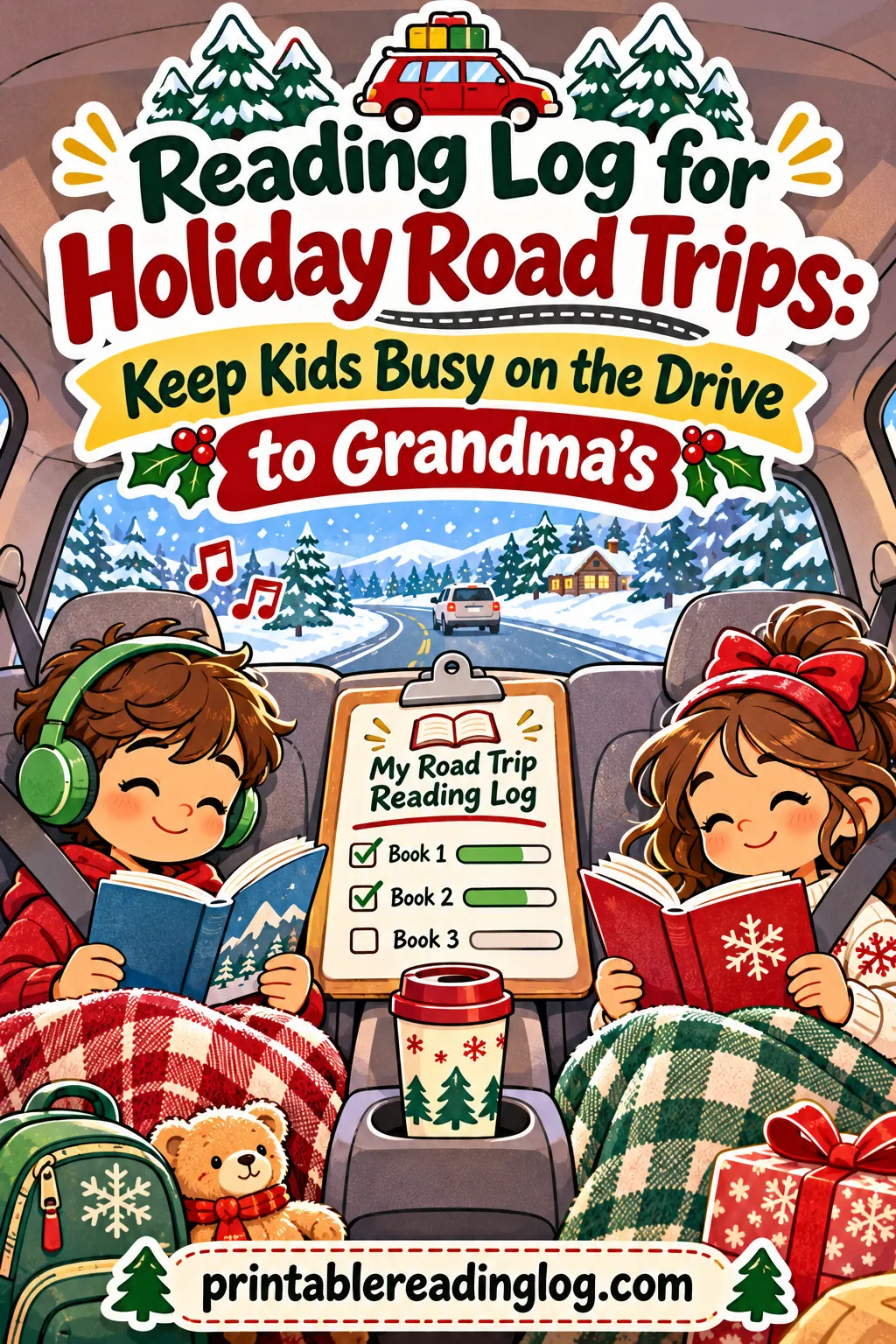
A road trip reading log works when reading is one block in a rotation rather than the whole plan: split the drive into legs, give each leg one 20- to 30-minute book or audiobook block, and let kids check it off when it's done. A six-hour drive becomes a string of short, manageable pieces, and the sheet gives everyone something to point at besides the clock.
You can build a trip log in a couple of minutes with our reading log maker: Kids preset, switched to minutes, with the initials column standing in for "who picked." Print one per child. Below is a sample rotation for a long drive, what to write in each column, how to keep a carsick child reading, a version for flights, what to pack, and what to say around hour three when it all starts to wobble.
📚 Printable Reading Log: make this log in 10 seconds
Set the name and goal, preview it, then print it free.
Free printables for this page
Ready-made, one-page PDFs from Printable Reading Log. Print as is, or change the columns in the maker above. See all free printable reading logs.
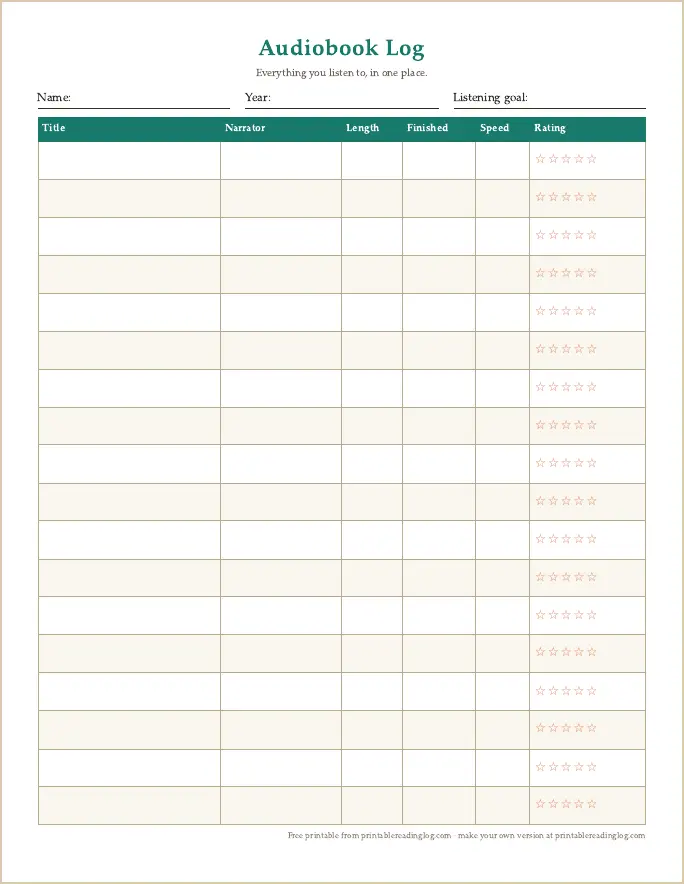
Audiobook Log
Track listening: title, narrator, length, date finished, playback speed and a rating.
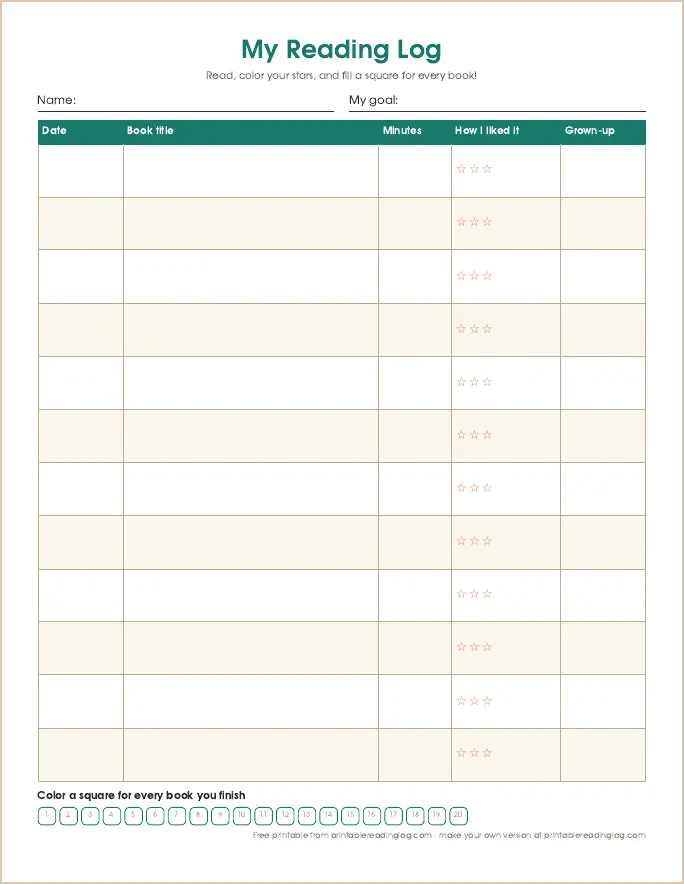
Kids Reading Log
Big rows for the date, book, minutes and a grown-up's initials, three stars to color for each book, and 20 goal squares.
Hour three, when the snacks run out
Most families know the pattern. The first hour is fine: snacks are fresh, the trip is exciting, and the kids are happy staring out the window. Then the snacks are gone, someone kicks a seat, and "How much longer?" starts arriving every few minutes.
A common piece of family travel advice is to change activities every 20 to 30 minutes on a long drive, because young kids' attention runs out quickly in a small space and a change resets it. The trouble is that most families pack one big activity, a tablet or a stack of books, and expect it to last for hours. It never does.
Holiday drives are harder than ordinary ones for several reasons at once. The trip to relatives is often the longest drive of the year, and holiday traffic can stretch five hours into seven while kids can't see why the car stopped moving. Everyone is tired from leaving early or packing late. The car is crammed with gifts, bags and extra coats, so there's less room to wiggle and more bumping into siblings. And when the tablet is the only thing that works, every handoff turns into an argument about whose turn it is.
Reading won't solve all of that, but a book or audiobook makes an excellent rotation block: it's quiet, it needs no charger (well, the book doesn't), and an audiobook can be shared by the whole car at once. The log keeps it in the rotation. When kids can see that the plan is "audiobook, then snack, then window game, then book," reading becomes a normal part of the day instead of something a parent springs on them at a bad moment.
Building the drive out of 20-minute pieces
Think of the drive as a series of short blocks. Reading is one kind; these are the others most families rotate through.
| Block type | Length | What it looks like | Noise level |
|---|---|---|---|
| Audiobook | 30 to 45 minutes | The whole car listens to one story | Quiet, shared |
| Book or comic | 15 to 25 minutes | Each child reads their own book | Quiet |
| Look-and-find | 15 to 20 minutes | Count red trucks, spot plates, find letters on signs | Talky |
| Snack | 10 to 15 minutes | One bag at a time, not all at once | Medium |
| Screen time | 20 to 30 minutes | A show or game, with headphones | Quiet |
| Rest | 20 to 40 minutes | Pillow, blanket, eyes closed, soft music or nothing | Quiet |
| Stop | 15 to 30 minutes | Bathroom, stretch, run around | Loud, outside |
Audiobook blocks can run longer than the rest because nobody has to hold anything or look down, and a good story keeps everyone listening. Paper books are better kept to about 20 minutes, for reasons the carsickness section explains.
Six hours to Grandma's with a 6-year-old and a 9-year-old
Here's one rotation for a family leaving at 8:00 in the morning. The times are approximate and will slide with traffic.
| Time | Leg | Block | Log it? |
|---|---|---|---|
| 8:00 | Leg 1 | Look-and-find while everyone settles in | No |
| 8:20 | Leg 1 | Audiobook, chapters 1 to 3 | Yes, 40 min |
| 9:00 | Leg 1 | Snack bag 1 | No |
| 9:15 | Leg 1 | Book or comic, each child's own pick | Yes, 20 min |
| 9:35 | Leg 1 | Rest or window time | No |
| 10:00 | Stop | Gas, bathrooms, stretch | No |
| 10:30 | Leg 2 | Screen time with headphones | No |
| 11:00 | Leg 2 | Audiobook, chapters 4 to 5 | Yes, 30 min |
| 11:30 | Leg 2 | "I spy" or 20 questions | No |
| 12:00 | Stop | Lunch | No |
| 12:45 | Leg 3 | Rest after lunch | No |
| 1:15 | Leg 3 | Swap a book with your sibling, then read | Yes, 20 min |
| 1:35 | Leg 3 | Snack bag 2 | No |
| 1:50 | Leg 3 | Audiobook, chapters 6 to 7 | Yes, 30 min |
| 2:20 | Leg 4 | Screen time | No |
| 2:50 | Leg 4 | "Almost there" countdown game | No |
| 3:00 | Arrive | Hugs | No |
The logged blocks add up to 40 + 20 + 30 + 20 + 30, or 140 minutes of reading and listening in a six-hour day. That's more than most kids manage on a school day, and it came in five short pieces instead of one long demand.
A few details make this plan work. Reading never appears twice in a row. Audiobooks land right after something active, a stop or a game, when kids are ready to settle. And screens aren't banned; they're simply one block among the others, which takes much of the heat out of "when do I get the tablet?"
Scaling the plan to the length of the drive
A good starting point is one reading or listening block per hour of driving, adjusted from there.
| Drive length | Audiobook blocks | Book blocks | Reading minutes (about) |
|---|---|---|---|
| 2 hours | 1 | 1 | 50 |
| 4 hours | 2 | 2 | 100 |
| 6 hours | 3 | 2 | 140 |
| 8 hours | 4 | 3 | 190 |
| 10+ hours over 2 days | 3 per day | 2 per day | 140 per day |
These are planning numbers, not quotas. If the audiobook is gripping and everyone wants one more chapter, let it run. If the kids fall asleep for an hour, skip the next block. The sheet only shows you what's happened so far.
A trip sheet that survives a bumpy back seat
A trip log should be small, simple and easy to fill in with a pencil on a moving road. In the maker, the Kids preset gives you a kid layout with goal squares and a coloring strip. It starts out counting books, so switch it to minutes for timed blocks. Use "Holiday Trip Reading" or "Mia's Trip Reading" as the heading, and something like "60 minutes of reading or listening each travel day" as the goal. Keep the kid style for younger children; around age 10, the adult style's slimmer rows look less babyish. Sky gives a wintry feel and Sunshine is bright and cheerful.
Turn on date, title, pages/minutes, initials and notes. A rating can stay if your kids like scoring books, or go if you need the room. Twelve rows suits a typical trip; the slider goes as low as 6 for a short drive and as high as 24 for several travel days. Pick 10 or 20 goal squares, whichever is closer to the number of days you'll be away, and keep the coloring strip on for kids under about 8. Print one per child plus a spare, because juice boxes get squeezed.
| Column | What to write |
|---|---|
| Date | The leg, such as "Leg 1" or "Plane," plus the day on a two-day trip |
| Title | The book or audiobook, such as "Audio: ch. 1 to 3" |
| Minutes | How long the block lasted, such as 20 or 40 |
| Initials | Who picked the book or audiobook for that block |
| Notes | A funny line, a favorite part, "swapped with sister," or "fell asleep" |
| Goal squares | One square colored for each day the goal was reached |
The initials column does more for peace in the car than anything else on the page. When each child picks the audiobook for a block and their initials go on the sheet, most "it's not fair" fights disappear, because everyone can see whose turn is next.
The night before you leave, pencil Leg 1, Leg 2, Leg 3 and Leg 4 into the date column, and the first few audiobook chapters too if you know the order. On the road the kids only add minutes and initials. A sheet that's half filled in before the car leaves the driveway is much easier to keep going than a blank one. If your crew mostly listens, the Audiobook preset starts in minutes with a notes column, and the audiobook log page has more layouts.
One story for the whole car
If you plan only one kind of reading for the trip, make it audiobooks. Travel-minded parents often suggest a series that spans ages, so the whole car shares one story. That gives the family something a pile of separate books can't: one thing to talk about at the next stop.
Most families count listening as reading, and many teachers accept audiobook minutes on school logs. If your child has a break log from school, ask whether listening counts; our page on fitting a teacher's break log around holiday plans covers that situation in detail.
Choosing the car audiobook
Aim for the middle of your kids' ages. With a 5-year-old and an 11-year-old, choose something an 8-year-old would love; the older one will still enjoy the humor and the younger one will follow most of it. Chapters of 10 to 20 minutes make natural stopping points. The narrator matters more than you'd expect, so listen to a sample first. One who does lively voices keeps kids hooked, while a soft, slow one can put everyone to sleep, which on some legs is exactly the idea.
A story new to everyone builds suspense, and an old favorite is comforting on a long, tiring day, so pick whichever suits your family's mood. Check the total running time in the library app: for a six-hour drive with three 30- to 45-minute listening blocks, a 3- to 5-hour book is about right, and you'll finish on the way home or during quiet time at Grandma's. Download everything to the device the night before, because cell signal often drops on rural highways.
Giving listeners a small job
Kids listen better with something small to do. Before each block, have everyone guess what will happen next and write the guesses in the notes; at the next stop, see who was right. Each child can pick a character and make a tally mark every time that name comes up. Kids who don't get queasy can draw their favorite scene on the back of the sheet. At the end of a block, ask for a one-word review of the chapter, or pause after a big moment and ask, "What would you do?"
Car speakers work best for shared listening. If one child wants a different story, headphones solve it, but keep the volume low enough that they can hear you. Agree before leaving that the story gets paused for directions, a question from the driver, or anything important, so nobody argues about the pause button.
Keeping a carsick reader in the game
The honest trouble with paper books in the car is that many kids feel queasy looking down at a page while the car moves. Some never feel it and some feel sick after two minutes, and you probably already know which kind you have. What follows is general, practical advice, not medical advice; if your child is often sick in the car, talk to their doctor before the trip.
For a child who gets carsick, audiobooks can be the entire reading plan, and listening counts. If paper reading works a little, keep it to 10 to 15 minutes, then look out the window for a while, and save it for straight highways rather than winding back roads or stop-and-go traffic. Holding the book up near eye level with the window in view bothers some kids less than a book in the lap. Comics, picture books and large-print chapter books ask for less close focus than dense small type. A cracked window or an air vent aimed at the child's face helps some kids, and so does a seat with a view out the front windshield. A 10-minute book block at a rest stop, or while a parent fills the tank, is car reading without the motion.
On the sheet, an audiobook block and a book block look the same: minutes go in the minutes column. Some families write "A" or "B" beside the title so they can see the mix at the end of the trip, and every block counts toward the goal either way.
| Kid | Best reading block in the car | Book blocks per leg |
|---|---|---|
| Never gets carsick | Book or audiobook | 1 or 2 |
| Sometimes queasy | Audiobook, plus short book blocks on the highway | 1 short one |
| Gets carsick easily | Audiobook only; books at stops and at Grandma's | 0 in motion |
| Young pre-reader | Audiobook, or a grown-up reads aloud from the front | Picture books at stops |
Gate waits, tray tables and delayed flights
Flying to relatives brings different problems: longer stretches of sitting still, long airport waits and tiny seatback space. On the bright side, many kids who feel queasy reading in a car do better on a plane, so paper books often work better in the air than on the highway. Use the date column to name the parts of the travel day instead of the legs of a drive.
| Leg | Typical length | Reading idea |
|---|---|---|
| Drive to airport | 20 to 60 minutes | Audiobook in the car |
| Security and walking | 30 to 45 minutes | None, keep moving |
| Gate wait | 30 to 90 minutes | Book or comic, plus a snack |
| Boarding and takeoff | 20 to 30 minutes | Window time, and a snack for little ears |
| In the air, first half | 30 to 90 minutes | Book block, then a screen block |
| In the air, second half | 30 to 90 minutes | Audiobook with headphones, then rest |
| Landing and baggage | 30 to 60 minutes | None |
A day with one flight of about two and a half hours can comfortably include 60 to 90 minutes of reading and listening without anyone being pushed. Pack the books in the personal item rather than the overhead bin so they're reachable, and choose paperbacks and comics that fit the seat pocket over heavy hardcovers. Wired headphones are a handy backup, since some planes have a jack and they never need charging. Download audiobooks at home, because airport and in-flight internet can't be relied on, and bring a folder or thin clipboard so kids can fill in the sheet on the tray table. One surprise book, handed over just after takeoff, buys a remarkable amount of calm.
Holiday delays happen. When they do, announce a "delay reading block" with a fresh book or a new audiobook, and log it. Kids usually find it funny to write "Delayed!" in the notes, and the delay becomes part of the story of the trip rather than a disaster.
A reading bag at every child's feet
A reading block only works if the book is in reach. Books packed in the trunk under the gifts might as well be at home, so give each child one small bag or bin that rides at their feet or in a seat pocket. Inside: two to four books at their reading level plus one easy favorite, a comic or joke book, their trip sheet on a clipboard, two pencils (pens leak and stain seats), headphones if your family uses them, and a small book light for evening driving if your car lacks reading lights.
For the car as a whole, download the audiobooks to at least two devices in case one dies, and bring a charging cable for whichever one is playing. A swap bin with a few books the kids haven't seen yet is worth its space. Add wipes, because sticky fingers and library books don't mix, a plastic bag to keep library books clean and dry, and that spare printed sheet.
For a six-hour drive, most kids get through two or three short books or part of a chapter book. Pack one more than you think they'll need and keep the rest for the visit, since kids often run out on day two at Grandma's, especially if the weather keeps everyone inside. If you're taking library books, check the due dates first. Many libraries allow online renewals and some offer longer holiday checkouts, but rules vary, so check your own library's. A sticky note inside each cover with the due date helps them come home on time, and our page on tracking library due dates has a simple system.
Fitting reading into the visit itself
Once you arrive, routines vanish. Bedtimes slide, cousins are everywhere and nobody knows where the books went. That's fine for a few days, and the same sheet can keep a little reading in the visit without making it homework.
Visits are full of people who love your kids, so put them to work. Ask a grandparent to read one picture book or one chapter before bed and have the child write the grandparent's initials in the row; it often becomes the favorite line on the whole page. Kids can trade a book with a cousin for the visit and write "swapped with" and the cousin's name in the notes. Many grandparents still have books from when the parents were small, and reading "the book Dad read when he was 8" is usually a hit. After a big holiday meal, when everyone is sleepy, a 20-minute quiet reading time on the couch is an easy sell. Kids also tend to wake before the grown-ups at a relative's house, and a book by the bed gives them something to do. If a grandparent can't be there in person, our grandparent video reading log covers reading together over a call.
Use the goal squares as a day counter, crossing out any you won't need, and let kids color one for each day they reach that day's goal. Travel days can carry a bigger goal than visit days. Write the daily targets in the notes of the first row so nobody argues about them later.
| Day type | Suggested goal | Why |
|---|---|---|
| Travel day by car | 45 to 60 minutes, mostly audio | Long stretches of sitting make it easy |
| Travel day by plane | 45 to 90 minutes | Waits and flights leave lots of time |
| Big holiday day | 0 to 10 minutes | It's a holiday; let it go |
| Ordinary visit day | 15 to 20 minutes | One bedtime chapter is enough |
| First day back home | 20 to 30 minutes | Helps settle back into a routine |
The drive home is often harder than the drive there: everyone is tired, the excitement is over, and the car is even fuller. Use the same rotation but lean harder on audiobooks and rest. A brand-new audiobook saved for the return trip, or book two of the series you started on the way, gives the kids something to look forward to. If you want the reading to carry on through the rest of break, the winter break reading challenge picks up where the trip leaves off.
What to say when the plan hits a bump
| Problem | What to try |
|---|---|
| "I don't want to read" | Offer two choices: audiobook now or book after the next stop |
| Fights over the audiobook | Take turns; the picker's initials go on the sheet |
| Carsick after a few minutes | Switch to audio for the rest of the leg; books at stops |
| Kids want screens the whole time | Keep screens as one block, not a reward for reading |
| The audiobook is boring | Give it two chapters, then switch to the backup |
| A child finishes their only book | Open the swap bin or trade with a sibling, and log the swap |
| Traffic doubles the drive | Add rest and longer audio blocks, not more paper reading |
| Little one can't read yet | They listen and color a square; a picture book at a stop |
| Kids fall asleep | Wonderful. Skip the next block |
Sometimes the right sentence matters more than the plan. When a child refuses, try "No problem. You can pick audiobook or book. Which one?" When siblings fight over the story: "Whoever didn't pick last time picks this one. Check the sheet." When a screen block ends: "Screen's done for this block. Next is the audiobook, then snacks." When someone feels sick: "Let's put the book down and listen instead. You can finish the page at the next stop." And when the whole car is grumpy: "Quiet block. Eyes closed or windows only for 20 minutes." Short, calm and predictable carries the day, and because the plan is written on paper, the sheet does a lot of the arguing for you.
Toddlers, teens and the parent driving solo
For toddlers and preschoolers, roughly 2 to 4, board books and touch-and-feel books work better than stories that need a grown-up reading aloud, and short story recordings of 5 to 15 minutes match their attention. Keep the sheet for the parent, or let the child put a sticker in the row after each story; the reading log for toddlers has a simpler layout.
Early readers of about 5 to 7 can manage 10 to 15 minutes of their own easy books plus longer shared audiobooks. Keep the kid style and the coloring strip, since they'll enjoy coloring and initials more than counting minutes, and let a parent fill in the numbers. Independent readers of 8 to 12 can handle 20 to 30 minutes of a chapter book at a stretch if they don't get carsick, and can keep the whole sheet themselves. Give them the family audiobook pick for at least one block; they're often the best at choosing stories everyone likes.
Teens tend to resist anything resembling a kids' chart. Print the adult style, or skip the sheet and simply ask them to choose one audiobook block for the car. Their own headphones and their own story usually work best, and the teen holiday break challenge is a better fit for the rest of the break. For broader ideas, see our page on motivating kids to read.
With one child you can be flexible: they might pick every audiobook, and a parent in the passenger seat might read aloud. With three or more, turn-taking is everything, so set a picking order before you leave and write it at the top of each sheet.
If you're the only adult in the car, you can't hand out books or retrieve a dropped pencil. Set everything up before you start, with books in reach, sheets on clipboards and audiobooks queued to play in order. Change the audio only at stops, never while driving, and save paper reading and log updates for stops too. When you're ready, print the sheets from the free maker, no account needed, pencil in the legs, and tuck them into the reading bags tonight.
Questions parents ask before a long holiday drive
How do I keep reading from becoming the thing the kids fight about?
Make it one predictable block among many, with snacks, games, rest and some screen time on either side. When kids can see the rotation written down, reading stops feeling like a punishment for wanting the tablet, and screens stop feeling like a prize.
Will the teacher accept audiobook minutes from the car?
Many teachers count listening time, but some school logs ask for print reading only. Mark audio rows with an "A" so the teacher can see them clearly, and ask before break if your child's sheet is going back to school.
How long should one book block be on the road?
About 20 minutes for a paper book and 30 to 45 minutes for an audiobook is a reasonable start. Younger kids may need shorter blocks. If they're begging for one more chapter, let it run long.
My child gets carsick within minutes. Is there any point in a reading log?
Yes. Fill the driving legs with audiobooks and save paper books for stops, the gate or the visit itself. Every listening block goes on the sheet the same way. If carsickness is frequent or severe, talk to your child's doctor.
How many books should go in each child's bag?
For a six-hour drive, two to four per child plus one easy favorite, with a family audiobook and a few extras in a swap bin. Pack one more than you expect to need, since kids often run out during the visit.
Does the same sheet work for a plane trip?
It does. Name the rows by airport leg instead, such as "gate wait" or "second half of flight." Many kids who can't read in a car read happily on a plane, so you may get more paper reading in the air.
What if we're away for two weeks?
Set the rows to 24, choose 20 goal squares and cross out the last six, and use smaller targets on visit days than on travel days. One bedtime chapter on an ordinary day at Grandma's is plenty.