How to Track Books You've Read (Simple Methods)
The simplest way to track books you've read is to keep a running log with each title, the date you finished it, and a quick rating or note. You can do this on a printable sheet, in a spreadsheet, or with an app, but a paper log is the fastest to start and the easiest to stick with. Just write down each book as you finish it, and you'll have a record you can trust for years. Grab a free printable reading log and you can start your list today.
Want to begin right now? Open the free reading log maker, print a clean tracker, and add your first finished book. No sign-up, no app, no fee.
Why Track the Books You Read?
It's easy to forget. Most of us can't name half the books we read three years ago, let alone whether we liked them. A simple tracker fixes that. It gives you a permanent record you can look back on, recommend from, and feel proud of.
There are real payoffs:
- You never lose a title again. No more "what was that book with the lighthouse?"
- You can spot your taste. A year of entries shows what genres and authors you actually love.
- You can recommend with confidence. A quick note reminds you why you liked something.
- You see your progress. A growing list is genuinely motivating, and it makes hitting a reading goal feel real.
You don't need anything fancy to get these benefits. You just need a consistent place to write things down.
The Three Main Ways to Track Books
There are three popular methods, and each has a clear best-use case. Here's how they stack up.
| Method | Best for | Pros | Cons |
|---|---|---|---|
| Printable log | Quick start, no tech | Free, private, no login, satisfying to fill in | You carry the paper |
| Spreadsheet | Data lovers | Sortable, searchable, great for stats | Needs a device, more setup |
| App | On-the-go logging | Syncs, recommends books, social | Logins, ads, data sharing |
There's no single winner, it depends on what you value. If you love sorting and charts, a spreadsheet is great. If you want recommendations and friends' reviews, an app fits. But if you want the simplest, most reliable method that you'll actually keep up, a printable log wins. Let's walk through each.
Method 1: A Printable Reading Log (Easiest)
A printable log is the lowest-friction way to track books, and it's the one most people stick with. You print a sheet, keep it where you read, and add a line each time you finish a book. No login, no battery, no distractions.
Here's a sample layout that captures everything you need without clutter:
| # | Title | Author | Date finished | Rating | Note |
|---|---|---|---|---|---|
| 1 | Educated | Tara Westover | Jan 14 | ★★★★★ | Couldn't stop |
| 2 | Project Hail Mary | Andy Weir | Feb 2 | ★★★★★ | So fun |
| 3 | The Midnight Library | Matt Haig | Feb 20 | ★★★★☆ | Thoughtful |
| 4 | Atomic Habits | James Clear | Mar 9 | ★★★★☆ | Practical |
A few tips to make it work:
- Keep it visible. Tape it inside a cupboard or pin it by your reading chair.
- Add the book the moment you finish, while your opinion is fresh.
- Use the note column. One line is enough to remember a book for years.
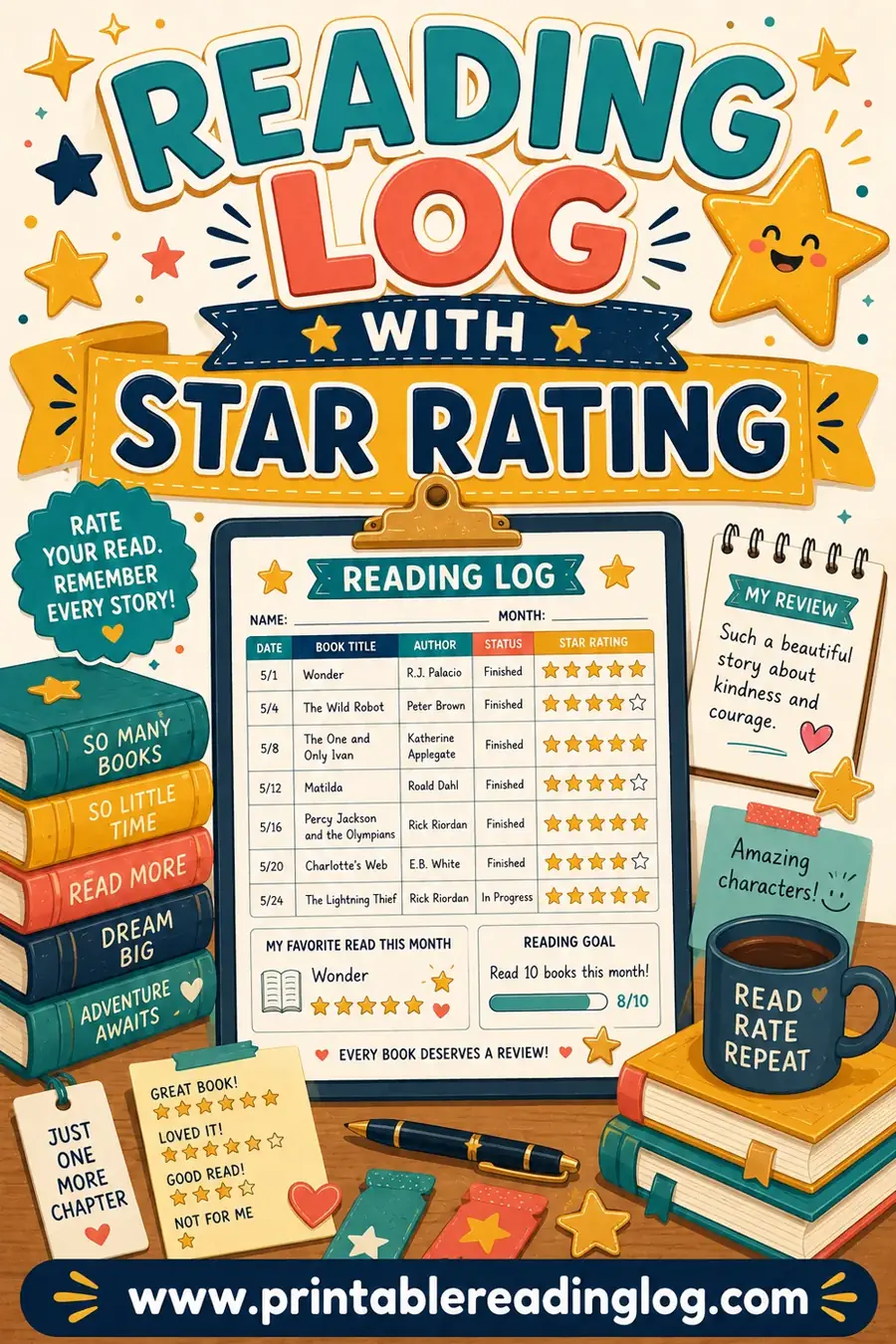
- A reading log with star rating makes the rating column quick and fun.
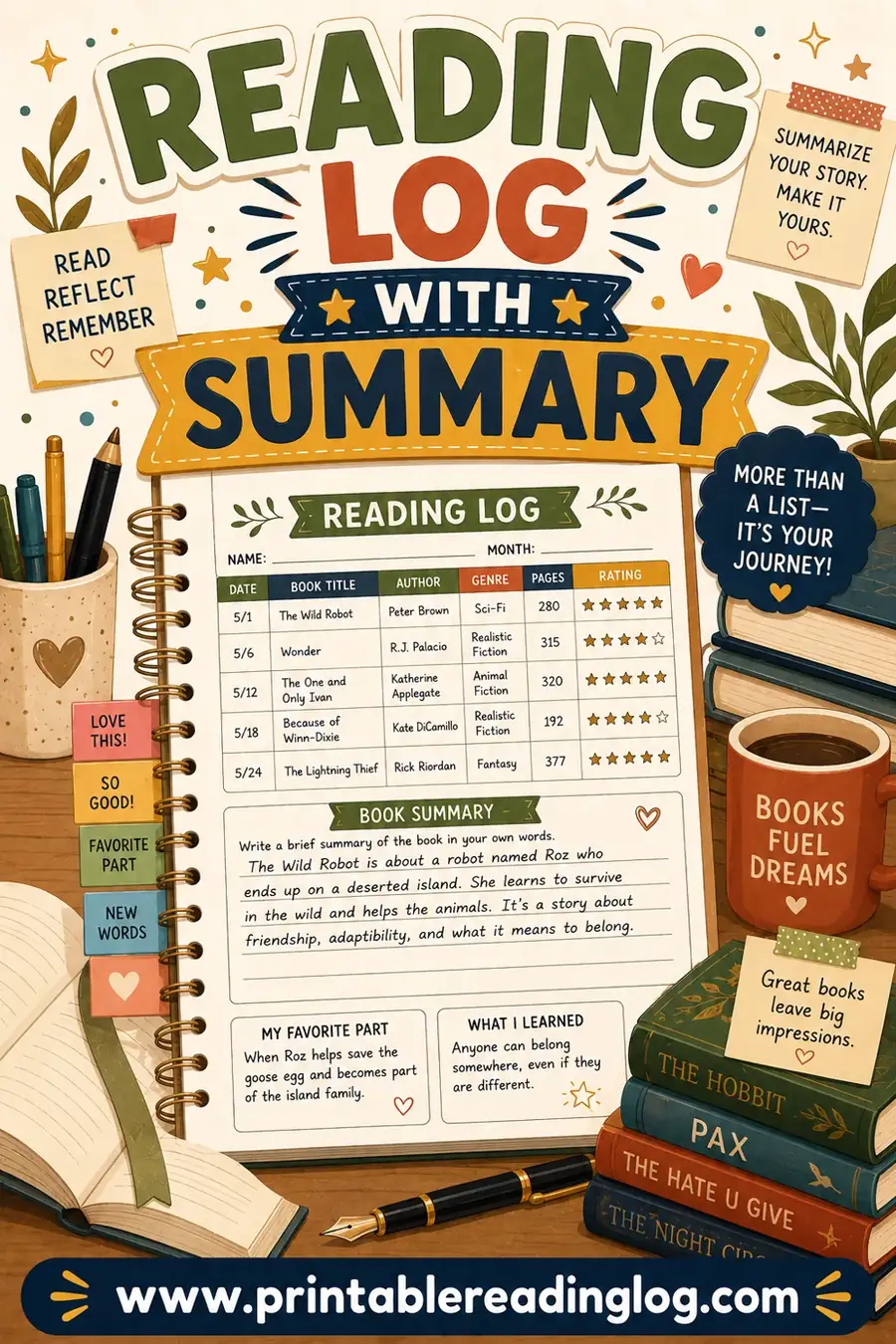
If you like writing a little more about each book, a reading log with summary gives you room for a few sentences per title.
Method 2: A Spreadsheet (Best for Data Fans)
If you love sorting, filtering, and seeing charts, a spreadsheet is your friend. Set up columns for title, author, genre, date, pages, and rating, and you can answer questions like "how many mysteries did I read?" or "what was my average rating this year?" in seconds.
To set one up:
- Make columns for title, author, genre, date finished, page count, and rating.
- Add a row per book as you finish it.
- Use filters to sort by genre, rating, or month.
- Build a quick chart if you want a visual of your year.
The trade-off is friction. You need a device open to log a book, and the initial setup takes a few minutes. Some people love the data; others find the extra step is exactly what makes them stop logging. If that's you, paper is the safer bet.
Method 3: A Reading App (Best for On-the-Go)
Apps like the popular reading trackers let you log books from your phone, get recommendations, and see what friends are reading. They're handy if you're often out and about and want everything synced.
The downsides are worth weighing:
- Logins and accounts. You're handing over an email at minimum.
- Ads and upsells. Many free apps push paid tiers.
- Data sharing. Your reading habits become someone's data.
- Distraction. Opening an app can pull you into scrolling instead of reading.
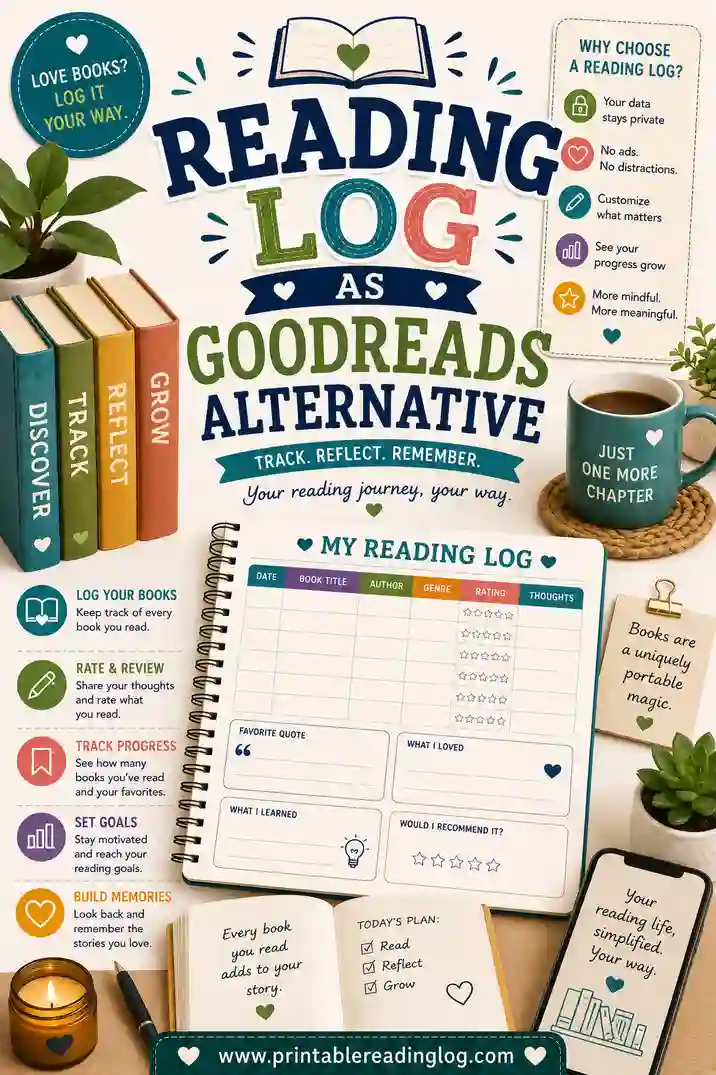
For readers who want the social and recommendation features, an app is great. For readers who just want a private, no-fuss record, it's overkill. We compared the two directly in our guide to using a reading log as a Goodreads alternative if you're torn.
What to Track for Each Book
Whatever method you pick, decide what details to capture. Track too little and the list is just titles; track too much and you'll quit. Here's a sensible set:
- Title and author — the basics, always.
- Date finished — anchors your year and shows your pace.
- Rating — a quick 1-to-5 stars helps you remember what you loved.
- A one-line note — the single most useful column. "Great twist," "slow start," "made me cry."
- Genre (optional) — handy if you want to spot patterns later.
- Format (optional) — paper, ebook, or audiobook, if you care to know.
Start with the first four. Add the others only if you'll actually use them. A lean tracker you keep beats a detailed one you abandon.
How to Build the Habit of Tracking
Tracking only helps if you keep it up. These habits make it automatic:
- Log at the finish line. Make adding a book part of finishing it, like a tiny celebration.
- Keep the tracker where you read. Friction is the enemy. The closer it is, the more you'll use it.
- Don't aim for perfect. Missed a book? Add it from memory and move on. A 90% accurate list is still gold.
- Review it now and then. Flipping back through your finished books is its own reward, and it reminds you to keep adding.
- Pair it with a goal. Tracking toward a yearly target gives each entry extra meaning.
The whole point is a record you'll actually have in five years. Pick the lightest method you'll stick with, and consistency takes care of the rest.
Which Method Fits You? A Quick Quiz
Still torn between paper, a spreadsheet, and an app? Match yourself to the reader below and you'll have your answer in a few seconds.
- **You want to start today with zero setup.** → Printable log. Print it, keep it by your chair, done.
- You love sorting, filtering, and end-of-year charts. → Spreadsheet. The setup pays off when you slice your data.
- You read on the go and want recommendations. → App. Logging from your phone fits a busy, mobile life.
- You've quit tracking before because it felt like a chore. → Printable log. Paper has the least friction, which is usually the real reason people stop.
- You want a private record nobody else can see. → Printable log or an offline spreadsheet. No account, no data sharing.
There's no wrong answer here. The "best" tracker is whichever one you'll still be using in November, not the one with the most features.
A Year in the Life of a Reading Log
To make this concrete, here's how a single paper log fills up over a year, and why the small habit pays off so well.
| Month | What the log shows | Why it helps |
|---|---|---|
| January | 2 books, both 5 stars | Strong start; momentum is real |
| April | 7 books, a clear sci-fi streak | You spot a genre you love |
| July | A slow month, 1 book | The blank space nudges you back |
| October | Back to 3 a month | You see the recovery, not just the slump |
| December | 26 books, with notes on each | A full, proud record of your year |
Notice that the log isn't just a count. By December it's a map of your reading life, your taste, your pace, your favorite finds, all from one line added per book. That's the quiet magic of tracking: a tiny habit becomes a keepsake.
Mistakes That Make People Quit Tracking
Most abandoned trackers fail for predictable reasons. Sidestep these and yours will keep going on its own.
- Logging too much. Ten columns feels thorough on day one and exhausting by week three. Start with title, date, and rating; add more only if you miss it.
- Logging in the wrong place. A tracker you keep in another room or buried in a folder gets forgotten. Put it where you read.
- Waiting to log. "I'll add it later" is where dates and details go to die. Log the moment you close the book.
- Trying to be perfect. A list that's 90% complete is still wildly useful. Missed a book? Add it from memory and move on, don't let one gap make you scrap the whole thing.
Frequently Asked Questions
What's the easiest way to track books I've read?
A printable reading log. You print a sheet, keep it where you read, and add a line each time you finish a book, no login, no battery, no setup. It's the method most people stick with because there's almost no friction. You can print one free from the reading log maker in under a minute.
Should I use an app or paper to track my books?
It depends on what you want. Apps offer recommendations, syncing, and social features but require accounts and can be distracting. Paper is private, distraction-free, and effortless to keep up. If you mostly want a reliable personal record, paper wins. If you want recommendations and to see friends' reviews, an app fits better.
What information should I record for each book?
At minimum, the title, author, date finished, and a quick rating. A one-line note is the most valuable extra, it reminds you why you liked a book years later. Genre and format are nice optional columns if you want to spot patterns. Keep it lean so you actually keep up.
How do I track books for a reading challenge?
Use a numbered list so you can see your count at a glance, then add the date and rating for each finished book. A printable tracker pinned where you'll see it keeps the challenge front of mind. Mark milestones along the way to stay motivated toward your target number.
Can I track audiobooks the same way?
Yes. Just log them like any other book, with the title, author, and date you finished listening. You might add a "format" column to note which titles were audio if you like keeping that distinction. An audiobook absolutely counts as a book read.
How do I catch up if I haven't tracked my books in a while?
Sit down and list everything you remember finishing, you'll recall more than you expect. Don't stress about exact dates for old books; an approximate month is fine. Once your back-catalog is in, switch to logging each new book right when you finish it so you never fall behind again.
Can I use one log for several years?
Yes, and many readers do. Start a new section or a new printed page each year so your totals stay separate, but keep the pages together in a binder or folder. Flipping back through several years of finished books is one of the most satisfying parts of tracking, you get a timeline of your reading life. Just print fresh pages when one year fills up.
What if I read books I didn't finish, do I track those too?
That's up to you, and there's a good case for it. A short "did not finish" note tells future-you which books to skip and why ("dragged after chapter three"). You can keep a separate DNF list or just mark abandoned titles with a quick note in your main log. Either way, it saves you from picking up the same disappointment twice.
Start Tracking Your Books Today
Tracking the books you've read is one of those small habits that pays off for years. Pick the method that fits you, paper for simplicity, a spreadsheet for data, an app for syncing, and stay consistent. For the easiest start, open the free reading log maker, print a clean tracker, and add the last book you finished. It's free, there's no sign-up, and your reading list starts now.