Advent Reading Plan 2026: One Bible Reading a Day From Nov 29 to Christmas Eve
Twenty-six short passages, read one a day, carry a family or a single reader from Sunday, November 29, 2026, the first Sunday of Advent, to Christmas Eve, Thursday, December 24. Most of them run just 3 to 15 verses. They walk through the Christmas story in order: God's promises in the Old Testament, the news to Zechariah and Mary, and the birth of Jesus in Bethlehem. Print the log, read one passage a day, and check it off.
Dates to write on the calendar now
- Advent 2026 starts Sunday, November 29.
- The four Sundays are Nov 29 and Dec 6, 13 and 20.
- 26 daily readings, most 3 to 15 verses.
- Each reading takes about 2 to 5 minutes aloud.
- Bonus readings for Christmas Day and Epiphany.
📚 Printable Reading Log: make this log in 10 seconds
Set the name and goal, preview it, then print it free.
Free printable for this page
Ready-made, one-page PDFs from Printable Reading Log. Print as is, or change the columns in the maker above. See all free printable reading logs.
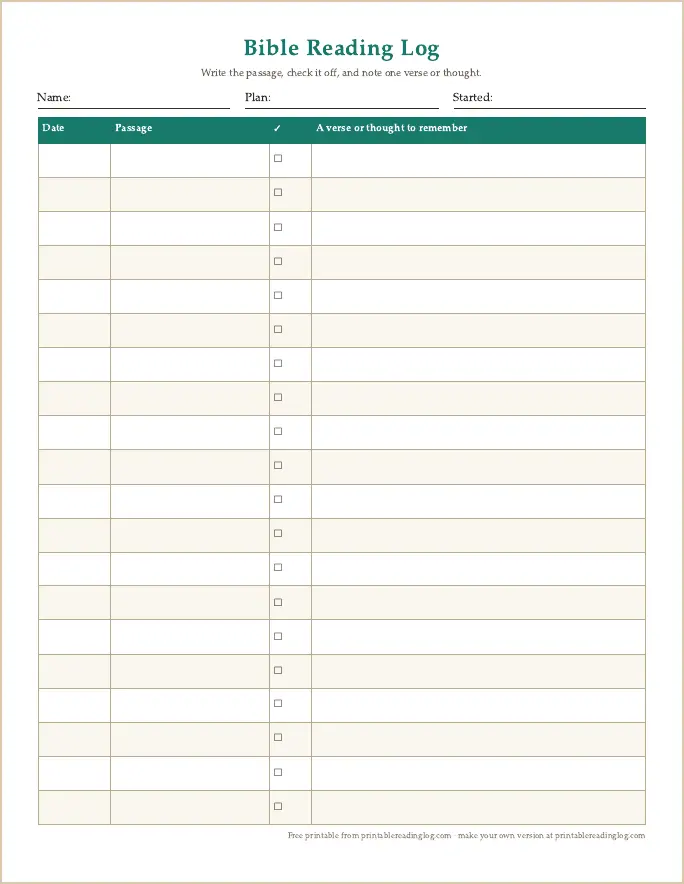
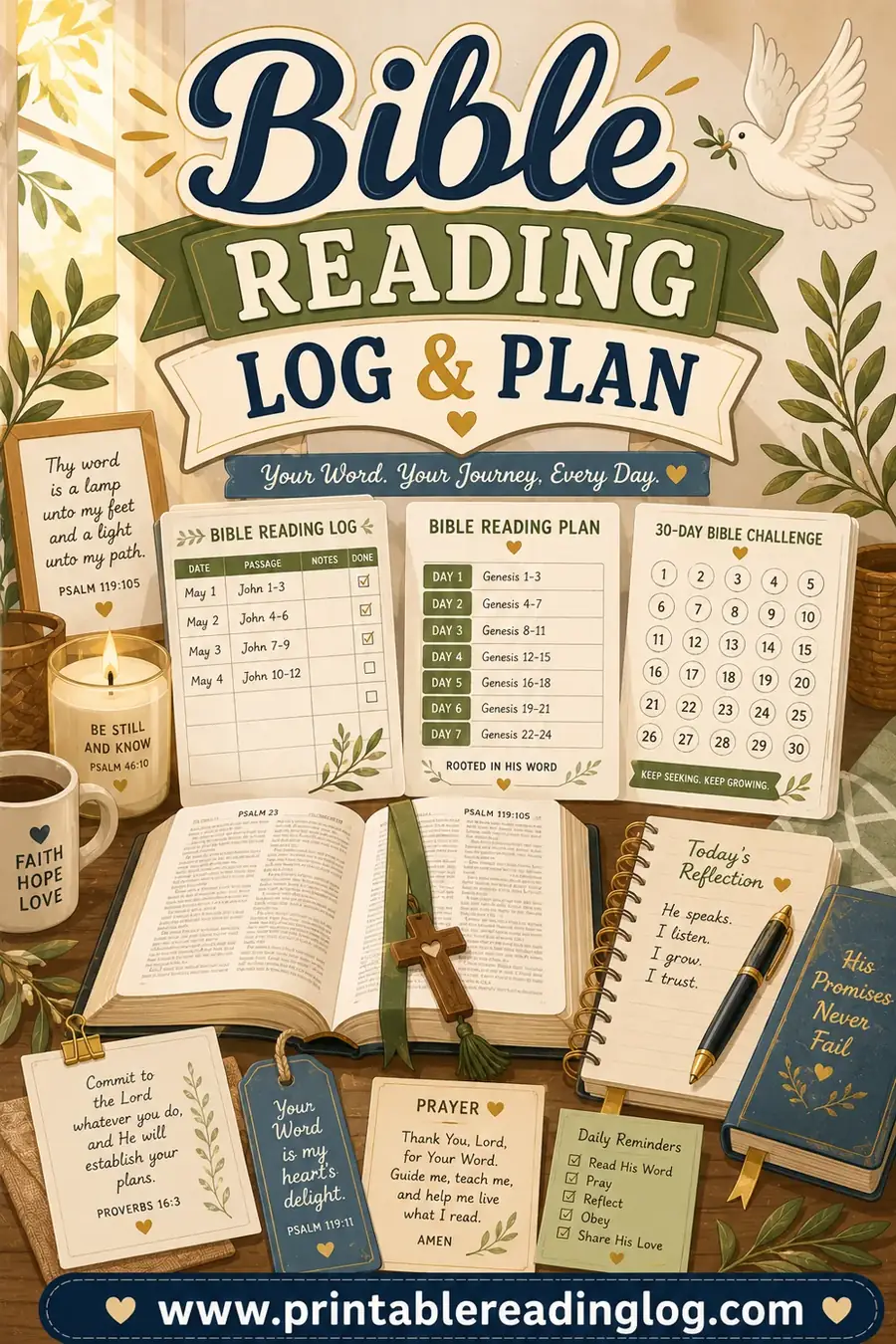
Bible Reading Log
Date, passage, a check box and a line for a verse or thought to remember, with 20 rows per page.
Set up your Advent log before Sunday
The log box above gives you a ready page. If you'd rather build your own, the Bible Plan preset in our reading log maker is the closest starting point. Name it "Advent Reading Plan 2026" or make it your family's, like "The Lee Family Advent." Log by date, and keep the columns simple: date, the passage (in the title column), a notes column, and initials if you want each family member to sign off on the day.
There are 26 readings, and the maker prints up to 24 rows on a page, so the easiest setup is two pages: one for weeks 1 and 2, and one for weeks 3 and 4. Copy the dates and readings from the tables below into the rows, or print this page and keep it alongside your log. Print it before Sunday, November 29, and keep it with your Bible, by the Advent wreath or on the kitchen table where you'll see it.
The kid-friendly style with a coloring strip works well for families with little ones, who love coloring a square after each reading. A plain adult style suits personal reading and fits neatly in a journal or Bible cover.
The full Advent reading plan for 2026
Each week has a simple theme that ties the readings together, and this overview is handy to copy onto the top of each week's rows before you start.
| Week | Dates | Theme | Where the readings are |
|---|---|---|---|
| 1 | Sun, Nov 29 to Sat, Dec 5 | The promise | Isaiah, Genesis, 2 Samuel, Micah |
| 2 | Sun, Dec 6 to Sat, Dec 12 | Prepare the way | Isaiah, Jeremiah, Malachi, Luke 1 |
| 3 | Sun, Dec 13 to Sat, Dec 19 | Mary and Joseph | Luke 1, Matthew 1 |
| 4 | Sun, Dec 20 to Thu, Dec 24 | The birth of Jesus | Luke 2, John 1 |
With kids, read the one-line summary first, then the passage. A child who hears "tonight an angel visits Mary" before the verses knows what to listen for.
Week 1: The promise (Sunday, November 29 to Saturday, December 5)
| Date | Reading | What it's about |
|---|---|---|
| Sun, Nov 29 | Isaiah 9:2-7 | A great light for people in darkness: "For unto us a child is born." |
| Mon, Nov 30 | Genesis 3:8-15 | Right after the first wrong choice, God gives a first promise of rescue. |
| Tue, Dec 1 | Genesis 12:1-3 | God promises Abraham that all families of the earth will be blessed through him. |
| Wed, Dec 2 | 2 Samuel 7:8-16 | God promises King David a kingdom that will last forever. |
| Thu, Dec 3 | Isaiah 7:10-14 | The sign of a child called Immanuel, which means "God with us." |
| Fri, Dec 4 | Isaiah 11:1-10 | A new shoot from the family of Jesse, and a peaceful kingdom where the wolf lives with the lamb. |
| Sat, Dec 5 | Micah 5:2-5 | A ruler will come from little Bethlehem. |
The first week is all about promises. It starts with light in the darkness, then steps back to Genesis and moves forward through Abraham, King David and the prophets. With kids, a good question for the whole week is simply "What did God promise today?" By Saturday they'll have heard about a child, a king, a peaceful kingdom and a small town called Bethlehem, and they'll start to see those promises point toward Christmas.
Week 2: Prepare the way (Sunday, December 6 to Saturday, December 12)
| Date | Reading | What it's about |
|---|---|---|
| Sun, Dec 6 | Isaiah 40:1-11 | "Comfort ye my people," and a voice calling to prepare the way. |
| Mon, Dec 7 | Jeremiah 23:5-6 | A righteous Branch from David's family will rule wisely. |
| Tue, Dec 8 | Isaiah 35:1-10 | The desert will bloom, and the blind will see. |
| Wed, Dec 9 | Malachi 3:1-4 | God will send a messenger ahead of him. |
| Thu, Dec 10 | Luke 1:5-17 | An angel tells Zechariah he and Elizabeth will have a son, John. |
| Fri, Dec 11 | Luke 1:18-25 | Zechariah doubts and can't speak until the baby comes. |
| Sat, Dec 12 | Isaiah 60:1-6 | "Arise, shine; for thy light is come," with gifts of gold and incense. |
Week two is about getting ready. The prophets talk about a voice calling to prepare the way and a messenger sent ahead, and then, on Thursday, the story moves into Luke and we meet Zechariah and Elizabeth. Kids often love Friday's reading, where Zechariah can't speak until the baby comes. A fun family question this week: "How do we get ready for something important?" It connects the readings to everything else happening in a busy December.
Week 3: Mary and Joseph (Sunday, December 13 to Saturday, December 19)
| Date | Reading | What it's about |
|---|---|---|
| Sun, Dec 13 | Luke 1:26-38 | The angel Gabriel visits Mary. |
| Mon, Dec 14 | Luke 1:39-45 | Mary visits her relative Elizabeth, and the baby leaps for joy. |
| Tue, Dec 15 | Luke 1:46-56 | Mary's song of praise. |
| Wed, Dec 16 | Luke 1:57-66 | John is born and gets his name. |
| Thu, Dec 17 | Luke 1:67-80 | Zechariah can speak again, and he sings. |
| Fri, Dec 18 | Matthew 1:1-17 | Jesus's family tree, from Abraham to Joseph. |
| Sat, Dec 19 | Matthew 1:18-25 | An angel speaks to Joseph in a dream. |
Week three is full of people and surprises: Gabriel's visit, Mary and Elizabeth together, two songs, a baby named John, and Joseph's dream. A simple question works every night: "Who was surprised today?" Friday's family tree is a long list of names. With young kids, read the first few names and the last few, and point out that it starts with Abraham from week one and ends with Joseph.
Week 4: The birth of Jesus (Sunday, December 20 to Thursday, December 24)
| Date | Reading | What it's about |
|---|---|---|
| Sun, Dec 20 | Luke 2:1-7 | The trip to Bethlehem, and the baby laid in a manger. |
| Mon, Dec 21 | Luke 2:8-14 | Angels bring good news to the shepherds. |
| Tue, Dec 22 | Luke 2:15-20 | The shepherds hurry to see the baby. |
| Wed, Dec 23 | Luke 2:22-38 | Simeon and Anna meet baby Jesus at the temple. |
| Thu, Dec 24 | John 1:1-14 | "The Word was made flesh, and dwelt among us." |
The last week is short, just five days, and it's the part most kids already know. Luke 2 brings the trip to Bethlehem, the manger, the angels and the shepherds. On Christmas Eve, John 1 gives a quieter, bigger-picture reading to end on. If your family has a Christmas Eve service or gathering, this reading fits beautifully before or after.
Two bonus readings
On Christmas Day, Friday, December 25, read Luke 2:1-20 all the way through together. And on Epiphany, Wednesday, January 6, 2027, read Matthew 2:1-12 about the wise men. Add two extra rows at the bottom of your log for these, so the season has a proper finish.
A small note: some Bibles number a few verses a little differently, and Isaiah 9 is the common one. If your reading looks one verse off, read the paragraph around it and you'll have the right passage.
The four Sundays of Advent in 2026
| Sunday | Date | Theme many churches use |
|---|---|---|
| First Sunday of Advent | November 29 | Hope |
| Second Sunday of Advent | December 6 | Peace |
| Third Sunday of Advent | December 13 | Joy |
| Fourth Sunday of Advent | December 20 | Love |
Churches and families use different themes and candle orders, so go with whatever your church does. If you light an Advent wreath at home, Sunday's reading is a natural time to light the new candle. You might write the week's theme at the top of that week's rows, so it's there each day as a small reminder.
Breakfast, bedtime or wreath-lighting: reading as a family
Pick one time. Breakfast, after dinner or bedtime all work. The same time each day is what makes it stick. Many families keep the Bible and the log right on the table where they eat.
Read the summary first. Even on nights you skip the question, the summary line from the tables above gives a five-year-old something to hold on to while the older language goes by.
Ask one question. "Who was surprised today?" or "What did God promise?" One question is plenty. You don't need a lesson every night.
Let a child check the box. For little ones, checking off the day on the log is half the fun. Take turns if you have more than one child, and write their initials in the initials column.
Keep it short on busy nights. Just read the passage and say goodnight. That still counts.
Some families pair these readings with a Christmas picture book each night, which is a lovely combination. Our Christmas book countdown covers the storybook side, and for little ones, Christmas read-alouds for kindergarten has a gentle 12-day plan. If you want to keep track of everyone who joins in, a family reading log works well alongside this one.
When the Old Testament weeks go over a preschooler's head
For preschoolers and early readers, the Old Testament weeks can feel abstract. Two easy fixes help a lot. First, use a children's Bible for the same stories, especially Luke 1 and 2. Read the children's version first, then a few verses from the full passage. Second, act it out. In week four, let kids play Mary, Joseph, the shepherds and the angels with a blanket and a doll in a laundry basket "manger."
Young children also enjoy drawing. Leave the notes column for a tiny picture: a star, a sheep, an angel, a manger. By Christmas Eve the log is a little illustrated story of the season. Teachers and church leaders can use the same idea, and the reading log for Sunday school shows how to set it up for a class.
Reading Advent on your own
If you're reading alone, try slowing down instead of adding more. Read the passage twice. Underline one phrase. Then write one sentence in the notes column about what stood out to you. By Christmas Eve you'll have a small record of your Advent that you can keep and reread next year.
Some readers like a few prompts for that one sentence. What word or phrase caught my attention? What does this passage say about waiting? Where do I need hope, peace or joy this week? You don't need to answer all of them. One honest line is enough. On Sundays, you might look back over the week's notes before reading the new passage. Seeing seven short lines together often shows a thread you didn't notice day by day, like how many times the readings talk about light, or about waiting. Couples and friends can read the same passage separately and share their one sentence over coffee or a text message. If one line starts to feel cramped, our reading journal page has ideas for a longer daily entry.
If you fall behind
December gets busy. Concerts, parties, travel and late nights can push a reading aside. If you miss a day or two, don't try to catch up all at once. Read today's passage and keep going, or double up on a Saturday morning. The point is to arrive at Christmas a little more ready, not to have a perfect log.
If you're traveling, take a phone photo of the plan or fold the printed log into your bag. Many families read in the car on the way to see relatives. Our holiday travel reading log has more ideas for reading on the road, and a daily reading log is handy if you want to keep a simple reading habit going through the whole break.
A candle, a turn for each reader and a keepsake page
You don't need crafts or a big plan. A few small touches make the daily reading feel like part of the season instead of one more thing to do.
Light a candle. Even without a wreath, one candle on the table while you read signals that this is a special few minutes. Let an older child be in charge of lighting it, with a grown-up nearby.
Give each reader a turn. Children who read well can take a verse or two. Younger ones can read the one-line summary from the table. Everyone gets a part, and everyone listens a little better.
Save the log as a keepsake. Write the year at the top and tuck the finished pages into your Bible or a Christmas box. Next Advent, pull out last year's log and see the notes and drawings. Over time, the stack becomes a family record of many Christmases.
Add a story afterward. If your children are older, a Christmas chapter book read a little each night pairs well with the Bible reading. Our Christmas chapter book read-aloud plan works out how many pages a night to finish by the 24th. And a read-aloud log for parents keeps track of every story you share across the season.
Once school lets out, the days get looser and routines slip. Keeping the reading at the same time each day, even during the break, is the simplest way to hold on to it. A winter break reading challenge can keep the kids' own reading going in the same stretch.
What to say on the first night, November 29
The opening night sets the tone for the rest of the month, so it helps to have a few words ready instead of jumping straight into Isaiah. With children, something like this works: "Starting tonight, we're going to read a little bit of the Bible every day until Christmas Eve. Each night is one piece of the Christmas story, and the first pieces happened a long, long time before Jesus was born. Tonight's piece is about a light in the dark." Then light the candle if you have one, read Isaiah 9:2-7, and let a child make the first checkmark.
With teenagers or adults, a plainer start fits better: "There are 26 short readings, one for each day. We'll spend a couple of minutes on each, and nobody has to have anything clever to say." Saying that out loud takes pressure off the people who worry they'll be asked a question they can't answer, and it makes it more likely they'll come back on Monday.
If you lead a Sunday school class or small group, the first meeting is a good moment to hand out the printed log and show how the rows match the tables above. Point out that week four is only five days long, so nobody is surprised when Christmas Eve arrives on a Thursday.
One family's first week on the log
Picture a household with two parents, a seven-year-old and a ten-year-old, reading after dinner. On Sunday the ten-year-old read Isaiah 9:2-7 aloud and the younger child wrote "light" in the notes column. Monday's Genesis 3 reading prompted questions about the garden that ran ten minutes past bedtime, which the parents allowed once and then decided to keep the talk to one question a night. Tuesday and Wednesday went quickly; the note for 2 Samuel 7 was a small crown drawn by the seven-year-old.
Thursday was a school concert, and nobody read. On Friday the family read Isaiah 7:10-14 at breakfast and Isaiah 11:1-10 after dinner, and the ten-year-old drew a wolf and a lamb side by side. Saturday's Micah reading was the shortest of the week, and the parents used the spare minutes to look back at the row of notes: light, a promise, a crown, Immanuel, a wolf and a lamb, Bethlehem. Reading those words in a column, the older child noticed that every one of them pointed toward a baby who hadn't arrived yet. Nobody had planned that conversation; the log made it possible.
What they changed for week two was small. They moved the log from a drawer to the table under the candle, because on Thursday nobody remembered it existed. And they agreed that on a night with an evening event, the reading would happen at breakfast instead of being skipped.
The nights that need a little more time
Most passages in this plan take two or three minutes, but a few are longer or need some explaining, and it helps to know which ones in advance. Isaiah 40:1-11 on December 6 is one of the longer Old Testament readings, and it shifts between comfort, a voice in the wilderness and a shepherd gathering lambs. With children, read it in two parts and pause after the voice calling to prepare the way, since that line comes back when John appears in week two.
Week three has two songs close together: Mary's on Tuesday, December 15, and Zechariah's on Thursday, December 17. Both are poetry, and both sound different from the story chapters around them. Reading them slowly, or letting a strong reader take them, helps listeners hear that the characters have stopped talking and started praising. Some families compare the two on Thursday night by asking which line from each song they liked best and writing both lines in the notes column.
Friday, December 18, is the family tree in Matthew 1:1-17. Adults reading alone may find it rewarding to read every name slowly and recognize Abraham and David from week one. With a group, it's a good night to let each person read a few names in turn, which keeps everyone listening.
Wednesday, December 23, is the longest reading in the plan, Luke 2:22-38, with both Simeon and Anna. If your evening is crowded two days before Christmas, read Simeon's part at breakfast and Anna's at night. Christmas Eve's John 1:1-14 is short but different in tone from the rest of week four, with no angels or shepherds, and older children sometimes need to hear that it tells the same story from a wider view.
Fitting the plan to who is at the table
Families with a wide age range can split the reading without splitting the family. A teenager reads the passage, a middle child reads the one-line summary from the table, and the youngest checks the box. Each has a real job, and none of them is bored for long.
Grandparents who live far away can join by phone or video. Choose one night a week, often Sunday, when a grandparent reads the passage and the children ask the question. Write the grandparent's initial in the initials column for that row; children tend to remember those nights. Our page on reading with grandparents over video has more ways to set this up.
Households where parents work evening shifts can treat the plan as a morning plan instead, reading over breakfast or in the car before school. The readings are short enough for a five-minute window, and nothing in the plan requires it to happen at night. A family that speaks two languages at home can read the passage in one language and talk about it in the other, which many children find natural.
Small problems that come up in December
A child keeps asking to skip to the manger
Tell them it's coming on December 20, and show them the row on the log. Seeing the date written down makes the wait concrete, and waiting is part of what Advent is about. Some children like to count the rows left each night.
The questions get too big for bedtime
Write the question in the notes column and promise to come back to it on Saturday morning. It respects the question without turning a two-minute reading into an hour, and Saturday conversations are usually calmer.
Two households over the holidays
Children who spend part of December in another home can take a copy of the log with them. Print two copies, and when they come back, copy over any checkmarks. If the other household doesn't read, the child can still read the one-line summary on their own and mark the day.
The log goes missing
Print a fresh page and start from today's row. The readings follow the calendar, so you never need to find your old place; today's date tells you where you are.
After Christmas: keep the habit going
Many families find that a few minutes of reading together each day is worth keeping. Once Epiphany passes, you might move into a longer plan for the new year. Our Bible reading log plan shows how to set one up with the same maker. Or simply keep reading a Gospel a chapter a day, and keep checking off the days.
Want a Christmas Eve tradition to go with this plan? The Christmas read-aloud tradition log keeps track of a special story each year, so you can look back on every Christmas Eve you've shared. If you want this year's log on the table by the first Sunday, the PDF on this page is already laid out, or you can make your own version with your family's name across the top.
What families ask before the first Sunday of Advent
When does Advent start in 2026?
Advent 2026 begins on Sunday, November 29, the fourth Sunday before Christmas. The Sundays of Advent are November 29 and December 6, 13 and 20, and Christmas Eve is Thursday, December 24.
What should I read during Advent?
A classic plan starts with God's promises in the Old Testament, moves to John the Baptist and Mary in Luke 1, and ends with the birth of Jesus in Luke 2 in the days before Christmas.
How long are the daily readings?
Most are 3 to 15 verses, so each takes about 2 to 5 minutes to read aloud. That leaves time to talk or pray together.
Can kids follow this plan?
Yes. The readings are short, and each day has a one-line summary to read first. For little ones, a children's Bible version of the same story works well.
What if we miss a day?
Read today's passage and keep going, or double up on a weekend. The plan is there to help, not to make anyone feel behind.
How many days are in the plan?
26 daily readings from November 29 to December 24, plus bonus readings for Christmas Day and for Epiphany on January 6, 2027.
Which Bible translation should I use?
Any one your family reads. A few verse numbers differ between Bibles, so if a passage looks one verse off, read the paragraph around it.
Can a church or class use this plan?
Yes. Print one log per child or family, or one for the classroom wall, and check off the readings together each week.