Read Together Across the Miles: Grandparent Video Reading Log
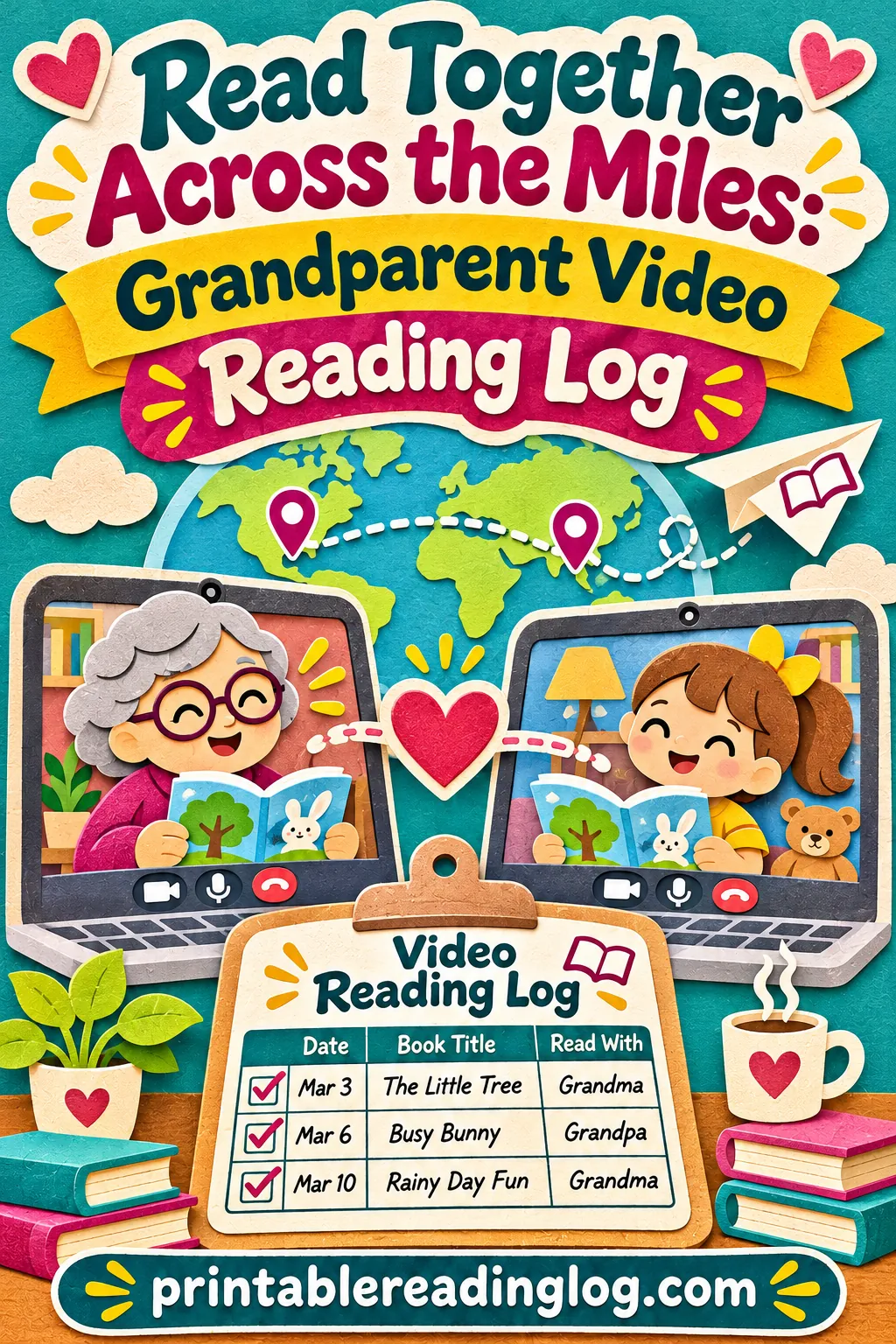
The simplest way to keep grandparent reading going over video calls is a shared printable log: after each call, write the date and the book, and let your grandchild add a sticker. Print one copy for the grandparent's house and one for the child's house, and the log turns scattered calls into a story you're building together. You can make it in a couple of minutes with the free reading log maker on our homepage.
Reading over a screen isn't the same as a lap and a lamp, but it can come surprisingly close. Kids look forward to "their" night with Grandma or Grandpa, grandparents get a real role in a child's week, and the log becomes a keepsake of every book you shared. This guide covers how to set up the log, how to make video story time work with wiggly kids and laggy connections, how to get the same book in both homes, and dozens of ideas for keeping the ritual fresh for years.
▶ Open this reading log ready to print
Why a Log Makes Long-Distance Reading Stick
Most families start video story time with lots of enthusiasm. Then a busy week happens, a call gets skipped, and before long nobody remembers which book you were in the middle of. A simple log fixes most of that.
Here's what a shared log does that a call alone can't:
- It gives the child something to hold. A paper log on the fridge is something a three-year-old can point to. "Grandpa's story night!" makes more sense when there's a row waiting to be filled.
- It remembers where you left off. Chapter books, especially, need a bookmark that lives in two houses. The log's notes column becomes that bookmark.
- It shows progress. After a month, a row of dates and stickers is proof of something you made together. Kids are proud of it, and grandparents often are too.
- It turns into a keepsake. Years from now, a stack of filled-in logs with a child's wobbly stickers and a grandparent's handwriting is a lovely thing to find in a drawer.
- It helps parents plan. One glance tells a busy parent whether this week's call has happened yet and which book needs to come along to the next one.
A log doesn't need to be fancy. Date, book and a sticker are enough for most families. Everything else is a bonus you can add if you like.
Who keeps the log?
There's no single right answer, so pick what suits your family:
| Setup | How it works | Best for |
|---|---|---|
| Child's house only | The child (or a parent) fills in a row after each call | Families with young children who love stickers |
| Grandparent's house only | Grandma or Grandpa keeps the log beside their reading chair | Grandparents who like to plan the next book |
| Both houses, matching logs | Each home has a copy and fills in the same row | Families who want a keepsake on both ends |
| Mailed back and forth | One log travels by mail each month with notes and stickers | Families who love the surprise of real mail |
The matching-logs setup is the most popular, because each side gets to see the list grow. Print two copies at the start of the month, keep one and mail the other, or have each household print its own.
How to Make the Grandparent Reading Log in the Free Tool
You'll make this log in the free printable reading log maker. The tool doesn't open pre-filled from a link, so follow these settings. It takes about two minutes.
Settings for a young child (about ages 2 to 6)
- Start with a preset: Choose Picture books. It's set up for short, quick reads, which is exactly what most video story times with little ones look like.
- Reader name: Write both names, such as "Story Time with Nana and Leo." Kids love seeing their own name next to a grandparent's.
- Reading goal: Something warm and simple, like "25 stories with Nana" or "A story every Sunday."
- Log style: Kid-friendly.
- What are you logging?: Books.
- Color theme: Let the child pick. Blush, Mint, Sky and Sunshine all look cheerful on the fridge.
- Columns: Turn on Date finished, Title, Star rating and Notes. Use the Notes column for stickers, a tiny drawing or a one-word reaction. Turn on Initials (P/T) if the grandparent would like to sign each row, which many grandparents enjoy.
- Rating style: Smiley. Young kids can circle or color a happy face for books they loved.
- Rows per page: Fewer rows means bigger rows, and bigger rows are easier for small hands to put stickers in. Pick a lower number.
- Goal-tracker bar: 10 or 25 squares. Each square is one story call. Coloring a square at the end of a call is a nice ritual on its own.
- Coloring strip: Leave it on. It gives the child something to do while waiting for the call to connect.
- Paper: Letter or A4 to match your printer, Portrait.
- Click 🖨️ Print / Save PDF.
Settings for an older child (about ages 7 to 11)
- Start with a preset: Choose Kids.
- Reader name: "Grandpa and Maya's Book Club" or similar. Older kids like a "club" name.
- Reading goal: Something like "Finish 3 chapter books together" or "50 calls by summer."
- Log style: Kid-friendly, or Adult-clean if your child feels too old for cartoon touches.
- What are you logging?: Minutes if you read long chapter books across many calls, or Books if you finish a book every call or two.
- Columns: Date finished, Title, Author, Pages/Minutes, Notes, and Recommend? (Y/N). Use Notes for "stopped at chapter 6" so both houses know where to start next time.
- Rating style: Stars or Number.
- Goal-tracker bar: 25 or 50 squares.
- "Books I want to read next": Turn this section on. It's a shared wish list both of you can add to during calls.
- Month: Fill it in if you print a new log each month.
- Click 🖨️ Print / Save PDF.
Settings for the grandparent's copy
Some grandparents like their own log, with a few changes:
- Pick the Adult-clean style and a Classic theme for a calmer look.
- Add Date started as well as Date finished, so they can see how long a chapter book took.
- Keep Notes wide. Many grandparents jot down what the child said about the story, such as a funny question or a favorite character. Those notes become treasures.
- Choose Landscape if they'd like more writing room.
If your family reads aloud a lot outside of these calls too, the read-aloud log for parents shows another layout you can use at home for bedtime stories.
Where to keep the log
Put the child's copy somewhere they'll see it every day: the fridge, a bedroom door, or clipped inside the book basket. Keep a small container of stickers right next to it, along with a pen. The grandparent's copy works best near wherever they take the call, so they can fill it in before hanging up.
Setting Up a Video Call Bedtime Story That Works
Reading on camera takes a little practice. Small changes on the grandparent's end make a big difference to how much the child can see and hear.
For the grandparent reading
- Prop up the phone or tablet. Holding a device in one hand and a book in the other is tiring and shaky. A stand, a stack of books or a sturdy box at eye level frees both hands.
- Sit facing a window or lamp, not with it behind you. Light behind you turns your face into a dark shape. Light in front makes your face and the pictures easy to see.
- Show the pictures slowly. Hold each page up to the camera for a few seconds longer than feels natural. There's often a small delay, and children need time to look.
- Tilt the book to avoid glare. Glossy pages can reflect light straight into the camera. A slight tilt usually fixes it.
- Check what the child sees. Some video apps flip your image on your own screen, so words look backward to you even though they look normal to the child. Ask once, "Can you read the cover?" and trust their answer.
- Read a little slower than usual. Connections can clip words. A slower, clearer voice carries better.
- Use reading glasses that stay put. Glancing between a screen and a page is easier with glasses that work for both distances. If that's tricky, ask the family about large-print editions.
For the family at the child's end
- Pick a cozy spot. A beanbag, the couch or bed works better than a desk. The child should feel like they're settling in for a story.
- Use the biggest screen you can. A tablet or laptop shows pictures more clearly than a phone.
- Keep the volume up and the TV off. Background noise is the number one reason kids lose the thread of a story.
- Have the log, stickers and a copy of the book nearby. More on the book in a moment.
- Stay close for little ones. A parent sitting nearby can help a toddler focus, point at pictures, and remind them to wave goodbye.
A simple story-time order
Kids like knowing what comes next. A short, predictable routine makes every call feel familiar:
- Hello and one question. "What was the best part of your day?" Keep it short so you get to the story.
- Look at the log. "This is call number 12. Let's see what we read last time."
- Read. One picture book, a chapter or two, or a few poems.
- Talk about it for a minute. One or two questions, not a quiz.
- Fill in the log together. The grandparent says the date and title, the child adds the sticker.
- Pick next time's book. Write it in the "Books I want to read next" box.
- Goodbye ritual. A special wave, a silly phrase, or the same closing line every time.
With young children, the whole call might last 10 to 15 minutes. That's plenty. A short, happy call that ends on time is better than a long one that falls apart.
Getting the Same Book in Both Homes
Kids love following along in their own copy, especially once they're starting to read. Here are the most common ways families get the book on both ends:
| Option | How it works | Pros | Things to know |
|---|---|---|---|
| Grandparent's copy only | Grandparent holds the book up to the camera | Easiest, no planning | Small print and details are hard to see |
| Matching library copies | Both households borrow the same title from their local library | Free, huge choice | Popular titles may have wait lists |
| Grandparent mails the book | Grandparent sends the book ahead, then reads from their own copy | Child keeps a gift, real mail is exciting | Plan a week or two ahead |
| Book swap by mail | Finished books travel back and forth with notes tucked inside | Builds a shared library over time | Needs a reliable routine |
| Free digital public-domain classics | Both open the same free classic on a tablet or e-reader | Instant, no cost | Many classic texts have few pictures |
| A family "story bag" | A parent buys or borrows a stack of books and shares the titles with the grandparent | Parent controls the choices | Grandparent needs the list in advance |
Picking books that work well on video
Not every book reads well over a screen. These features help:
- Big, bold pictures. Busy, detailed illustrations are hard to see on a phone.
- Repeating lines. Books with a refrain the child can join in on keep them engaged even when the sound is a bit choppy.
- Short chapters. For older kids, chapters you can finish in 10 to 20 minutes make natural stopping points.
- Funny voices. Animals, giants and grumpy characters give grandparents a chance to ham it up.
- Questions to answer. Books that invite the child to guess, count or find something on the page turn listening into a conversation.
Classic read-alouds to start with
These well-known public-domain classics are easy to find in libraries and as free digital editions, so both homes can get a copy quickly:
For little ones (about ages 2 to 5) - Mother Goose nursery rhymes - Aesop's fables, one or two short fables per call - The Tale of Peter Rabbit and other early Beatrix Potter tales - Simple folk tales such as The Three Little Pigs, The Little Red Hen and The Gingerbread Man
For early readers (about ages 5 to 8) - The Velveteen Rabbit - Rudyard Kipling's Just So Stories, one story per call - Grimm's fairy tales, chosen carefully, since some are quite dark - Hans Christian Andersen tales, such as The Ugly Duckling
For chapter-book listeners (about ages 7 to 11) - The Wonderful Wizard of Oz - Alice's Adventures in Wonderland - The Wind in the Willows - Heidi - The Secret Garden - Black Beauty
Award lists are a great source of newer books too. Many families pick from Caldecott Medal winners for picture books and Newbery Medal winners for older kids, and libraries usually display those lists. If you want help choosing by age and interest, the guide on how to choose books for your child is a good place to start.
Grandparent Read-Aloud Ideas by Age
What works with a two-year-old won't work with a ten-year-old. Use this as a quick guide, then adjust to the child in front of the camera.
| Age | Call length | What to read | What to log | Sticker idea |
|---|---|---|---|---|
| 1 to 2 | 5 to 10 minutes | Board books, nursery rhymes, songs | Date and title | One big sticker per call |
| 3 to 4 | 10 to 15 minutes | Picture books, repeating stories | Date, title, smiley | Sticker plus a smiley face |
| 5 to 6 | 15 minutes | Picture books, short fables, easy readers | Date, title, smiley, who read | Sticker for reading a page to Grandma |
| 7 to 8 | 15 to 20 minutes | Early chapter books, story collections | Date, title, chapter reached | Sticker per finished chapter |
| 9 to 11 | 20 to 30 minutes | Longer chapter books, taking turns | Date, title, pages or minutes, notes | Sticker or a star for each finished book |
| 12 and up | Varies | Shared novels, book-club style chats | Title, date started and finished, rating | A quick written review instead of stickers |
Toddlers and preschoolers
Little ones won't sit still for long, and that's fine. Keep it short, sing a bit, and let them show you their own books too. Some calls will be three minutes of story and five minutes of the toddler showing Grandpa their toy dinosaur. Log it anyway. It still counts as story time.
Try "show and tell" books, where the child holds up their favorite book and the grandparent reads it from memory or from their own copy. Picture books with animals to name, colors to point out, or sounds to make work especially well.
If your family keeps a separate list of all the picture books a child has heard, the picture book log makes a nice companion to the video call log.
Kindergarten to second grade
This is the age where children start reading themselves, which opens up a wonderful twist: the child reads to the grandparent. Even a few pages of an easy reader is a big deal. Add a column note like "Leo read 3 pages!" and celebrate it.
Split the reading. The grandparent reads the left page and the child reads the right, or the child reads every line that repeats. It builds confidence without turning the call into homework.
Third grade and up
Older kids are ready for chapter books read across many calls. This is where the log really earns its spot, because a chapter book might take six or eight calls to finish. Write the chapter or page you stopped at in the Notes column every time.
Older kids also love taking turns, choosing the next book, or even running the call themselves. A grandparent and grandchild reading the same chapter book on their own, then talking about it on a call, is a sweet bridge from read-aloud to a two-person book club. The chapter book log is handy if the child wants to track the books they're reading solo, too.
20 Ways to Keep Long-Distance Story Time Fresh
Even the best routine gets stale after a few months. Mix in one of these ideas whenever calls start to feel flat. Each one still ends the same way: a row on the log and a sticker.
- Theme months. Animal stories in one month, fairy tales the next, poems the month after that.
- Character voices night. The grandparent does every voice, as silly as possible.
- Child reads to Grandpa. Flip roles once a week, even if it's just a few pages.
- Mystery book. The grandparent mails a wrapped book with "Do not open until our call" written on it.
- Pajama party call. Both sides wear pajamas and bring a stuffed animal to listen too.
- Grandparent's childhood favorite. Read a book the grandparent loved as a kid and talk about what life was like back then.
- Parent's childhood favorite. Read a book the child's parent loved when Grandma read it to them years ago.
- Act it out. After the story, the child acts out a favorite part on camera.
- Draw the ending. Stop before the last page and ask the child to draw what they think happens. Show the drawings next call.
- Poem a day week. Short calls, one poem each, every day for a week.
- Cousin story time. Several grandchildren join the same call from different homes.
- Book and a snack. Read a story about food and eat the same simple snack on both ends.
- Rhyme hunt. The child listens for rhyming words and holds up a finger for each one.
- Counting books. Count objects on each page together.
- "Would you rather" pause. Halfway through, ask a "would you rather" question tied to the story.
- Shared wish list. Spend one call filling in the "Books I want to read next" box together.
- Library tour. The child carries the tablet to their bookshelf and picks three books to read over the coming weeks.
- Story in the yard. On a nice day, read outside on both ends and show each other the weather.
- Holiday specials. Seasonal books around birthdays and family holidays, saved just for those dates.
- Milestone celebration. When the goal-tracker bar fills up, plan a special call with a new book as a gift.
Grandparent read-aloud questions that aren't a quiz
A minute of chat after the story makes it feel shared. Pick one or two of these, not all of them:
- "Who was your favorite character? Why?"
- "What would you have done if you were in the story?"
- "Did anything surprise you?"
- "What do you think happens after the last page?"
- "Which picture would you hang on your wall?"
- "Does this remind you of anything that happened to you?"
- "Should we read this one again someday?"
Write any especially funny or thoughtful answer in the Notes column. Those little quotes are often the best part of an old log.
Sticker, Reward and Keepsake Ideas
The sticker is small, but it's the moment kids remember. A few ideas to make it special:
- A special sticker set just for Grandma calls. Keep them in an envelope marked with the grandparent's name, and use them only for story time.
- Grandparent-mailed stickers. Every month or two, the grandparent mails a new sheet of stickers to use on the log. Opening real mail is a treat for kids.
- Matching stickers. Both households use the same sticker for the same call, so the two logs look identical.
- Stamp instead of stickers. A small rubber stamp with an ink pad works just as well and never runs out.
- Colored squares. For a no-supply option, the child colors one square of the goal-tracker bar per call.
- A milestone treat. When the log is full, the grandparent sends a card, a new book, or a small handmade gift.
Turn finished logs into a keepsake
When a log page fills up, don't throw it away. Families keep them in a lot of lovely ways:
- A story-time binder. Clip each month's log into a binder with page protectors.
- A yearly scrapbook. At the end of the year, bind the logs together with photos of the calls.
- Mail the full page to the grandparent. Many grandparents keep them in a drawer or frame a favorite.
- Count the year. On the last call of the year, add up how many stories you read together and write the number on the cover of the binder.
Families who'd like to track reading from everyone in the house, not just story calls, might enjoy the family reading log, which pairs nicely with this one.
Scheduling Across Time Zones and Busy Weeks
The best schedule is the one you can actually keep. A single, fixed weekly call beats three calls that keep getting moved.
| Situation | Schedule idea |
|---|---|
| Grandparent is several hours ahead | Child's after-dinner time is the grandparent's late evening, so try weekend mornings instead |
| Grandparent is several hours behind | The grandparent's morning coffee is the child's bedtime story |
| Grandparent lives overseas | Pick one weekend slot that works for both and protect it |
| Busy school-year evenings | One short weekday call plus one longer weekend call |
| Several grandparents want a turn | Rotate nights, and give each grandparent their own column or color on the log |
| Summer and holidays | Try a daily "story week" while school is out |
Put it on the calendar. A recurring reminder on both phones helps more than anything else.
Have a backup plan. If a call can't happen, the grandparent can record a short video reading the next chapter, and the child watches it before bed. Log it as "video story" so the routine doesn't break. Keep these recordings private to the family.
Missed a week? Just start again. There's no streak to break. Add the next row with the date and keep going.
Troubleshooting video story time
| Problem | What to try |
|---|---|
| The child wanders off mid-story | Shorter books, more questions, and a parent sitting nearby |
| Pictures are blurry or dark | More light on the grandparent's side, hold the book closer, tilt to cut glare |
| Sound keeps cutting out | Move closer to the internet router, close other apps, turn off video for a minute |
| The child can't hear clearly | Turn up the volume, use the bigger device, turn off background noise |
| The grandparent struggles with the tech | Set up one simple app, write step-by-step instructions on a card, and have the family call them |
| The child says "boring" | Let them pick the book, add funny voices, or try a theme month |
| The log keeps getting lost | Tape it to the fridge and keep the stickers in a jar beside it |
| Calls keep getting canceled | Move to a time that's easier, even if it's shorter |
| Sibling interruptions | Give siblings their own turn or their own story night |
| The child is shy on camera | Start with a puppet or stuffed animal "listening" with them |
A note for grandparents new to video calls
If you've never used video calls much, that's completely normal. Ask a family member to set up the app on your device and show you how to answer a call with one tap. Practice once or twice with a grown-up before the first story night. Write the steps on an index card and keep it beside your reading chair with the log and your book. After a few calls, it'll feel easy.
Ready to start your first story night? Open the free reading log maker, choose Picture books for little ones or Kids for older children, add both your names, turn on the Notes column for stickers, and print a copy for each home.
▶ Open this reading log ready to print
Frequently Asked Questions
What do I write in a grandparent reading log?
The basics are the date, the book title and a sticker or smiley for each call. For chapter books, add the chapter or page where you stopped. Many families also add a short note with something funny the child said.
How long should a video call bedtime story be?
For toddlers and preschoolers, 10 to 15 minutes is usually plenty. Older kids reading chapter books can happily go 20 to 30 minutes. Ending a call while everyone's still enjoying it is better than stretching it too long.
What are good books for grandparent read-aloud calls?
Books with big pictures, repeating lines and short chapters work best on a screen. Public-domain classics like Aesop's fables, Beatrix Potter's early tales and The Wonderful Wizard of Oz are easy to find in both homes. Caldecott and Newbery Medal winner lists are also great places to look.
Does the child need their own copy of the book?
No, but it helps, especially once a child is learning to read. Matching library copies, a book mailed by the grandparent, or a free digital classic all work. For toddlers, the grandparent's copy held up to the camera is usually enough.
Can this log work for long-distance reading with older kids?
Yes. Older kids can use the Kids preset with Minutes or Books, add the Author and Notes columns, and track chapter books across many calls. Some grandparents and older grandchildren turn it into a two-person book club.
How can grandparents who aren't comfortable with tech join in?
Keep it to one simple video app and have a family member set it up. Write short step-by-step instructions on a card. A phone or tablet on a stand means the grandparent only has to answer the call and read.
What if we miss a few calls?
That's fine. There's no streak to lose. Just add the next row with the new date and pick up where you left off. The log is a record of good times, not a test.
Should both homes keep a log?
Many families like matching logs, one for each house, so both sides see the list grow. If that's too much, keep one log at the child's house and mail it to the grandparent when it's full.