Christmas Read-Aloud Tradition Log: Keep Track of Every Book by Year
The simplest way to remember every holiday book your family reads together is one sheet that lives in the box with the stockings: a row per book, with the year, who listened, a star rating, whether it comes back next December, and the line everyone kept repeating. Each year you unpack it with the ornaments, add this season's rows, and the tradition quietly writes its own history.
Think of it less as a reading log and more as a guest book for your family's December. Nobody writes summaries or counts minutes. A family that reads eight holiday books a year fills one page in about three years; a family that reads twenty-four fills a page every season. Either way, next November you can glance at one sheet and answer three questions in a minute: what did we read, what did we love, and what is coming back?
📚 Printable Reading Log: make this log in 10 seconds
Set the name and goal, preview it, then print it free.
Free printables for this page
Ready-made, one-page PDFs from Printable Reading Log. Print as is, or change the columns in the maker above. See all free printable reading logs.
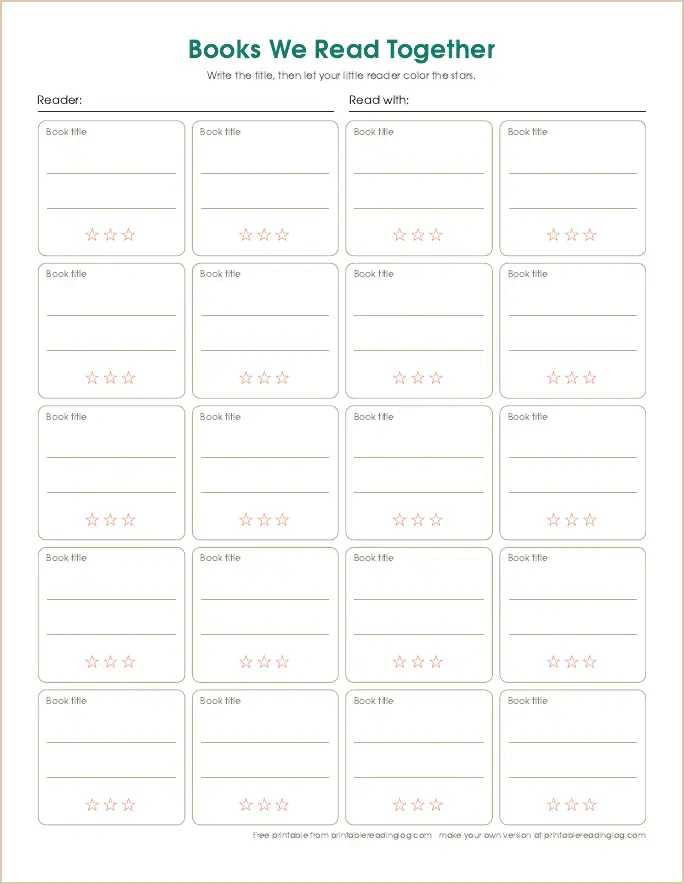
Picture Book Log
Twenty boxes for read-aloud picture books, each with a title line and three stars for little ones to color.
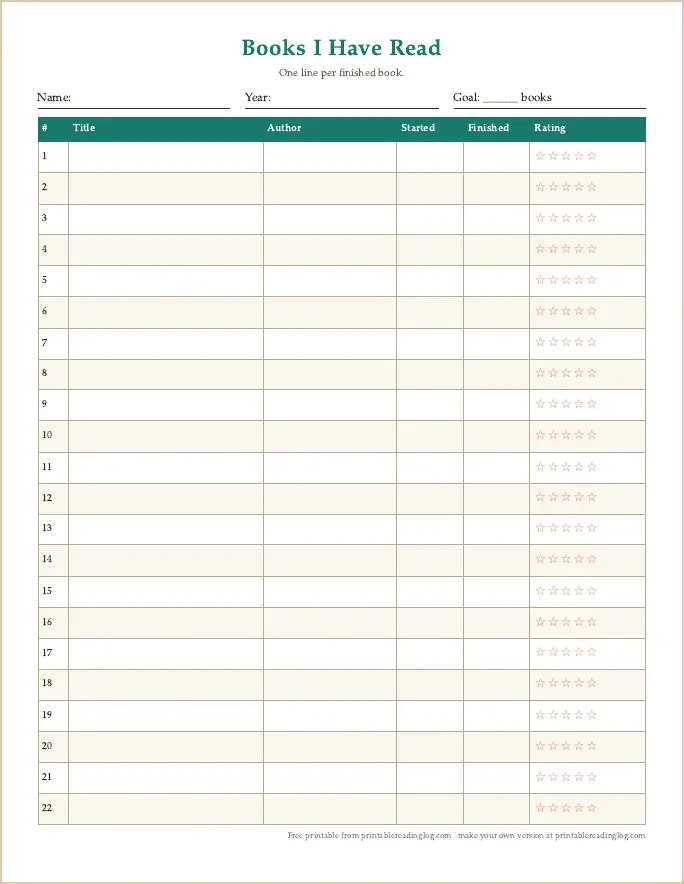
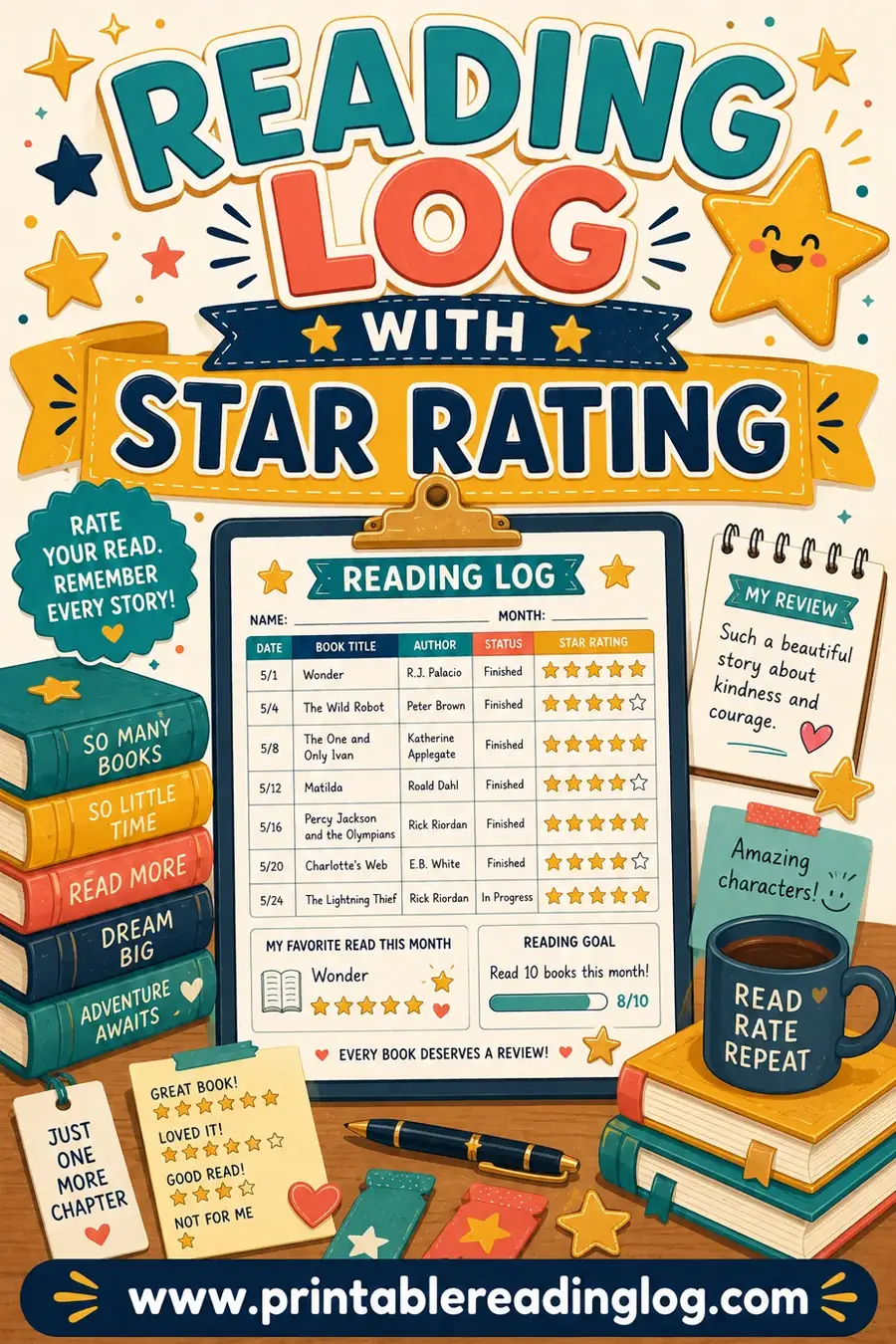
Book Log (books read)
A clean list of every book you finish: title, author, dates started and finished, and a five-star rating.
The December books nobody remembers by the following November
Nobody plans to forget their holiday books. It happens because those books only come out for a few weeks a year. In December you read a stack of picture books, a chapter book or two, maybe the Christmas story from Luke. Everyone has a favorite. Then the books go back in a bin or back to the library, eleven months pass, and nobody can say which ones the kids begged for and which ones they wandered away from halfway through.
That gap causes small, familiar problems. You borrow the library book that bored everyone last year because its cover looks charming again. The book your youngest asked for every single night never gets requested, because the youngest doesn't remember it either. One sibling insists a book was the best ever while the other calls it "for babies," and there's nothing written down to settle it. Grandparents who would love to give a holiday book are left guessing. And ten years from now, you'll want to know which book your teenager adored at four, which is exactly the kind of detail memory loses first.
A tradition log fixes all of that with about thirty seconds of writing a night. It is not a daily tracker and it has no goal. Plenty of rows can stay half filled. Its only job is to carry this December's opinions into the next one.
Seven boxes per book, and how to relabel them
Keep each row short enough to fill in during the last sleepy minutes of bedtime. Five to seven details are plenty; more than that and the log stops getting filled by the second week of December.
| Detail | Why it earns a box | Column on the sheet |
|---|---|---|
| Year | Shows which December, and spaces out repeats | Date (write 2026) |
| Title | Find it again on the shelf or at the library | Title |
| Author | Spot authors your family likes | Author |
| How it went over | Separates favorites from flops | Star rating |
| Bring it back? | The single most useful planning answer | Recommend (circle Y or N) |
| Who listened | Which kids were there, and who chose | Initials |
| Favorite line or moment | The keepsake part | Notes |
The reading log maker uses a fixed set of column headings, so you relabel a few in your head. Date holds the year. The recommend column, which prints a Y and an N in every row, becomes "bring it back next year?" Initials records who listened. Notes is roomy enough for a short quote. Pencil a one-line key across the top margin so everyone in the house reads the sheet the same way.
The initials box is narrow, so agree on a shorthand. First initials for each listener (M, J, A), ALL when the whole family was on the couch, G for a grandparent who read or listened, and a small star beside the initial of whoever chose the book. In the notes box, LIB marks a library copy and OURS a book on your own shelf. A finished row might read: 2026 | title | author | five stars | Y | ALL, M* | "Dad did the grumpy voice" OURS. That row takes fifteen seconds tonight and will make you smile in 2036.
The favorite-line column, which matters more than the stars
If you add only one thing beyond the title, make it the favorite line. Children often remember a single phrase from a book long after the plot has gone, and they repeat it at odd moments all year. Write it down the night they say it. If nobody has a line, record a moment instead: "Baby clapped at the bells page," "Read it by flashlight when the power went out," "First year J read a page out loud."
Those notes are what turn a list into a keepsake. A decade from now, whether a book got four stars or five will matter much less than the scrap of conversation in the last column. Preschoolers are especially good for this. Ask one question after the book, such as "What was your favorite picture?", and write their answer word for word. Their exact phrasing, odd grammar and all, is the part you'll treasure.
Printing a landscape sheet with 24 rows
In the maker, start from the Adult Yearly preset, which gives a clean, compact layout meant for a long list of books. Type a heading such as "Our Christmas Books by Year" or "The Garcia Family Christmas Books" in the reader name box, and use the goal line for a motto, perhaps "Every holiday read-aloud, year after year" or "One more chapter, please." Keep the adult style so the rows stay slim and the page looks like a keepsake rather than a worksheet, and keep the log counting books, one row each.
Turn on date, title, author, star rating, recommend, initials and notes, and turn off pages/minutes and genre. Stars suit a family with small children, since coloring them in is half the fun; the number rating works better for older kids who enjoy arguing over a three versus a four. With seven columns, choose landscape on Letter or A4 so the notes box can hold a full sentence, and slide the rows to 24, the maximum, so one sheet covers several Decembers. Leave the goal tracker off, because this isn't a goal, and switch on the read-next list at the bottom, which becomes your "try next year" wish list. Mint or Blush look festive without much ink; Classic is kindest to the cartridge if you print several copies.
The maker remembers your settings in that browser, so the same layout is often waiting next December. Save the PDF even if you print a paper copy, because when the page fills up in a few years you'll want a blank that matches exactly.
One family sheet or a page for each child
Most families do best with a single shared sheet. It is the family's tradition, and one page is far easier to keep track of than four. A separate page per child makes sense in a few situations: children far apart in age, where a teenager is reading a holiday novel while the preschooler is on picture books; children who split December between two homes and carry a log back and forth; or a child who simply loves keeping records and would treasure a page with their own name on it.
For a child's own page, switch the maker to the kid style, pick the Sunshine theme and add the coloring strip. Rows get taller, stars get bigger, and there's a strip of pictures to color as books are finished. Toddlers won't write a row, but they can color the stars; let them pick a crayon for each rating and press hard. The toddler reading log page has more on keeping very young listeners involved.
After two or three seasons you'll notice certain books get five stars every time. Print a second, shorter sheet with only title, author and notes, call it "Our Forever Christmas Books," and copy the all-time favorites onto it. That's the list you'll hand to your children when they have children of their own.
A routine from late November to early January
The log works because it becomes part of December rather than one more chore. This rhythm fits around a busy month:
| When | What happens | Time |
|---|---|---|
| Late November | Unpack the log, read last year's rows together, circle every Y | 10 minutes |
| Late November | List this year's books: the Y titles plus two or three from the wish list | 10 minutes |
| Early December | Place library holds; holiday books go fast | 15 minutes |
| Each reading night | Fill one row right after the last page | 30 seconds |
| Weekends | Catch up any rows skipped on busy nights | 5 minutes |
| Christmas Eve | Read the special book, then read the year's rows aloud | 10 minutes |
| Early January | Add new wish-list titles, photograph the page, pack it away | 5 minutes |
The late-November look back is the best part. Sit down with the kids, read last year's rows, and let them react. "Oh, I forgot about that one!" is exactly what you're hoping to hear. Circle the returning favorites, choose a few new titles from the wish list, and you have the season planned before December 1. Families who like a wrapped book every night can pair this with the Christmas book countdown list, and those who also follow daily Scripture readings may enjoy the Advent reading plan.
Keep the log and a pen in the same basket as the holiday books. Fill the row immediately after the last page, because by morning the favorite line will be gone. On nights when everyone is drooping, write just the year and title and finish the stars on Saturday. Many families save one special book for Christmas Eve; after it, read the whole season's rows aloud, favorite lines included. Some add a final note that night: "Best book this year: ___."
Deciding which books return and which take a rest
After two or three years you'll own or know more holiday books than there are nights in December. The recommend column, together with the year in the date box, lets you choose without guessing and keeps beloved books from wearing thin.
A rest rule helps. Any book that isn't an all-time favorite sits out for a few years before returning, and three years is easy to check because the year is right there in the first column. Treat it as a suggestion, though. If your six-year-old asks for the same book every December, that book has earned its place, and traditions are allowed to repeat.
| Group | Rule | How it looks on the log |
|---|---|---|
| Forever favorites | Every year | Five stars and Y, two or more years running |
| Good books | Rest a couple of years | Three or four stars and Y |
| Outgrown | Pass along or donate | Y in the past, but the youngest is now too old |
| Flops | Skip unless asked | N, or one or two stars |
| New this year | Try two to four | From the wish list |
Say your family reads about fifteen holiday books each December and the log now holds forty rows from three seasons. Five forever favorites come back automatically. Four good books last read in 2023 return from their rest. Two good books read in 2025 stay on the shelf until about 2028. Four new titles come from the wish list or the library. That's thirteen planned, with room for two surprises, like a gift that arrives mid-month or a book a child brings home from school.
Sometimes a favorite gets a lukewarm reaction, and the log shows it plainly: three years of five stars, then two. Before retiring it, hand it to a new reader, such as an older child reading to a younger one. Give it one year off. Read it somewhere different, by the tree with the lights off and a flashlight, or on a video call with a grandparent. Or ask a different question afterward: "Which page would you hang on the wall?" draws a different answer than "Did you like it?" If the stars stay low after all that, mark it "outgrown" in the notes and pass it to a younger cousin.
Mixing picture books, chapter books and Christmas Eve classics
The log doesn't care what you read, but a varied mix makes a richer tradition. Short picture books, five to ten minutes aloud, suit little ones and hectic weeknights. Longer picture books fill a cozy weekend evening. A chapter book read a chapter a night gives children six and older a story that lasts the whole month. Classic poems make a short Christmas Eve ritual, families of faith often read the nativity account on Christmas Eve or morning, and winter books about snow and animals stretch comfortably into January. Times vary widely with the reader and how many questions get asked along the way.
A few public-domain classics have been read aloud at Christmas for generations, such as the 1823 poem about the night before Christmas and the nineteenth-century novella about a miser who changes on Christmas Eve. Older stories like these make good anchor books, the ones that return every year while the rest of the list rotates. For a list sorted by age, the page of Christmas read-alouds for kindergarten is a handy starting point, and the grown-ups in the house might like the Christmas books for adults list for their own evenings.
A chapter book read over many nights takes one row in the tradition log, not one per night. Write the year and title when you start, then add stars and the favorite line when you finish. If you'd like to track it night by night, use a separate sheet; the Christmas chapter book read-aloud plan spaces a novel across December, and the read-aloud log for parents covers everyday tracking. Library copies are in heavy demand in December, so the LIB note tells you next year to place holds early; the page on tracking library due dates helps when a dozen holiday books are out at once.
Toddlers, teens, cousins and grandparents on one page
A family with a four-year-old and a ten-year-old can share one log if the books take turns: a short picture book one night, a chapter of something longer the next, with each child adding a star beside their initial when it was their pick. Many children between eight and eleven love being put in charge of a record, so consider handing the pen to the older child. It becomes their job, and their handwriting becomes part of the keepsake. If a preschooler wants the same book four nights in a row, log it once and add "asked for it four nights running."
Teenagers may not want a nightly read-aloud, but many still enjoy the one or two traditions they grew up with. Invite them only to the forever favorites and the Christmas Eve book, ask them to read one book to a younger sibling, or request a one-word review for the notes column; teens often enjoy playing the harsh critic. Don't push. A teen who skips a year often comes back, and seeing their own childhood initials on the page is a strong pull.
When cousins visit, a row reading "ALL + cousins K, B, T" is a lovely record of a crowded living room; if there are too many names, write ALL and list them in notes. Grandparents can join by video, read from their own home, or share a favorite from your own childhood. Write G in the initials box and "Grandma read it over video" in notes. The grandparent video reading log has a fuller setup for long-distance read-alouds. When children split December between two households, keep one log at each home and combine the favorites in January, or print two copies from the same saved PDF so both houses use matching sheets.
Storing the log so it survives ten Decembers
A tradition log only helps if you can find it next year. The best home is the holiday decorations box itself, slipped into a sheet protector or a large zip bag, because it comes out the same day as the stockings. Taping it inside the lid of the holiday book bin works too, and some families keep a three-ring binder of traditions where the log sits beside the cookie recipes and the ornament list.
Photograph the filled page each January and keep the picture in a folder with the blank PDF. If the paper copy is lost in a move, every title and every favorite line survives. When a page fills, print a new one from the saved PDF and staple it behind the first, so over time you build a thin booklet with the oldest year at the back.
| Holiday books a year | Page used each year | Pages after ten years |
|---|---|---|
| 6 | A quarter | About 3 |
| 12 | Half | 5 |
| 18 | Three quarters | About 8 |
| 24 | A full page | 10 |
Ten pages is a slim stack holding a decade of December. Small touches make it feel special: heavier paper for the first page, a tiny dated drawing in the margin from each child, a photo of everyone reading taped to the back, and a short line at the bottom of each season such as "The year we got snowed in" or "First Christmas in the new house."
Snags that show up after a few seasons
If rows stop getting filled by mid-December, the log is probably stored away from the books; move it into the basket. If nobody remembers who liked what, the ratings were skipped on tired nights, so fill stars on the weekend while memories are fresh. When kids argue over one family rating, let each child color a star next to their own initial, or switch to number ratings and average them. A cramped notes box usually means portrait layout with many columns; switch to landscape or drop the author column. A child who refuses to listen on a given night is usually tired or facing a book that's too long, so swap in a poem and log that instead.
Some Decembers simply fall apart. A move, a new baby, an illness or a hard season can mean three books instead of fifteen, or none. Write the year anyway with a note like "A quiet year. We'll be back," and pick up again next season. The log is a record, not a scoreboard, and a quiet year belongs in your family's story too.
Around eight to twelve, some children decide read-alouds are for little kids. Giving them a role often helps: reader, log keeper, or the one who chooses the Christmas Eve book. Let them pick a longer book closer to their age, read the old log together so they can laugh at their younger self's opinions, and let them skip some nights without a fuss. The family reading log page has more ideas for keeping shared reading feel like a treat, and the star rating log page offers different star keys if ratings are your kids' favorite part.
What families ask about keeping a holiday read-aloud log
How many holiday books should we aim for each December?
There's no right number. Some families read one book a night from December 1 to 24, others read a handful on weekends; pick what fits your month and let a few years of rows show you what suits your household.
Can the column headings say "year" and "favorite line"?
The maker uses fixed headings, so you can't type custom ones. Use date for the year, notes for the favorite line, initials for who listened and the recommend column for "bring it back," and pencil a short key along the top.
Do we log a chapter book once or every night we read it?
Once, with one rating and one favorite line. If you want night-by-night progress, keep that on a separate sheet so the tradition page stays easy to scan next November.
Does the sheet keep what we write?
The maker saves your layout, meaning heading, columns, theme and paper size, in that browser. The rows themselves are handwritten on paper, which is why a January photo and a saved blank PDF are worth keeping.
Where should the log live between Christmases?
In the decorations box, protected in a sheet sleeve, so it surfaces exactly when the stockings do. A binder of family traditions or the lid of the holiday book bin also works well.
What if we skip a whole year?
Write the year and a short note, such as "Quiet year, back next time," and carry on the following December. Many families find that seeing the gap on the page makes them keener to begin again.