Christmas Chapter Book Read-Aloud: How Many Pages a Night to Finish by the 24th
To finish a Christmas chapter book read-aloud by the 24th, divide the story's pages by the nights you can really read (not all 24), round up, and recheck the math every few days: pages left divided by nights left. A 240-page book over 20 real reading nights comes to 12 pages a night, and a simple log on the fridge shows you the evening you start slipping.
Our reading log maker builds that log quickly. With the By pages preset and 24 rows you get one line per December night, a Pages column, a spot for who listened, and a 25-square goal grid to color as you go. The sections below walk through the page math with worked examples, books that have exactly 24 chapters, counting your real nights on the calendar, the settings to use, and what to do the morning after you miss two nights in a row.
📚 Printable Reading Log: make this log in 10 seconds
Set the name and goal, preview it, then print it free.
Free printables for this page
Ready-made, one-page PDFs from Printable Reading Log. Print as is, or change the columns in the maker above. See all free printable reading logs.
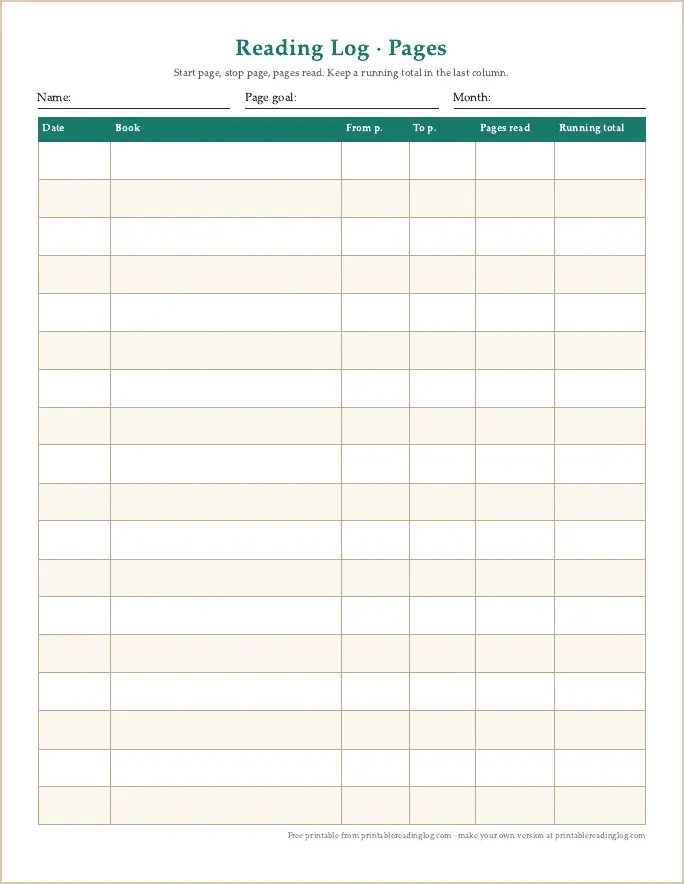
Reading Log by Pages
Log the page you started and stopped on each day; the sheet adds up pages read and a running total.
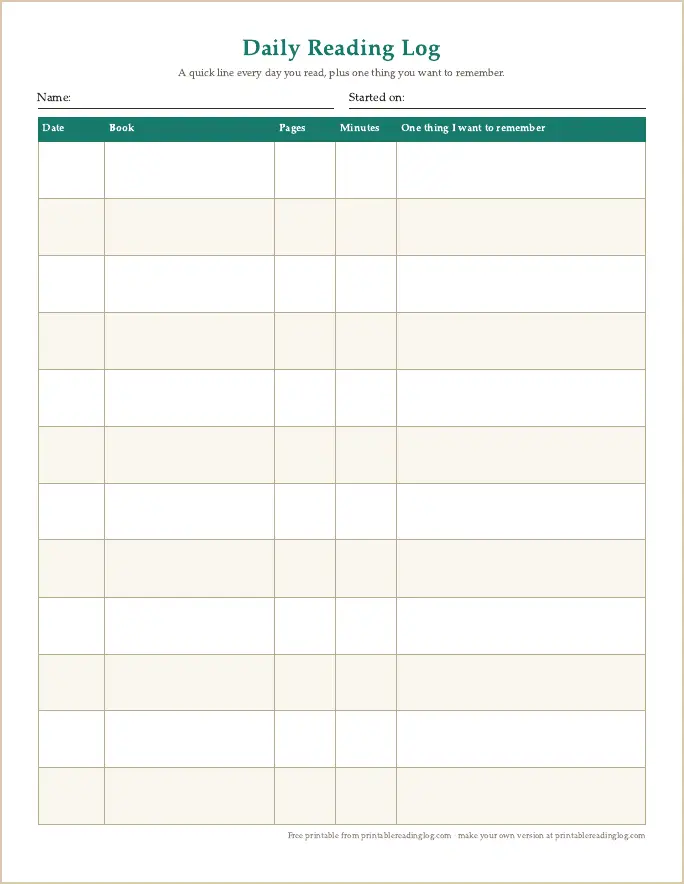
Daily Reading Log
Taller rows with room for a one-line note: date, book, pages, minutes and what happened in the reading.
The second week of December, when read-alouds stall
You start strong. The book is cozy, the tree lights are on, and everyone is under one blanket. Then the second week arrives with a concert, two parties, a late practice and a night when the whole family falls asleep on the couch. By the 18th you're barely halfway, wondering whether to read for an hour a night or quietly give up.
The reasons are predictable. Most plans assume all 24 nights, and almost no family gets them, because busy evenings were never in the math. "A chapter a night" sounds even, but one chapter can be 6 pages and the next 22. Without a log, falling behind is invisible until it's too late to fix calmly, and with no catch-up plan the missing pages simply pile up at the end. Sometimes the book itself is the issue: a 400-page novel is a lovely goal, but it may need more than one month.
Every one of those can be handled before you read page one. Pick a book that fits the month, plan with your real calendar, and write down the stopping page each night so you always know where you stand.
Dividing the book by the nights you'll really read
There is one formula: pages a night = total pages ÷ reading nights, rounded up.
What matters is dividing by reading nights rather than calendar days. Count only the evenings you can actually sit down with the book. If you aren't sure, assume you'll lose about one night in five to the season and plan on 20 nights instead of 24.
For "total pages," use the page where the story ends, not the last printed page. Skip the author's note, acknowledgments and any preview chapter at the back, and subtract front pages too. A book that runs from page 9 to page 236 has 228 pages to read.
Three books, three starting dates
Take a 240-page book started on December 1. There are 24 calendar nights to the 24th, and you already know about four busy ones: a concert, a party, a travel day and a late practice. That leaves 20 reading nights, and 240 ÷ 20 gives 12 pages. Had you planned on all 24, you'd have set 10 pages a night, and those four lost evenings would have left you 40 pages short on Christmas Eve.
Now a 160-page book started December 8. That's 17 calendar nights, minus three busy ones, so 14 reading nights. 160 ÷ 14 is 11.4, which rounds up to 12 pages. At 12 a night you'll reach page 156 after 13 nights, so the 14th night is only 4 pages. That short last night is your slack if something comes up.
Finally, a 300-page book started tomorrow, November 29. There are 26 calendar nights to Christmas Eve; take away five busy ones and you have 21. 300 ÷ 21 is 14.3, rounded up to 15 pages. If 15 pages sounds like a lot for your family, a shorter book will make December much calmer.
| Story pages | 24 nights | 20 nights | 16 nights | 12 nights |
|---|---|---|---|---|
| 96 | 4 | 5 | 6 | 8 |
| 120 | 5 | 6 | 8 | 10 |
| 160 | 7 | 8 | 10 | 14 |
| 200 | 9 | 10 | 13 | 17 |
| 240 | 10 | 12 | 15 | 20 |
| 300 | 13 | 15 | 19 | 25 |
| 360 | 15 | 18 | 23 | 30 |
Every number is rounded up. Find the book's length on the left and your honest count of reading nights across the top.
Turning pages into minutes
Pages and minutes don't line up the same way in every book. Big print with pictures goes quickly; a dense page of small type takes much longer. Time yourself on the first night: note the clock, read the planned pages, and look again. If 12 pages took 25 minutes and that's longer than your kids can sit still, you know right away to start earlier or choose something shorter.
Reading aloud also slows down in December. There's more stopping to talk, more questions about what a word means, and more yawning. That's part of what makes it worth doing, so leave room for it in the plan instead of racing through.
Books written in 24 chapters
Some holiday chapter books come with 24 short chapters, one for each day from December 1 to Christmas Eve. If you've chosen one, the plan is built in: one chapter a night.
It's still worth a few minutes of planning, because a chapter-a-day book runs into the same busy evenings, and missing three in a row can feel like a lot to make up. Flip through first and pencil each chapter's page count onto your log so you can see which nights are long. If you know the 9th is concert night, decide now to read chapters 9 and 10 together on the 10th, or read chapter 9 over breakfast that morning. A Saturday afternoon is an easy place to read two or three chapters if you've slipped. And if chapter 24 ends up on Christmas Day, you've still had a happy ending.
When the chapters refuse to divide evenly
Plenty of books have 14 or 19 chapters of all different lengths. For those, plan by pages and use chapter breaks as stopping points: look at where your page target falls each night and stop at the nearest chapter end, whether it comes a little before or a little after.
| Night | Page target | Nearest chapter end | What you read |
|---|---|---|---|
| 1 | Page 12 | Chapter 1 ends on page 14 | Chapter 1 (14 pages) |
| 2 | Page 24 | Chapter 2 ends on page 22 | Chapter 2 (8 pages) |
| 3 | Page 36 | Chapter 3 ends on page 39 | Chapter 3 (17 pages) |
| 4 | Page 48 | Chapter 4 ends on page 47 | Chapter 4 (8 pages) |
You'll be a few pages ahead some nights and behind on others, and it evens out because you always write down the page where you actually stopped. Our chapter book log page has more on tracking longer books chapter by chapter.
Five minutes with the family calendar before December 1
This short sit-down saves the whole plan. Open the calendar and look at every evening from your start date to the 24th, sorting each into one of three kinds.
Most will be reading nights, ordinary evenings at home. Some are skip nights you already know about: late concerts, parties, travel days, overnight guests, a parent working late. A few are make-up nights, usually weekends or the first days of winter break, when you could read longer if you needed to. Read the target pages on reading nights, nothing on skip nights, and use make-up nights only if you fall behind. If you never need them, they turn into slow, extra-cozy evenings.
One family's December 2026
This year December 1 is a Tuesday and Christmas Eve is a Thursday. Here's a sample calendar with school ending Friday, December 18; swap in your own events.
| Dates | Plan | Notes |
|---|---|---|
| Dec 1 to 4 (Tue to Fri) | 4 reading nights | First week, normal routine |
| Dec 5 to 6 (Sat, Sun) | 1 reading, 1 make-up | Saturday is a family event |
| Dec 7 to 11 (Mon to Fri) | 3 reading, 2 skip | School concert Wed, late practice Thu |
| Dec 12 to 13 (Sat, Sun) | 1 reading, 1 make-up | Sunday is quiet |
| Dec 14 to 18 (Mon to Fri) | 4 reading, 1 skip | Class party Thu |
| Dec 19 to 20 (Sat, Sun) | 2 reading nights | First weekend of break |
| Dec 21 to 23 (Mon to Wed) | 2 reading, 1 skip | Travel or guests on the 23rd |
| Dec 24 (Thu) | Final night | Read the last pages together |
Add it up and you get 17 regular reading nights, 4 skip nights, 2 make-up nights and Christmas Eve. Treat the make-up nights as backups, count Christmas Eve, and that's 18 planned nights. For a 216-page book, 216 ÷ 18 is 12 pages a night, with two spare evenings in your pocket.
Setting up a one-page December log
A plan in your head is easy to lose. A plan taped to the fridge is not. The maker builds a single December sheet that shows every night, the page you reached and who was listening, and it remembers your setup in that browser for next year.
Choose the By pages preset, which turns on the Pages column you'll track progress with. In the name line, type something like "Our December Read-Aloud," which becomes the heading, and put your number in the goal line: "Finish by Dec 24: 12 pages a night." The kid style suits a family whose children will help fill it in; the adult style has slimmer rows that fit 24 nights neatly on one page. Sky gives a wintry look and Mint is softer.
For columns, keep date, title, pages/minutes, initials and notes, and switch author off since it's the same book every night. Leave a rating on if your kids enjoy scoring each night's chapter. Set the rows to 24, one per night from the 1st to the 24th, or match your own count if you start later. Turn on the goal grid at 25 squares, cross out the one you won't need (or more, if you planned fewer nights), then print on Letter or A4 in portrait.
| Column | What to write each night |
|---|---|
| Date | The date, such as 12/3, or "skip" on a planned skip night |
| Title | The chapter number and name, or "Ch. 5 to 6" for a double night |
| Pages | The page you stopped on, such as "p. 48" |
| Initials | Who listened tonight, or who did the reading |
| Notes | A word about the chapter, a make-up note, or a cliffhanger to remember |
| Goal squares | One square colored for each night you read |
Writing the page you stopped on, rather than how many pages you read, makes catch-up math far easier. One glance at the last filled row tells you exactly where you are.
Penciling in the targets ahead of time
Before the first night, lightly pencil the target page into each row: 12, 24, 36 and so on, with "skip" beside the planned skip nights. Each evening, write the real stopping page beside the target. Comparing the two takes a second, and you'll never have to guess if the family is ahead or behind. If the kid-style rows spill onto a second sheet at 24 rows, switch to the adult style. The read-aloud log for parents has other layouts if you'd like to track several books at once.
Picking a book that fits the month
The right book makes the plan easy. The wrong one, usually too long or too advanced for the youngest listener, makes it hard however carefully you plan. Read the table above backward: decide how many pages a night feels comfortable, then multiply by your real reading nights.
As rough starting points, young listeners of about 4 to 6 tend to manage 5 to 8 pages a night, so roughly 100 to 160 pages over 20 nights. A mixed group of about 5 to 10 can usually take 8 to 12 pages, which suits a book of 160 to 240 pages. Older kids of about 8 to 12 often enjoy 12 to 18 pages, enough for 240 to 360. These aren't rules. Some 5-year-olds will listen happily for half an hour and some 10-year-olds drift off after ten minutes, and you know your own children.
Short chapters help more than anything, because they give natural stopping points and make "just one more" easy on a good night. Cliffhangers are the best possible reason to come back tomorrow. Look for something that works for every age at the table, which usually means humor, animals, adventure or family stories, and a few illustrations if little ones are listening. A snowy setting or a family getting ready for the holidays feels right in December, though any book you love will do. And choose something the grown-up reading it is looking forward to, since you'll be living with it for weeks. If you're still choosing, our Christmas book countdown list and the picks for kindergarten-age listeners are good places to browse.
Older classics with long chapters
Many families like a classic for the holidays. Older books can have long chapters, old-fashioned words and slow openings. They're still worth it, but plan for the extra length: read the first chapter yourself before December, and if it takes more than 20 minutes aloud, start earlier or split the longest chapters across two nights.
The same ten minutes every evening
A read-aloud lasts longest when it happens at the same point in the evening, every evening, so nobody has to remember it. Right after dinner, after baths, or just before lights out all work. When the moment comes, check the log for tonight's target, then ask the kids what happened last time; a one-sentence recap helps everyone settle back into the story. Read to the nearest chapter break after the target, jot down the stopping page, who listened and a word or two about the chapter, and let a child color tonight's square. Kids tend to fight over that last job. If writing even that much feels like too much on a tired night, write the page number alone and fill in the rest tomorrow.
The moment you close the book matters as much as the reading. Stopping mid-scene, when the target page lands in the middle of something exciting, is a gift rather than a problem, and a short question keeps the story alive until tomorrow: "What do you think she'll find behind the door?" or "Who do you think sent the letter?" Write the children's guesses in the notes column in a few words. A week later, reading back "Sam thinks it's the neighbor" after the real answer arrives is one of the small pleasures of keeping the log. On nights when the kids are tired and cranky, skip the question entirely and simply say, "We'll find out tomorrow." Over the month, the notes column fills with predictions, favorite lines and the odd complaint about a character, and by Christmas Eve it reads like a small diary of the book as your family heard it. Many parents keep that sheet with the holiday decorations, since it shows at a glance which book the family shared that year and what everyone thought along the way.
A little atmosphere goes a long way. Switch off the overhead lights and read by the tree or a lamp. Save a mug of cocoa or warm milk for read-aloud time only. Let the kids build a blanket nest on the floor, and give little hands something quiet like coloring, a puzzle or play dough so they can listen without wiggling. An older child might enjoy reading one character's lines. Our page on family reading nights has more ideas along these lines, and if you'd like to make the whole thing an annual ritual, see the Christmas read-aloud tradition log.
Sharing the reading
Nobody has to read every single night. Parents can take turns, an older sibling can take a chapter, and a grandparent can read over a video call on the nights they aren't visiting; the grandparent video reading log covers how that works. Put the reader's initials in the Initials column, and by Christmas Eve the kids will enjoy counting how many people joined in.
Two missed nights and a 240-page book
At some point you'll miss a night you didn't plan to miss, maybe two. What matters is the next morning. The usual mistake is adding every missed page to the next evening. If you were reading 12 a night and lost two nights, 36 pages tomorrow sounds fair, but it turns a cozy 20 minutes into an hour that nobody enjoys. Spread the gap instead: new pages a night = pages left ÷ nights left, rounded up.
Say the book is 240 pages, planned at 12 a night. It's the morning of December 11 and you stopped last night on page 85, when the plan had you near page 96. You have 155 pages left and 14 nights from the 11th through the 24th. 155 ÷ 14 is 11.07, which rounds up to 12, so your original target still works. Planning with spare nights and a rounded-up number is what saves you here.
If you'd slipped further and stopped on page 60, you'd have 180 pages over the same 14 nights, or 12.9, rounded up to 13 a night. One extra page per evening. Write the new target in the goal line or in that day's notes and carry on.
Spending a make-up night
Make-up nights, usually weekends or the first quiet days of break, are where bigger gaps get closed. One can be a longer evening, an afternoon on the couch or a weekend morning in pajamas. Many families find a slow Saturday afternoon with something warm to drink ends up being the best read-aloud time of the month.
| Problem | What to do |
|---|---|
| Missed one night | Nothing special; the rounded-up target and spare nights cover it |
| Missed two or three nights | Recalculate pages left ÷ nights left, or use one make-up night |
| Missed a whole week | Recalculate; if the target more than doubles, add weekend daytime sessions |
| Kids lose interest | Read a shorter section, stop on a cliffhanger, ask what they think happens next |
| A chapter is very long | Split it at a scene break and finish the next night |
| Too tired to read aloud | Play an audiobook of the same book for one night and note it on the log |
| Traveling | Pack the book, or let a grandparent or cousin take a turn |
| Little sibling won't settle | Give them a quiet activity, or read them a short picture book first |
Letting the deadline slide
If you're truly far behind, change the goal. The week after Christmas is often the quietest of the whole season, and a book finished on December 28 is still a December read-aloud. Nobody is grading you, and the point was always the evenings together.
Adjusting for toddlers, only children and two homes
With toddlers or preschoolers in the room, a long chapter book can lose them. Read the youngest a short picture book first and start the chapter book once they're settled, or save the chapter book for after the little one is in bed so the older kids' plan keeps going.
With one child, the read-aloud can be more flexible. Some families read at breakfast on school days or on weekend afternoons. If your child reads some pages to you, mark that in the Initials column so they can see their share.
With a wide age range, say 4 and 11, choose something from the younger end of the middle with humor and short chapters. Let the older child read aloud sometimes, or give them a book of their own for break with a separate reading log by pages.
If the kids split December between two homes, borrow or buy a second copy or agree that the book travels with them. Write the stopping page clearly every night, and text a photo of the log to the other parent so the reading can pick up at either house.
If you want a chapter book plus a short picture book each night, make the chapter book the goal book and treat picture books as a bonus; only the chapter book needs to go on the sheet. When you're ready, print the log from the free maker, no account needed, pencil in the targets, and start on the first night you've marked.
Questions families ask in the first week of December
We haven't started and it's already December 5. Is it too late?
Not at all. Count the nights from tonight to the 24th, subtract the busy ones, and divide. Starting on the 5th with 16 real nights, a 160-page book is 10 pages a night, which is very manageable. A longer book can simply run into the week after Christmas.
Our book has 24 chapters but some are twice as long as others. Should we still do one a night?
Yes, if the long ones still fit your bedtime. Pencil each chapter's page count onto the log in advance so you can see which evenings are heavy, and put the longest chapters on weekends or quiet nights where possible.
How long should one night's reading last?
That depends on your kids' ages and attention. Time the first night to see how long your planned pages take. If it runs past what your family enjoys, start earlier in the month or switch to a shorter book rather than pushing through.
Can an audiobook stand in on busy nights?
Many families play the audiobook of the same book on hectic evenings or long drives. Mark it in the notes so you know where you are in the story. Others keep the read-aloud for live reading only, and either choice works.
Should we record pages read or the page we stopped on?
The stopping page. It makes the catch-up math instant, because pages left is just the last story page minus the number in your latest row.
Is it worth starting a long book before December?
For books of 300 pages or more, yes. Starting in late November spreads the load and keeps nightly targets under 15 pages. Books of about 100 to 200 pages fit comfortably inside December.
What if the kids want to keep going past the target?
Let them, and write the real stopping page. A night that runs ahead becomes a cushion for a later concert or party, and the next recalculation will show a smaller nightly number.