Read-Aloud Books for Kindergarteners: A Month-by-Month Guide
Five-year-olds will sit still for a surprisingly long time if the book lets them shout, giggle or join in on a repeated line, so the picture books that win kindergarten are short, funny or heartfelt, with big pictures. Start the year with Chrysanthemum by Kevin Henkes and Don't Let the Pigeon Drive the Bus! by Mo Willems, then follow the calendar: snow books in January, Love Monster in February, The Curious Garden for Earth Day and Oh, the Places You'll Go! on the last day. This guide walks through the whole school year, month by month and holiday by holiday, with a week plan for each big day.
Dates and timings for the 2026-27 school year
- Most kindergarten read-alouds take 5 to 10 minutes.
- Two or three short books a day often beat one long one.
- Groundhog Day 2027 is Tuesday, February 2.
- Lunar New Year 2027 is Saturday, February 6.
- Earth Day 2027 is Thursday, April 22.
- Mother's Day 2027 is Sunday, May 9.
📚 Printable Reading Log: make this log in 10 seconds
Set the name and goal, preview it, then print it free.
Free printables for this page
Ready-made, one-page PDFs from Printable Reading Log. Print as is, or change the columns in the maker above. See all free printable reading logs.
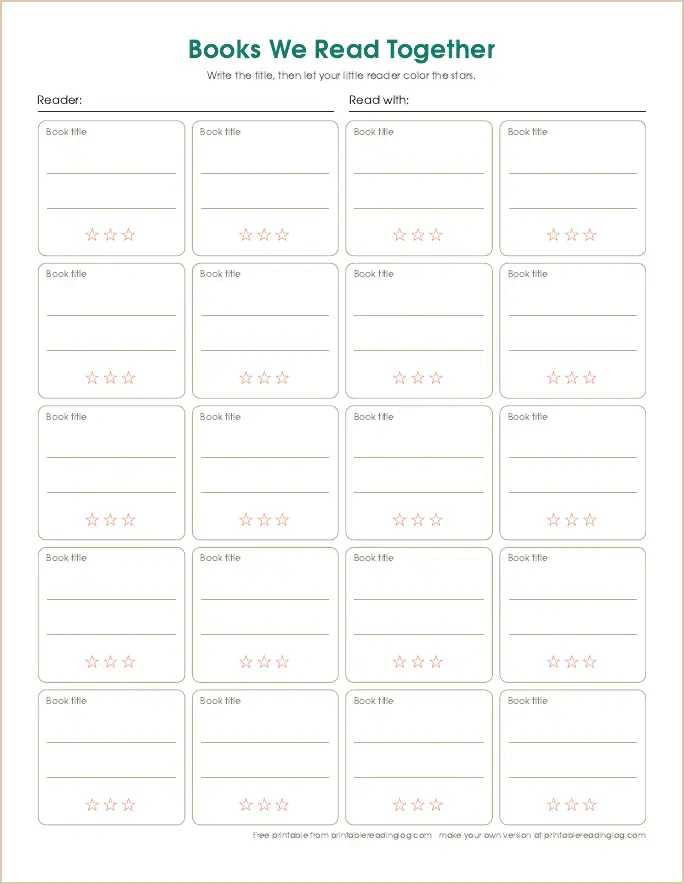
Picture Book Log
Twenty boxes for read-aloud picture books, each with a title line and three stars for little ones to color.
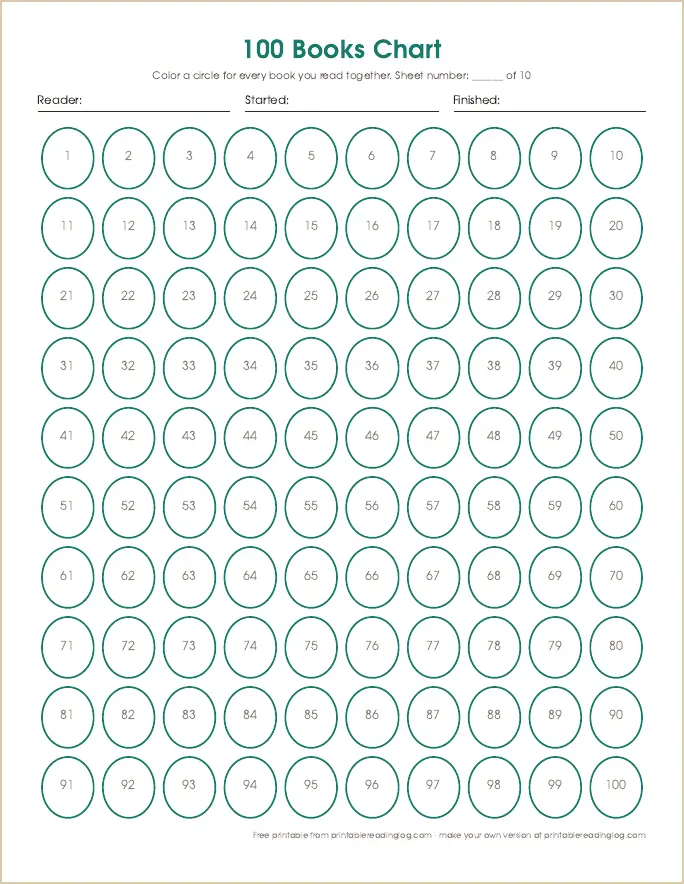
100 Books Chart
One hundred numbered circles to color, one per book; ten sheets make 1,000 books.
The rainy-day basket that works in any month
Once your log is printed, you need books to fill it. This guide follows the school year, month by month, with a short plan for each big holiday. Pick two or three books a week and reread the ones that get a big reaction. Check the next month's list about two weeks ahead so library holds arrive in time; the table below gives one dependable starter per stretch of the year if your library is thin. Before the calendar, though, keep a small basket of books that work in any month, for rainy afternoons, sub days and mornings that need a laugh.
| Month | Start with | Author |
|---|---|---|
| September | Chrysanthemum | Kevin Henkes |
| October and November | Caps for Sale | Esphyr Slobodkina |
| January | The Snowy Day | Ezra Jack Keats |
| February | Love Monster | Rachel Bright |
| March and April | The Curious Garden | Peter Brown |
| May | Are You My Mother? | P.D. Eastman |
| June | Last Day Blues | Julie Danneberg |
For laughs, nothing beats Don't Let the Pigeon Drive the Bus! by Mo Willems, where kids get to shout "No!" at a pigeon who begs and bargains. We Are in a Book! by the same author has Elephant and Piggie realizing someone is reading them. Interrupting Chicken by David Ezra Stein, Click, Clack, Moo: Cows That Type by Doreen Cronin, Dragons Love Tacos by Adam Rubin and The Book with No Pictures by B.J. Novak all earn an "Again!" Press Here by Hervé Tullet lets kids press, shake and tilt the book.
For early reading skills, choose books with rhyme and repetition. Chicka Chicka Boom Boom by Bill Martin Jr. and John Archambault teaches letter names with a rhythm kids remember. Pete the Cat: I Love My White Shoes by Eric Litwin has a song kids can "read" along with. If You Give a Mouse a Cookie by Laura Numeroff is great for cause and effect, and The Very Hungry Caterpillar by Eric Carle covers days of the week and counting.
For the classics, keep Corduroy by Don Freeman, Where the Wild Things Are by Maurice Sendak, Harold and the Purple Crayon by Crockett Johnson, Swimmy by Leo Lionni and Strega Nona by Tomie dePaola close by. Each one has been loved for generations and still reads beautifully out loud.
September and October: first weeks, feelings and friends
The first weeks of kindergarten are full of big feelings, so lead with books that name them. Chrysanthemum by Kevin Henkes is about teasing and loving your own name, and it's a must for week one. Wemberly Worried, also by Kevin Henkes, is about a mouse who worries about everything, including starting school. The Recess Queen by Alexis O'Neill shows a playground bully and a new kid who changes everything with kindness.
As the class settles in, add books about being yourself. A Bad Case of Stripes by David Shannon is about worrying too much about what others think. The Day the Crayons Quit by Drew Daywalt shows the same problem from many points of view, since each crayon writes a complaint letter. Giraffes Can't Dance by Giles Andreae and Tacky the Penguin by Helen Lester both celebrate finding your own way to shine.
October is a good time for the community and curiosity books. Last Stop on Market Street by Matt de la Peña follows a boy on a bus ride with his grandma, noticing beauty in everyday places. Officer Buckle and Gloria by Peggy Rathmann pairs safety tips with a very funny police dog. Rosie Revere, Engineer by Andrea Beaty is about trying again after a flop, and it's perfect before a building activity.
A gentle first-month routine: one feelings book on Monday, a funny book midweek, and a reread of the week's favorite on Friday. Ask one question after each book, like "How did Chrysanthemum feel when they laughed at her name?" One good question is plenty at this age.
November and December: cozy classics and the holidays
As the days get shorter, the classics shine. Caps for Sale by Esphyr Slobodkina is wonderful for acting out, with a peddler, a tree full of monkeys and a lot of copying. Make Way for Ducklings by Robert McCloskey follows a duck family looking for a safe home in Boston. Mike Mulligan and His Steam Shovel by Virginia Lee Burton shows an old steam shovel proving it can still do a big job. Stellaluna by Janell Cannon, about a baby bat raised by birds, opens up talk about families and differences.
December has its own full list. Our Christmas read-alouds for kindergarten page has 20 favorites and a 12-day plan, so this guide doesn't repeat them. If your family likes one wrapped book a night, the Christmas book countdown walks you through it, and a Christmas read-aloud tradition log keeps the titles from year to year. For the break itself, a winter break reading challenge keeps the stories going until school starts again.
January: New Year's books and snow days
The first week back is the time for New Year's books. Squirrel's New Year's Resolution by Pat Miller is the go-to: Squirrel doesn't know what a resolution is, asks her friends, and finds one of her own by helping. The Night Before New Year's by Natasha Wing has a family trying hard to stay awake until midnight. P. Bear's New Year's Party by Paul Owen Lewis is a counting book where more guests arrive as the clock strikes each hour. Chicken Soup with Rice by Maurice Sendak has a short poem for every month, so read January's poem on day one.
Fresh-start books fit all month. The Dot by Peter H. Reynolds, The Most Magnificent Thing by Ashley Spires and Jabari Jumps by Gaia Cornwall are about trying, failing and trying again, which is what a good resolution is all about.
Then come the snow books. The Snowy Day by Ezra Jack Keats, White Snow, Bright Snow by Alvin Tresselt and Snowflake Bentley by Jacqueline Briggs Martin are all Caldecott Medal winners, and Owl Moon is one too. For a room of five-year-olds, though, the best-loved snow picks tend to be The Mitten by Jan Brett, Snowmen at Night by Caralyn Buehner and Stranger in the Woods by Carl R. Sams II and Jean Stoick.
A snow-day plan
On a real snow day, read The Snowy Day in the morning after you look out the window. Go outside, then read Owl Moon by the window. In the afternoon, draw animal tracks you spotted outside. Finish with cocoa, a blanket and The Mitten. Act it out with a big mitten and a pile of stuffed animals and you have a whole day.
Early February: Groundhog Day and Lunar New Year
February is the busiest read-aloud month of the year, so plan it in two halves. Groundhog Day 2027 is Tuesday, February 2. For kindergarten, Groundhug Day by Anne Marie Pace, about a groundhog who is afraid of his shadow, and Groundhog's Runaway Shadow by David Biedrzycki are the best fits. Gregory's Shadow by Don Freeman is a gentle classic, and Groundhog Day! by Gail Gibbons gives clear, simple facts. Substitute Groundhog by Pat Miller is a funny one for the end of the week.
Keep the legend light. You can say, "People say if the groundhog sees its shadow, we get six more weeks of winter. It's a fun tradition, not real weather science."
Lunar New Year 2027 falls on Saturday, February 6, and begins the Year of the Goat. Families with roots in China, Korea, Vietnam and many other places celebrate, and traditions differ from family to family. For kindergarten, start with Bringing In the New Year by Grace Lin, where a family sweeps, decorates and makes dumplings, and Ruby's Chinese New Year by Vickie Lee. The Great Race by Dawn Casey tells how the zodiac animals got their order, and it's great to act out with twelve kids as animals.
| Day | Read | Quick activity |
|---|---|---|
| Mon, Feb 1 | The Great Race | Act out the race |
| Tue, Feb 2 | Groundhug Day | Check the class prediction |
| Wed, Feb 3 | Gregory's Shadow | Flashlight shadow puppets |
| Thu, Feb 4 | Bringing In the New Year | Paper lanterns from red paper |
| Fri, Feb 5 | Ruby's Chinese New Year | Find the Goat for 2027 |
Mid-February: Valentine's Day, Presidents Day and Black History Month
Valentine's Day 2027 is a Sunday, so most classes will celebrate on Friday, February 12. Keep the books about friendship and kindness. Love Monster by Rachel Bright, about a monster looking for someone to love him, and The Day It Rained Hearts by Felicia Bond, where Cornelia Augusta turns falling hearts into valentines, are the two classroom favorites. Somebody Loves You, Mr. Hatch by Eileen Spinelli shows how one kind note can change someone's day, and Pete the Cat: Valentine's Day Is Cool by Kimberly and James Dean is an easy, cheerful pick. Read before the party, not during. A story first thing settles excited kids.
Presidents Day 2027 is Monday, February 15. For five-year-olds, keep it simple and about history, not politics. Abe Lincoln's Hat by Martha Brenner tells how Lincoln carried papers in his hat, Duck for President by Doreen Cronin is a funny story about a duck who wants to be in charge, and Presidents' Day by Anne Rockwell shows a classroom learning why we have the holiday.
Black History Month books work all of February, and all year. For kindergarten, pick books with one clear hero. Ron's Big Mission by Rose Blue and Corinne J. Naden follows young Ron McNair, who later became an astronaut, as he insists on checking out library books himself. Mae Among the Stars by Roda Ahmed is about a girl who dreams of going to space. A Weed Is a Flower by Aliki is a gentle life of George Washington Carver. Testing the Ice by Sharon Robinson and Martin's Big Words by Doreen Rappaport are good next steps. Stop and ask, "How do you think they felt?" If you read a harder story, pair it with one about joy or achievement.
March and April: spring, seeds and Earth Day
Spring read-alouds are all about things that grow. Earth Day 2027 is Thursday, April 22, so the week of April 19 makes a natural Earth Week. Keep the message hopeful. Little kids don't need scary facts; they need small things they can do, like turning off the tap and planting a seed.
The Curious Garden by Peter Brown, where a boy named Liam helps a garden spread across a gray city, and The Tiny Seed by Eric Carle are the two easiest classroom favorites. Planting a Rainbow by Lois Ehlert doubles as color review, and A Seed Is Sleepy by Dianna Hutts Aston is gorgeous, gentle nonfiction. The Earth Book by Todd Parr and 10 Things I Can Do to Help My World by Melanie Walsh give kids simple green habits. Hey, Water! by Antoinette Portis sends them looking for water everywhere.
The Lorax by Dr. Seuss is the one everyone knows, but it's long for five-year-olds. Read it over two sittings. The same goes for Miss Rumphius by Barbara Cooney.
| Day | Read | Quick activity |
|---|---|---|
| Mon, Apr 19 | The Tiny Seed | Plant a bean in a clear cup |
| Tue, Apr 20 | Hey, Water! | Find five places water shows up |
| Wed, Apr 21 | The Earth Book | Draw one way to help the earth |
| Thu, Apr 22 | The Curious Garden | Plant flowers or pick up litter with gloves |
| Fri, Apr 23 | The Lorax, part two | Say one thing a tree gives us |
May: Mother's Day and the people who love us
Mother's Day 2027 is Sunday, May 9, so the week of May 3 is your reading week. It's often Teacher Appreciation Week too, so keep each book short and cozy. Are You My Mother? by P.D. Eastman and Mama, Do You Love Me? by Barbara M. Joosse are two classroom classics. Owl Babies by Martin Waddell, about three baby owls waiting for their mother to come back, is lovely for kids who feel nervous at drop-off. The Mother's Day Mice by Eve Bunting leads straight into a talk about gifts that don't cost money, like a song, a hug or a helping hand.
For giggles, try Mother Bruce by Ryan T. Higgins, about a grumpy bear who ends up raising goslings, or Is Your Mama a Llama? by Deborah Guarino. My Mom by Anthony Browne is perfect right before kids draw their own "my special grown-up" page.
Not every child has a mom at home. Say "mom or special grown-up," which takes two extra words and lets every child join in. A Mother for Choco by Keiko Kasza is a gentle adoption story, Grandma's Purse by Vanessa Brantley-Newton is great for kids being raised by grandparents, and The Hello, Goodbye Window by Norton Juster, a Caldecott Medal winner, centers on a girl's grandparents. If you know a child has lost a mom, a quiet word with the family before the week starts helps.
Late May and June: the last weeks of school
End-of-year books are about memories, growing up and what comes next. Start the countdown about ten school days out. Last Day Blues by Julie Danneberg is a funny favorite from the author of First Day Jitters. Miss Bindergarten Celebrates the Last Day of Kindergarten by Joseph Slate was made for this exact moment. The Night Before First Grade by Natasha Wing helps kids who are a little nervous about next year.
In the middle of the countdown, read The Important Book by Margaret Wise Brown and let each child finish "The important thing about me is..." Have You Filled a Bucket Today? by Carol McCloud makes a good kindness wrap-up. The Invisible String by Patrice Karst comforts kids who feel sad about leaving a teacher or friends, and Goodbye, Friend! Hello, Friend! by Cori Doerrfeld reminds them that every goodbye leads to a new hello.
Save a send-off for the very last day. Many teachers choose Oh, the Places You'll Go! by Dr. Seuss or Wherever You Go by Pat Zietlow Miller. For a kindergarten graduation, I Knew You Could! by Craig Dorfman is a sweet fit. Then hand out a summer reading log so the stories keep going, and share a few ideas from our guide on how to prevent the summer slide with families.
Birthdays: a read-aloud for any month
Birthdays happen all year, and a birthday book makes the day feel special. Happy Birthday to You! by Dr. Seuss is a silly, rhyming celebration. Happy Birthday, Moon by Frank Asch has a bear trying to throw the moon a party. For kindergarten, Happy Birthday, Dear Duck by Eve Bunting, Llama Llama Birthday Drama by Anna Dewdney and A Birthday Basket for Tia by Pat Mora are just right. Bunny Cakes by Rosemary Wells, where Max and Ruby make a cake for Grandma, pairs well with a simple baking project at home.
In class, let the birthday child pick the read-aloud for the day. At home, a lovely tradition is to read one book on each birthday and write it in a log you keep for years. You can also give a book as a gift with a short note inside about why you chose it. Years later, that list of birthday books is a sweet keepsake.
Five to ten minutes on the rug: pacing a read-aloud
Most kindergarten read-alouds take 5 to 10 minutes. Five-year-olds can usually listen to a whole picture book, especially when they get to join in. Watch the wiggles. If kids are restless, it's fine to stop and finish later, or to switch to a shorter book.
Preview the book first so you know where the funny parts and big page turns are. Use voices; they don't have to be good. Before a big page turn, pause and ask, "What do you think happens next?" Let kids join in on repeated lines and rhymes. After the last page, ask one question, like "What was your favorite part?" and leave it there.
One colored square per book, all the way to 100
A simple log turns read-aloud time into something kids can see. When you build the class sheet, choose the Kids or Picture books preset, keep the date, title and star rating columns, and switch the rating to smileys so non-writers can join in. Add a row of 25 or 50 goal squares for the helper of the day to fill in, use the month picker to label each sheet, and print one page per month. The Mint theme suits spring and Blush suits February, but any theme works.
Write a class goal at the top, like "100 books together this year," and let a different child color the square each day. At the end of each month, look back at the page together and vote for the favorite. That book goes into the reread basket for the next month.
For a ready-made setup, see our reading log for kindergarten or the picture book log. A monthly reading log fits this calendar nicely, one sheet per section of this guide. Families reading at home can use the read-aloud log for parents, and if your child is younger, the 1000 Books Before Kindergarten log is a fun long-term goal. Clip this month's book list to the back of the sheet so the next title is always within reach.
What kindergarten teachers and parents ask about read-aloud time
What are the best read-aloud books for kindergarteners?
Favorites include Chrysanthemum by Kevin Henkes, Don't Let the Pigeon Drive the Bus! by Mo Willems, Corduroy by Don Freeman, Chicka Chicka Boom Boom by Bill Martin Jr. and John Archambault, and Last Stop on Market Street by Matt de la Peña.
How long should a kindergarten read-aloud be?
Most take 5 to 10 minutes. Two or three short read-alouds spread across the day usually work better than one long one. Split longer books like The Lorax over two sittings.
How many books should I read to my kindergartener?
Many families aim for at least one book a day, and many classrooms read two or three. Rereading a favorite counts every time.
What is a good Groundhog Day book for kindergarten?
Groundhug Day by Anne Marie Pace and Groundhog's Runaway Shadow by David Biedrzycki are great fits. Gregory's Shadow by Don Freeman is a gentle classic for younger listeners.
What are good Valentine's Day read-alouds for kindergarten?
Love Monster by Rachel Bright and The Day It Rained Hearts by Felicia Bond are the two favorites. Somebody Loves You, Mr. Hatch by Eileen Spinelli is a sweet one about kindness.
What should I read on the last day of kindergarten?
Miss Bindergarten Celebrates the Last Day of Kindergarten by Joseph Slate is made for it. Many teachers end with Oh, the Places You'll Go! by Dr. Seuss or Wherever You Go by Pat Zietlow Miller.
Which snow books won the Caldecott Medal?
The Snowy Day by Ezra Jack Keats, White Snow, Bright Snow by Alvin Tresselt, Owl Moon by Jane Yolen and Snowflake Bentley by Jacqueline Briggs Martin all won the Caldecott Medal. Our Newbery and Caldecott checklist has more award winners to track.
How do I keep track of all our read-alouds?
Print a simple log with the date, title and a smiley or star rating, and add a goal tracker kids can color. For a class target that feels reachable, our goal-setting guide suggests numbers by age.