Reading Log with Questions: A Free Printable and 80 Prompts
"What problem does the main character have?" One question like that, answered in a sentence at the end of each reading session, is what separates this log from a plain list of dates, titles and minutes. It costs about two minutes and gives a teacher or parent a window into what the child actually understood. Below are 80 reading log questions sorted by type and grade, sentence starters for kids who freeze, and filled-in rows to show what a good answer looks like.
| Grade | Answer style | Sample starter |
|---|---|---|
| K to 1st | A word, a drawing or said out loud | I liked... / I felt... |
| 2nd to 3rd | One sentence | I wonder why... / This reminds me of... |
| 4th to 5th | Two or three sentences with a detail | The character changed because... |
| 6th and up | A short paragraph with evidence | The author wants us to think... |
| Nonfiction, any age | One fact plus one question | One thing I learned is... |
📚 Printable Reading Log: make this log in 10 seconds
Set the name and goal, preview it, then print it free.
Free printable for this page
Ready-made, one-page PDFs from Printable Reading Log. Print as is, or change the columns in the maker above. See all free printable reading logs.
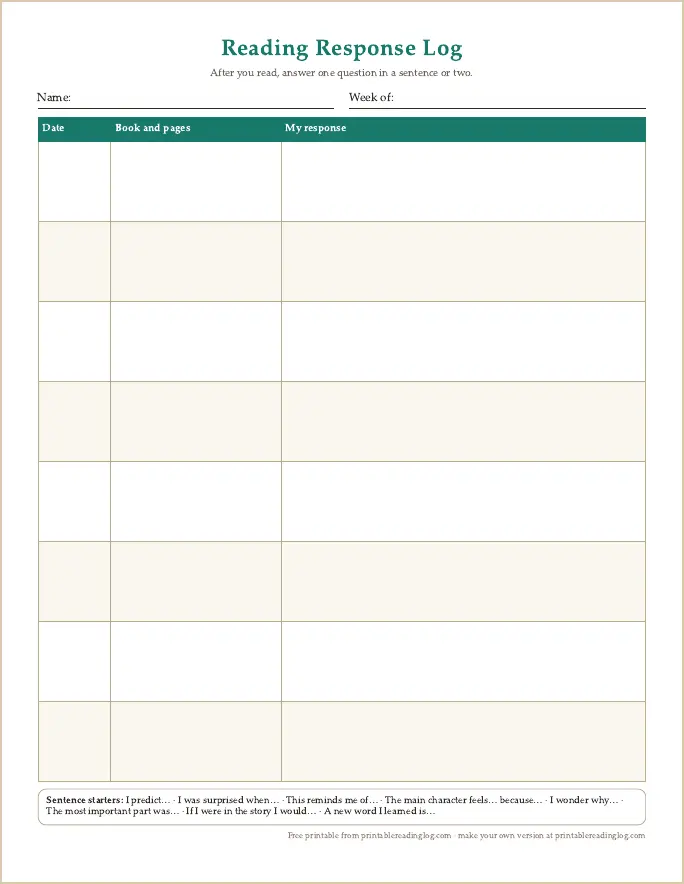
Reading Log with Response Questions
Date, book, pages and a two-line written response each day, with sentence starters printed at the bottom.
Read, fill the row, answer one question, close the book
Your log has a response column waiting. Here's the routine that keeps it light. First, read for the usual time, about 15 to 30 minutes depending on age. Second, fill in the date, title and minutes or pages. Third, answer one question in a sentence or two. Younger kids can say the answer out loud while a grown-up writes it, or draw a quick picture.
One question, not five. The moment a reading log turns into a worksheet, kids start to dread reading time, and that's the opposite of what you want. Rotate the questions each night so it stays a little different, and let your child choose the question when you can. Choice keeps it fun, and kids often pick the one they have the most to say about.
A response column changes what the log shows. A basic log shows how much a child read. A log with answers shows how they thought about it, which is why teachers love it and why it's worth the extra two minutes.
What good answers look like
Here are a few filled-in rows across different ages, so you can see that short answers are perfectly fine.
| Date | Book | Minutes | Question and answer |
|---|---|---|---|
| Jan 5 | Charlotte's Web | 20 | What problem does the main character have? Wilbur is scared he will be made into bacon, and Charlotte promises to help him. |
| Jan 6 | Charlotte's Web | 15 | What do you wonder? I wonder how the words get in the web. |
| Jan 7 | Hatchet | 25 | How would you feel in this setting? I'd be so scared to be alone in the woods. |
| Jan 8 | A book about sharks | 15 | What fact surprised you? Some sharks have to keep swimming to breathe. |
Notice that none of these answers are long. Each one shows the child understood something or noticed something. That's the goal. A single honest sentence beats a paragraph copied from the back cover.
Fiction questions about characters and setting
These 15 prompts work for picture books, chapter books and novels. Character questions are a great place to start, because kids usually have strong feelings about the people in a story.
| # | Question |
|---|---|
| 1 | Who is the main character? Describe them in three words. |
| 2 | What does the main character want more than anything? |
| 3 | How did a character feel today? How do you know? |
| 4 | Which character would you want as a friend? Why? |
| 5 | Did a character change in this chapter? How? |
| 6 | What is one choice a character made? Would you have done the same? |
| 7 | Who is causing trouble in the story, and why do you think they act that way? |
| 8 | If you could ask a character one question, what would it be? |
| 9 | What does a character say or do that shows what they're like? |
| 10 | How is a character like you? How are they different? |
| 11 | Where and when does the story take place? |
| 12 | Describe the setting using three of your five senses. |
| 13 | Would you want to visit this place? Why or why not? |
| 14 | How would the story change if it happened somewhere else? |
| 15 | What clues tell you when the story happens: past, present or future? |
A good way to use this group is to stay with one character for several nights. On Monday, a child describes the main character in three words. By Friday, they can say whether that character has changed, and why. Watching their own answers build across a week shows kids that a story moves, and it gives you an easy conversation at dinner. Setting questions fit nicely at the start of a new book, when everything is still unfamiliar.
Fiction questions about plot, theme and connections
These 20 prompts get kids thinking about what happened, why it matters and how it connects to their own life. Prediction questions are especially good for chapter books, because tomorrow's reading checks today's guess.
| # | Question |
|---|---|
| 16 | Tell what happened during this reading session in three sentences. |
| 17 | What is the main problem in the story? |
| 18 | How do you think the problem will be solved? |
| 19 | What was the most exciting part of today's reading? |
| 20 | What happened first, next and last? |
| 21 | What do you think will happen next? What makes you think so? |
| 22 | Was yesterday's prediction right? What actually happened? |
| 23 | Did anything surprise you? What was it? |
| 24 | What is one event that caused another event to happen? |
| 25 | If you could change one thing that happened, what would it be? |
| 26 | What lesson is the author trying to teach? |
| 27 | Does this story remind you of something in your own life? |
| 28 | Does it remind you of another book or movie? How? |
| 29 | How did today's reading make you feel? |
| 30 | What is a big idea in this book, like friendship, courage or fairness? |
| 31 | Would you recommend this book to a friend? Who, and why? |
| 32 | What would you title today's chapter? |
| 33 | What is your favorite sentence from today? Copy it down. |
| 34 | What picture formed in your mind while reading? |
| 35 | If you were the author, how would you end the story? |
Connection questions, like numbers 27 and 28, often get the richest answers, because kids love linking a book to their own life or a favorite movie. Save the theme questions for later in a book, once there's enough story to think about. Early on, a child may not know the lesson yet, and saying so is honest. "I don't know yet, but I think it's about being brave" is a perfectly good answer.
Questions for nonfiction reading
Nonfiction needs different questions, since there's usually no main character or plot. These 12 prompts focus on facts, new words and what the reader still wants to know. They work well for animal books, biographies, science topics and history.
| # | Question |
|---|---|
| 36 | What is this book or chapter mostly about? |
| 37 | What are three new facts you learned today? |
| 38 | What is one fact that surprised you? |
| 39 | What is a new word you learned? What does it mean? |
| 40 | What question do you still have about this topic? |
| 41 | How do the pictures, maps or diagrams help you understand? |
| 42 | Why do you think the author wrote this book? |
| 43 | Find a heading. What did you learn in that section? |
| 44 | How could you use what you learned in real life? |
| 45 | Tell one fact you would teach your family tonight. |
| 46 | What is one fact and one opinion from your reading? |
| 47 | Compare two things from your reading. How are they alike and different? |
Nonfiction questions are a natural fit for homeschool days, science units and kids who'd rather read about volcanoes than stories. Question 40 is a favorite, because it sends kids looking for their next book on the same topic. If your family keeps records for a portfolio, answers to these prompts show learning clearly, and the homeschool reading log explains how to organize them.
Quick prompts for kindergarten to second grade
Little kids do best with short prompts they can answer with a word, a sentence or a drawing. At this age, talking counts as much as writing. A two-minute chat about the question while you tuck them in is a perfectly good response, and a grown-up can jot down a few of their words in the log.
| # | Prompt |
|---|---|
| 48 | Draw your favorite part. |
| 49 | Who was in the story? |
| 50 | Where did the story happen? |
| 51 | Was the story happy, sad, funny or scary? |
| 52 | What happened at the beginning? |
| 53 | What happened at the end? |
| 54 | What was the problem? |
| 55 | Did you like the book? Color a smiley face. |
| 56 | What is one new word you read? |
| 57 | What would you do if you were the main character? |
| 58 | Draw the main character. |
| 59 | Would you read this book again? |
| 60 | Tell a grown-up about the story in your own words. |
For logs built just for these ages, see our first- and second-grade sheets or the reading log for kindergarten. If your child is still learning English, short prompts like these also work well alongside the reading log for ESL students.
Deeper questions for third grade and up
Older kids can handle questions that ask why and how, and they can write two or three sentences with a detail from the book to back up their answer. These 20 prompts work well from third grade through middle school.
| # | Question |
|---|---|
| 61 | What is the theme so far? Use one detail from the text to support it. |
| 62 | How does the author build suspense? |
| 63 | Whose point of view is the story told from? How would it change from another character's view? |
| 64 | What is the most important event so far, and why? |
| 65 | How has the main character grown since the beginning? |
| 66 | What does the title mean? Does it fit the book? |
| 67 | Find a simile or metaphor. What does it mean? |
| 68 | What can you infer about a character that the author doesn't say directly? |
| 69 | Summarize today's reading in 25 words or fewer. |
| 70 | What is one question you would ask the author? |
| 71 | How does the setting affect what happens? |
| 72 | Agree or disagree: the main character made the right choice. Explain. |
| 73 | Which character changed the most, and what caused it? |
| 74 | What does this book teach about the real world? |
| 75 | Rate this chapter from 1 to 5. Explain your rating. |
| 76 | If this book were a movie, what would the trailer show? |
| 77 | Was the author's purpose to entertain, inform or persuade? |
| 78 | What is a word the author chose that you really liked? Why does it work? |
| 79 | Write a short text message from one character to another. |
| 80 | What do you predict will happen by the end of the book? Use clues. |
Our upper-elementary logs have more ideas for this age, and older students can use the same prompts with the middle school reading log.
Sentence starters for kids who freeze
Some kids know what they think but get stuck on the first word. A sentence starter taped to the log solves that. For kindergarten and first grade, try "I liked...", "I felt..." and "My favorite part was..." Second and third graders can use "I wonder why...", "This reminds me of..." and "I think ... will happen." Fourth and fifth graders do well with "The character changed because...", "One thing I learned is..." and "I disagree with ... because..." From sixth grade up, try "The author wants us to think...", "This theme shows..." and "A question I still have is..."
Responses don't always have to answer a question, either. A child can write one sentence about the main idea ("Today, Wilbur learned that Charlotte had a plan"), a feeling ("I felt nervous when the storm started"), a question ("Why did she keep it a secret?"), a connection ("This reminds me of when I moved"), a prediction ("I think the dog will find the key") or a favorite line. Giving kids those six options makes the response column feel more open and less like a test.
A sample week of rotating questions
If you're not sure where to start, here's a simple plan for one week with a chapter book. On Monday, ask a character question, like number 1: describe the main character in three words. On Tuesday, try a setting question, like number 13: would you want to visit this place? On Wednesday, go for the problem with number 17. On Thursday, ask for a prediction with number 21. On Friday, check it with number 22: was your prediction right? On the weekend, let your child pick any question from the list, or skip the question and just enjoy the book.
This kind of rhythm gives kids something to look forward to, because Friday's answer depends on Thursday's guess. It also covers the main story skills in one week without ever asking more than one question a night. For a picture book week with a younger child, use the same idea with the K to 2nd grade prompts: who was in the story on Monday, where it happened on Tuesday, the problem on Wednesday, the ending on Thursday, and a drawing of the favorite part on Friday.
One sentence, a doodle, or a blank line on a tired night
One sentence is enough for most children. Younger readers can draw a picture or say the answer while an adult writes it down. Older students can write two or three sentences, and middle schoolers a short paragraph. If your child groans at writing, make it smaller: a doodle, a thumbs up or down with one word, or a sentence on a sticky note stuck to the log.
It's also fine to leave the response blank some days. Reading time matters most, and a tired child who read for 20 minutes has done the important part. If writing is a real struggle, or reading itself is hard, talk with the teacher about options like answering out loud. The what counts as reading for a child with dyslexia page has gentle everyday ideas.
Set up a log with a response column
In our log builder, the Classroom or Kids preset is the easiest starting point. Turn on the Notes column, which becomes the space for answers. Keep the other columns lean, such as date, title and minutes or pages, so the response column gets as much room as possible. Choosing landscape orientation and fewer rows per page, around 8 to 10, gives kids a wider line to write on.
Name the page with your child's name or your class name, choose kid-friendly or clean adult style, and print a few pages for the term. Keep them in a folder with the question list tucked inside. If you'd like longer written answers, the reading log with summary gives a bigger box for each book.
Answering the answers: what adults do with the response column
Read the answers. Even a quick check mark or "Great point!" tells kids that someone cares about what they wrote. Say something kind about the response before anything else, and ask a follow-up like "Tell me more." Don't correct spelling in a response, since the point is the thinking, not the mechanics.
Print the full question list and let kids choose. Bring the logs to parent-teacher conferences, because a log with answers shows what a child understood, not just how long they read. And know when to switch formats. A log with questions is quick: one row, one short answer. A journal gives a whole page to write and reflect, which suits book reports, book clubs and kids who love to write. Our notes on starting a reading journal cover that next step, and the same questions work well in a book club reading log.
When one question a night starts to feel stale, change the rhythm. Use character questions all week, then switch to predictions the next. Your settings stay in the browser you used, so a fresh page is a minute's work.
A few common mistakes are easy to fix. If answers are getting shorter and shorter, the question may be too hard or too samey, so switch groups. If your child copies sentences from the book, ask for a feeling or a connection instead, since those can't be copied. If logging has turned into a nightly argument, drop the question for a week and just log the reading. Our page on defusing the nightly log standoff has more calm ideas. When you bring the question back, let your child pick the first one from the list.
Two weeks in one fourth grader's response column
Picture a fourth grader named Maya starting Hatchet in early November. Her teacher asks for 20 minutes a night and one answer, and Maya's mom lets her choose the question from the printed list. The first week's rows look like most first weeks. Monday: 20 minutes, chapters 1 and 2, question 1, "Brian is scared, alone, and stubborn." Tuesday: 22 minutes, question 12, "It smells like the lake and it's loud with bugs and cold at night." Wednesday: 18 minutes, question 17, "He has no food and nobody knows where he is." Thursday: 20 minutes, question 21, "I think he will find a way to make fire." Friday: 25 minutes, question 22, "Kind of right. He got sparks but no fire yet."
Read those five answers together and a pattern shows up quickly. Maya is good at noticing what is happening and at guessing what comes next, and her setting answer used three senses without being told twice. What she never did was say why anything mattered. Every answer stays on the surface of the plot, which is completely normal for a nine-year-old in the first third of a survival story, and it tells her mom exactly where a little nudge would help.
So in week two her mom changed one thing. Instead of the whole list, she offered Maya a choice of two each night, and one of the two was always a "why" question: number 24 about cause and effect, number 6 about a character's choice, number 68 about what the author doesn't say directly. Maya still picked the easier one on two nights, and that was allowed. But on Wednesday she chose number 6 and wrote, "Brian decided not to give up after the plane went over. I would have cried for a week. He is braver than he thinks." On Friday, with number 73, she wrote, "Brian changed the most. At first he waited to be saved and now he just does stuff."
Those two sentences are the whole reason a response column exists. The minutes were nearly identical across both weeks, so a plain log would have shown no change at all. The answers showed a child moving from retelling to reasoning in ten days, and the only thing the adult did was narrow the menu. When her mom brought the sheets to the November conference, the teacher had a concrete example of growth to point at rather than a general impression.
Explaining the question column on day one of the school year
Teachers who roll out a log with questions usually get better answers all year if they spend ten minutes modeling it on the first day. Read a short picture book aloud, stop, and fill in one row on the board while the class watches. Say the question, think out loud for a moment, and write one plain sentence. Then write a second, weaker answer next to it, something like "It was good," and ask the class which one tells you more about what the reader understood. Kids spot the difference immediately, and you have set the standard without a rubric.
A short note home saves a lot of confused emails in September. Something like this works: "Each night your child will read for about 20 minutes, fill in one row, and answer one question from the list in the folder. One honest sentence is plenty. If your child would rather tell you the answer, you are welcome to write it down for them. Please don't fix spelling in the answer column; I'm looking at their thinking. If a night goes badly, a blank answer box is fine as long as the reading happened." That last line matters, because parents who feel the answer is mandatory are the ones who end up writing it themselves.
Parents starting the routine at home can use even fewer words with the child. "After you read tonight, pick one question and tell me or write one sentence. You choose which question." Then stop talking. The temptation is to suggest an answer when the child pauses, but a ten-second silence often produces a better sentence than any hint would.
Reading a month of answers for patterns
After about four weeks, lay the sheets side by side and read only the answer column, ignoring minutes and titles. You're looking for three things. First, length: are answers creeping up, holding steady, or shrinking? A slow climb from five words to fifteen is a good sign. A steady drop usually means the questions have become a chore, not that the child has stopped thinking.
Second, which question types the child picks when given a free choice. A child who always chooses prediction questions is engaged with the plot and enjoys being right. One who always picks "draw your favorite part" or "how did it make you feel" may be avoiding writing more than avoiding thinking. One who never picks a nonfiction question might simply not be reading nonfiction, which is worth noticing on its own. None of these is a problem to fix by force; each is a hint about what to offer next.
Third, whether the answers mention the book at all. An answer like "I liked it" could be about any book ever written. An answer that names a character, a place or an event shows the child was actually with the story. If most of a month's answers are book-free, the questions may be too open. Switch to ones that require a detail, such as number 9 ("What does a character say or do that shows what they're like?") or number 20 ("What happened first, next and last?"), for a week or two.
Teachers can do a lighter version of this across a whole class by skimming just the Friday answers from every log. In twenty minutes you'll see which students are writing summaries, which are making connections, and which are copying the back cover, and that is useful grouping information for small-group reading.
When the response column stops working
Every answer is a retelling of the plot
Retelling is a real skill, so don't discourage it, but it can become a rut. Take retelling questions off the list for a week and offer only questions that start with "why," "would you" or "what if." Number 25 ("If you could change one thing that happened...") and number 63 about point of view are hard to answer with a plot summary.
Two siblings share one book and copy each other's answers
Give them different question groups. The younger child answers from the K to 2nd grade list and the older one from the third grade and up list, so even when they read the same chapter of Charlotte's Web together, their answers can't overlap. Many families find the shared book then becomes a conversation, with each child explaining their answer to the other.
The child reads only graphic novels
Almost every question on the list still works, and a few work better. Number 34 about the picture in your mind becomes "Which panel would you hang on your wall?" Number 41 about pictures and diagrams fits naturally. Our page on whether graphic novels count on a reading log covers the minutes side of that question.
Answers arrive in a rush at the bottom of the backpack
If the log comes back on Friday with five answers in the same pencil, written in four minutes, the problem is timing, not effort. Move the question to the moment the book closes, before anything else happens, and keep the log and a pencil inside the book as a bookmark. A forgotten week can be handled calmly; the catch-up guide for a forgotten log suggests honest ways to fill the gap.
What teachers and parents ask about the response column
My child answers "I don't know" every night. What now?
Switch to an easier group, like the K to 2nd grade prompts, or offer two questions and let them choose. A sentence starter such as "I liked..." also gets the pencil moving.
How many questions should kids answer each night?
One is plenty. A long list turns reading into a worksheet. Rotate the questions so each night feels a little different.
What are good reading log questions for kids?
Try "What is the main problem in the story?", "What do you think will happen next?", "How did a character feel, and how do you know?" and "What is one new word you learned?"
Can young kids use a reading log with prompts?
Yes. Kindergarten to second graders can answer with a word, a drawing or out loud while a grown-up writes. Short prompts like "Who was in the story?" work best.
What is a reading log with response?
It's the same idea with a more open column: kids write one sentence back to what they read, such as a feeling, a question, a connection or a prediction, instead of answering a set question.
What are good reading response sentence starters?
Try "I liked...", "I wonder why...", "This reminds me of...", "I think ... will happen" and "The character changed because..."
Should I correct spelling in reading responses?
Usually not. The response is about thinking, so praise the idea first. Spelling practice can happen at another time.
Are reading log answers useful at conferences?
Very. A log with answers shows what a child understood, not just how long they read, which makes it a helpful thing to share with a teacher.