My Child Refuses to Do the Reading Log: What to Do
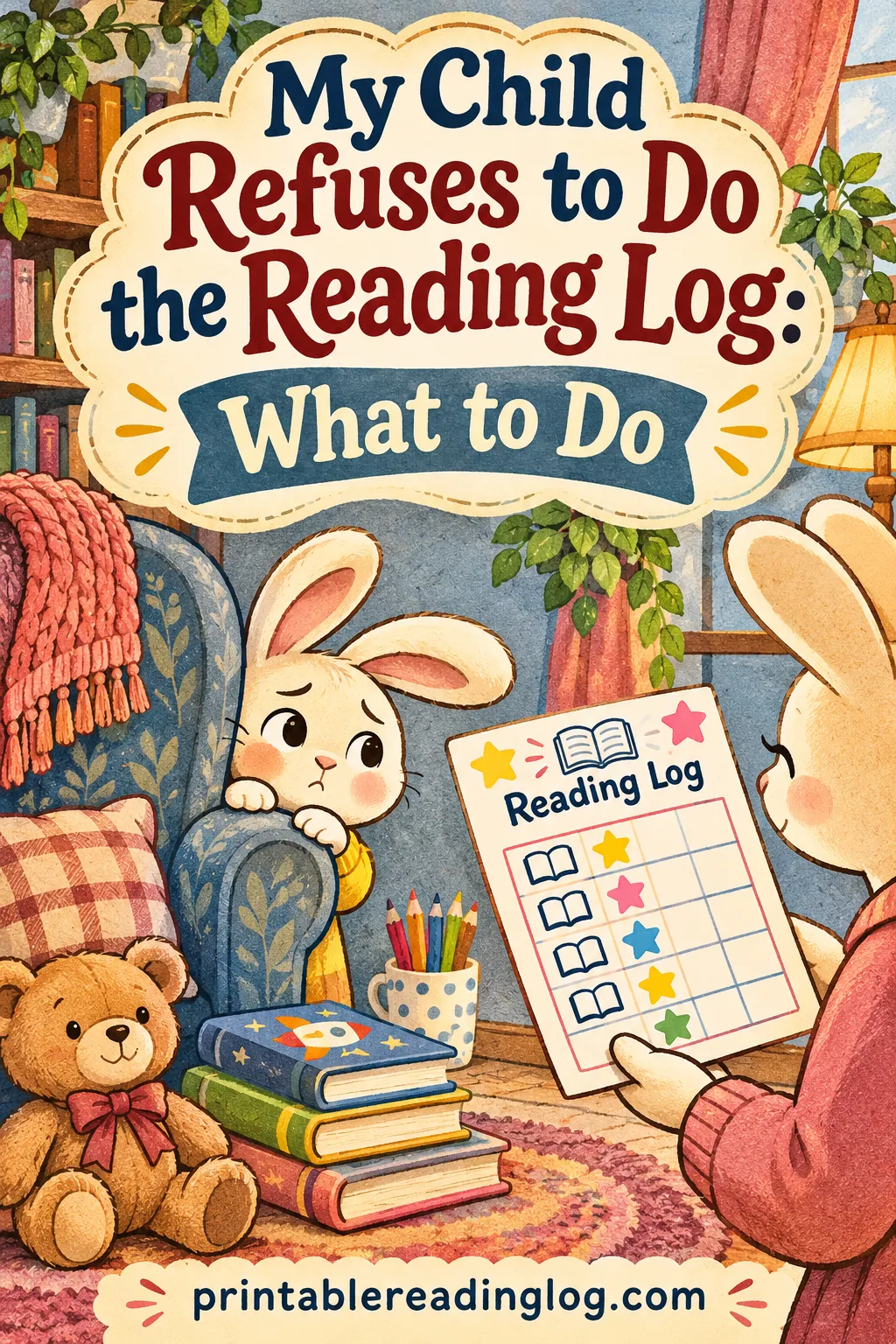
When your child refuses the reading log, separate the reading from the logging: keep the reading time, shrink the paperwork, and find out which part your child actually hates. Most refusals are about the form, the timer or the book, not about reading itself, and each of those has a simple fix.
The fastest way to lower the temperature is to swap a strict nightly sheet for a flexible weekly one with fewer boxes, a smaller goal and room for read-alouds and audiobooks. You can build that kind of log in a couple of minutes with the free printable reading log maker, then talk to the teacher about using it. The rest of this guide walks you through finding the reason, scripts for the hard conversations, exact tool settings, and a plan for the next four weeks.
▶ Open this reading log ready to print
Why Kids Refuse the Reading Log (and What Each Reason Looks Like)
A reading log battle almost always has a cause underneath it. Before you change anything, spend a few evenings just watching. When does the meltdown start? Is it when you say "reading time," when the timer comes out, or when the pencil and the sheet appear? The moment the mood flips tells you a lot.
Here are the most common reasons, and the clues that point to each one.
| What you notice | Likely reason | First thing to try |
|---|---|---|
| Happy to read, melts down at the sheet | The writing part feels like extra homework | You fill in the log; child only checks a box |
| Watches the clock the whole time | The timer turns reading into a sentence to serve | Count books, chapters or pages instead of minutes |
| Refuses the assigned or chosen book | The book is too hard, too easy or boring to them | Let them pick, including comics and nonfiction |
| Fine on weekends, refuses on school nights | Too tired after a long day | Move reading earlier or split into two short sessions |
| Says "I'm bad at reading" | Reading feels hard and the log keeps proving it | Read together; log shared reading |
| Argues about honesty or "fake" minutes | Feels watched or distrusted | Let them initial their own rows |
| Refuses everything school-related lately | General homework fatigue or a rough patch | Shrink every task; talk to the teacher |
| Cries or shuts down, not just argues | Strong anxiety or a possible learning struggle | Pause the pressure and ask the school for help |
You might see more than one row. That's normal. Pick the one that seems loudest and start there.
The writing is the problem, not the reading
For many younger kids, especially in kindergarten through third grade, writing is slow and tiring. Copying a long title, the author's name, the page numbers and a sentence about the book can take longer than the reading itself. A child who loved the story can still hate that last ten minutes with the pencil.
You'll know this is the issue if your child reads happily, even asks for "one more chapter," and then falls apart the moment you say "now fill in your log." The fix is to take the writing off their plate, at least for now.
The timer is the problem
"Read for 20 minutes" sounds simple. But for some kids, a timer turns reading into a countdown. They glance at it every few lines, lose track of the story, and announce "done!" at 20:00 exactly, often mid-sentence. Reading becomes something to endure.
If your child reads more on a long car ride than during official reading time, the timer may be the thing they're pushing against. Switching what you count can take that pressure away.
The book is the problem
A book that's too hard is exhausting. A book that's too easy can feel babyish. A book that's just boring to your child makes 20 minutes feel like an hour. And when a child is told what to read, the reading log becomes proof that they did something they didn't want to do.
Watch what your child reads when nobody's asking. Cereal boxes, game guides, joke books, facts about sharks, graphic novels, sports pages? That's your starting point.
Tiredness and timing
By 8 p.m., some kids are simply done. They've been following instructions all day. A reading log at the end of a long evening of homework, practice and dinner can feel like one demand too many. If the same child happily reads on a Saturday morning, timing is probably part of the problem.
Reading feels hard
Some children push back on the log because the log keeps showing them what they find difficult. If your child guesses at words, gets tired after a page or two, avoids reading aloud, or says things like "I'm the worst reader in my class," the log may be landing on a sore spot.
This isn't something to diagnose at home. If you notice these signs, especially if they've lasted a while, talk to the teacher. Ask what they see in class and whether extra support would help. Follow the school's guidance on next steps.
Feeling watched
Older kids in particular can bristle at a log that needs a parent signature every night. It can feel like being checked up on. When a child feels distrusted, they sometimes refuse just to keep a little control. Giving them ownership of the log, such as initialing their own rows, can change the mood quickly.
What to Do Tonight: Calm the Reading Log Battle Fast
You don't need a whole new system to get through tonight. These steps lower the pressure right away while you figure out the longer plan.
- Keep reading, drop the fight. Tell your child, "Tonight we're just going to read. I'll take care of the log." Then do it.
- Read together. Sit next to them, take turns with pages, or read to them. Shared reading counts as reading.
- Let them choose the book. Anything at a reasonable level is fine for tonight, including a comic, a magazine or a favorite they've read ten times.
- Shorten it. If 20 minutes is a war, aim for 10 good minutes. A calm 10 minutes is worth more than a tearful 20.
- Fill in the log yourself. Write the date and title. Let your child make one mark, like a check, a star or a smiley.
- End on something nice. Stop at a fun part, not a hard one, so tomorrow starts on a good note.
That's it. You're not giving up on the log. You're resetting the mood so reading itself stays safe.
A short script for the moment of refusal
When your child says "I'm not doing it," it's tempting to argue. Try something like this instead:
"I can tell you really don't want to do the log tonight. That's okay to feel. The reading is the important part. How about we read together for ten minutes, and I'll write it down?"
Then stop talking and open the book. Many power struggles end the second there's nothing left to push against.
If your child still refuses, offer a choice with two good options: "Do you want me to read to you, or do you want to read to me?" Kids who feel cornered often relax when they get to pick.
Separate the Reading From the Logging
The most useful idea in this whole guide is this: the reading log is a tool to support reading. When the log starts to hurt reading, it's time to change the log.
Think about what the log is really for. In most classrooms, it's there to encourage regular reading at home and to give the teacher a rough picture of what kids are reading. Most teachers would rather have a calm child who reads every night with a simple checkmark than a child who hates books because of a worksheet.
Here's how to split the two jobs:
- The reading job belongs to your child. They pick the book (within reason) and do the reading, or listen, or read along.
- The logging job can belong to you, at least for now. You write titles and dates. Your child adds a quick mark.
- The goal belongs to the family. You set it together, keep it small, and celebrate when you hit it.
Once the reading is calm again, you can slowly hand pieces of the logging back. More on that in the four-week plan below.
What a "minimal" log looks like
A low-pressure log has far fewer boxes than most school sheets. For a child who's refusing, aim for something like this:
- One row per day, or even one row per book
- Columns: Date, Title, and one check or smiley
- No sentences, summaries or page counts unless the teacher truly needs them
- A visible goal that's small enough to reach this week
That's the kind of sheet you'll set up in the free tool later in this guide. If you'd like more ideas for what can go on a log, the reading log ideas for kids page has plenty of fun column and layout options.
Make Reading Feel Like a Choice Again
A child who refuses the log is often a child who feels reading is something done to them. The goal is to hand some of that control back without letting reading slide.
Let them choose what counts
Ask the teacher if these can count toward the log. Many teachers say yes when you ask:
- Audiobooks, especially with the printed book open to follow along
- Read-alouds, where you read and your child listens
- Graphic novels and comics
- Magazines and kids' newspapers
- Nonfiction: animal facts, how-to books, sports books, cookbooks
- Rereading favorites
- Reading to a younger sibling, a pet or a stuffed animal
- Joke and riddle books
- Poetry collections
Each of these still builds vocabulary, listening and a love of stories. For struggling or tired readers, audiobooks and read-alouds can keep them enjoying books while their decoding skills catch up. The guide on how to log audiobooks shows simple ways to record listening time.
Let them choose the book
Choice is one of the strongest tools you have. A child who picked the book has a reason to open it. A child handed a book has a reason to resist.
Some ways to give real choice without losing all structure:
- The two-book rule. You pick two or three books you're happy with, and your child picks one.
- Library free-for-all. Once a week, your child picks anything they like from the kids' section, no comments from you.
- The quit rule. If a book isn't working after a few chapters, they can stop and pick another. Grown-up readers do this all the time.
- Series power. Once a child finds a series they like, the next book is easy to start. Ask a librarian for series at your child's level.
- Interest first. Dinosaurs, horses, soccer, space, cooking, video game strategy, mysteries. Follow the interest, even if the book isn't one you'd choose.
If you're not sure what's a good fit, the guide on how to choose books for your child explains simple ways to check difficulty, like the "five-finger" page test.
Let them choose when and where
Reading on the floor with the dog, in a blanket fort, in the bath, in the car before school, on the porch steps. A change of place can make reading feel less like homework. So can a change of time:
- Before school: some kids are fresher in the morning.
- Right after school: a snack and a book before other homework.
- Two short sessions: 10 minutes after school and 10 at bedtime.
- Weekend top-ups: if the teacher allows a weekly total, longer weekend reading can cover a busy weekday.
Change What You Count
A lot of reading log refusal comes from what the log measures. If minutes are the problem, count something else. If the teacher requires minutes, you can often still change how they're tracked.
| What you count | Works well for | Watch out for |
|---|---|---|
| Minutes | Kids who like a clear finish line | Clock-watching, stopping mid-sentence |
| Pages | Kids who like seeing numbers grow | Racing through, picking only thin books |
| Chapters | Chapter-book readers who like milestones | Chapters vary a lot in length |
| Books finished | Picture-book readers and fast readers | Long books feel slow to "count" |
| Days read (check only) | Reluctant readers, tired kids | Gives the teacher less detail |
| Shared reading sessions | Struggling or very young readers | Ask the teacher if it counts |
For many reluctant readers, a simple "days read" checkmark is the gentlest option. Your child sees a row of checks fill up, and nobody's watching a timer. If the teacher still needs minutes, you can jot the rough minutes yourself in a small column while your child handles the checks.
If you want to look at minutes from the other side, the guide on how many minutes kids should read per day gives a calm look at common goals by age, so you can talk to the teacher about a number that fits your child.
Lower the goal, then let it grow
A goal your child can hit builds confidence. A goal they keep missing builds resentment. If the class goal is 20 minutes a night and your child is refusing, ask if you can start at 10 for two weeks and then build up. Most teachers will happily agree when they see you're trying.
Small goals also help children feel the win of a full row. Five checks out of five feels great. Two minutes short every night feels like failing, even when the child read a lot.
How to Make a Kinder Reading Log in the Free Tool
You can build a low-pressure reading log in the free reading log maker in about two minutes. It doesn't open pre-filled from a link, so here are the exact settings to pick for a child who's been refusing the log.
Settings for a child who refuses (ages 5 to 10)
- Start with a preset: choose Weekly log. A weekly view feels shorter and less endless than a month of empty rows.
- Reader name: type your child's name, or let them type it. Ownership matters.
- Reading goal: write something small and reachable, like "Read 5 days this week" rather than a minute total.
- Log style: pick Kid-friendly.
- What are you logging? Choose Date if you want simple daily checks, or Books if your child reads short books.
- Color theme: let your child pick: Sky, Blush, Mint or Sunshine.
- Columns: turn on only Title, Star rating and Initials (P/T). Leave Author, Notes, Genre and the date columns off for now.
- Rating style: choose Smiley. It's fast and fun, and there's no writing involved.
- Rows per page: keep it low, around 7 for a weekly sheet.
- Goal tracker: turn on the bar with 10 squares so the finish line feels close.
- Coloring strip: turn it on. Many younger kids like coloring a little picture after reading.
- Click 🖨️ Print / Save PDF.
This gives you a short sheet with big friendly rows, one smiley to circle, and a goal your child can actually finish.
Settings for an older child (ages 10 to 13)
Older kids often hate anything that looks babyish, so change a few things:
- Start with a preset: Weekly log or Monthly log.
- Log style: Adult-clean often goes down better with tweens.
- What are you logging? Books or Pages, if they like seeing numbers grow.
- Columns: Title, Date finished, Star rating and Recommend? (Y/N). The recommend column gives them an opinion, which many tweens enjoy.
- Rating style: Number or Stars.
- Goal tracker: 25 squares for a month.
- Books I want to read next: turn it on. A list of books they're excited about turns the log into something they own.
Settings for a child who's mostly listening
If your child is reading mostly through audiobooks or read-alouds for now:
- Start with a preset: Audiobook or Kids.
- What are you logging? Minutes, if the teacher wants time, or Books for finished stories.
- Columns: Title, Initials (P/T) and Notes. Use Notes for a single word like "listened," "read along" or "read to me."
The Initials column is handy here. You can initial read-aloud rows, and your child can initial the ones they read on their own. Over time, you'll both see more of their initials appear.
For a ready-made starting point aimed at younger readers, the reading log for kids page shows the kid-friendly options in action.
Ready-to-Use Log Setups by Situation
Here are complete setups for common refusal situations. Pick the one closest to yours and copy it into the tool.
The writing-hater (ages 6 to 9) - Preset: Weekly log - Columns: Title, Star rating - Rating style: Smiley - Who writes: Parent writes titles, child circles a smiley - Goal: 4 or 5 reading days this week
The clock-watcher (ages 7 to 11) - Preset: Weekly log - What are you logging: Books or Pages - Columns: Title, Pages/Minutes, Star rating - Who writes: Child writes pages, parent writes title if needed - Goal: a page or chapter number, not minutes
The tired after-school kid (any age) - Preset: Weekly log - Columns: Title, Initials (P/T) - Who writes: Whoever is less tired - Goal: 10 minutes on school nights, a longer read on the weekend
The "I'm bad at reading" child (ages 6 to 10) - Preset: Kids - Columns: Title, Initials (P/T), Notes - Notes: "read together," "I read," "listened" - Goal: shared reading most nights, with one page they read aloud to you
The tween who feels watched (ages 10 to 13) - Preset: Monthly log - Log style: Adult-clean - Columns: Title, Date finished, Star rating, Recommend? (Y/N) - Who writes: Child fills it in; parent signs once a week, not nightly - Goal: a book total for the month, set by the child
The book-avoider (any age) - Preset: Kids or Weekly log - Turn on: Books I want to read next - Columns: Title, Genre, Star rating - Goal: try three different kinds of books this month
The genre column turns sampling into a little game. One week it's a joke book, the next a graphic novel, the next a book about sharks. Your child gets to discover what they like without the pressure of loving every book.
Talk to the Teacher (With a Plan, Not a Complaint)
Teachers see reading log battles every year. Most will be glad to hear from you, especially if you come with a specific idea instead of just "my child won't do it." A short, friendly note usually works better than a long one.
What to ask for
Pick one or two of these. Asking for everything at once can feel like you're trying to skip the assignment.
- Counting audiobooks and read-alouds toward the log
- A smaller nightly goal for a few weeks, then building up
- A weekly total instead of a fixed nightly amount
- Using your own printed log instead of the class sheet
- Dropping the written summary or sentence for now
- A weekly parent signature instead of a nightly one
- Advice on books that fit your child's level
A sample note to the teacher
Here's a simple note you can adapt. Keep it short and warm.
Hi [Teacher's name], I wanted to let you know that the nightly reading log has turned into a real struggle at home. [Child] is reading, but the log itself is causing tears most nights. Would it be okay if we tried a simpler weekly log for the next few weeks, with shorter sessions and audiobooks counting too? I'll still sign it each week so you can see what [he/she/they] read. I'd love any ideas you have. Thank you!
Then follow up in two or three weeks with a quick update. "Things are much calmer, and [Child] has read four books this month" goes a long way.
Questions worth asking at a conference
If you have a parent-teacher conference coming up, these questions can give you useful information:
- How does my child seem during reading time at school?
- Is the book level we're using at home a good fit?
- What's the real purpose of the log in your class?
- Is there any flexibility in how it's filled in?
- Is there anything you've noticed that I should know about?
That last question opens the door if the teacher has seen signs of a reading struggle. If they have, follow the school's guidance on next steps.
A Four-Week Plan to End the Reading Log Battle
Changing everything at once rarely sticks. This plan rebuilds the habit in small steps, so reading comes first and the log comes back gradually.
| Week | Reading goal | Who fills in the log | Focus |
|---|---|---|---|
| Week 1 | 10 minutes, any book, read-alouds count | Parent writes; child adds a smiley | Calm, no fights, child chooses |
| Week 2 | 10 to 15 minutes, child's choice | Parent writes title; child writes date or checks | Build a streak; celebrate full weeks |
| Week 3 | 15 minutes or one chapter | Child writes title; parent helps if needed | Hand back small pieces of the log |
| Week 4 | Teacher's goal, or close to it | Child fills in; parent signs weekly | Child owns the log with support |
If week three goes badly, stay in week two for a while. There's no deadline here. The point is a child who reads without a fight, not a perfect schedule.
How to celebrate without bribes
Rewards can help some kids get started, but big prizes for reading can make reading feel like a job. Simple, reading-related rewards often work better:
- Choosing the next library book or bookstore visit
- Staying up 10 minutes later to read
- A special reading spot or flashlight for reading in a fort
- Picking the family read-aloud
- Reading a favorite book to a grandparent on a video call
For more ideas that keep the focus on reading itself, the guide on reading incentive ideas has plenty of low-key options.
Mistakes That Make the Reading Log Battle Worse
Even caring parents fall into these. If any sound familiar, it's an easy thing to change.
- Making the log a punishment. "No screens until your log is done" can tie reading to losing something. Try putting reading before screens as a routine instead.
- Arguing about exact minutes. Debating whether it was 18 or 20 minutes turns reading into a negotiation. Round generously.
- Correcting spelling on the log. The log isn't a spelling test. Let small mistakes go.
- Comparing siblings or classmates. "Your sister always did hers" rarely motivates anyone.
- Banning favorite formats. Telling a child comics "don't count" can push away a reader who was just getting started.
- Saving reading for the very end of the day. An exhausted child will fight anything.
- Filling in fake entries to avoid the fight. It's tempting, but it teaches that the log is a game. Write a smaller, honest entry instead.
- Giving up on reading altogether. You can pause the paperwork. Try hard not to pause the reading.
When It's More Than a Reading Log Battle
Most refusals fade once the pressure drops and the books get better. But sometimes the log is just the place where a bigger struggle shows up.
Talk to the teacher, and follow their guidance, if you notice things like:
- Reading seems to take much more effort than for other kids the same age
- Your child avoids reading aloud or gets very upset when asked
- They mix up words or letters often, or lose their place a lot
- They say they hate school, not just the log
- Headaches, stomachaches or tears show up mostly around reading or homework
- The refusal stays strong for weeks even after you've made reading easier
None of these mean something is wrong for sure. They're simply reasons to ask the school what they see and what support is available. If you have concerns about your child's eyes, hearing or overall well-being, check in with your child's doctor, too.
For kids who need extra support for a while, a reading log for reluctant readers keeps the format extra gentle, and the guide on how to motivate kids to read has more ways to build a love of books at home.
Ready to Try a Calmer Log?
A reading log that your child refuses isn't doing its job. A short, friendly log with a reachable goal, choice of books and room for read-alouds can turn the nightly fight into a few calm minutes together. Start with the Weekly log preset, keep only two or three columns, pick a smiley rating, and let your child choose the colors.
Make your child's low-pressure reading log free and print it tonight. Give it two weeks before you judge whether it's working. Most families see the mood shift long before they see the minutes go up.
▶ Open this reading log ready to print
Frequently Asked Questions
Should I force my child to do the reading log?
Forcing usually makes the battle bigger and can make reading itself feel like a punishment. Keep the reading time, but make the log smaller and easier, and fill in the writing yourself for a while. If the teacher needs the log, talk to them about a simpler version.
Is it okay for me to fill in my child's reading log?
Yes, especially for younger kids or children who find writing hard. Writing the titles and dates while your child adds a check or smiley is honest, as long as the reading actually happened. Let the teacher know you're doing this so there are no surprises.
Do audiobooks count on a reading log?
Many teachers count audiobooks, especially when a child follows along in the printed book. Listening still builds vocabulary and understanding of stories. Ask the teacher, and note "listened" or "read along" in the log so it's clear.
What if my child only wants to read comics or graphic novels?
Graphic novels and comics are real reading, with plenty of words, story structure and vocabulary. Many reluctant readers find their way into longer books through them. Let them count, and gently offer other options alongside them rather than instead of them.
My child reads but lies about the minutes. What should I do?
Stay calm and avoid turning it into a trust battle. Often the child is trying to escape the pressure of the timer. Switch to counting books, chapters or days read, and let your child initial their own rows so the log feels like theirs.
How long should a reluctant reader read each night?
Start with a goal your child can reach without tears, even if it's 10 minutes or a single chapter. A calm, short session every day usually does more than a long, unhappy one. Build up slowly and check with the teacher about the class goal.
What if the teacher won't change the reading log?
Ask what part of the log matters most to them, then focus your energy there. You can still change the home routine: read together, let your child choose books, read earlier in the day, and fill in the sheet yourself. If the struggle continues, ask for a short meeting to talk it through.
Can I use my own printed reading log instead of the school's?
Many teachers are fine with it if it records the same basic details. Show the teacher your sheet first, and include the columns they ask for, such as title and parent initials. You can make a simple one in the free reading log maker with just the columns you need.