What Counts as Reading for a Child With Dyslexia?
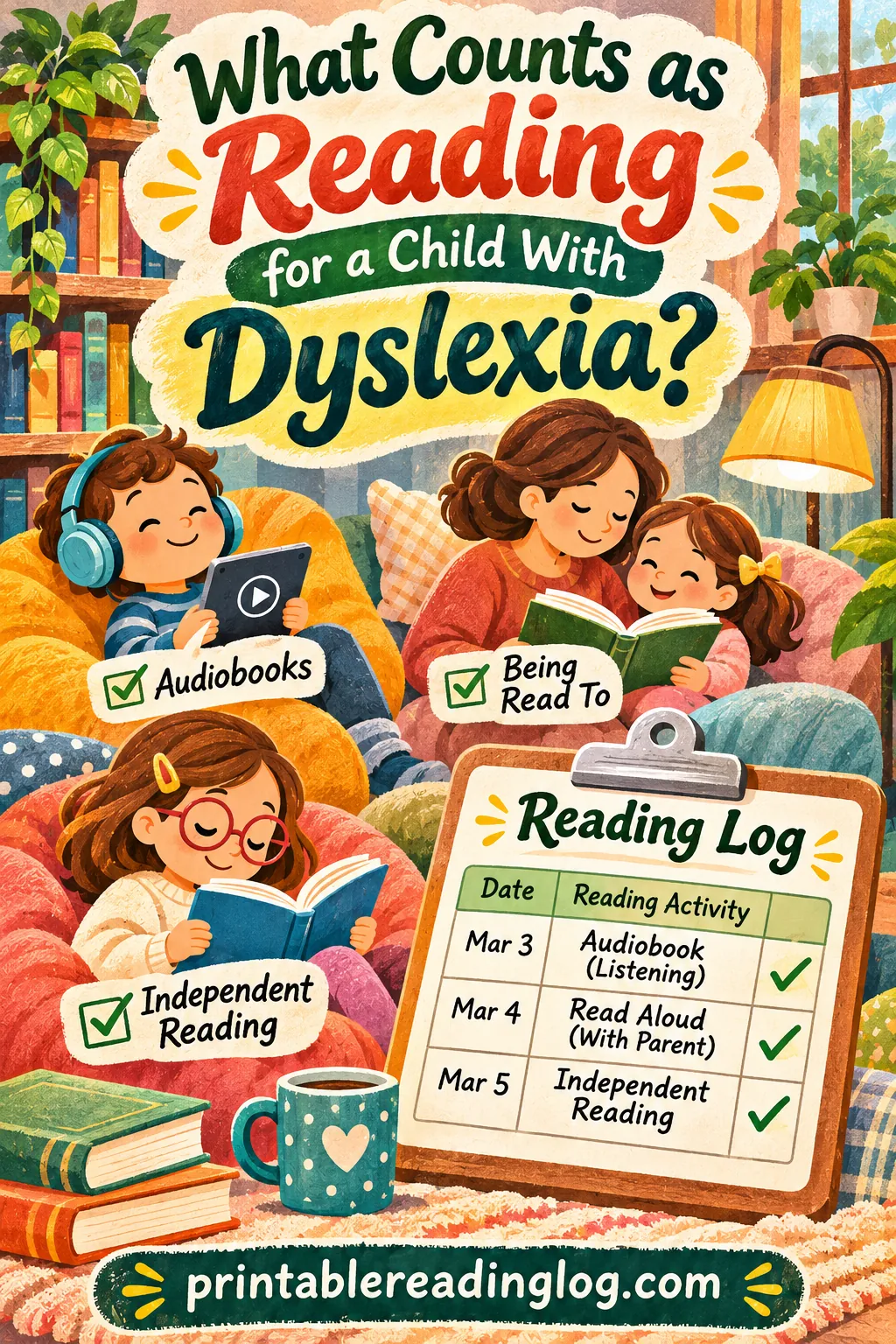
For most children with dyslexia, audiobooks, being read to, shared reading and their own decoding practice can all count as reading, as long as you log each format honestly and the teacher agrees with how you're counting it. The easiest way to do that is a reading log with a separate column for each kind of reading, so your child gets credit for the stories they take in while the teacher still sees how much independent decoding practice happened.
You can make that log in a couple of minutes with the free printable reading log maker. Pick the Kids preset, log minutes instead of books, and add a column for how the reading happened. The rest of this guide walks through what usually counts, what to ask the teacher, exact settings for the log, sample weeks, and what to do when a reading log starts to feel like a nightly battle.
One quick note before we start. Every child with dyslexia is different, and every school handles accommodations differently. Nothing here replaces advice from your child's teacher, reading specialist, tutor or evaluation team. Think of this as a practical way to organize the conversation and the paperwork, not a set of rules.
▶ Open this reading log ready to print
The Short Answer: What Usually Counts
Here's the core idea. A reading log usually exists to do one of two jobs, sometimes both:
- Build a love of stories, vocabulary and background knowledge. For this job, the way the words reach your child matters less. Listening to a chapter book builds vocabulary and comprehension the same way reading it with their eyes would for a fluent reader.
- Build decoding and fluency through practice. For this job, your child needs time spent looking at print and working out words, at a level that fits them.
A child with dyslexia often needs both jobs done, but done separately. The listening side keeps them in step with classmates on stories, ideas and big words. The decoding side is shorter, slower and more carefully matched to their level.
So instead of asking "does an audiobook count?", it helps to ask "count toward which goal?" Once you split the two, most of the stress goes away.
| Type of reading | Usually counts toward stories and vocabulary? | Usually counts toward decoding practice? | What to write on the log |
|---|---|---|---|
| Audiobook, listening only | Yes | No | Minutes, title, "L" for listening |
| Audiobook while following the printed text | Yes | Partly, ask the teacher | Minutes, title, "L+T" for listen and track |
| Parent or sibling reads aloud | Yes | No | Minutes, title, "RA" for read aloud |
| Shared or paired reading (take turns) | Yes | Yes, for the child's turns | Minutes, title, "S" for shared |
| Child reads a decodable or leveled book alone | Yes | Yes | Minutes or pages, title, "O" for own reading |
| Tutoring or reading intervention session | Ask the teacher | Often yes | Minutes, "T" for tutoring |
| Text-to-speech on a tablet or computer | Yes | No, unless they follow along | Minutes, title, "TTS" |
| Graphic novel or comic | Yes | Yes, if they read the words themselves | Minutes, title, "O" |
| Reading signs, recipes, game cards | Sometimes | Sometimes, ask | Usually a note, not a row |
The pattern you'll notice: almost everything counts for something. The log just needs to say which something.
Why Audiobooks and Read-Alouds Matter So Much
If your child has dyslexia, you've probably seen it. They understand stories well above the level they can decode. They laugh at the right parts, ask sharp questions and remember plot twists from weeks ago. But the words on the page are hard work.
That gap is exactly why listening is so useful. When your child only reads books they can decode, they're often stuck with short, simple texts that are far below what their brain can handle. Listening lets them meet the same rich books their classmates are reading: longer sentences, bigger words, more interesting characters and more complex plots.
Many literacy guides and many schools treat audiobooks and read-alouds as real reading for exactly this reason. Some schools list them as a formal accommodation for students with dyslexia. Others welcome them on reading logs without any paperwork at all. And some still want the log to show independent reading only. That's why the most important step is a short conversation with the teacher, which we'll get to in a moment.
What listening usually builds:
- Vocabulary. Your child hears words they'd never meet in a book they can decode yet.
- Background knowledge. History, science, other places, how people talk and think.
- Comprehension skills. Predicting, following a plot, keeping track of characters, understanding cause and effect.
- Stamina for long stories. Holding a chapter book in their head across days or weeks.
- A sense of being a reader. This one's easy to overlook. A child who keeps hearing "you can't read that book" starts to believe books aren't for them. Listening keeps the door open.
What listening usually doesn't build on its own:
- Sounding out words
- Recognizing spelling patterns
- Reading speed and accuracy on the page
That second list is the job of structured reading practice, usually guided by a teacher, tutor or reading specialist. It's normally shorter in time and matched to where your child is right now. Your reading log can show both kinds side by side, so nobody has to choose.
What to Ask the Teacher (Script Included)
Before you change how you fill in the log, send a short note or bring it up at pickup. You don't need a formal meeting. Most teachers are glad a parent asked instead of guessing.
Here's a simple note you can copy, change and send:
Hi, I have a question about [child's name]'s reading log. Because of dyslexia, a lot of [his/her/their] reading happens by listening to audiobooks or being read to, and [he/she/they] also do shorter practice reading books at [his/her/their] own level. Would it be okay to log both on the reading log, with a letter showing which kind each entry was? If you'd rather the log show only independent reading, I'm happy to do that too. Is there a minimum amount of own-reading practice you'd like to see each week? Thank you!
That note does a few useful things. It tells the teacher what's actually happening at home. It offers a clear system instead of a vague request. And it asks for a practice target, which gives you something concrete to aim for.
Questions worth asking, if you get the chance to talk:
- Do audiobooks and read-alouds count toward the weekly minutes goal?
- Should listening be logged separately from my child's own reading?
- Is there a minimum number of minutes of own reading you want each week?
- Should my child follow along in the printed book while listening, or is listening alone fine?
- Does tutoring or intervention time count, or should it stay off the log?
- Does my child need to write the entries, or can I write them while they dictate?
- If the log has a written summary or response, can my child say it out loud or draw it instead?
- Is there anything in my child's plan, such as a 504 plan or IEP, that already covers this?
If your child has a written plan, accommodations for reading assignments may already be listed. Ask the teacher or case manager to point you to the right section. Rules and terms vary from school to school, so the school is the best source on what applies to your child.
What if the teacher says only independent reading counts? That's okay. You can still keep a listening column for yourself at home, or keep a second simple log just for listening. It's worth keeping, because it shows how much your child is really engaging with books, which can be useful at conferences. Then turn in the version the teacher asked for.
A Simple Format Code System
The fastest way to log mixed reading is a short code in front of each entry. Kids pick it up quickly, and teachers can read a week at a glance.
| Code | Means | Example entry |
|---|---|---|
| O | Own reading, child reads the words | O, decodable book, 10 min |
| S | Shared reading, child and adult take turns | S, chapter 3, 15 min |
| RA | Read aloud, adult reads to child | RA, bedtime story, 20 min |
| L | Listening to an audiobook | L, chapter book, 25 min |
| L+T | Listening while tracking the printed words | L+T, chapter 2, 15 min |
| T | Tutoring or intervention practice | T, tutor session, 30 min |
Keep the codes short. If your child writes them, two letters is about the limit before writing becomes a chore. You can also use colors instead: a green dot for own reading, a blue dot for listening, a yellow dot for shared reading. Colors are great for younger kids or for any child who finds writing tiring.
A few tips that keep the system easy:
- Put the code key at the top of the page. Write it once in the margin so the teacher doesn't have to guess.
- Use the same codes all year. Changing systems mid-term confuses everyone.
- Let your child choose the code. Asking "was that you reading, or us reading together?" is a small comprehension check in itself.
- Don't turn the code into a ranking. "O" isn't better than "L." They're different jobs.
How to Make a Dyslexia-Friendly Reading Log in the Free Tool
You can build this log in the free reading log maker without any design work. The tool doesn't have a dedicated "listening" column, so you'll use the Notes column for the format code. Here are the exact settings.
Step by step:
- Start with a preset: choose Kids. If your child mostly listens, you can choose Audiobook instead, then switch the log style to Kid-friendly.
- Reader name: type your child's first name. Kids like seeing their name at the top.
- Reading goal: set a weekly or monthly minutes goal that the teacher agreed to, not a page goal. Pages punish slow decoders and don't fit listening at all.
- Log style: pick Kid-friendly for elementary ages, Adult-clean for middle and high school students who might feel a cartoon look is babyish.
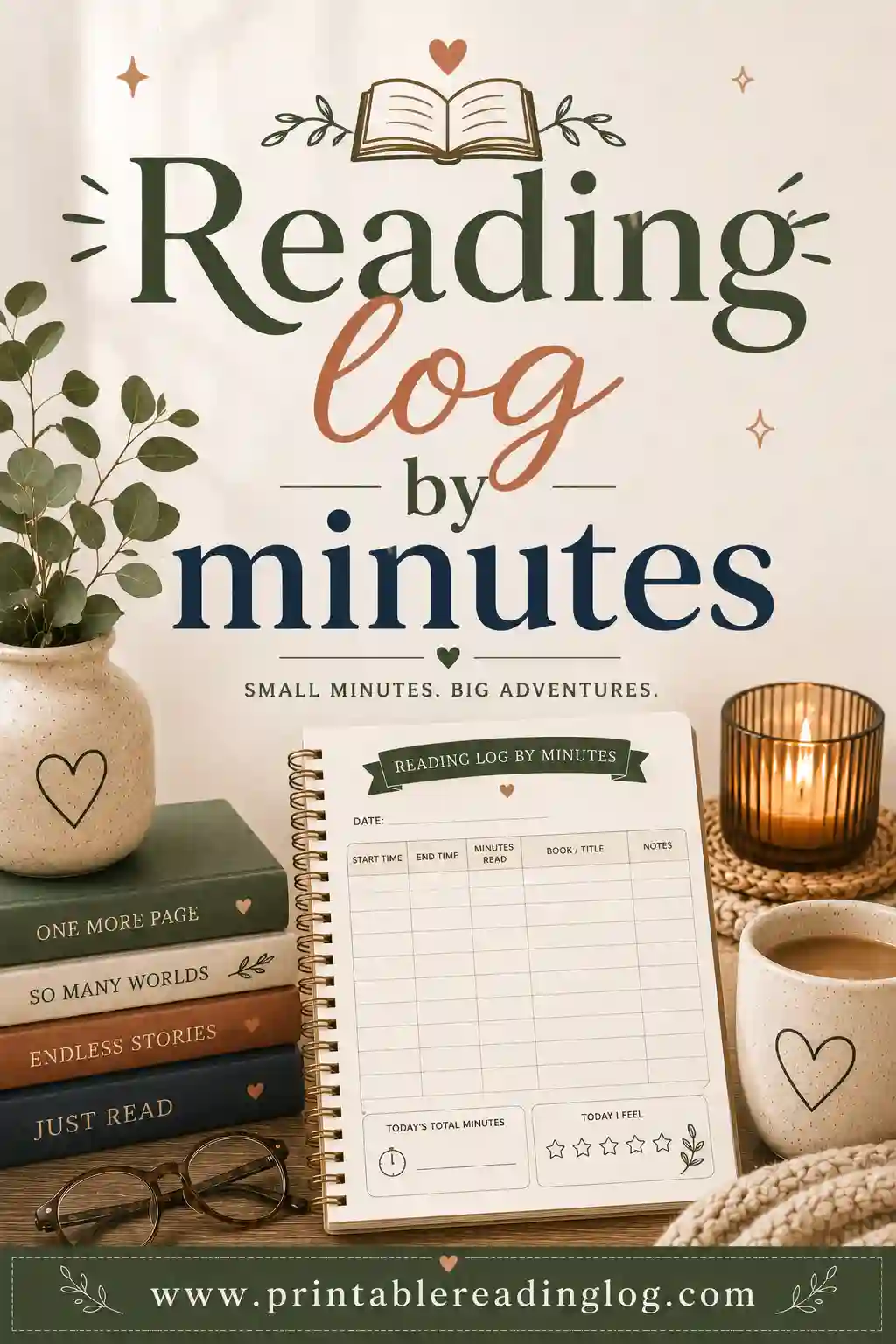
- What are you logging?: choose Minutes. Minutes treat a 15-minute decoding session and a 15-minute audiobook chapter the same way on paper, which is fair for effort.
- Columns: turn on Title, Pages/Minutes, Notes and Initials (P/T). Add Date finished if the teacher wants dates. Leave Author off for younger kids to save writing. Leave Genre off unless the class is doing a genre challenge.
- Rating style: Smiley works well. It's a quick circle instead of a written response. Turn on the Star rating column if your child enjoys rating books.
- Color theme: any theme is fine. Classic prints most clearly on a home printer, and a calm, plain page can feel less busy for some readers.
- Paper: Letter for the US, Portrait.
- Rows per page: fewer rows mean bigger writing spaces. For a child who struggles with handwriting, choose a lower number so each row has room for big letters.
- Goal tracker: turn on the 10 or 25 square bar. Each square can stand for one session of any type. Coloring a square right after reading gives a quick, visible win.
- Month: set the month if your log covers a month.
- Coloring strip: keep it on for younger kids if they like it.
- Click 🖨️ Print / Save PDF.
How to fill it in: In the Notes column, write the code first (O, S, RA, L, L+T or T), then anything else. In Pages/Minutes, write the minutes. In Initials, you or the teacher initial the row.
Want two logs instead of one? Some families find it cleaner to keep separate pages. Print one log with the Kids preset for own reading, and a second with the Audiobook preset for listening. Staple them together. The teacher sees both, and the own-reading page doesn't look thin next to a full listening page. For more on logging listening time, the guide on how to log audiobooks goes further, and there's a ready-made audiobook log page too.
Recommended setups by age
| Age or grade | Preset | Log style | Columns | Rows | Extras |
|---|---|---|---|---|---|
| Kindergarten to 1st grade | Picture books or Kids | Kid-friendly | Title, Pages/Minutes, Initials (P/T) | Fewest rows | Smiley rating, coloring strip, 10-square goal bar |
| 2nd to 3rd grade | Kids | Kid-friendly | Title, Pages/Minutes, Notes, Initials (P/T) | Low | Smiley rating, 25-square goal bar |
| 4th to 5th grade | Kids or Weekly log | Kid-friendly | Title, Pages/Minutes, Notes, Star rating, Initials (P/T) | Medium | Books I want to read next |
| Middle school | Weekly log or Monthly log | Adult-clean | Title, Author, Pages/Minutes, Notes, Date finished | Medium | Star rating, Recommend? (Y/N) |
| High school | High school or Audiobook | Adult-clean | Title, Author, Pages/Minutes, Notes, Date finished, Genre | Medium to high | Number rating, challenge bar |
These are starting points. If a column causes stress, drop it. A shorter log that gets filled in beats a perfect log that sits in the backpack.
Sample Weeks You Can Copy
Seeing a filled-in week helps. Here are a few realistic patterns. Use them as ideas, not targets, and match the amounts to what the teacher and any tutor recommend.
Sample week: 2nd grader, early in intervention
| Day | Code | What | Minutes | Initials |
|---|---|---|---|---|
| Mon | O | Decodable reader from school | 8 | Parent |
| Mon | RA | Bedtime chapter book | 15 | Parent |
| Tue | L+T | Picture book with audio, following along | 10 | Parent |
| Wed | O | Same decodable reader, reread | 8 | Parent |
| Wed | RA | Bedtime chapter book | 15 | Parent |
| Thu | T | Tutor session | 30 | Tutor |
| Fri | S | Take-turns page reading | 10 | Parent |
| Sat | L | Audiobook in the car | 20 | Parent |
Notice how short the own-reading entries are. That's normal. Decoding practice is tiring when it's hard, and a few focused minutes can be worth more than a long, frustrating session. Ask the teacher or tutor what length makes sense for your child.
Sample week: 4th grader who loves long stories
| Day | Code | What | Minutes | Initials |
|---|---|---|---|---|
| Mon | L | Chapter book audiobook, chapters 4 and 5 | 30 | Parent |
| Mon | O | Leveled book at their level | 10 | Parent |
| Tue | L+T | Same chapter book, chapter 6, following print | 20 | Parent |
| Wed | O | Graphic novel, reading the speech bubbles | 15 | Parent |
| Thu | S | Class novel, alternating pages | 15 | Parent |
| Fri | L | Audiobook before bed | 25 | Parent |
| Sun | O | Leveled book, reread a favorite part | 10 | Parent |
This child's listening is well above grade level, and their own reading is matched to their decoding level. Both show up on the log. A teacher reading this sees a kid who's engaged with books every day and doing steady practice.
Sample week: 7th grader using audiobooks as an accommodation
| Day | Code | What | Minutes |
|---|---|---|---|
| Mon | L+T | Class novel, assigned chapters | 35 |
| Tue | L | Free-choice audiobook | 30 |
| Wed | L+T | Class novel, assigned chapters | 35 |
| Thu | O | Short articles on a favorite topic | 15 |
| Fri | L | Free-choice audiobook | 40 |
| Sat | O | Graphic novel | 20 |
Older students often feel embarrassed by a log that shows "easy" books. Using minutes and short codes keeps the focus on time and effort, not on book levels. It's also more private if the log gets passed around.
Listening Well: Making Audiobook Time Count for More
Not all listening is equal. Twenty minutes of an audiobook playing in the background while your child builds blocks is different from twenty minutes of curled-up, paying-attention listening. Both are fine, but if you want listening time to carry real weight on the log, a few habits help.
Pick books at their thinking level, not their decoding level. This is the whole point of listening. If your fourth grader loves animal adventure stories, try a long, rich one, even if they couldn't decode the first page. Public-domain classics such as The Wind in the Willows, Black Beauty, The Secret Garden and Treasure Island are widely available as free audio recordings through libraries and public-domain collections, and they're full of words kids won't meet in easier books.
Try following along sometimes. Listening while tracking the printed words, with a finger or a reading strip, links the sounds to the print. Some children with dyslexia find this helpful, and some find it tiring or distracting. Try it in short bursts, maybe one chapter a week, and see how your child responds. Ask the teacher or tutor whether they recommend it for your child.
Adjust the speed. Many audiobook players let you slow narration down a little or speed it up. A slightly slower pace can help with following along. A normal pace is usually fine for listening only.
Talk about it after. A two-minute chat turns listening into a comprehension workout. You don't need a worksheet. Try:
- "What happened in that chapter?"
- "Who do you think is going to cause trouble next?"
- "Was there a word you didn't know?"
- "If you were in the story, what would you have done?"
- "Which part would make a good picture?"
Let them retell it into the log. If the log has a summary or Notes column, your child can say one sentence out loud while you write it, or they can draw a tiny picture. That's still their thinking on the page. If the teacher wants a written response, ask whether dictation is okay. The guide to reading logs for special education has more ideas for adapting the written parts of a log.
Free and low-cost ways to find audiobooks
- Your public library's digital lending app, which usually includes audiobooks
- Physical audiobook kits at the library, often a book plus an audio recording
- Free public-domain recordings of classic stories
- Organizations that provide accessible-format books to students with print disabilities, which some schools can help you sign up for (ask the school's reading specialist)
- Text-to-speech features already built into most phones, tablets and computers
Ask the librarian, too. Many children's librarians are happy to suggest listening picks by age and interest.
When the Reading Log Turns Into a Nightly Battle
For a lot of families, the reading itself isn't the hardest part. The log is. Writing titles, counting minutes and filling in summaries can take longer than the reading did, and for a child who already works twice as hard at school, that extra paperwork can tip a good evening into tears.
Here are common problems and fixes that don't require anyone to bend the truth.
| Problem | What might be going on | Try this |
|---|---|---|
| Writing the title takes forever | Spelling and handwriting are hard, and titles are long | Write the title once at the top of the week and use "same" or an arrow on later rows. Or the parent writes it while the child watches. |
| Child melts down at the summary box | Written responses are a separate, harder skill | Ask the teacher if a spoken retell, a drawing or one dictated sentence is okay |
| Own-reading time ends in frustration | The book is too hard, or the session is too long | Ask the teacher for books at the right decoding level and keep sessions short. Stop on a success. |
| Child says listening "doesn't count" | They've heard that from someone, or they feel like it's cheating | Explain the two jobs: listening grows your story brain, practice grows your decoding brain. Both go on the log. |
| Log comes back with a low grade | Teacher didn't know about the format codes, or the minutes goal assumed fluent reading | Send the teacher note from earlier in this guide and ask how they'd like it handled |
| Sibling comparisons | A younger sibling reads harder books alone | Keep logs private at home. Celebrate each child's own squares on the goal bar. |
| You forget to log | Busy evenings, tired parents | Keep the log and a pencil next to the bed or wherever reading happens. Fill it in right after, not later. |
| Child wants to quit reading | Reading has become linked to stress | Take a few days of listening-only, just for fun, and check in with the teacher about the pressure |
A word about honesty. It's tempting to round up, or to write "read alone" when it was really a read-aloud, so your child doesn't look behind. Try not to. An honest log helps the teacher and any tutor see what's actually working. If own-reading minutes are low, that's useful information for them, not a mark against your child. And your child notices when the log matches what really happened. That builds trust in the whole process.
Protect the love of stories. If you only remember one thing from this guide, make it this: keep at least some reading time completely free of correction and pressure. A bedtime read-aloud where nobody asks your child to sound out anything. An audiobook in the car just because it's a great story. That time is what keeps a child with dyslexia believing books are for them. It also counts on the log.
A quick evening routine that works for many families
- Practice first, while energy is higher. Do the short own-reading session early in the evening, not right before bed.
- Log it right away. One row, the "O" code, the minutes. Color one goal square.
- Story time later. Read-aloud or audiobook, at whatever pace and length feels good.
- Log that too. One row, "RA" or "L," the minutes. Color another square.
- Done. No extra worksheet, no long discussion unless your child wants one.
This takes about two minutes of logging a night. If it's taking longer, the log is probably asking for too much. Simplify the columns or talk to the teacher.
Things that usually shouldn't go on the log
Being generous about what counts doesn't mean anything goes. These usually aren't logged as reading time, though you can always ask the teacher if you're unsure:
- Shows or movies, even ones based on books
- Video games, unless the teacher has said a text-heavy game counts
- Time spent looking for a book or setting up the audiobook
- Audiobooks that played while your child was asleep or clearly not listening
- Homework worksheets for other subjects, unless the teacher counts them
If something falls in a gray zone, such as a long recipe your child read out loud while cooking with you, a short note in the margin is better than a full row. Let the teacher decide how to count it.
Talking to your child about what counts
Children with dyslexia often pick up the idea, from classmates or from their own struggles, that "real" reading only happens when you read every word yourself. How you talk about the log can gently push back on that.
Try phrases like these:
- "Listening to a book is a real way to read. Lots of grown-ups read with their ears."
- "Your practice reading is like training. It's shorter because it's hard work, and that's how training should be."
- "This log shows everything you did with books this week. Look how many squares you colored."
- "Your brain understood that whole chapter. That's reading."
- "The teacher wants to see both kinds, so we're writing both down."
You can also let your child see you log your own listening. If you listen to audiobooks on a commute or while doing chores, mention it. Kids notice what adults treat as normal.
Make Your Log Today
You now have everything you need to answer the question at the top of this page for your own family. Talk to the teacher, pick a simple code system, and log both listening and practice so your child gets credit for all the reading they really do.
Open the free printable reading log maker, choose the Kids preset, switch to Minutes, turn on the Notes and Initials (P/T) columns, add a 10 or 25 square goal bar, and print. If you'd like more ideas for the kids' version, the reading log for kids page has more layouts, and the read-aloud log for parents is handy if most of your reading together is out loud.
▶ Open this reading log ready to print
Frequently Asked Questions
Do audiobooks count as reading for a child with dyslexia?
At many schools, yes, especially for building vocabulary, comprehension and a love of stories. Some schools also list audiobooks as a formal accommodation. Policies vary, so ask your child's teacher whether listening counts toward the reading log goal and how they'd like it marked.
Does being read to count on a reading log?
Often it does, particularly for younger kids and for children who are still building decoding skills. Log it separately from your child's own reading, with a code like "RA," so the teacher can see both. If the teacher wants independent reading only, keep the read-aloud entries on a separate page for yourself.
How much independent reading should my child with dyslexia do?
That depends on your child, their current skills and any intervention plan they're on. Ask the teacher, reading specialist or tutor for a target. Short, focused practice at the right level is often more useful than long sessions with books that are too hard.
Is it cheating to use audiobooks for a reading log?
No, as long as you log them honestly as listening. Cheating would be writing that your child read a book alone when they actually listened to it. A clear code on each row keeps everything above board and gives the teacher the full picture.
Should my child follow along in the book while listening?
Some children with dyslexia benefit from tracking the printed words while they listen, and others find it tiring. Try it in short bursts and watch how your child responds. Your child's teacher or tutor can tell you whether they recommend it.
What if my child can't write the log entries?
Let them dictate while you write, use short codes or color dots instead of words, and choose fewer rows per page so writing spaces are bigger. Ask the teacher whether a spoken or drawn response is okay in place of any written summary.
Should I log tutoring sessions?
Ask the teacher. Some count tutoring or intervention time as reading practice, and others want the log to show home reading only. If it's allowed, mark it with its own code, such as "T," so it's easy to spot.
What's the best type of reading log for a child with dyslexia?
A log that tracks minutes, not pages, with a Notes column for a format code and as little required writing as possible. The free reading log maker lets you build one in a few minutes with the Kids preset, the Minutes setting and a short goal bar.
Will logging listening make my child's reading look worse?
Usually the opposite. Separating listening from own reading shows the teacher how much your child engages with books, while the own-reading rows show steady practice. That's a more accurate and encouraging picture than a thin log with only a few short decoding sessions on it.