Run a School Read-a-Thon: Reading Log and Sponsor Pledge Sheet
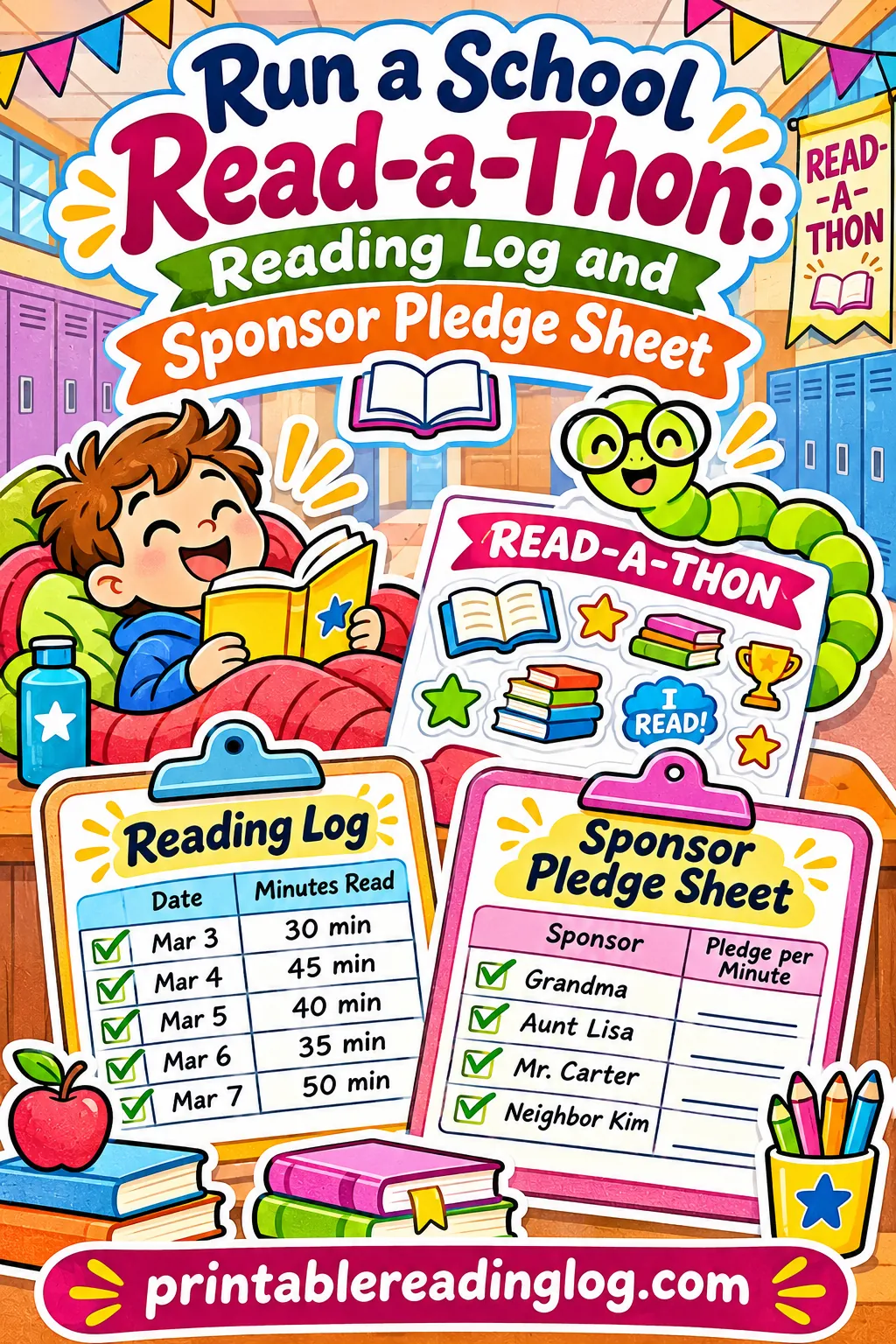
Every student in a school read-a-thon carries two pieces of paper: a minutes log they fill in at home, and a sponsor sheet where relatives and neighbors write down a flat gift or a capped per-minute pledge. If those two sheets are clear, the rest of the event mostly runs itself. If they are muddled, the PTA spends a week of evenings untangling them.
This plan is for the volunteer who raised a hand at the fall meeting and now owns the read-a-thon. You won't need a paid fundraising platform. You need a counting unit the whole school agrees on, a logging window with a hard end date, sheets a seven-year-old can fill in, and a tally plan that exists before the first log comes back in a crumpled folder.
📚 Printable Reading Log: make this log in 10 seconds
Set the name and goal, preview it, then print it free.
Free printables for this page
Ready-made, one-page PDFs from Printable Reading Log. Print as is, or change the columns in the maker above. See all free printable reading logs.
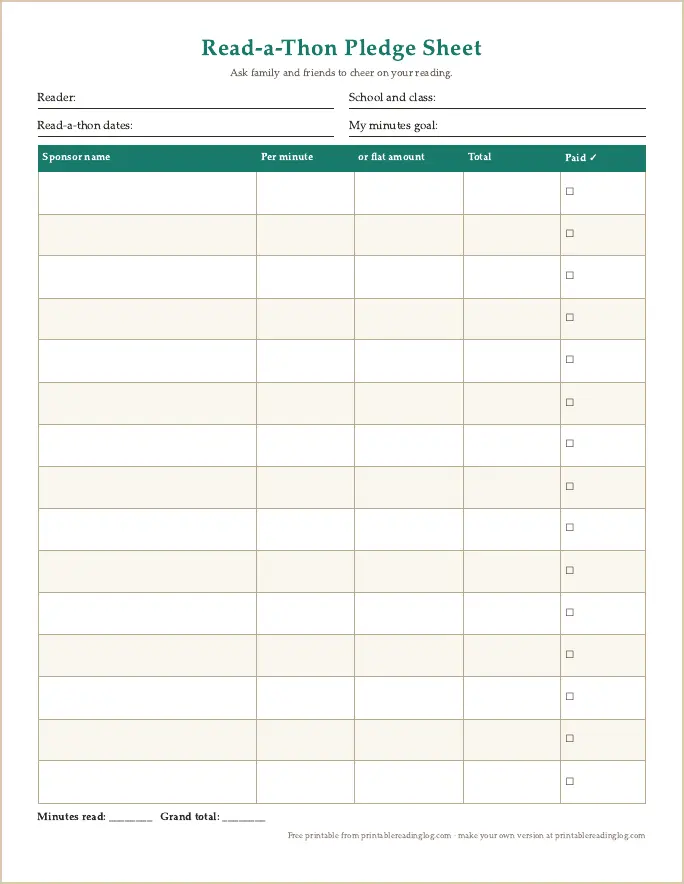
Read-a-Thon Pledge Sheet
A sponsor sheet for a school read-a-thon: sponsor, pledge per minute or flat amount, total and paid check box.
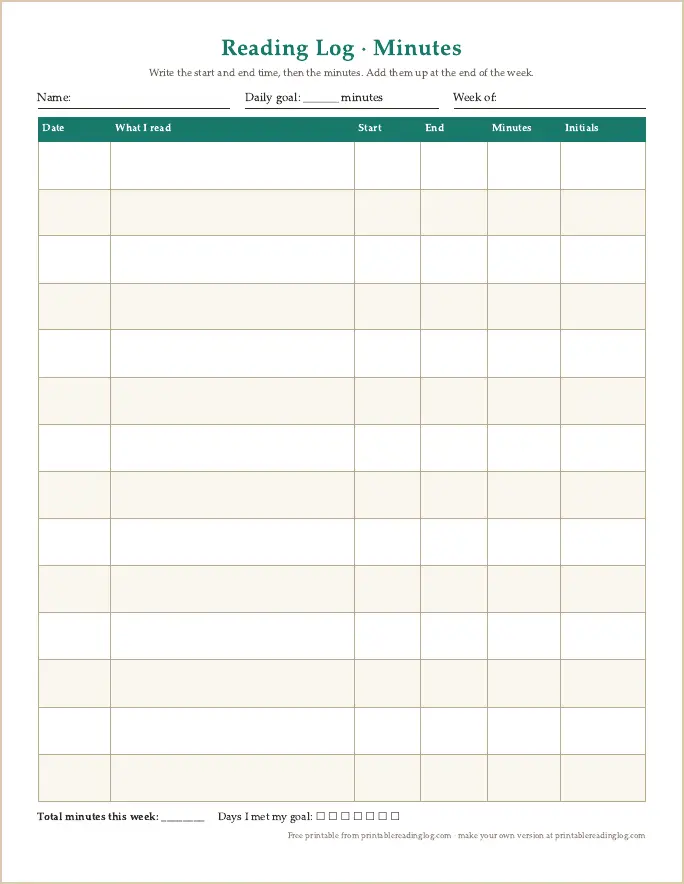
Reading Log by Minutes
A nightly minutes log with start and end times, minutes read, parent initials and a weekly total box.
Decide these before any packet goes home
- One unit for the whole school (minutes is the fairest)
- Two pledge types only: flat gift or per-minute with a cap
- Whether reading during the school day counts
- The last logging day and the turn-in deadline
- Who handles money, and how two people sign off on it
Why a paper read-a-thon still suits a whole school
A read-a-thon is a reading challenge with a fundraising side. Students read for a set stretch, usually one to three weeks, while family and friends back them with either a fixed gift or a pledge tied to how much they read. When the window closes, the log comes back, sponsors pay what they promised, and the school celebrates both the minutes and the total.
Keep the order of those two things straight in every message you send. The reading is the event; the money is a welcome side effect. A child with fourteen cousins and a child with no sponsors at all should both feel the event belongs to them, and that only happens if posters, announcements and prizes lead with minutes.
Paper earns its place here for practical reasons. Every family can use it without a login, an app or an email address. A second grader coloring one square for every ten minutes can see progress in a way a number on a screen never shows. A teacher can flip through a stack of logs with a parent initial column and spot a missing week in seconds. And the school owns the format, so nobody is tied to a platform's fees or account rules. If you have looked at apps and want to compare, the page on free alternatives for running a reading challenge covers the digital side.
The cost of paper is that somebody has to add things up. That is why a good chunk of this plan is about the counting, and why the sheet layouts below are built to make that counting fast.
Splitting the job between a minutes log and a sponsor sheet
Resist the urge to put everything on one page. A combined form gets crowded, and crowded forms come back half filled. Give each sheet one job.
| Sheet | Who fills it in | What it records | When it comes back |
|---|---|---|---|
| Minutes log | Student, with an adult initialing each day | Date, book, minutes, initials | On the turn-in deadline |
| Sponsor sheet | Sponsors, helped by the parent | Name, contact, pledge type, rate, cap, amount due, paid | A copy before reading starts, then again with payments |
Some schools staple the two together. Others send the sponsor sheet home a full week early so families have time to call grandparents, and the log follows on day one. Either schedule can run smoothly, provided both sheets carry the student's name, teacher and grade in the same spot at the top. A loose page with that header always finds its way back to the right folder.
Count minutes rather than pages or books if your event spans several grades. A kindergartner's picture book and a fifth grader's chapter book take wildly different effort per page, and minutes treat them the same. Read-alouds fit naturally, since twenty minutes of listening is twenty minutes on the log. Sponsors also understand "per minute" or "per hour" without any explanation. Pages can work for an upper-grade-only event and books for a short primary event, but for K through 5 or K through 8, minutes saves a lot of awkward questions. The minutes-based log format page shows what that layout looks like on its own.
Laying out the sponsor sheet column by column
This layout fits on one Letter or A4 page turned to landscape, with room for twelve to fifteen sponsor rows. Copy it into a word processor or spreadsheet, or rule it by hand if that is faster.
Across the top, print the student's name, teacher and grade, the read-a-thon dates, the log turn-in deadline and the payment deadline, followed by a short friendly line such as "You are cheering on a reader this month." Then the sponsor table:
| Column | What goes in it | Why it is there |
|---|---|---|
| Sponsor name | First and last name | So the school can thank them |
| Relationship | Grandparent, neighbor, aunt, family friend | Helps the parent follow up |
| Contact | Phone or email, sponsor's choice | Payment reminder and thank-you only |
| Pledge type | Flat or per-minute (circle one) | The column counters read first |
| Rate | Amount per minute or per hour | Blank for a flat gift |
| Cap | The most this sponsor will give | Protects sponsors from surprises |
| Flat amount | The gift, if flat | Blank for per-minute |
| Amount due | Filled in after counting | Calculated by a volunteer |
| Paid | A checkbox | So nobody is asked twice |
The footer needs four lines: total of flat gifts, total due after counting, total collected, and a sentence on how to pay, for example "Send payment in a sealed envelope marked with your child's name and teacher, or use the school's usual payment method." Leave a small box for the volunteer who checks the sheet to initial.
Flat gifts versus per-minute pledges with a cap
Offer exactly two choices. Every extra option is another way for a counter to make a mistake at nine o'clock on tally night.
A flat gift is a set amount no matter how much the child reads. Plenty of sponsors prefer it, and it can be collected before reading even begins, which makes the treasurer's life easier.
A per-minute pledge promises an amount for every minute or hour read, up to a maximum. That maximum is not optional. A child who discovers a series she loves can turn a small rate into a total far beyond what Grandpa pictured, and nobody wants that phone call. With a cap written on the sheet, the sponsor knows the ceiling from the start.
The math is simple enough to print on the sheet itself: multiply the student's total minutes by the rate, compare the result with the cap, and the amount due is whichever number is smaller. If your school prefers per-hour pledges, divide total minutes by 60 first and decide in advance whether you round down or to the nearest quarter hour. Put that rounding rule in the family letter. Sponsors and parents like being able to check the figure themselves, and a printed rule ends most disputes before they start.
Keeping sponsor details private
Sponsor sheets ride around in backpacks and pass through a lot of hands, so collect as little as you can. One contact method per sponsor is enough unless your school genuinely needs addresses for receipts. Leave birthdays, home addresses and photos off both sheets entirely.
Tell families plainly who will see the sheet, which is normally the classroom teacher and the PTA counters, and what happens to it afterward. Once payments are reconciled, shred or return the sheets according to your school's records rules. When you thank sponsors publicly, a general note to "everyone who backed our readers" is plenty; names go public only with permission.
Fundraising rules differ from district to district. Some limit who may handle cash, some forbid door-to-door asking, and some require specific receipts. Ask your principal or PTA treasurer for the local rules before you finalize the sheet rather than working from what another school did.
Building the minutes log for each grade band
The log is the sheet kids touch every day, so spend your care there. In the reading log maker, start from the Classroom preset if logs will pass through teachers, or the Kids preset for a friendlier look that goes straight home. Set the log to count minutes, then type the school target into the reading goal line, something like "300 minutes in 2 weeks," so it prints across the top. Turn on the date, title, pages/minutes and initials columns, and add author for older students. A two-week event fits well with 14 to 16 rows, one per day plus a couple of spares; a three-week event needs a second page or a longer sheet.
The goal squares are what younger kids remember. With 25 squares and a 250-minute goal, each square is ten minutes; with 50 squares and 500 minutes, it is still ten. Use the challenge bar for a single line such as "Read-a-Thon: Feb 3 to Feb 14." The plainest color theme copies cleanly in black and white on a school machine. Save the finished PDF somewhere shared, because a lost log in week two is much easier to replace from a saved file than by rebuilding the sheet.
| Grade band | Style | Columns | Goal squares | Note |
|---|---|---|---|---|
| Pre-K and K | Kid, Kids preset | Date, minutes, initials | 10 | Parent writes, child colors |
| Grades 1 and 2 | Kid | Date, title, minutes, initials | 25 | A tiny drawing can stand in for a title |
| Grades 3 to 5 | Kid or adult | Add author | 25 or 50 | A smiley rating adds fun |
| Grades 6 to 8 | Adult, Classroom preset | Add star rating | 50 or 100 | Students initial; parent signs at the end |
| Family or staff division | Adult | Date, title, minutes | 50 | A friendly side challenge for grown-ups |
The initials column does more quiet work than anything else on the page. A parent or teacher scribbling two letters next to each day keeps totals believable and gives counters something to trust. For families with three children in the event, print each child's log in a different color theme so the sheets stop getting swapped on the kitchen counter. A teacher running a smaller version inside one room may prefer the class minutes goal tracker, which adds everyone's time toward a shared target.
Deciding what counts as reading time
Families will ask this the first evening, so answer it on the log itself. A generous rule is easiest to defend: reading alone, reading aloud to someone, being read to, audiobooks, graphic novels, magazines, ebooks, reading in another language, and reading to a younger sibling or the dog all count. Watching a show based on a book does not, and neither does time in apps that are mostly games. If your school uses an approved reading app, say whether its minutes count.
The one gray area worth settling is reading done during the school day. Many schools count home reading only, so the event adds reading instead of relabeling minutes that were happening anyway. Others count every minute. Either rule is defensible; what matters is that it is printed on the log so no parent has to guess. If the graphic novel question comes up at a meeting, the page on whether graphic novels count has the reasoning, and the page on daily reading targets by age helps you set a per-student goal that stretches kids without discouraging them.
A four-week countdown to day one
Volunteers nearly always underestimate setup. Give yourself about four weeks before reading starts and another week or two afterward for counting and collection.
| When | Task | Who |
|---|---|---|
| 4 weeks out | Principal and PTA approval, dates, fundraising rules | PTA chair, principal |
| 4 weeks out | Unit, pledge types, cap rule, what counts, deadlines | Read-a-thon lead |
| 3 weeks out | Build both sheets; one teacher proofreads | Lead, a teacher |
| 3 weeks out | Recruit counters, about one per two or three classes | Lead |
| 2 weeks out | Print and sort into class packets | Volunteers, office |
| 10 days out | Family letter and sponsor sheet go home | Teachers |
| 1 week out | Announce at assembly or morning announcements | Principal, lead |
| Day 1 | Minutes log goes home; reading begins | Teachers |
| Midpoint | Short "halfway there" note home | Lead |
| Deadline day | Collect logs; grace period starts if you have one | Teachers |
| Week after | Count, fill in amounts due, send payment notes | Counting team |
| Two weeks after | Collect, mark paid, celebrate, thank sponsors | Lead, treasurer |
Of all those dates, the turn-in deadline matters most. An event with a soft ending drags on for weeks, totals keep shifting and counters lose patience. Print the deadline in bold on the log, the sponsor sheet and the letter, and say it again in the midpoint note.
The family letter and the half-page sponsor note
A short letter saves hours later, because families who understand the rules fill in the sheets correctly. Adapt this one:
Our Read-a-Thon starts [date].
Dear Families, from [start date] to [end date] our school is holding a Read-a-Thon. We want more reading at home, and a little help toward [what the money funds, such as new classroom libraries].
Your child reads at home on as many days as possible. Reading alone, being read to, audiobooks and graphic novels all count. Each day, your child writes the date, the book and the minutes on the log, and you add your initials.
If you wish, invite family and friends to sponsor your child on the sponsor sheet, with a flat gift or a per-minute pledge that has a maximum. Every child takes part in the reading whether or not they have sponsors.
Please return the log by [deadline]. After we count, we will send home what each sponsor owes; payments are due by [payment deadline]. Questions go to [volunteer name and contact]. We are grateful you read with your child.
That third paragraph is the one to protect when the letter gets edited by committee. Some families cannot ask relatives for money, and children notice quickly who is left out, so every flyer and announcement should repeat that reading counts with or without sponsors.
Many kids feel shy asking an adult for a pledge, and a half-page note gives them words to hand over instead of having to say them:
I'm reading for my school's Read-a-Thon. From [start] to [end], I'm aiming for [goal] minutes. Would you sponsor me? You can give a set gift, or a small amount for every minute I read, up to a maximum you pick. You only pay after I finish, and I'll show you my log. From [child's name]
Four of these fit on one sheet. Cut them apart and let kids tuck one into a card for a grandparent who lives across the country.
Pledge rules that keep sponsors comfortable
Almost every read-a-thon headache traces back to a pledge rule nobody wrote down. Settle these before reading starts.
Refuse any per-minute pledge without a cap. If a sheet comes back with the cap box empty, a volunteer should check with the family before day one, not after the minutes are in. List the flat gift first on the sheet; many sponsors pick it when they see it at the top, and it is the easier option to collect and count.
If pledges are per hour, decide what 45 minutes means. "Nearest quarter hour" is easy to explain, and per-minute pledges avoid the problem altogether. Set the deadline with a short grace period, for example "Logs due Friday; logs in by Monday still count; after that we can't add minutes," and then hold to it for every family equally.
Occasionally a log comes back with numbers that look enormous. Plenty of kids really do read for three hours on a rainy Saturday, so don't accuse anyone. Recheck the adding, then trust the initials. If a teacher has a genuine concern, a friendly chat about the best book on the log usually settles it. The cap protects the sponsor either way.
Plan for students with no sponsors from the beginning. Some schools award class or grade-level prizes based on total minutes, so every child moves a team goal. Others ask a few staff members or local businesses to sponsor the whole school, which gives every reader at least one backer. Keep rewards about reading, too: extra recess, a pajama reading afternoon or a class read-aloud party all celebrate books, and the low-cost reading rewards page has more.
Tally night: counting logs and filling in amounts due
Counting is where a paper read-a-thon keeps or loses its volunteers. Have teachers keep returned logs and sponsor sheets clipped together in one folder per class, with a cover list showing two boxes beside each name: log in, pledges in. Each class also gets a counting sheet with student name, total minutes, number of sponsors, flat total, per-minute total and amount due. A spreadsheet is welcome if one volunteer enjoys them, but paper works.
Add minutes first. Have a second volunteer recheck any log above roughly twice the school goal, purely for arithmetic slips. Then, for each per-minute sponsor, multiply minutes by rate, compare with the cap, and write the smaller figure in the amount due column. Photocopy the sponsor sheet before it goes home so the school keeps a record, and let the treasurer handle money according to your school's cash rules, which usually means two people count together and both sign.
For a large school, gather four to six volunteers for one evening or one morning. Give each pair a stack of class folders, a calculator and a pen in a color no family used. Once a pair finds its rhythm, a class goes by in well under an hour, and a second pair checks the high totals. Bring snacks; people come back next year to a counting night that felt like a party.
| Problem | What to do |
|---|---|
| Log with no name | Match by folder and handwriting, or ask the teacher; next year have teachers pre-write names |
| Pledge with no cap | Ask before reading starts; if it is already over, ask the sponsor directly |
| Lost log midway | Print a fresh one from the saved PDF and let the family rebuild it with initials |
| Hours and minutes mixed | Convert to minutes; bold "minutes only" on next year's sheet |
| Log after the grace period | Thank the family, count it toward class goals if you can, explain pledge totals already went out |
| Sponsor wants to change | Before reading, update it; after, let them switch to a flat gift |
| Sponsor never pays | One polite reminder through the family, then let it go; never pressure the child |
If a family wants to give without sponsors, accept with thanks and add a "family gift" line to next year's sheet.
Celebrations, thank-you notes and other formats
Kids remember the celebration long after they forget the sheets. Show the school total in minutes on something big: a paper thermometer in the front hall, or a paper chain where each link is an hour of reading. Share the money total if you like, but in smaller print. Give every child who returned a log a certificate, name a most-improved reader in each class, and reward the class with the highest average minutes. Avoid prizes that go only to students with the most sponsors.
Thank sponsors twice, once with a note or drawing from the child and once with a short PTA message about what the money will buy. If it paid for classroom libraries, photograph the new shelves (without student faces unless you have permission) and send the picture home. Families who see where the money went say yes again.
The same two sheets adapt to smaller events. A single teacher can run a one-class version with a flat-gift-only sponsor sheet and a classroom reading log that stays at school. A reading-only version drops the sponsor sheet altogether, which suits a spring screens-off week. A family reading night in the gym uses one shared page with a row per family member. Middle schoolers can run their own event through student council, with homeroom teams and a teacher checking the counts. A break-time version uses a two-week log and a deadline on the first Friday back; the winter break challenge for kids has ideas for that stretch. Libraries and scout troops can swap "teacher and grade" for "group" and follow their own organization's fundraising rules, and the library reading log page covers that setting.
Before you box everything up, spend fifteen minutes writing notes for next year: how many logs came back out of how many went home, which grade found the sheets confusing, how long counting took and with how many people, which pledge questions came up more than once, and what families said they liked. Keep those notes with the saved log PDF, the sponsor sheet file and the letter in one shared folder. Moving the deadline to the top of the log or adding a single line about what counts can make the second year noticeably smoother.
Questions PTA volunteers ask before launching a read-a-thon
How many sponsor rows should the sheet have?
Twelve to fifteen rows fit on one landscape page and cover nearly every family. A child with more sponsors than that can use a second sheet stapled behind the first, with the same name and teacher written at the top so it stays with the original.
What is a sensible cap to suggest for per-minute pledges?
Let sponsors choose their own cap, but print an example in the family letter so they have a reference point, and make sure the cap box is filled before reading starts. A volunteer who checks sheets the week before day one catches almost every blank.
How long should the reading window be?
Most schools run one to three weeks, and two is a popular choice because it builds a habit without kids losing interest. Whatever you pick, put the turn-in deadline a day or two after the last reading day, not a week later.
Should parents initial every single day?
For elementary grades, yes, because daily initials make totals easy to trust and quick to count. Middle schoolers can initial their own rows, with one parent signature at the bottom of the finished log.
What if a teacher doesn't want to collect money?
Teachers only need to collect the logs and sponsor sheets. Payments can go in sealed, labeled envelopes to the office or through the school's usual payment method, with the treasurer and a second volunteer handling the counting.
Can younger siblings who aren't enrolled join in?
Many schools welcome them on a family log that counts toward celebrations but not toward a student's pledges. Decide this in advance and mention it in the letter, since families with toddlers often ask.
What do we do with the sheets after the event?
Keep the class counting sheets and copies of sponsor sheets until payments are reconciled, then shred or return them according to your school's records rules. Save the blank log PDF and the sponsor template for next year.