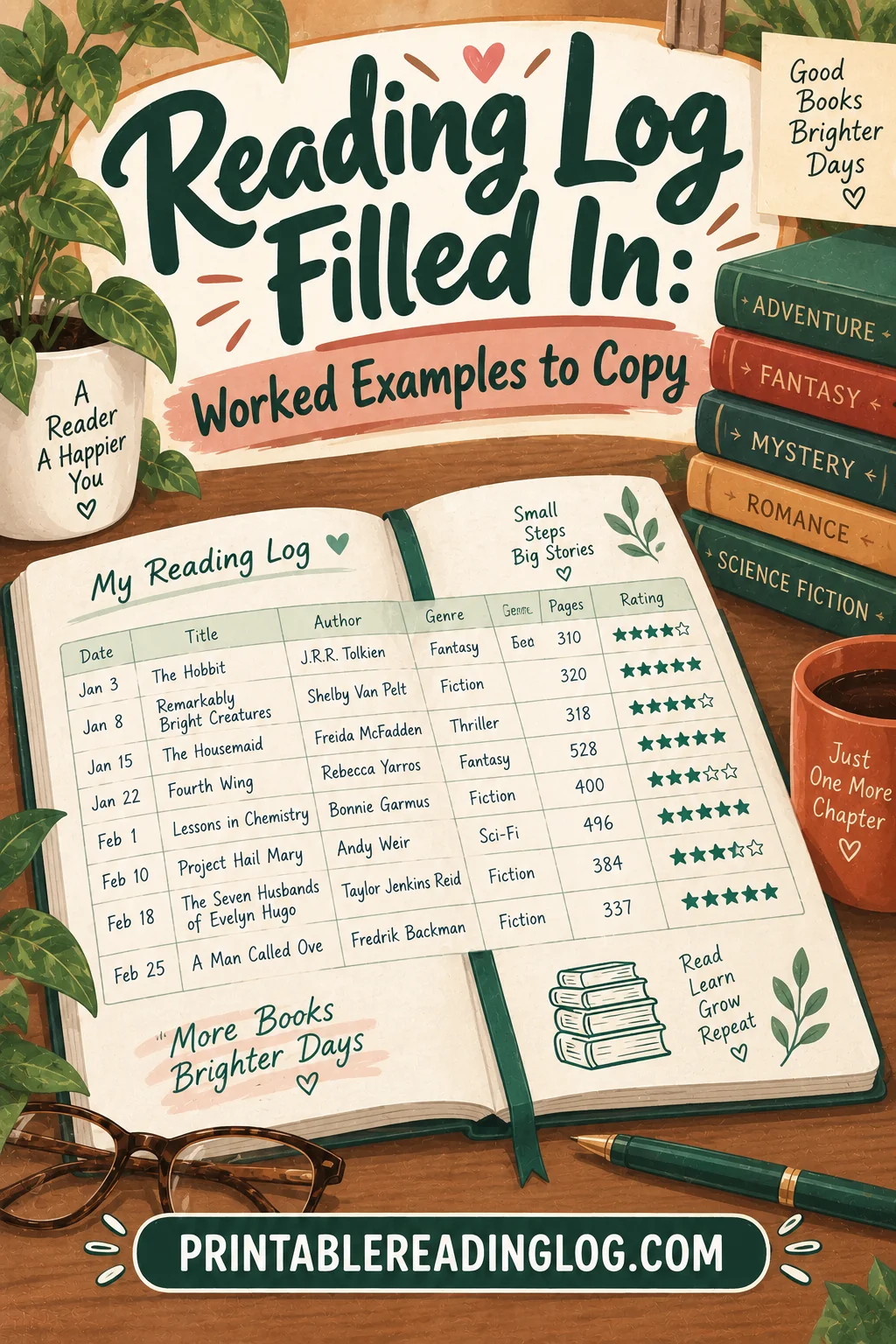
Reading Log Filled In: Worked Examples to Copy
A reading log filled in correctly has four things in every row: the date, the title, how much was read, and nothing else unless the school asked for it. Everything past those four columns is where logs go wrong, and the examples below show exactly what a good row looks like at four different reading ages.
If you have ever stared at a blank grid wondering how much detail belongs in each box, this is the answer: less than you think, and the same amount every time.
What One Good Row Looks Like
Here is a completed row for an eight-year-old reading a chapter book:
| Date | Title | Pages | Initial |
|---|---|---|---|
| Mar 4 | The Wild Robot | 22-38 | LR |
That is a finished entry. It took about eight seconds to write. The date is abbreviated, the title is written the way the child says it rather than copied off the cover in full, the pages are a range so you can see the progress, and the initial is there because the school asked for it.
Notice what is not there. No summary. No star rating. No genre. No "what I learned." Those are the fields that turn a fifteen-second task into a five-minute one, and a five-minute task is the reason children start hiding the folder.
Example of a Reading Log for a Six-Year-Old
Early readers cannot write much, and the log should not ask them to. Minutes rather than pages, short titles, and an adult doing the parts that involve handwriting stamina.
| Date | Book | Minutes | Grown-up |
|---|---|---|---|
| Mon 3 | Frog and Toad | 10 | AR |
| Tue 4 | Frog and Toad | 10 | AR |
| Wed 5 | The Gruffalo (again) | 15 | AR |
| Thu 6 | Dog Man | 10 | AR |
| Fri 7 | The Gruffalo (again) | 10 | AR |
Two things in that week are worth pointing out, because parents often try to fix them and should not.
The same book appears three times. Re-reading is not wasted time. It is how early readers build fluency and confidence, and a book read for the fourth time is the book where a child finally reads smoothly instead of decoding word by word. Log it, and write "(again)" if you like, but do not push for variety.
One title is a graphic novel. It counts. So do comics, joke books, magazines, recipes and the back of a cereal box. Narrowing the definition of reading is the fastest way to teach a child that what they enjoy does not qualify.
At this age the child's own contribution can be a sticker or a check mark, and the adult writes the rest. That is not cheating. The point at six is establishing that reading happens daily, not producing a document.
An Example of a Reading Log for a Nine-Year-Old
By nine, a fluent reader is working through chapter books over multiple days, and the log shifts from minutes to pages. The child writes it themselves from here on.
| Date | Title | Pages | Notes |
|---|---|---|---|
| Apr 8 | Charlotte's Web | 1-24 | |
| Apr 9 | Charlotte's Web | 24-51 | |
| Apr 10 | Charlotte's Web | 51-78 | got sad |
| Apr 11 | Guinness Book of Records | dipped in | |
| Apr 12 | Charlotte's Web | 78-104 | |
| Apr 14 | Charlotte's Web | 104-184 | finished it |
That is what a real week looks like, and it is worth studying because it is much messier than the blank template implies.
One book runs across five entries. Repeating the title on consecutive rows is correct. Some children try to write a book only once and then have nowhere to record Tuesday, which produces gaps that were not really gaps.
A day is missing. April 13 is not there. Leave it. A log with honest gaps is a record; a log backfilled on Sunday from memory is a work of fiction and it teaches the child that the log is an obligation to satisfy rather than a thing they own.
One entry is a non-fiction dip. "Dipped in" is a perfectly good page entry for a facts book nobody reads front to back. Forcing a page range onto that kind of reading is an invented number.
The notes column is mostly empty and that is fine. Two words on the day something happened is better than a required sentence every day. Optional fields that stay optional get used honestly.
A Reading Log Sample for a Middle Schooler
Around eleven or twelve, per-session logging starts to feel like surveillance, and most readers respond much better to a running list of books finished. This is a different document, not a smaller version of the same one.
| Started | Finished | Title | Author | Rating |
|---|---|---|---|---|
| Sep 2 | Sep 9 | The Hobbit | Tolkien | 5 |
| Sep 10 | Sep 12 | Wonder | Palacio | 4 |
| Sep 14 | — | Percy Jackson 1 | Riordan | gave up p60 |
| Sep 15 | Sep 21 | The Hunger Games | Collins | 5 |
The abandoned book is the most useful row on that page. A reading log sample that only records finished books quietly teaches that quitting a book is a failure to be hidden, which is exactly backward. Recording "gave up p60" is honest, it is information, and over a term it tells you something real about what this reader actually likes.
Authors get last names only. Ratings are a number out of five with no explanation attached. The whole page should take under a minute a week.
An Adult Reading Log Filled In
Adults abandon anything with more than four columns, usually within a month. This is what survives:
| Finished | Title | Rating |
|---|---|---|
| Jan 14 | Piranesi | 5 |
| Feb 2 | The Overstory | 4 |
| Feb 19 | A Gentleman in Moscow | 4 |
No start dates, no page counts, no notes. The value of an adult log is almost entirely in looking back at the end of a year and being surprised by what you read, and three columns deliver that as well as ten would.
Writing a Reading Log: What Goes in Each Column
The mechanics matter more than they sound like they should, because ambiguity in a column is what causes arguments at bedtime.
Date. Use the shortest form that stays clear: "Mar 4" or "4/3" or just the day number if the month is printed at the top. Writing out the full date every day is thirty wasted seconds a week and it adds nothing.
Title. Whatever the child calls the book. "Percy Jackson 1" is a better entry than "Percy Jackson and the Lightning Thief" if that is what the book is in your house. Copying the full subtitle off the cover is a chore that discourages logging.
Pages or minutes, never both. Minutes for young readers and picture books, pages for fluent readers on chapter books. Asking for both doubles the work and the second number is usually estimated anyway. Page ranges ("22-38") beat totals ("16 pages") because the range shows where the child is in the book.
Adult initial. Only if the school requires it. If they do, the column belongs at the far right of the row and needs enough width to actually sign in.
Notes. Leave it optional and leave it blank most days. Two words when something happened is worth more than a compulsory sentence.
When you are writing a reading log with a child, do the first three rows together and then hand it over completely. The habit you want is the child reaching for the log without being told, and that only forms if it is theirs.
The Situations Templates Never Cover
Every real log runs into these within the first two weeks.
One book over many days. Repeat the title on each row with a new page range. Do not wait until the book is finished to write anything.
Two books in one day. Two rows, same date. Nothing breaks.
A book that was abandoned. Log it with "stopped" and the page. Quitting a book is a legitimate reading decision and hiding it teaches the wrong lesson.
A re-read. Log it normally. Add "(again)" if you want a record of it. Re-reading is genuinely valuable practice.
An audiobook. Log it in a way that marks it as listening, because it builds vocabulary and comprehension but not decoding. Many families use a small "A" in the corner of the row. If the school specifically requires reading practice, an audiobook probably should not replace it, but it should not be discouraged either.
Being read to. Counts, especially before age eight. Shared reading is where a lot of vocabulary growth happens, and a child listening to a book above their own reading level is doing something valuable.
A day with no reading at all. Leave the row blank or skip it entirely. Do not write "0" every time; a page of zeros reads as a record of failure and gets buried.
What a Bad Filled-In Log Looks Like
It is easier to see the rules by breaking them. Here is a week that went wrong:
| Date | Title | Summary | Genre | Feeling | Minutes |
|---|---|---|---|---|---|
| 1 March 2026 | Charlotte's Web by E.B. White | Wilbur is a pig and Charlotte is a spider and they are friends and then | Fiction | Good | 20 |
| 2 March 2026 | Charlotte's Web by E.B. White | Good | 20 | ||
Four things went wrong here and they are the four that go wrong everywhere.
The summary column ate the log. Summarizing is a separate skill that takes ten times longer than logging. Required after every session, it turns twenty minutes of reading into a writing assignment, and it is the single most common reason children start avoiding the log. The row for March 2 is empty because the child had already learned what that column costs.
The feeling column produced "Good" twice and would have produced it thirty more times. A question that always gets the same answer teaches that reflection prompts are box-ticking.
The genre column asks for expertise the child does not have. Most children cannot reliably classify genre, and guessing wrong feels like failing at something that was supposed to be about reading a story.
The log stopped on day three. That is the actual outcome of a six-column design, and it is why the four-column version above is not a compromise but the correct answer.
If a school genuinely requires summaries or reflections, do them once a week rather than daily. One thoughtful paragraph on Friday about the week's reading is more useful than five rushed sentences, and most teachers will agree if you ask.
Choosing Between Reading Log Templates
Different reasons for keeping a log call for genuinely different pages, and using the wrong one is why so many get abandoned in week three. Reading log templates fall into four honest categories.
The school log. Whatever the school asks for and not one field more. Adding your own columns to a required document makes an obligation heavier without adding value.
The streak log. For building the habit. A month grid of empty boxes with one sticker or check per session, and nothing written at all. Best for ages four to eight, and best for any child who finds handwriting itself effortful.
The book list. Title, author, finished date, rating. For readers from about eleven up, and for adults. It produces something worth keeping, which a minutes grid never does.
The variety log. Adds a genre column, used to notice patterns rather than enforce them. Only worth printing if you have a specific question, like whether a child reads anything but one narrow category.
Pick one and keep it for a full term. Switching mid-year resets the habit and throws away the accumulated sense of progress that was doing the motivating.
Setting Up Your Own
Once you know which columns you want, a printable reading log lets you turn individual columns on and off and print the result, so you can produce a four-column sheet for a six-year-old and a book list for a teenager from the same place. Print one month per page rather than one week, so the sheet fills slowly and visibly, and print two copies: one for the folder and one for the refrigerator. The visible copy is the one keeping the habit alive.
A children's reading log in particular needs rows about twice as tall as they look like they need to be. Adult line spacing is the most common design mistake in a printed log, and a child who cannot fit "Charlotte's Web" in the box will write smaller, then messier, then not at all.
What the Log Is For
Worth being clear about, because the purpose determines the format and most logs fail by trying to serve three purposes at once.
If the point is building a habit, the log should be almost empty: a tick, a sticker, a number. If the point is evidence for a school, it should contain exactly what the school asked for. If the point is a record worth keeping, it should be a book list rather than a session grid. If the point is spotting a pattern, add one column and no more.
Trying to do all four at once produces the six-column disaster above, which nobody completes.
And the overriding rule: if the log is ever the reason a child reads less, the log is wrong, not the child. Cut it back to a single tick if that is what it takes. A child who reads every day and records nothing is in a considerably better position than one who reads twice a week and produces a beautifully complete record.
Frequently Asked Questions
What should a reading log filled in by a child actually contain? Date, title, and either minutes or pages, plus an adult initial only if the school requires one. Anything beyond those four fields makes logging slower than the reading it is meant to support.
Should we write a summary in every entry? No. Summarizing is a separate skill that takes far longer than logging and is the most common reason children start avoiding the log entirely. If a school requires it, do one reflection per week rather than one per day.
How do I log a book that takes two weeks to read? Repeat the title on each row with a new page range, such as 22-38 one day and 38-60 the next. Waiting until the book is finished leaves two weeks of blank rows and hides the reading that actually happened.
Do audiobooks and graphic novels count? Yes, and so do comics, magazines, non-fiction and re-reads. Mark audiobooks with a small letter so you can tell them apart later, since listening builds vocabulary and comprehension but not decoding practice.