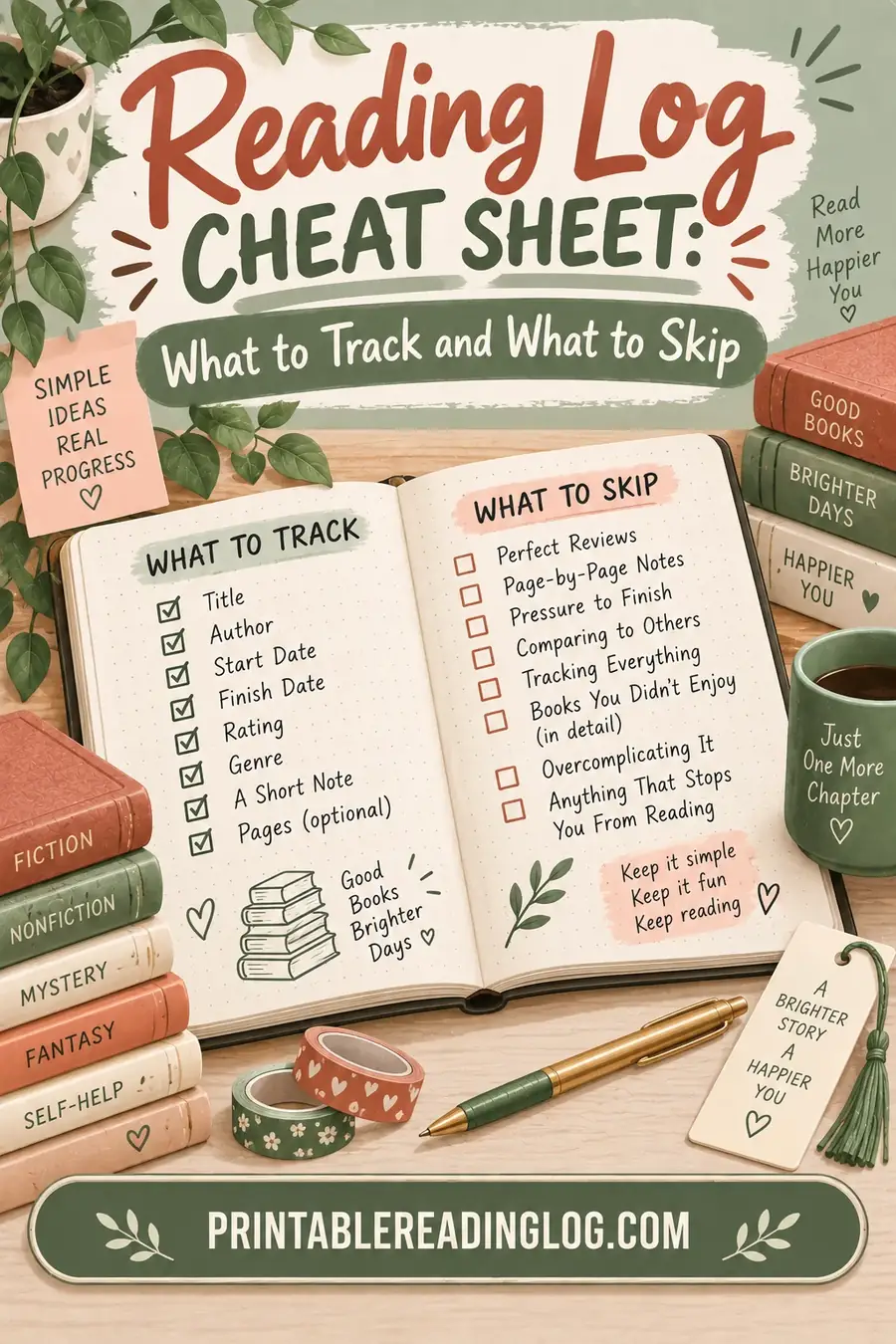
Reading Log Cheat Sheet: What to Track and What to Skip
A reading log fails for one reason more than any other: it asks for more than the child is willing to write, so logging becomes the reason not to read. The fix is knowing which fields do real work and cutting everything else.
The Four Fields That Matter
Date. Establishes the habit and shows a streak. One box, five seconds.
Title. What they read. Also builds a record they're often proud of by the end of a term.
Minutes or pages. One or the other, never both. Minutes suits younger children and picture books; pages suits fluent readers on chapter books.
Adult initial (if required by school). Only if your school actually asks for it.
That's the whole log. Everything below this line is optional and most of it is counterproductive.
What to Cut
"Write a summary." The single most common reason children come to dread the log. Summarizing is a separate skill, it takes ten times longer than logging, and requiring it after every session turns twenty minutes of reading into a writing assignment.
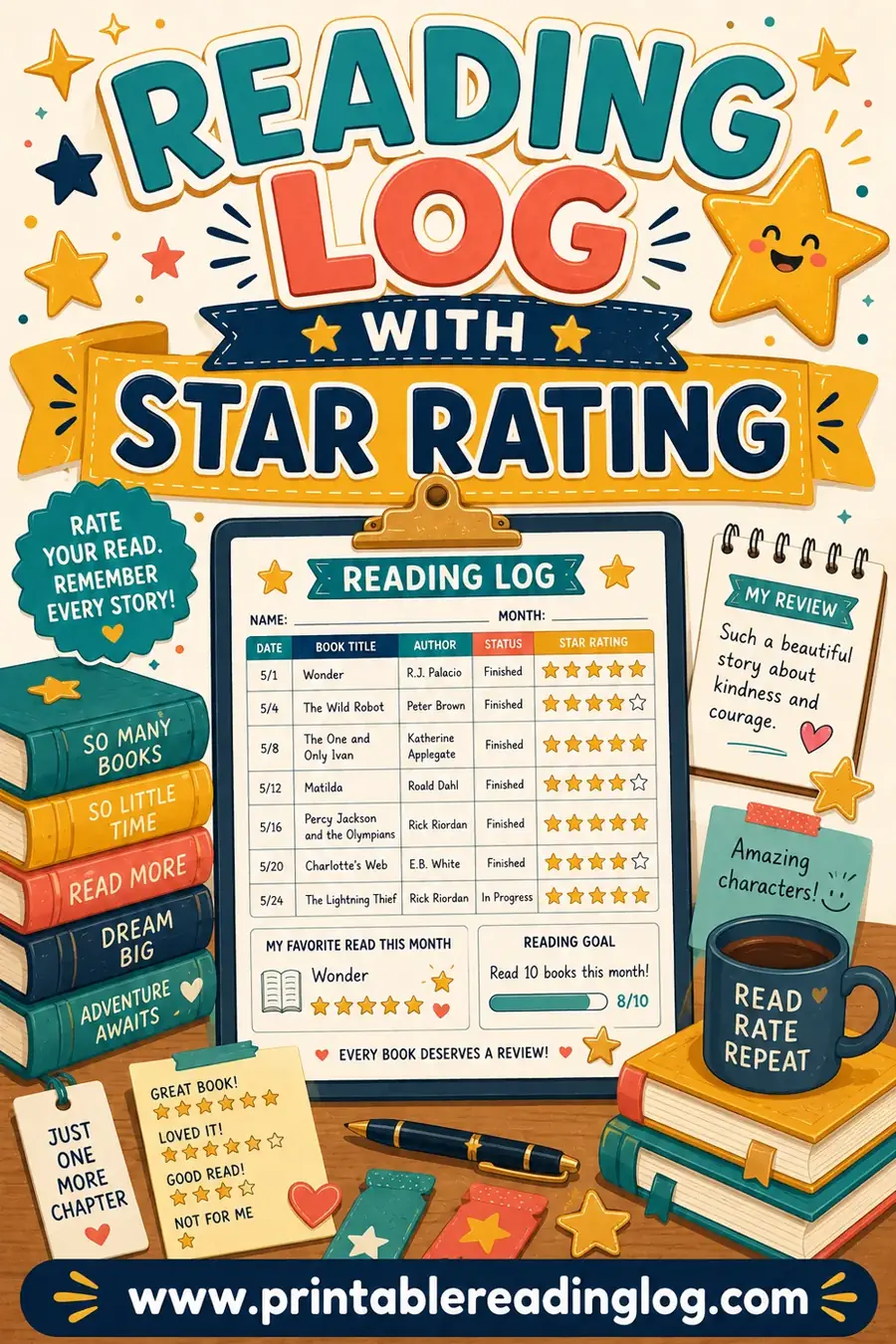
Star ratings on every book. Fine occasionally, tedious daily.
"New words I learned." Good instinct, wrong place. It interrupts reading to hunt for vocabulary, which fragments the flow that fluency depends on.
Genre classification. Children don't reliably know genres, and getting it wrong feels like failing.
"How did this book make you feel?" Produces "good" every time and teaches that reflection questions are box-ticking.
Start and finish times. Doubles the arithmetic for no benefit over a simple minutes box.
If a school requires some of these, do them weekly rather than daily — one reflection on Friday about the week's reading is far more useful than five rushed ones.
Formats by Age
| Age | Format | Track | Session |
|---|---|---|---|
| 4-6 | Sticker chart | One sticker per session | 10 min |
| 6-8 | Simple grid | Date, title, minutes | 15 min |
| 8-11 | Grid + occasional note | Date, title, pages | 20-30 min |
| 11+ | Book list | Title, author, date finished, brief rating | Own pace |
The shift around age 11 matters. Older readers generally resent per-session logging and respond much better to a running list of books finished. It respects that they're now reading in long stretches rather than measured daily bursts.
Making the Habit Stick
Log immediately after reading, at the same spot. The log lives where the reading happens — bedside, kitchen table, book bag. A log in a different room gets forgotten.
The child writes it, not the adult. Ownership is the point. An adult-completed log tracks nothing about the child's relationship with reading.
Keep the daily action under thirty seconds. This is the whole design constraint.
Don't backfill a week on Sunday night. Common, and it teaches that the log is an obligation to satisfy rather than a record. Better to have gaps.
Missed days are fine. Say so explicitly. A log that feels like a record of failure gets hidden.
Reading Time by Age
Rough guidance for what to expect, if you're setting a target:
- Ages 4-6: 10-15 minutes, usually read aloud together
- Ages 6-8: 15-20 minutes, mix of independent and shared
- Ages 8-11: 20-30 minutes independent
- Ages 11+: 30+ minutes, or simply "a chapter"
Consistency beats duration. Ten minutes daily builds fluency more reliably than an hour on Saturday, because reading fluency comes from frequent practice rather than accumulated hours.
What Counts as Reading
Worth deciding explicitly, because the narrow definition puts children off:
Count it all. Graphic novels, comics, magazines, non-fiction, recipe books, the back of a cereal box, re-reads of a favorite. Re-reading in particular is genuinely valuable — it builds fluency and confidence, and children who re-read are not wasting time.
Audiobooks are a judgment call. They build vocabulary and comprehension and don't build decoding skill. Many families log them separately. If a school requires reading practice specifically, audiobooks probably shouldn't replace it — but they shouldn't be discouraged either.
Being read to counts, especially for younger children. Shared reading is where a lot of vocabulary growth happens.
Setting Up Your Own
Whether printed or handwritten, keep it to one page per month rather than one per week — a page that fills slowly shows progress, while a page that's replaced constantly loses that.
A printable reading log covers the standard formats, and printing a month at a time on a single sheet is usually the right unit. Stick it inside the front of the reading folder or on the fridge, whichever is closer to where the reading actually happens.
Logs by Purpose
Different reasons for keeping a log call for genuinely different formats, and using the wrong one is why many get abandoned.
School requirement. Whatever the school asks for, minimally. Adding extra fields to a required log makes an obligation heavier without adding value. If the school wants minutes and a signature, record minutes and a signature.
Building a habit. A streak-focused format — a grid or sticker chart where the visual is the reward. Minimal detail; the point is the mark, not the record.
Tracking what was read. A book list rather than a session log. Title, author, date finished, and optionally a rating. Suits older readers and produces something genuinely satisfying to look back on.
Encouraging variety. A log with a genre column, used to notice patterns rather than to enforce them. Useful for a child who reads exclusively in one narrow area.
Supporting a struggling reader. Minutes only, with no titles and no summaries. Reduce the log to the smallest possible thing so it never becomes another obstacle.
Personal adult reading. Usually a simple list of books finished, dates optional. Adults abandon anything more structured within weeks.
Sample Formats
The minimal grid (ages 6-10): Date | Title | Minutes | Adult initial
The book list (ages 11+): Title | Author | Started | Finished | Rating
The streak chart (ages 4-8): A month grid of empty boxes, one sticker per session, nothing written.
The variety tracker (ages 8-12): Date | Title | Genre | Minutes
The reluctant-reader log (any age): Date | Minutes. Nothing else.
Pick one and keep it for a full term before changing. Switching formats mid-year resets the habit and usually loses the accumulated sense of progress that was doing the motivating.
Getting a Reluctant Reader to Log
For a child who resists both the reading and the recording, the log itself is often the easier problem to fix.
Cut it to one field. Just minutes. No title, no signature, nothing else. A log that takes five seconds isn't a barrier.
Let them log audiobooks and comics. Narrowing what counts is one of the fastest ways to make a child feel their reading doesn't qualify, which is the opposite of the goal.
Log together. You record your reading alongside theirs. Removes the sense of being monitored and models the habit.
Use a sticker chart instead of writing. For a child who finds writing itself effortful — which is often the underlying issue — a chart that needs no handwriting removes the real obstacle.
Drop the log entirely for a fortnight. If the recording has become the point of conflict, remove it and focus on the reading. The log is a tool, not the objective, and it can come back later.
Talking to the Teacher About It
If a school-mandated log is causing friction at home, it's worth raising rather than enduring.
Most teachers will flex. The requirement usually exists to encourage daily reading, not to produce a specific document. A teacher told that the summary field is causing a child to avoid reading will generally drop it.
Bring the specific problem, not a complaint. "He'll read for twenty minutes but the writing afterwards ends in tears" is actionable. "The log isn't working" isn't.
Ask what the log is actually for. Sometimes it's tracking minutes for a program; sometimes it's evidence for a review; sometimes it's habit-building. The purpose determines which fields genuinely matter.
Offer an alternative. A photo of the book cover, a voice note, a tick chart. Teachers are generally receptive to anything that produces the same information with less friction.
Reading Time in Context
| Age | Suggested daily | Realistic minimum |
|---|---|---|
| 4-6 | 10-15 min | 5 min, shared |
| 6-8 | 15-20 min | 10 min |
| 8-11 | 20-30 min | 15 min |
| 11+ | 30 min+ | A chapter |
Consistency beats duration at every age. Ten minutes daily builds reading fluency more effectively than seventy minutes once a week, because fluency comes from frequent practice rather than accumulated hours. A log that captures five short sessions is recording something more valuable than one capturing a single long one.
What a Log Is Actually For
Worth being clear about, because the purpose determines the format and most logs fail by trying to serve several purposes at once.
Building the habit. The most common reason, and the one that argues for the simplest possible log. A tick, a sticker, a number. The record exists to make the streak visible, not to capture information.
Evidence for a school. Requires whatever fields the school asks for and nothing more. Adding to a required log makes an obligation heavier without benefit.
Noticing patterns. A parent wondering whether a child only reads one genre, or only reads at weekends, needs slightly more detail — a genre column, or dates rather than just ticks.
Creating a record worth keeping. A book list rather than a session log. Children who keep one through several years often value it considerably later, in a way nobody values a minutes-tracking grid.
Motivating through visible progress. Charts, streaks and totals. Format matters more than content here.
Trying to do all five at once produces a log with eight columns that nobody completes. Pick the one that matters and cut everything else.
Quick Reference
Fields worth having: date, title, minutes or pages, adult initial if required. Fields to cut: summaries, ratings on every book, new vocabulary, genre classification, feelings, start and finish times. Session length: 10-15 min at ages 4-6, 15-20 at 6-8, 20-30 at 8-11, 30+ from 11. Daily action limit: thirty seconds. Anything longer gets skipped. Missed days: fine, and say so out loud. What counts: comics, graphic novels, magazines, non-fiction, re-reads, being read to. All of it.
One Final Principle
If the log is ever the reason a child reads less, the log is wrong — not the child. It exists to support a reading habit, and any version that competes with the reading itself has stopped doing its job.
Cut it back to a single tick if that's what it takes. A child who reads every day and records nothing is in a considerably better position than one who reads twice a week and fills in a beautifully complete record.
Printing It: What a Reading Log Print Out Should Include
A log that works on screen often fails on paper, usually for dull reasons that are easy to fix before you hit print.
One page, one month. A reading log print out that spans two pages gets separated, and half of it is lost by week three. Thirty-one rows on a single sheet is the target; if it does not fit, cut a column rather than adding a page.
Wide enough rows for a child's handwriting. Adult line spacing is a common mistake. For elementary students, rows should be about twice as tall as they look like they need to be.
Black and white by default. Most home and classroom printers are monochrome, and a design that depends on colored headers turns into gray mush. Use bold type and borders for structure instead.
A signature column, at the right edge. If a teacher has to initial it, that column has to be the last thing on the row and it has to be wide enough to sign in.
Margins of at least half an inch. Anything closer gets clipped by the printer or lost in a hole punch.
Print two copies: one for the folder, one for the refrigerator. The visible one is what keeps the habit alive.
Frequently Asked Questions
What should a reading log include? Date, title, and either minutes or pages — plus an adult initial only if the school requires it. Anything beyond those four fields tends to make logging slower than it's worth.
Should children write a summary in their reading log? Not daily. Summarizing is a separate skill that takes far longer than logging and is the most common reason children start avoiding the log entirely. Once a week is plenty if it's required at all.
How long should a child read each day? Roughly 10-15 minutes for ages 4-6, 15-20 for 6-8, and 20-30 for 8-11. Consistency matters more than duration — short daily reading builds fluency better than one long weekly session.
Do graphic novels and comics count? Yes. So do magazines, non-fiction, recipe books and re-reads of favorites. Narrowing what counts is one of the fastest ways to make a child feel their reading doesn't qualify.