ADHD Adults: Why You Can't Finish Books and a Log That Helps
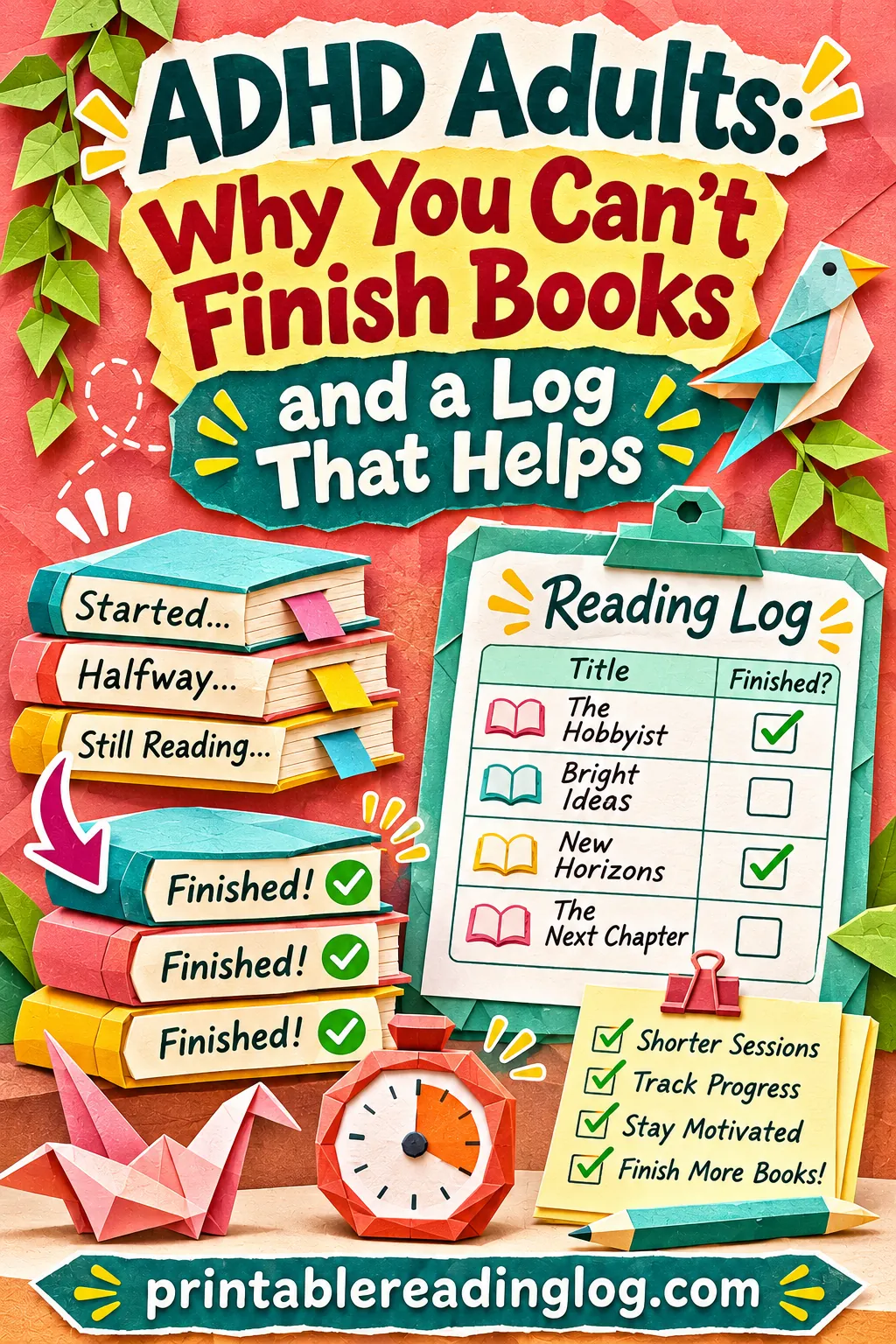
If you have ADHD and your nightstand is a graveyard of books abandoned around chapter four, lower the daily goal to two minutes, write down every session however short, and allow yourself to quit a book that has stopped pulling you in. Finishing becomes far more likely once progress is visible and the effort needed to begin is close to zero.
What follows is a practical system rather than a pep talk: tiny sessions tied to something you already do, one book always waiting on deck, a check-in point for quitting, and a single printed sheet folded inside the book so it can't wander off. No app to forget, nothing to download.
One honest caveat first. This is habit help, not medical advice. If reading trouble is affecting your job, your studies or how you feel day to day, bring it up with your doctor or therapist, who knows your situation and can tell you how a routine like this fits with whatever plan you already have.
📚 Printable Reading Log: make this log in 10 seconds
Set the name and goal, preview it, then print it free.
Free printables for this page
Ready-made, one-page PDFs from Printable Reading Log. Print as is, or change the columns in the maker above. See all free printable reading logs.
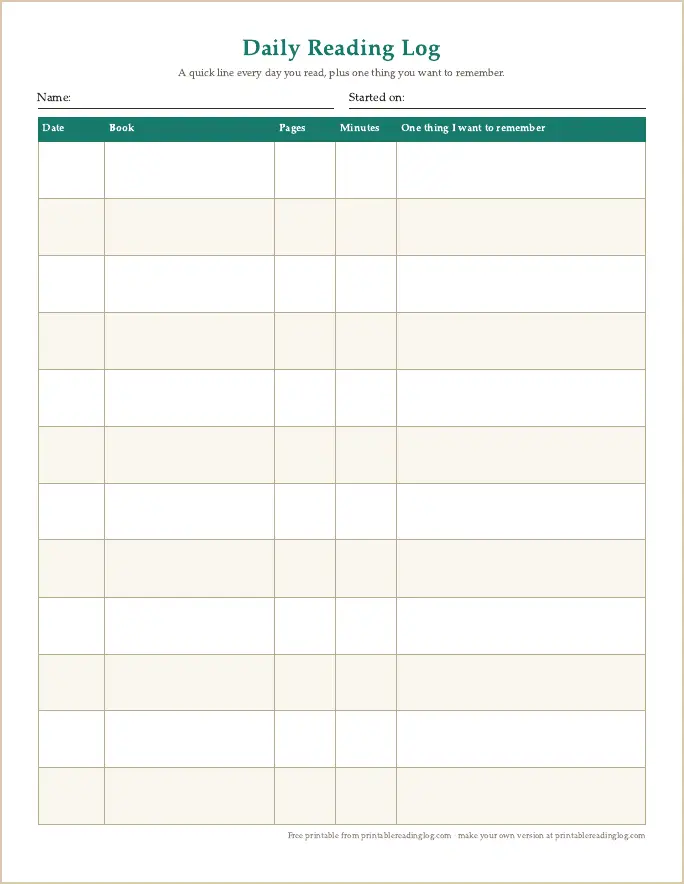
Daily Reading Log
Taller rows with room for a one-line note: date, book, pages, minutes and what happened in the reading.
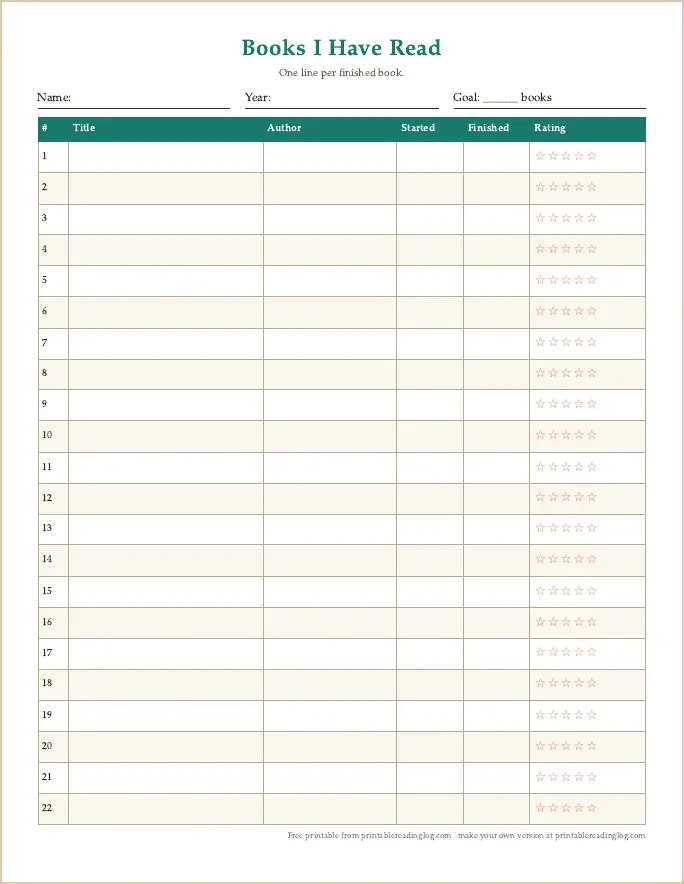
Book Log (books read)
A clean list of every book you finish: title, author, dates started and finished, and a five-star rating.
The whole system on one index card
- Daily floor: two minutes, tied to a cue like the morning coffee
- Log every session with a tick and the page you stopped on
- Check in around page 60; quitting is a decision, not a failure
- Choose the next book when you're halfway through this one
Chapter four, where so many books get abandoned
You aren't lazy, and you aren't a bad reader. Plenty of adults with ADHD adore books. They buy them, borrow them, stack them beside the bed, and then can't get past the middle. The reasons people describe tend to cluster into a handful of patterns, and you may recognize one or all of them.
The first is that the novelty wears off. Opening a book is exciting, with new characters, a new setting and a new idea, and somewhere around the midpoint that buzz fades and the book starts to feel like a task. That is very often exactly where the bookmark stops moving. Second, the goal looks too big. "Thirty pages tonight" or "finish by Friday" sounds sensible, but a large, fuzzy task is easy to put off, a skipped day becomes a skipped week, and the book drifts onto the someday pile.
Time also has a way of evaporating. You planned to read before bed, picked up your phone for one second, and it was an hour later. Without a clear cue, reading gets swallowed by whatever is in front of you. Then, after a week away, you open the book and can't remember who anyone is. Rereading feels tedious, so you don't return at all. Even when you do sit down, your eyes can reach the bottom of a paragraph while your mind is somewhere else entirely, and after the third time the book goes back on the nightstand.
Finally, there's no visible progress. A to-do list gives you a satisfying tick; a half-read book gives you nothing. And every unfinished spine on the shelf becomes a small reminder of not following through, which makes starting again even harder. Notice that none of this is about intelligence or how much you like stories. It's about starting, continuing, and seeing yourself move, and those are exactly the things a simple structure can support.
Why two minutes is the right size for a session
The center of this approach is a single rule: a reading session can last two minutes and still count fully. That sounds too small to matter, and the smallness is deliberate. A two-minute target is so easy that your brain has no time to build a case against it. You don't need a quiet hour, the right chair or the right mood. You need two minutes and a book within arm's reach.
What often happens next is that you keep going. Two minutes becomes ten, sometimes twenty. But the official goal stays at two, so if you stop at two you still succeeded and your streak is intact. A goal you can meet on your worst day builds a habit; a goal you can only meet on your best day mostly builds a pile of reproach.
To make it work, attach reading to something you already do every day: pouring coffee, sitting on the bus, waiting for the kettle, getting into bed. Leave the book exactly there, on the counter, in the bag, on the pillow, because if you have to go looking for it, the session won't happen. Open it, read for two minutes or a page or two, make one mark on the log, and then keep going only if you feel like it. On days when you have energy and a gripping chapter, read for an hour and log that too, but don't raise the daily floor because of one great evening. The floor is what keeps you reading through the hard weeks, and the hard weeks are where most books get abandoned.
If you'd like more on anchoring a routine to an existing daily moment, the page on building a reading habit you'll keep goes further into choosing cues.
A log you can fill in faster than you can read a page
A reading log does what a half-finished book can't: it shows you moving. Each tick is evidence. Across a week or a month, the ticks add up to something you can actually see, which motivates in a way "I'm on page 112" never quite manages. For an ADHD reader, the right log is short and forgiving. If logging takes longer than reading, you'll stop logging, so keep each entry to a few seconds.
| Write this | Why it helps | Leave off |
|---|---|---|
| A tick for every session, even two minutes | Every reading day becomes visible | Nightly reflections |
| The page where you stopped | No hunting for your place after a gap | Exact start and stop times |
| Rough minutes | Total time visibly grows | Reading speed |
| One word or one line | Reminds you of the story after a break | Chapter summaries |
| Finished titles with a date | A win you can point to | An elaborate rating scheme |
| Two or three next books | Momentum when one book ends | A list of every book you own |
The page number does the most work. When you return after four days away, you know exactly where to start. The one-line note does the next most: before closing the book, write something like "Ana found the letter," and next time read that line first. You'll be back inside the story in seconds instead of flipping back three chapters.
A log in a drawer gets forgotten. Fold the printed sheet in half and use it as your bookmark, with a pen clipped to it if you can. Every time the book opens, the log is right there. People who want to record a sentence or two about each finished book sometimes add a second sheet like the log with a summary line, but keep that separate from the quick daily ticks.
The page-60 check-in and the permission to quit
This surprises people: quitting books can help you finish more of them. If you believe you must finish everything you start, a slow book becomes a wall. You don't want to read it, but you don't feel allowed to start anything else, so for weeks you read nothing at all. Many readers, with or without ADHD, find a deliberate quitting point clears that jam.
A common version is to read to roughly page 60 or 70 and then ask yourself three questions. Do I want to know what happens next? Do I look forward to picking this up, even a little? Is it slow because it is building toward something, or slow because it simply isn't for me? If the answers are mostly no, stop. Write the title on your log with "DNF" and the page you reached. You made a choice on purpose rather than drifting, and that's a different feeling from quietly giving up. For a very short book, check in sooner; for a long one, give it a bit more room. Having a check-in point matters more than the exact page.
Some books aren't wrong for you, only wrong for this month. A dense history might be a slog during a busy quarter and wonderful on a quiet week off. Mark it "paused" with the page number and put it back on the shelf with a copy of your log tucked inside. You can also mark a book "skimmed" if you skipped parts but got the gist, and decide for yourself whether it counts toward your total.
| Mark | Meaning | Next move |
|---|---|---|
| Finished, with date | Read to the end | Color a goal square and enjoy it |
| DNF + page | Tried it, chose to stop | Start the on-deck book today |
| Paused + page | Good book, wrong moment | Shelve it with the log inside |
| Skimmed | Got the gist | Count it or not, your call |
Keeping the next book on deck
A familiar trap: you finish a book, feel great, and then have no idea what to read next. A week of browsing becomes a month of nothing, and the momentum is gone. The answer is an on-deck book, chosen before the current one ends. Halfway through is a good moment to pick it.
Put it somewhere you'll see it, on top of the stack, on the nightstand, or at the head of your library holds. Write it in the read-next list at the bottom of your printed sheet, and keep that list to two or three titles, because twenty starts to feel like homework. Make it something you're genuinely excited about and save the "I really should read this" books for later. When you close the last page of the current book, start the next one the same day, even if only for two minutes. If library books are part of the plan, a note of the due date beside each one helps, and the page on keeping track of library due dates has a simple method.
Books and formats that hold a wandering attention
There's no single right book for an ADHD reader, but some kinds are easier to stick with while you rebuild the habit. Books with short chapters give you plenty of natural stopping points and a steady stream of small finishes; completing a chapter in five minutes feels good. Short books, such as novellas and slim nonfiction, are finishable, and a 150-page book you complete beats a 600-page one you abandon. Story and essay collections let you stop between pieces, read out of order, or pause for a week without losing a thread.
Graphic novels and illustrated books carry part of the story in pictures, which helps some readers stay on the page, and they count as reading. Fast-moving genres such as thrillers, mysteries and adventure keep pages turning. Follow whatever you're curious about this month, whether that's gardening, astronomy or a particular century, while the interest is strong. Rereading a book you loved is low effort and still a finish. And many public-domain classics, the Sherlock Holmes stories among them, first appeared in installments, so they were built to be read a little at a time.
Format matters as much as the book. Audiobooks let reading slip into a walk, a commute, cooking or folding laundry, and moving while listening helps some people focus. Some readers listen while following the print, which keeps eyes and attention on the same sentence. Ebooks offer adjustable font size, line spacing and a built-in dictionary, which can make a page feel less crowded. Print has its own advantage: a physical book on the table is a visible reminder, and it never sends you a notification. Log audiobooks exactly as you'd log print; if you want a separate sheet for listening, the audiobook log has room for minutes and narrators.
Pulling your attention back to the page
Even with the right book, attention drifts. Choose one or two of these to try rather than all at once. Reading with a pencil helps many people: underline a line you like, put a small star in the margin, or write one word at the foot of the page, using sticky tabs for library copies. Sliding a bookmark, or the folded log, down the page keeps your eyes on one line at a time. When you notice you've drifted, read the next paragraph aloud or in a whisper, which tends to snap focus back.
Experiment with place. Some people concentrate better somewhere a little busy, like a café or a park bench, while others need silence. The phone belongs in another room, or at least face down across it, because every buzz is an invitation to stop. Background sound is personal; soft wordless music, rain sounds or a fan help some readers and distract others. A short timer of ten minutes can make starting easier because the end is in sight, and when it rings you can take a break or keep going if you're absorbed.
Setting up a sheet with short rows and a 10-square tracker
In the reading log maker, start from the Adult Yearly preset for a clean grown-up layout, or the Monthly preset if a fresh page each month sounds appealing; a clean slate after a slow few weeks can feel very good. Give it a name with a little humor, such as "My Two-Minute Reading Log," and a goal small enough to finish: "Read 2 minutes a day" or "Finish 6 books this year." You can always raise a goal later. Choose the adult style for a calm, uncluttered page, especially if busy layouts make your eyes jump.
Set the log to count minutes so every short session gets its own line. Keep the columns lean: date started for the session date, title, pages/minutes for rough minutes or the stopping page, notes for your one-liner or a DNF mark, date finished for the day you complete a book, and an optional rating. Smileys are the fastest rating to fill in. Leave author, genre, initials and recommend off for now; you can add them if you miss them. Portrait Letter or A4 folds neatly into a bookmark. Pick a higher row count so there are plenty of short lines, because a full page of tiny ticks is a pleasure to look at. Turn on the goal tracker with 10 squares and color one per finished book, or per week with five reading days. Ten feels reachable; a hundred can feel like a mountain. Switch on the read-next list for your on-deck titles, print two or three copies so a spare is always handy, and tuck one into the book you're reading now.
| Day | Minutes | Page | Note |
|---|---|---|---|
| Monday | 2 | 14 | Coffee read |
| Tuesday | 15 | 31 | Bus ride, good chapter |
| Wednesday | 0 | 31 | Packed day |
| Thursday | 3 | 35 | Before bed |
| Friday | 25 | 68 | Couldn't put it down |
| Saturday | 2 | 70 | Page 60 check-in: keep going |
| Sunday | 10 (audio) | 82 | Listened on a walk |
That week adds up to fifty-seven minutes and nearly seventy pages, with a zero day in the middle. On paper it looks like progress because it is progress.
A month aimed at one finished book
If some structure would help, try a four-week arc and bend it to fit your life. In week one, choose a short, interesting book, pick your daily cue, and read two minutes a day, logging every session. Pages and speed don't matter yet; the only target is opening the book on most days. In week two, keep the two-minute floor and notice which times and places work, writing them in the notes column. Try one attention trick from above and choose your on-deck book by Sunday.
In week three, do the page-60 check-in and either keep going or switch, without agonizing. If you're enjoying the book, try one longer sitting, perhaps on a weekend morning. In week four, keep the small sessions going, and when you reach the last page, write the date, color a square, and open the on-deck book that same day. At the end of the month, count the sessions and minutes. Sharing the page with a friend can feel surprisingly good.
Expect bumps. If you miss three or more days, restart today with two minutes and no makeup sessions. If you lose the log, print a fresh one; the old ticks still happened. If you're bored mid-book, do the check-in now wherever you are. If you can't remember the story, read your one-line notes or skim the last chapter. Three books going at once and none finished? Pick one, pause the others with page numbers noted. If logging feels like a chore, cut columns until it's just a tick and a page. If the unfinished pile weighs on you, mark the ones you won't return to as DNF and let them go. And if you hyperfocus and read until 2 a.m., enjoy it, log it, and keep tomorrow's goal at two minutes so the next day doesn't feel like a letdown.
Small rewards help a habit settle: a colored square or sticker for each finished book, a favorite tea or blanket saved only for reading time, telling a friend or a group chat when you finish, or a relaxed book club where you can show up having read only part of the book. If you set a yearly target, the pages on setting a realistic reading goal and reading more books in a year keep it grounded, and if December arrives with the target far off, catching up on a yearly goal offers an honest plan. Readers who want a broader adult layout can compare the adult reading log and the monthly reading log.
What a month of ticks tells you about your own attention
Once a full month of sessions sits on the sheet, spend five minutes reading it like a map rather than a report card. Start with the notes column and circle every session longer than fifteen minutes. Then look at what those circled rows share. For many readers the answer is a place or a time: the bus, a Saturday morning, the half hour after a walk. That is your best reading slot, and it deserves protecting more than any new goal does.
Next, look for clusters of zeros. Three blank days in a row usually line up with something specific, like a deadline at work, a week of poor sleep or a family visit. You can't prevent those weeks, but you can plan for them: next time one is coming, switch to an audiobook or a story collection for those days so the streak bends instead of breaking.
Then check the page numbers against the dates. If the stopping page barely moved over a week even though the ticks kept coming, the sessions are happening but the book isn't holding you. That's a quiet signal to run the page-60 check-in early. If the page numbers jump in big leaps on a few days, you may be a reader who does best in occasional long sittings, and a looser weekly target could suit you better than a strict daily one.
Finally, count the finished and DNF marks together. Both are decisions, and a month with one of each is a month where you stayed in charge of your reading instead of letting books drift. Write one sentence at the bottom of the sheet about what you'll change next month, keep it to a single adjustment, and print the new page.
Questions adults with ADHD ask about finishing books
Why do I lose interest halfway through almost every book?
Many adults with ADHD describe the same arc: the excitement of a new book fades in the middle, big goals feel heavy, and a few days away make the story hard to re-enter. Tiny daily sessions, a visible log and a planned check-in point make that middle stretch much easier to cross.
Is a two-minute session really worth logging?
Yes, because starting is usually the hardest part and two minutes removes most of the resistance. Often it grows into more; when it doesn't, you've still kept the habit alive and stayed connected to the story.
How do I know when to give up on a book?
Check in around page 60 or 70 and ask whether you want to know what happens next. If not, write DNF and the page on your log and move straight to your on-deck book.
Should I have more than one book going?
Some people like a light book and a heavier one side by side. If you notice you keep starting books and finishing none, go back to one at a time with the next book waiting in view.
How do I start again after months of not reading?
Choose a short, enjoyable book, pick a daily cue and read for two minutes. You don't have to return to the book you stalled on; a new book and a fresh sheet often feel lighter.
Can a log stand in for ADHD treatment?
No. It's a practical tool for building a habit. If you think you have ADHD, or your current approach isn't helping, talk with your doctor or therapist, and use the log alongside whatever support they recommend.