Behind on Your Yearly Reading Goal in December? A Catch-Up Plan That Is Honest
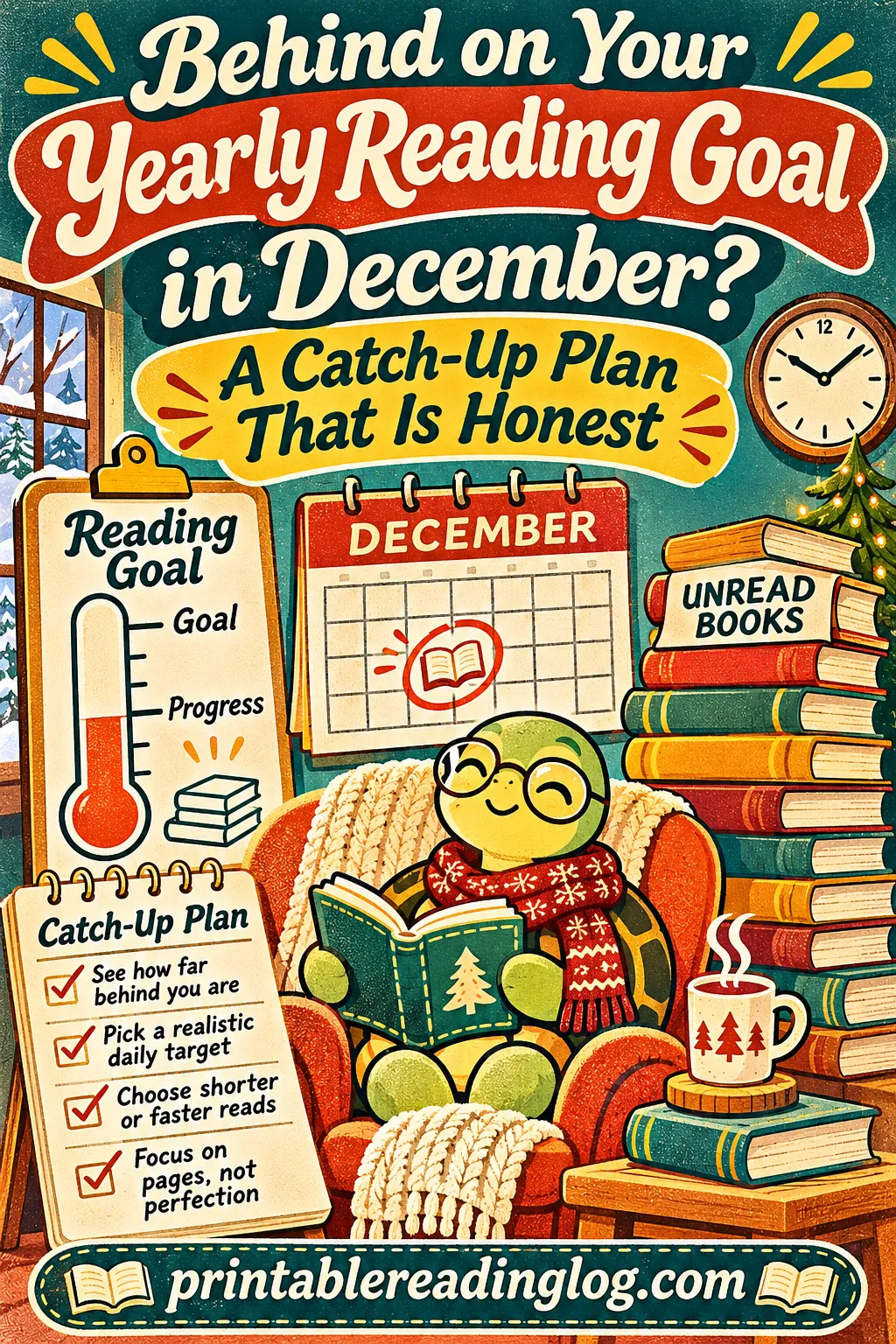
If you're behind on your reading challenge in December, turn the gap into pages: add up the pages you still need, divide by the days left (counting today), and read that number each day, recalculating every morning so a missed day never snowballs. Then hold that number up against the time you actually have and decide honestly whether to sprint, trim the goal, or let it go.
A one-page catch-up sheet helps more than you'd expect, and our reading log maker prints one with a pages column, a challenge bar to color and a short list for quick-read picks. This guide works through the math for three different readers, a simple way to choose, how to set the sheet up, the morning reset, how to pick shorter books without feeling like you're padding, and what to do when the 20th arrives and the number looks huge.
📚 Printable Reading Log: make this log in 10 seconds
Set the name and goal, preview it, then print it free.
Free printable for this page
Ready-made, one-page PDFs from Printable Reading Log. Print as is, or change the columns in the maker above. See all free printable reading logs.
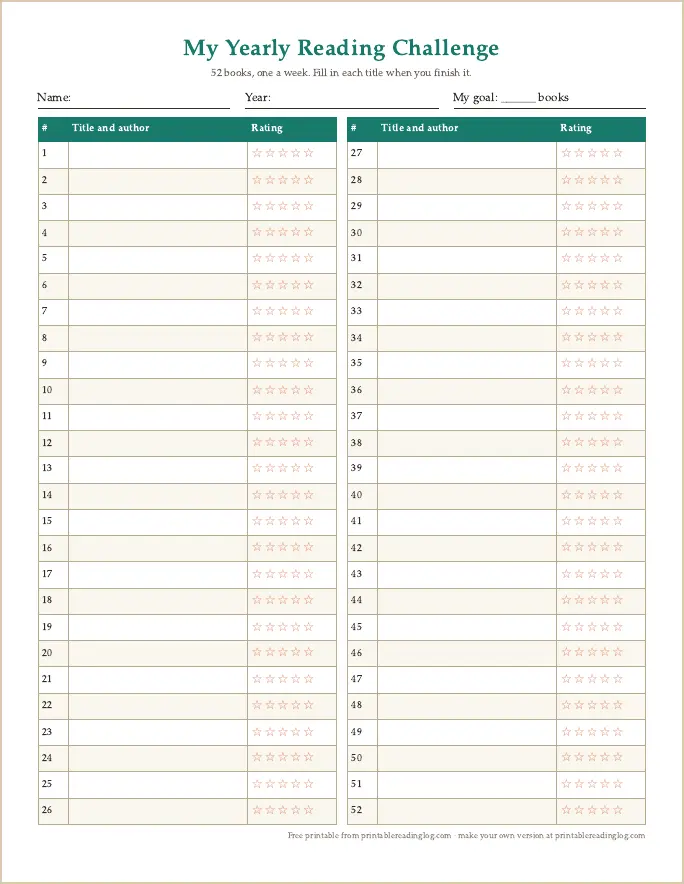
Yearly Reading Challenge (52 books)
Fifty-two numbered spaces for a book-a-week year, in two columns, with a small rating space for each book.
Three numbers before you panic
"I'm behind" always feels bigger than it is. Before you either panic or give up, get three numbers on paper; it takes about five minutes.
The first is books left: your goal minus the books you've finished. A goal of 30 with 24 done leaves 6. The second is pages left, the page counts of the specific books you plan to read, counting only the unread part of anything you're partway through. The third is days left, every day from today through December 31 including today: 31 on December 1, 17 on December 15.
Then divide: pages left ÷ days left = pages a day, rounded up. That single number tells you far more than "6 books behind." Six novellas and six doorstop fantasies are very different Decembers.
| Reader | Goal | Done | Books left | Pages left | Start date | Days left | Pages a day |
|---|---|---|---|---|---|---|---|
| A | 24 books | 20 | 4 | 4 × 300 = 1,200 | Dec 1 | 31 | 39 |
| B | 30 books | 27 | 3 | 3 × 280 = 840 | Dec 15 | 17 | 50 |
| C | 52 books | 41 | 11 | 11 × 320 = 3,520 | Dec 1 | 31 | 114 |
Reader A needs 39 pages a day, a comfortable evening for many people. Reader B needs 50, doable with some planning. Reader C needs 114 a day through a month full of holidays, travel and visitors. Those are three very different situations, and each deserves a different decision.
How long your pages actually take
Pages only mean something once you know how long they take you, and reading speed varies a lot between people and between books, so don't borrow anyone else's figure. Pick the book you'll actually read next, set a timer for 20 minutes, read normally, and count the pages. Multiply by three for pages per hour.
| Pages a day needed | At 30 pages an hour | At 40 pages an hour | At 50 pages an hour |
|---|---|---|---|
| 39 | About 1 hour 20 minutes | About 1 hour | About 47 minutes |
| 50 | About 1 hour 40 minutes | About 1 hour 15 minutes | 1 hour |
| 114 | About 3 hours 50 minutes | About 2 hours 50 minutes | About 2 hours 20 minutes |
Now the real answer isn't "6 books behind" but "about an hour a night," which is something you can check against an actual calendar. One more thing before you move on: if you're halfway through a 400-page book, that's 200 pages left, not 400. Forgetting the bookmark is one of the most common reasons people think they're further behind than they are.
Sprint, trim or stop
With a daily time in hand, look at your December honestly. Holiday weeks are busy: work parties, school events, travel, cooking and visitors all eat evenings, and a plan that ignores them falls apart by the 10th.
Sketch the reading time you really have. For a lot of people that's something like 20 ordinary days at 45 minutes, 5 hectic days at 15 minutes and 6 slow holiday days at 90 minutes. That's 900 + 75 + 540, or 1,515 minutes, roughly 25 hours for the month.
Compare that with what the goal needs. At 40 pages an hour, Reader A needs 30 hours (1,200 ÷ 40), about 1.2 times the 25 available: tight, but close. Reader C needs 88 hours (3,520 ÷ 40), more than three times what's there. That isn't close at all.
| Your situation | What it usually means | A reasonable choice |
|---|---|---|
| Time needed is less than time you have | You're fine; you need a plan | Sprint: print the sheet and read your daily number |
| Up to about 1.5 times what you have | Possible, but tight | Sprint with shorter books mixed in and audiobooks on busy days |
| 1.5 to 2 times what you have | Very tight | Trim: lower the goal by a few books and finish strong |
| More than twice what you have | Not realistic this month | Stop chasing it, or set a smaller December goal |
These are rough lines. A reader with two weeks off can stretch further than someone working retail hours through Christmas Eve, and you know your own month best.
Sprinting without starting to resent your books
A sprint works as long as you're still enjoying what you read. If you catch yourself skimming just to finish, or choosing books you don't care about only because they're short, the goal has stopped doing its job. It was supposed to get more good books into your year, not turn reading into a chore.
Trimming on purpose
Most reading apps and challenges let you change the goal whenever you like, and on paper it's easier still: cross out the old number and write the new one. Dropping from 30 to 26 in December, after 26 books you enjoyed, still leaves you a year with 26 books in it.
The most honest trim is lowering the number to what the daily math says you'll really reach. Another is switching the measure: if you read several very long books this year, a page count may describe your year better than a book count. Some readers also like to split the tally, with finished books in one column and partly read books in another.
Letting the goal go
If December is a hard month for any reason, it's allowed to win. Write your final count on the sheet and, next to it, what you're proud of from the year. Next year's goal can use what you learned, which is covered near the end of this page.
A 24-row catch-up sheet
Paper suits a short sprint because it's always in sight and it never pings you. In the maker, choose the By pages preset so every row has a pages column. Type "December Catch-Up" as the heading and your own numbers as the goal, something like "4 books left, 39 pages a day." If you'd rather fill those in by hand, type blanks and use a pen. The adult style gives tighter rows, and the Classic theme prints cleanly with little ink.
Keep date, title, pages and notes, and switch off author and rating for now, since you're tracking progress rather than reviewing. Set the rows to 24, the maximum, which covers December 8 to 31 on one sheet; start earlier and you'll want two copies. Turn on the challenge bar, which prints "My reading challenge: ___ of N books" with segments and milestone stars, and choose the goal-square count nearest your full-year goal, such as 25 for a goal of 24 or 50 for a goal of 52, crossing out any extras. Add the next-reads list at the bottom, which gives you eight title-and-author lines for your short-book picks. Print on Letter or A4 in portrait.
Before your first reading day, color a challenge segment for every book you've already finished this year. If you've read 20 of 24, color 20; seeing most of the bar already full is a real lift. Write "20 of 24 books" in the blank, list your next books in the order you'll read them, and put today's pages-a-day number beside the goal.
Turning the Notes column into a countdown
The notes box does the most work on this sheet. In each row, write the pages left after today. It becomes a running countdown showing exactly where you stand, and when it hits zero you're done. A row might read: Dec 9 | (title) | 42 | 870 left, 22 days → 40 tomorrow. That last part is the morning reset described next.
If you'd rather track time than pages, especially when you're mixing audiobooks with print, use the Monthly preset instead. It prints 31 numbered rows, a minutes column and a month picker; set it to December and write your daily minutes target at the top. Everything else here works the same way in minutes. The monthly reading log and reading log by pages pages show both layouts in more detail.
Recalculating every morning instead of owing pages
The most important habit in the whole plan is this: work out the day's number fresh each morning, from pages left and days left, instead of "owing" yesterday's pages.
Most catch-up plans die the same way. You miss a day and now you owe 78 pages instead of 39. You miss another and it's 117. That number feels impossible, so you stop. Recalculating means a missed day doesn't become a debt; it just spreads the remaining pages over the remaining days, so the target rises a little, not a lot.
| Date | Pages left at start | Days left (incl. today) | Today's target | Pages read | Pages left after |
|---|---|---|---|---|---|
| Dec 1 | 1,200 | 31 | 39 | 45 | 1,155 |
| Dec 2 | 1,155 | 30 | 39 | 40 | 1,115 |
| Dec 3 | 1,115 | 29 | 39 | 0 (work party) | 1,115 |
| Dec 4 | 1,115 | 28 | 40 | 0 (school concert) | 1,115 |
| Dec 5 | 1,115 | 27 | 42 | 60 | 1,055 |
| Dec 6 | 1,055 | 26 | 41 | 85 (lazy Sunday) | 970 |
| Dec 7 | 970 | 25 | 39 | 30 | 940 |
Two zero days, and the target only climbed from 39 to 42; one good weekend brought it straight back. Without the reset, Reader A would have "owed" 117 pages on the 5th and very likely quit. The whole calculation is pages left divided by days left including today, rounded up.
Blocking out the days you won't read
You can also build busy days in from the start. Mark the travel days, parties, the 24th and the 25th on your calendar. If you'll lose six days, divide by 25 instead of 31. For Reader A that's 1,200 ÷ 25, or 48 pages on reading days and nothing on the marked ones. Some people find that easier to live with than a daily number they know they'll miss, and the morning recalculation still works either way.
Aim to finish around December 28 rather than the 31st. Three spare days absorb a cold, a snowstorm or a book that turns out longer than you thought, and if you finish early you can start January's first book with no pressure at all.
Is a short book in December cheating?
It's a fair question, and the honest answer depends on why you're choosing it. Reading a novella you've meant to get to for years is simply reading. Grabbing the shortest thing on the shelf only to bump a number is something you'll probably feel a bit hollow about in January. A useful test: would you be glad you'd read this book even if it counted toward nothing? If so, it belongs on your list, however short it is.
| Kind of book | Typical length | Why it suits December |
|---|---|---|
| Novellas | Often under 200 pages | A whole story in a few evenings |
| Short story collections | Varies; one story a night | Easy to fit around busy days |
| Poetry collections | Often under 120 pages | Short sittings, lots to think about |
| Essay collections | Varies | One essay over a cup of cocoa |
| Plays | Often under 120 pages | Fast, mostly dialogue |
| Graphic novels | Varies widely | Rich stories in a sitting or two |
| Middle-grade novels | Often 150 to 300 pages | Many adults love them, and they read quickly |
| Holiday classics | Some under 100 pages | Seasonal and just right for the month |
| A reread of an old favorite | Your choice | Fast because you know it; counts for most readers |
Page counts vary by edition and print size, so check the copy you'll actually read when you add it to your list. If you want seasonal ideas, our roundup of Christmas books for adults includes several shorter titles.
Audiobooks fill the hours print can't
Audiobooks are a real help this month because they fit time you can't use for print: driving to relatives, wrapping, cooking, walking the dog. Most readers count a finished audiobook as a book read. On the catch-up sheet, write the listening time in the notes, such as "2 hrs listened," and leave the pages box empty for that row. For a dedicated listening record, the audiobook log page has a few layouts.
Settling your counting rules before choosing books
Every reader has their own rules about what counts, and they're yours to set. Changing them in December just to make the numbers work tends to feel off, though, so decide first and pick books second.
| Question | Common choices | What matters |
|---|---|---|
| Audiobooks? | Most readers say yes | Be consistent across the year |
| Rereads? | Many say yes | Same rule as the rest of the year |
| Picture books read to kids? | Many say no for an adult goal | Keep a separate family read-aloud tally if you like |
| A book you didn't finish? | Most say no | Some log the pages toward a page goal instead |
| Short books the same as long ones? | Yes, in a book-count goal | If that bothers you, track pages too |
There's no official rulebook for a personal reading goal. The only rule worth keeping is honesty with yourself: if something feels like padding to you, it probably is, and you'll know.
Where December reading time hides
The math only works if the minutes show up. December is crowded, but it's also full of small gaps. Twenty minutes before the house wakes up adds up to about 10 hours over the month. Holiday lines, school pickup and appointments are all waiting time, so keep a book or an audiobook with you. Long drives are audiobook time and flights or train rides are print time. A long afternoon of wrapping or cooking can cover a third of an audiobook. Swapping one scroll session a day for a chapter, with the phone in another room, makes a surprising difference.
The biggest gap of all is the week between Christmas and New Year's, the slowest week of the year for many people. Plan to read more then and less during the first busy weeks.
| Dates | What's going on | Reading plan |
|---|---|---|
| Dec 1 to 7 | Normal week | Hit the daily number and start your longest remaining book |
| Dec 8 to 14 | Holiday events start | Shorter books, audiobooks on event days |
| Dec 15 to 21 | Busiest week for many | Daily number on half the days, recalculating each morning |
| Dec 22 to 26 | Travel and family | Audio in the car, a short book in your bag, nothing planned on the big days |
| Dec 27 to 30 | Slow week | Your catch-up days: longer sessions |
| Dec 31 | Last day | Buffer only; ideally you're already done |
The longest book goes first, while you still have ordinary evenings and fresh energy, and the shortest picks wait for the final stretch when every finished book is quick. Keep the printed sheet where you'll see it daily, on the fridge, by the bed or tucked in your current book as a bookmark. Coloring a challenge segment at the end of a book is a small reward that gets surprisingly motivating as the bar fills. Our guide to reading more books in a year has more on carving out time.
When the 20th comes and the number looks huge
| Problem | Why it happens | What to do |
|---|---|---|
| Daily number keeps climbing | Several zero days in a row | Redo the time-needed math; it may be time to trim |
| Bored with the current book | Too long, or wrong for December | Set it aside for January and pick from your quick-read list |
| Keep forgetting to read | No set time | Attach reading to morning coffee or bedtime |
| Skimming to finish | Pressure is too high | Slow down; a skimmed book isn't one you'll remember |
| Reading lots, count barely moves | Long books | Track pages too, so the work shows on paper |
| Family visits leave no quiet | Busy house | Earbuds and an audiobook, or 15 minutes in a quiet corner before bed |
| Sheet ran out of rows | Started early in the month | Print a second copy from your saved PDF |
On the 20th, when you're tired and the number looks enormous, do the morning math anyway. It's usually smaller than it feels. If it really isn't workable, that's useful information too.
And if you get sick, face a family emergency or simply run out of energy, put the sheet away. The goal is a nice extra; rest comes first, and nobody is keeping score but you. If you come back with only a few days left, run the numbers once more. If they're realistic, go for it. If not, write your final count and close the year with a note about what you loved.
Reader B's sprint from the 15th to the 31st
The tables above show the math in pieces. Here is how one whole sprint might go for Reader B, who starts on December 15 with 27 of 30 books done and three books left, about 840 pages in total, for 50 pages a day.
On the 15th, Reader B times a 20-minute session in the first book and gets 14 pages, so about 42 pages an hour. Fifty pages a day is roughly 70 minutes. Looking at the calendar, there are two work events, a school play, two travel days and Christmas itself. That's six days with little or no reading, so Reader B divides 840 by 11 reading days instead of 17 and gets 77 pages on each of those days, close to two hours. That feels like too much on weeknights, so the plan changes: the third book on the list, a 320-page novel, is swapped for a 180-page novella that had been on the shelf for a year. Pages left drop to 700, and 700 divided by 11 is 64 a day, about an hour and a half.
The first five days go roughly to plan. Rows read 66, 58, 0, 70 and 72, and the notes column counts down from 700 to 434. The first book is finished on the 19th, and a segment of the challenge bar gets colored. Book two is an audiobook for the drive to family on the 21st, and four hours in the car cover most of it. On the sheet, that row says "3 hrs 40 min listened" in the notes, with the pages box left blank and the remaining print pages updated by hand.
The 22nd to the 26th are almost all zero days, as expected. On the morning of the 27th, the countdown says 190 pages left and the calendar says five days. That's 38 pages a day, which feels easy after the earlier numbers. Reader B finishes the audiobook while cooking on the 27th and reads the novella over two quiet evenings, writing "30 of 30" in the blank on the 29th with two days to spare.
What made it work was not reading speed. It was the honest swap of one long book for a short one Reader B actually wanted to read, the decision to plan around the six busy days instead of pretending they wouldn't happen, and the morning reset that kept the number believable. If the swap had felt like padding, the better choice would have been trimming the goal to 29 and reading the long novel in January. Either ending is a good December, as long as it was chosen on purpose.
Writing down the change, then planning next year
If you trim or stop, do it deliberately and write it down: "Changed goal from 30 to 26 on Dec 14." It's honest, and you'll be glad of the record when you set next year's goal.
Before picking a new number, look back at the year. When did you fall behind? A slow summer or a packed fall is something next year's plan can account for. What kinds of books did you read? Several long ones can make a lower count a great year. Which months were your best? Those show your natural pace. And did the goal help or get in the way? Some readers read more with a number to chase; others read better without one. If you're curious how your total compares, our page on how many books the average person reads puts it in context.
A simple way to set next year's goal is to take this year's final count and decide whether you want a little more, about the same or a little less, then split it by month so you can check your pace as you go. Twenty-four is two books a month; 36 is three.
| Goal type | Example | Works well for |
|---|---|---|
| Book count | 24 books this year | Readers who like a simple target |
| Pages | 7,500 pages this year | Readers who love long books |
| Minutes or hours | 30 minutes a day | Readers who want a habit more than a number |
| Monthly | 2 books a month | Readers who fall behind and give up |
| Themed | One classic a month | Readers who want variety more than volume |
A monthly goal is especially kind to busy readers, because you can't fall six books behind in December when each month starts fresh. For help choosing, see how to set a reading goal. If paper helped this month, the yearly reading challenge log walks through a full-year sheet: print it in January, color a segment for each finished book, and check it at the end of every month so December doesn't sneak up again. Adults who want a plainer everyday sheet can start from the reading log for adults, and you can print tonight's catch-up page from the free maker on our home page, no account needed.
Questions readers ask in a December catch-up
Do I count today when I work out days left?
Yes. On December 1 there are 31 days including today, and on December 15 there are 17. Counting today keeps the morning recalculation consistent from one day to the next.
What if a book I planned turns out much longer than its page count suggested?
Dense print can make 300 pages feel like 450. Time a 20-minute session in that book specifically, redo the hours math, and swap it for something from your quick-read list if it's going to eat the whole month. It'll still be there in January.
Should a book I abandon partway count toward the goal?
Most readers don't count unfinished books toward a book total, though some log the pages they read toward a page goal. Whatever you choose, use the same rule you used earlier in the year.
I'm 11 books behind with three weeks left. Is there any point?
Probably not for the original number, unless most of those books are very short. Set a smaller December goal you can actually reach, write the change on your sheet, and use the year's record to choose next year's target.
Can I count audiobooks I listen to while wrapping gifts?
Most readers do count finished audiobooks. If you counted them earlier in the year, count them now. Note the listening time in the notes column so the sheet shows how the book was finished.
Does the maker keep track of my pages?
No. It builds and prints the sheet and remembers your setup in that browser, but the pages get filled in by hand on paper. Save a PDF of the blank sheet so you can print another when you run out of rows.
How do I stop this from happening again next December?
Break next year's goal into months and check the total on the last day of each one. Falling one book behind in April is easy to fix; finding out you're six behind in December is not.