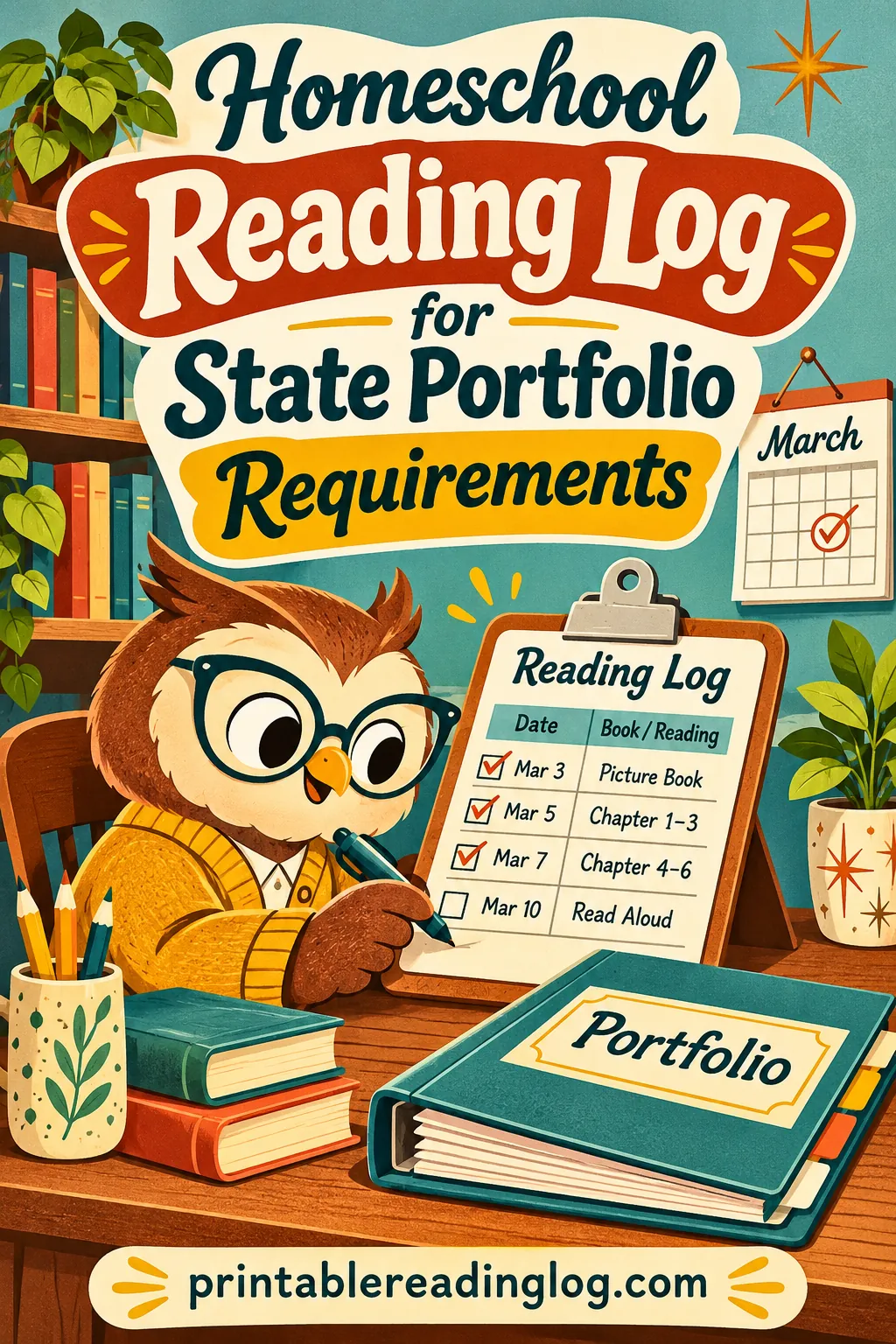
Homeschool Reading Log for State Portfolio Requirements
To meet most homeschool reading log requirements, keep a running, dated list of every book your child reads or hears, with the title, author and the date, filled in as you go rather than rebuilt at the end of the year. That simple habit covers what most portfolio reviewers and evaluators look for, and it's easy to add more detail if your state or evaluator asks for it.
Rules really do vary by state, and they change, so always check your state's official homeschool guidance before you decide what to record. This guide shows you what a strong reading record usually includes, how to separate read-alouds from independent reading, and exact settings to build a clean, printable log in the free reading log maker in a few minutes.
▶ Open this reading log ready to print
The Short Answer: What a Homeschool Reading Log Should Record
If you're short on time, here's the core of it. A reading log that holds up well in a portfolio usually has these pieces for every book:
- Title of the book
- Author
- Date you started or finished it (or both)
- How it was read: read-aloud, independent, audiobook or shared
- Which child read it, if you're homeschooling more than one
Some families add a subject (history, science, literature), a page count, a quick rating, or a one-line note. Those extras can be helpful, but the five items above are the backbone.
The single most important habit is writing entries down at the time. A log filled in week by week, with dates that match the school year, looks and feels very different from a list typed up the night before a review. Many homeschool parents and evaluators describe that difference, and it's the reason this guide focuses so much on routine.
Why a Log Kept as You Go Matters
You might wonder why it matters when the list gets written. After all, the books were read either way.
The answer is that a reading log is evidence of what happened during the year. When entries are made week by week, the log naturally shows the rhythm of your school year: a burst of reading during a history unit, slower weeks around the holidays, a summer of chapter books. Different pens, a few crossed-out words, and dates that move steadily forward all tell a reviewer this was a working record.
A list reconstructed from memory at the end of the year tends to look different. It's often too neat, missing dates, or vague about when each book was read. Some evaluators and reviewers may ask more questions about a log like that. And honestly, it's much harder for you to remember everything months later.
Keeping the log as you go has benefits beyond any review:
- You'll remember more. Books from September are easy to forget by May.
- You can see gaps. A quick look shows if science reading has slipped or if one child has mostly been listening.
- It's less work. Two minutes a week beats a stressful weekend of digging through library receipts.
- Your kids see their progress. A long list of finished books is something to be proud of.
- It builds a reading history. Year after year, the logs become a record of your child's growth as a reader.
Check Your State's Rules First
Homeschool laws and guidance vary widely across the US. Some states ask families to keep a portfolio or records, some ask for periodic evaluations or test results, some ask for very little, and the details can change. Families in states like Florida and Pennsylvania often talk about reading lists in their portfolios, but you should never rely on what another family, a forum, or a blog post says your state requires. That includes this one.
Before you set up your log, look up the current rules from official sources and from people who know your area.
Where to look
- Your state's department of education website. Many have a homeschool page with official guidance.
- Your state's statutes. The education code is usually searchable online. Look for the homeschool or home education section.
- Your local school district, if your state has families file paperwork with the district.
- Your evaluator or umbrella school, if you use one. They can tell you what they like to see.
- Statewide homeschool organizations. They often summarize the law and point you back to the official text.
Questions to answer before you design your log
Write down the answers to these questions. They tell you exactly what columns you'll need.
| Question | Why it matters for your log |
|---|---|
| Does my state ask me to keep a portfolio or records at all? | Tells you whether the log is required or just good practice |
| Is a reading list specifically mentioned? | If yes, follow the exact wording |
| Do records need to be dated or kept as the year goes? | Tells you if every row needs a date column |
| Who reviews the records, and when? | Helps you plan check-ins and how to organize pages |
| How long should records be kept? | Tells you whether to store logs for one year or several |
| Does my evaluator have a preferred format? | Some like titles and authors only; some want subjects too |
| Are there separate rules for different ages or grades? | You might need different logs for different kids |
If you can't find a clear answer, contact your state's education department or your evaluator directly. It's always better to ask than to guess. And if the rules change partway through the year, adjust your log going forward and keep what you've already recorded.
What to Record: A Column-by-Column Guide
Once you know your state's rules, you can decide how detailed to be. Here's what each common column does, and how important it usually is for a portfolio-style log.
| Column | What to write | How useful for a portfolio |
|---|---|---|
| Title | The full book title | Core: almost always expected |
| Author | Author's name (last name is fine) | Core: helps identify the book |
| Date started / Date finished | Month and day, with the year on the page | Core: shows the log was kept through the year |
| How read | RA (read-aloud), IR (independent), AB (audiobook), SH (shared) | Very helpful: shows a mix of reading |
| Reader | Child's initials, if several kids share one log | Very helpful for families with more than one student |
| Subject or genre | Literature, history, science, faith, poetry, fun | Helpful: links reading to your curriculum |
| Pages or minutes | Page count or time spent | Optional unless your evaluator asks |
| Rating | Stars, number or smiley | Optional: nice for the child, rarely needed |
| Notes | One line: "narrated back," "wrote a summary," "part of Civil War unit" | Helpful: shows how reading connected to learning |
Core vs. nice to have
If your state or evaluator wants a simple reading list, stick with Title, Author and Date, plus a How read note. That's quick enough that you'll actually keep up with it.
If you'd like your log to show more learning, add Subject and a short Notes column. A one-line note like "narrated back the chapter" or "drew a map of the journey" turns a list into a small record of how you used the book.
Avoid making the log so detailed that you dread filling it in. A log you keep up with all year is worth more than a beautiful one that stops in October.
Small details that help a lot
- Write the year at the top of every page. Dates like "3/14" make sense only if the page shows which school year it belongs to.
- Use full titles. "The second one in the series" won't mean much later.
- Record books you didn't finish. A note like "stopped at chapter 6, too advanced" is honest and shows real reading choices.
- Include rereads. If your child read a favorite three times, it's fine to note it.
- Keep short works too. Picture books, poetry collections and short story collections all count as reading for many families.
Read-Alouds, Independent Reading and Audiobooks: Log Them Separately
Homeschool reading happens in a lot of ways. You read history aloud at the kitchen table. Your eight-year-old reads chapter books in bed. Everyone listens to an audiobook in the car. Your teen reads a classic novel for literature and discusses it with you.
All of that is real learning, but it's helpful to mark which kind of reading each entry was. A reviewer looking at a seven-year-old's list of long classic novels may wonder how a young child read them alone. A simple "RA" next to each one answers the question before it's asked.
A simple code system
Use short codes in a "How read" or Notes column so entries stay quick:
- RA: read-aloud (a parent or older sibling reads; the child listens)
- IR: independent reading (the child reads alone)
- AB: audiobook
- SH: shared reading (you take turns, or the child reads along with you)
- BC: book club or co-op reading
- LS: literature study (a book read slowly with discussion or written work)
Put a key at the top or bottom of the page so anyone reading the log understands the codes. The guide on how to track read-alouds has more ideas for recording family reading time.
One log or two?
Some families keep everything on one sheet with a "How read" column. Others keep a separate log for read-alouds and another for independent reading. Both work. Here's how to choose:
| Setup | Best for | Downside |
|---|---|---|
| One log per child, with a How read column | Families with one or two kids, simple records | Family read-alouds get written on each child's sheet |
| One family read-aloud log plus one independent log per child | Families who read aloud to several kids at once | More pages to keep track of |
| One log per subject | Families organizing by unit or subject | Easy to miss fun reading that doesn't fit a subject |
| One log per term or quarter | Families with regular check-ins | Pages need clear dates so they stay in order |
If your state or evaluator reviews each child separately, make sure every child's portfolio includes the family read-alouds they listened to. You can either copy those titles onto each child's log or put a copy of the family read-aloud log into each child's folder.
How to Make a Homeschool Reading Log in the Free Tool
The free printable reading log maker lets you set up exactly the columns you need and print as many pages as you like. It doesn't open pre-filled from a link, so here are the settings to choose.
Settings for a portfolio-ready log (elementary)
- Start with a preset: choose Monthly log. A page per month makes it easy to see that records were kept through the year.
- Reader name: your child's full first name. If several children share the log, type the family name instead.
- Reading goal: optional. Something like "40 books this school year" can be motivating, but it isn't needed for records.
- Log style: Kid-friendly for younger children who like to help, or Adult-clean if you'll fill it in and want a tidy look for reviewers.
- What are you logging? Books.
- Color theme: Classic prints clearly in black and white and copies well.
- Columns: turn on Title, Author, Date started, Date finished, Genre and Notes. Add Initials (P/T) if more than one person fills it in.
- Rating style: Stars or Smiley, if you keep the rating column. You can leave the Star rating column off entirely for a cleaner record.
- Paper: Letter, Landscape, which gives each column more room for longer titles.
- Rows per page: a medium number, enough for a typical month of reading.
- Month: set the month at the top of each page as you print it.
- Click 🖨️ Print / Save PDF.
Use the Genre column for your subject (History, Science, Literature, Faith, Poetry) and the Notes column for your RA/IR/AB code plus a few words.
Settings for a teen (middle and high school)
Older students often keep their own logs, and their records may feed into a transcript or course description later.
- Start with a preset: High school or Adult Yearly.
- Log style: Adult-clean.
- What are you logging? Books or Book review, if you want room for a short response.
- Columns: Title, Author, Date started, Date finished, Genre, Pages/Minutes and Notes.
- Rating style: Number.
- Books I want to read next: turn it on. It's a useful planning space for next term's reading list.
For a teen working through a literature course, the Notes column can hold the course name, like "American Lit" or "World History reading," so it's easy to match books to courses later.
Settings for a family read-aloud log
- Start with a preset: Monthly log or Weekly log.
- Reader name: "Family Read-Alouds" plus the school year.
- Columns: Title, Author, Date started, Date finished, Genre and Notes.
- Notes: list which children were listening, by initials.
Print a fresh page whenever you fill one up. For a page with homeschool-friendly defaults ready to go, the homeschool reading log shows a good starting layout.
How many pages to print
You don't need to print the whole year at once. Many families print one or two months at a time and keep a few blank sheets in the binder. That way, if you change your columns in the middle of the year, you haven't wasted a stack of paper.
Sample Log Entries by Age
Seeing real entries makes it much easier to start. Here are example rows written the way you might actually fill them in. Book titles here are public-domain classics.
Early elementary (about ages 5 to 7)
| Date started | Date finished | Title | Author | Subject | Notes |
|---|---|---|---|---|---|
| Sept 3 | Sept 3 | The Tale of Peter Rabbit | Beatrix Potter | Literature | RA, narrated back |
| Sept 8 | Sept 19 | Aesop's Fables (selected) | Aesop | Literature | RA, 2 fables a day |
| Sept 22 | Sept 22 | Library picture book on seasons | (author) | Science | SH, read together |
| Oct 1 | Oct 24 | The Velveteen Rabbit | Margery Williams | Literature | RA, drew favorite scene |
At this age, most entries are read-alouds or shared reading. That's normal, and marking it clearly keeps the record honest.
Upper elementary (about ages 8 to 11)
| Date started | Date finished | Title | Author | Subject | Notes |
|---|---|---|---|---|---|
| Sept 5 | Sept 30 | The Wonderful Wizard of Oz | L. Frank Baum | Literature | IR, oral narration weekly |
| Sept 12 | Oct 10 | Heidi | Johanna Spyri | Literature | RA, family read-aloud |
| Oct 2 | Oct 6 | Library book on volcanoes | (author) | Science | IR, made a diagram |
| Oct 14 | Nov 8 | The Secret Garden | Frances Hodgson Burnett | Literature | AB with print copy |
Middle and high school (about ages 12 and up)
| Date started | Date finished | Title | Author | Subject | Notes |
|---|---|---|---|---|---|
| Aug 28 | Sept 25 | Little Women | Louisa May Alcott | American Lit | IR, discussion questions |
| Sept 10 | Oct 2 | Narrative of the Life of Frederick Douglass | Frederick Douglass | US History | IR, written response |
| Oct 5 | Oct 30 | A Christmas Carol | Charles Dickens | British Lit | LS, essay on themes |
| Oct 12 | Nov 20 | The Adventures of Tom Sawyer | Mark Twain | Literature | IR, free reading |
Notice that every row has a real date and the notes show how the book was used. That's what makes a reading log useful as a record, not just a list.
Keeping the Log Current and Portfolio-Ready
The best reading log system is the one that fits into a week you already have. Here's a routine that takes only a few minutes.
Daily: the two-second habit
Keep the log where reading happens. Clip it to the inside cover of your read-aloud book, keep it on the kitchen counter, or tape a page inside your planner. When a book is started or finished, jot the date and title right then. You can fill in the author and notes later.
For younger kids, keep a sticky note in the book they're reading. When they finish, the sticky note goes on the log page, and you copy it over at the end of the week.
Weekly: the five-minute catch-up
Pick one time each week, like Friday afternoon or Sunday evening, to tidy the log:
- Add any books you forgot during the week
- Fill in missing authors and dates
- Add a one-line note about how each book was used
- Check that read-alouds appear on every listening child's record
- Glance at the subjects to see if one area is getting skipped
Five minutes a week adds up to a complete, dated record by the end of the year with almost no stress.
End of each term or quarter
Every few months, take a slightly longer look:
- Make sure every page has the child's name and the school year
- Put pages in order by month
- Make a copy or take clear photos of the pages, in case the originals get lost
- Pull a few work samples that connect to the books (a narration, a drawing, a written response)
- Note any books you plan to finish next term
End of the year: building the portfolio section
When it's time to put the portfolio together, the reading log section is mostly done already. Use this checklist.
- [ ] Cover page or label: child's name, school year, "Reading Log"
- [ ] All monthly pages in order, with dates through the whole year
- [ ] Key for your codes (RA, IR, AB, SH, LS)
- [ ] Family read-aloud log included or copied into each child's section
- [ ] A few work samples tied to specific books
- [ ] Any extra items your state or evaluator asks for
- [ ] A copy or photos stored somewhere safe at home
How long you keep records afterward is another question for your state's guidance. Many families keep reading logs for several years simply because they're lovely to look back on.
Paper, digital or both?
Some families prefer a spreadsheet or app. Others like paper they can hand to an evaluator. Paper logs have a nice advantage for records: handwriting and dates added over time naturally show the log was kept as the year went along. You can also do both: keep the printed log as your main record and take a photo of each page when it's full. The best free reading logs for homeschool roundup compares a few different approaches if you're still deciding.
Troubleshooting Common Homeschool Reading Log Problems
Even organized families run into trouble. Here are common problems and practical fixes.
| Problem | What to do |
|---|---|
| You're months behind and the review is coming | Start a dated log today. For past months, rebuild what you can from library history, receipts and photos, and be honest that those entries were added later |
| You have three kids and one shared read-aloud | Keep one family read-aloud log, and add listeners' initials in the Notes column |
| Your child reads too fast to keep up with | Log at the end of each day, or keep a stack of finished books by the door to record weekly |
| Your child reads lots of short books | Log them anyway; use a page with more rows, or group a day's picture books on one line with a count |
| Your teen won't fill in the log | Let them keep it their own way as long as it has title, author and date, and check it weekly |
| You lost a month's page | Rebuild that month from library records and memory, mark it as rebuilt, and start keeping photo backups |
| Your evaluator wants a different format | Change columns going forward; keep your earlier pages as they are |
| Books don't fit neatly into subjects | Use "Free reading" or "Literature" and let the log show variety |
| You're not sure what your state wants | Contact your state's education department or your evaluator, and keep a simple title, author and date log while you wait |
If you're starting late in the year
It happens. Maybe you just pulled your child out of school, or the log slipped during a hard season. Don't panic, and don't try to make a rebuilt list look like it was kept all along.
Instead:
- Start your dated log right now and keep it going from today.
- Rebuild the earlier months separately. Use library checkout history, online order history, photos and your child's memory.
- Label the rebuilt section clearly, for example "Books read Sept to Jan, compiled in February from library records."
- Keep going consistently. A few honest months of steady logging show your routine from here on.
Being upfront about a rebuilt section is usually far better than a list that tries to hide it. If you're worried about how it will be viewed, ask your evaluator ahead of time.
If you homeschool several children
With more than one child, logs can get confusing fast. A few tips:
- Give each child their own color theme in the tool so pages are easy to sort at a glance
- Put each child's name in the Reader name field so it prints at the top of every page
- Keep one binder section per child, plus a section for family read-alouds
- Let older kids log their own reading, and check their pages during your weekly catch-up
For more ideas on homeschool record-keeping and reading routines, the reading log for homeschoolers page covers setups for different family sizes.
Start your log this week
The easiest day to start a dated reading log is today. Pick the Monthly log preset, turn on Title, Author, the two date columns, Genre and Notes, choose the Classic color theme, and print a page for each child plus one for family read-alouds. Then check your state's official guidance and adjust the columns if you need to.
Build and print your homeschool reading log free, clip it to the book you're reading right now, and write today's date on the first line.
▶ Open this reading log ready to print
Frequently Asked Questions
What should a homeschool reading log include?
Most families record the title, author, and the date each book was started or finished, plus a note on whether it was a read-aloud, independent reading or an audiobook. Some add a subject and a one-line note about how the book was used. Check your state's official guidance and ask your evaluator if you're not sure what's expected.
Do all states require a homeschool reading log?
No. Requirements vary a lot from state to state, and some don't ask for any reading list at all. Look up your state's current homeschool rules on your department of education website or in the state statutes, and ask your evaluator or a statewide homeschool group to point you to the official text.
Can I count read-alouds on my child's reading log?
Many families do, and they're an important part of homeschool learning. Mark them clearly, for example with "RA," so it's obvious which books your child heard and which they read alone. If you're unsure how your evaluator views read-alouds, ask before the review.
Do audiobooks count as reading for a homeschool portfolio?
Audiobooks are commonly included in homeschool reading logs, especially when marked as listening. Note "AB" so the record is clear, and mention if your child followed along in a print copy. Your state's guidance or your evaluator can tell you if there's any reason to list them separately.
What if I didn't keep a reading log as the year went along?
Start a dated log today and keep it going. Rebuild earlier months from library records, receipts and photos, and label that section honestly as compiled later. Talk to your evaluator ahead of time if you're concerned.
How detailed does each entry need to be?
For many families, title, author and date are enough. Adding how the book was read and a short note makes the log more useful as a record of learning. Keep it simple enough that you'll actually fill it in every week.
Should each child have a separate reading log?
Usually, yes, especially if each child has their own portfolio or evaluation. Keep a separate log per child plus a family read-aloud log, and make sure shared books appear in each listening child's records. The Reader name field in the free tool makes each child's pages easy to tell apart.
How long should I keep homeschool reading logs?
That depends on your state, so check its official guidance on record keeping. Many families keep their logs for several years anyway, both for peace of mind and because they're a wonderful record of their kids' reading lives. Taking photos of each full page is an easy backup.
Can my teen keep their own reading log for high school?
Yes, and it's great practice in responsibility. Use the High school preset with title, author, dates, subject and notes, and review it together once a week. Their log can also help when you write course descriptions or a transcript later.