High School Homeschool Reading List for Credit: Hours and Records
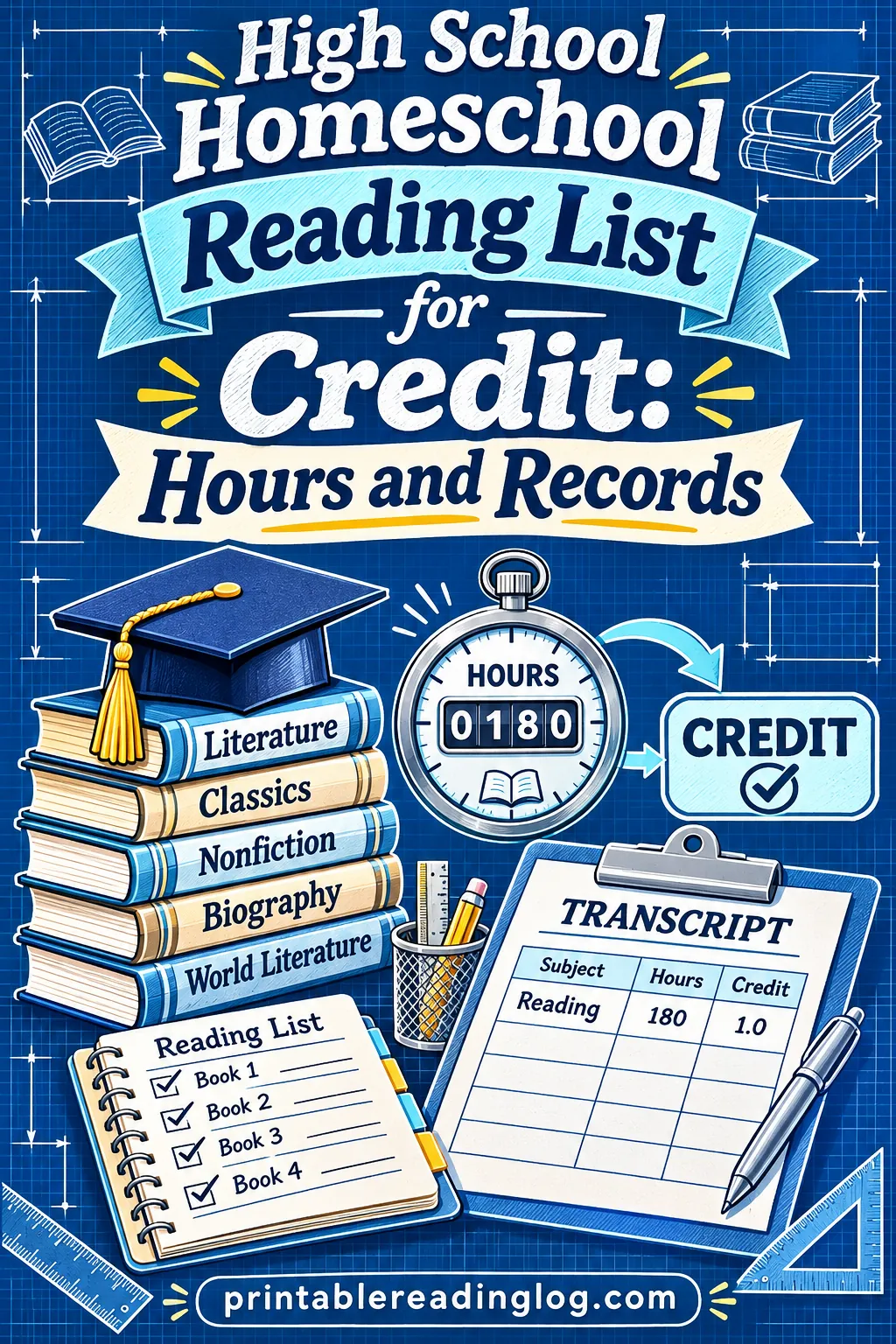
To turn independent reading into homeschool reading credit, log every book with its title, author, dates and hours, pair the reading with written or spoken responses, and stop at a clear hour target (many families use about 60 to 90 hours for a half credit and 120 to 180 for a full credit). Then summarize that log into a course title, a short description and a grade on the transcript. The rules for what counts vary by state, so check your state's official homeschool guidance before you finalize anything.
The easiest way to keep the records is a printed log your teen fills in every reading session. The free reading log maker has a High school preset with columns for title, author, pages or minutes, dates and initials, and it prints in a minute. Below you'll find the hour math, the exact records worth keeping, ready-to-use reading lists, the tool settings, and a sample transcript entry.
▶ Open this reading log ready to print
How Many Hours of Reading Make a Credit?
There's no single national number for a homeschool credit. Most homeschool credit guides start from the old idea of a "Carnegie unit," which ties one high school credit to roughly 120 hours of instruction over a school year. Many homeschool families stretch that to a range of about 120 to 180 hours for a full credit, because lab, discussion and writing time count too. Guides from different homeschool publishers don't agree on one figure, which is exactly why you should pick a target, write it down, and apply it consistently.
Here's a practical way to think about it:
| Credit amount | Common hour range | What that looks like week to week (36-week year) |
|---|---|---|
| Quarter credit | About 30 to 45 hours | About 1 hour a week |
| Half credit | About 60 to 90 hours | About 2 to 2.5 hours a week |
| Full credit | About 120 to 180 hours | About 3.5 to 5 hours a week |
A few points help keep this honest:
- Pick one number and stick to it. If you decide a half credit equals 75 hours, use 75 hours for every reading-based course on the transcript. Consistency matters more than the exact figure.
- Count the work around the reading, too. Writing a response, discussing a chapter, or researching background on an author is part of the course. You can log those minutes as long as you label them.
- Don't count the same hour twice. If your teen reads a history book for a history credit, those hours shouldn't also go toward English. Pick one course per book.
- Check your state and any umbrella school or co-op. Some states, umbrella programs and accrediting groups have their own definitions of a credit. Your state's department of education or your state homeschool organization is the place to confirm.
Does reading alone count, or does it need responses?
Reading by itself is a good start, but a course usually needs some kind of output that shows thinking. Most homeschool credit guides suggest pairing a reading list with responses, such as short essays, narrations, discussion notes or a project. If a college admissions office or umbrella school ever asks how you assigned the credit, "she read 14 books, wrote a response to each, and completed two longer essays" is much stronger than "she read a lot."
A simple rule of thumb many families use: plan for roughly three to four hours of reading for every one hour of response work. That's not a formal rule, just a balance that keeps the course mostly reading while still producing a portfolio.
What Records to Keep for Reading Credit
The goal of your records is simple: anyone looking at them later should be able to see what was read, when, for how long, and what your student did with it. You don't need fancy software. A printed log, a folder of responses, and a one-page course summary cover nearly everything.
| Record | What to write | Why it helps |
|---|---|---|
| Reading log | Date, title, author, pages or minutes, initials | Shows the hours and the actual books |
| Book list | Final list of every title and author for the course | Goes into the course description or portfolio |
| Response samples | Essays, narrations, discussion notes, projects | Shows thinking, supports the grade |
| Hour total | Running tally of reading plus response time | Supports the credit amount |
| Course summary | Course title, description, materials, grading method | Becomes the transcript entry |
| Grade record | Rubric scores or a simple grade per response | Supports the final grade |
Keep these records for good
Homeschool credit guides generally advise keeping high school records permanently, not just until graduation. Transcripts get requested for college applications, scholarships, military enlistment, jobs and sometimes years later for graduate programs. A few sheets in a labeled binder (and a scanned copy saved somewhere safe) cost almost nothing and can save a lot of stress.
A good storage setup:
- One binder or folder per school year.
- A tab for each course, with the reading log on top.
- Responses filed right behind the log, in date order.
- The course summary as the first page of the tab.
- A scan or photo of everything saved to a backup drive or cloud folder at the end of each semester.
What a single log row should include
Each row on the log is a mini record. If you fill in these fields every session, totaling hours at the end of the semester takes ten minutes:
- Date of the reading session
- Title and author of the book
- Pages read (for example, 112 to 148) or minutes spent
- Initials from the student, and from the parent if you're co-signing
- Notes, such as "chapter 9 to 11" or "discussion with Dad, 20 min"
Many families like to log both pages and minutes. Pages show progress through the book, while minutes add up to hours for the credit. If that feels like too much, log minutes only and write the page range in the notes once a week.
Building the Reading List: Ready-to-Use Lists
A reading-based credit is much easier to defend when the list has a clear theme. "American Literature" or "World History Through Primary Sources" looks better on a transcript than "Assorted Reading." Below are sample lists made entirely of public-domain classics and historical documents, so they're easy to find free at the library or online. Mix in modern titles your family chooses, too. Award lists, such as Newbery Medal or National Book Award winners, are good places to look for those.
For a half credit, plan on roughly 8 to 12 titles, depending on length. Longer novels count for more hours, so you don't need a fixed number of books, just enough to reach your hour target.
American Literature (half or full credit)
- The Autobiography of Benjamin Franklin by Benjamin Franklin
- The Scarlet Letter by Nathaniel Hawthorne
- Walden by Henry David Thoreau (selected chapters)
- Narrative of the Life of Frederick Douglass by Frederick Douglass
- Moby-Dick by Herman Melville (or selected chapters)
- Little Women by Louisa May Alcott
- Adventures of Huckleberry Finn by Mark Twain
- The Red Badge of Courage by Stephen Crane
- The Call of the Wild by Jack London
- The Awakening by Kate Chopin
- Ethan Frome by Edith Wharton
- The Great Gatsby by F. Scott Fitzgerald
- Selected poems by Emily Dickinson and Walt Whitman
- Selected short stories by Edgar Allan Poe and Washington Irving
British Literature (half or full credit)
- Hamlet or Macbeth by William Shakespeare
- Pride and Prejudice by Jane Austen
- Frankenstein by Mary Shelley
- Jane Eyre by Charlotte Brontë
- Wuthering Heights by Emily Brontë
- Great Expectations or A Tale of Two Cities by Charles Dickens
- Silas Marner by George Eliot
- The Strange Case of Dr. Jekyll and Mr. Hyde by Robert Louis Stevenson
- The Importance of Being Earnest by Oscar Wilde
- Heart of Darkness by Joseph Conrad
- Selected poems by William Wordsworth, John Keats and Alfred Tennyson
World Literature (half or full credit)
- The Odyssey by Homer (an older public-domain translation)
- Antigone by Sophocles
- Don Quixote by Miguel de Cervantes (abridged or selected chapters)
- The Count of Monte Cristo by Alexandre Dumas
- Les Misérables by Victor Hugo (abridged)
- Crime and Punishment by Fyodor Dostoevsky
- A Doll's House by Henrik Ibsen
- The Death of Ivan Ilyich by Leo Tolstoy
- Selected stories by Anton Chekhov
- The Metamorphosis by Franz Kafka
History Through Primary Sources (half credit in history)
- The Declaration of Independence
- Common Sense by Thomas Paine
- Selected essays from The Federalist Papers
- The U.S. Constitution and Bill of Rights
- Democracy in America by Alexis de Tocqueville (selected chapters)
- Incidents in the Life of a Slave Girl by Harriet Jacobs
- The Gettysburg Address and Lincoln's Second Inaugural Address
- Up from Slavery by Booker T. Washington
- The Souls of Black Folk by W. E. B. Du Bois (selected chapters)
- The Jungle by Upton Sinclair
- The Prince by Niccolò Machiavelli (for a world history version)
How to mix classics with modern books
You don't have to build the whole course from classics. A common pattern is a "spine" of four to six required titles plus free-choice books that fit the theme. For an American Literature course, that might be five classics from the list above plus four modern American novels or memoirs your teen picks from an award list or a librarian's suggestions. Write every title on the log, whether it was assigned or chosen.
Responses That Turn Reading Into a Course
Responses are where a reading list becomes a class. They also give you something to grade. You don't need a response for every chapter. One solid response per book, plus a couple of longer pieces each semester, is plenty for most homeschool English credits.
Response options by effort level
| Response type | Rough time | Best for |
|---|---|---|
| One-paragraph summary and reaction | 15 to 20 minutes | Every book, quick check of understanding |
| Oral narration recorded or discussed with a parent | 15 to 30 minutes | Students who think out loud, busy weeks |
| Quote journal (3 quotes with a sentence each) | 20 to 30 minutes | Building close-reading habits |
| One-page analytical response | 45 to 90 minutes | Most books in an English credit |
| Character or theme comparison across two books | 1.5 to 3 hours | Midterm or end-of-unit work |
| Full essay with a thesis and citations | 4 to 8 hours over a week | One or two per semester |
| Creative project (letter in a character's voice, alternate ending, podcast episode) | 2 to 4 hours | Variety, reluctant writers |
Response prompts that work for almost any book
Print these and tape them inside the binder. Your teen picks one or two per book:
- What does the main character want most, and what stands in the way?
- Which scene changed how you felt about a character? Why?
- What question does the author seem to be asking? Do you agree with the answer the book gives?
- Pick one quote that sums up the book. Explain why.
- How does the setting (time and place) shape what happens?
- Compare this book with another on the list. What do they share? Where do they differ?
- If this book were written today, what would change?
- What did this book teach you about the time it was written?
- Who would you recommend this book to, and who would you warn away?
- What's one thing you'd ask the author if you could?
For history credits, swap in prompts like "What problem was the author trying to solve?", "Who was the intended audience?", and "What does this document leave out?"
Logging response time
Log response work on the same sheet as reading, with a short label in the notes column, such as "Response: one-page analysis" or "Discussion with Mom." At the end of the semester you can total reading and response time separately, which shows a balanced course. If you'd like a separate sheet just for written summaries, the reading log with summary layout gives your teen more writing space per book.
How to Make the Credit Log in the Free Tool
Here are the exact settings that work well for a high school credit log in the free printable reading log maker. It prints from your browser, so there's nothing to install. The tool doesn't open pre-filled from a link, so pick these settings yourself once the page loads.
- Start with a preset: choose High school. It gives you a clean layout with a sensible set of columns to start from.
- Reader name: your student's full name plus the course, such as "Emma R., American Literature." Writing the course name here makes each printed page self-labeling in the binder.
- Reading goal: write the credit target in words and hours, such as "Half credit: 75 hours" or "Full English credit: 150 hours."
- Log style: pick Adult-clean. It looks more like a school record and less like a kids' sticker chart.
- What are you logging? Choose Minutes if hours are your main measure, or Pages if you'd rather show progress through each book. Many families pick Minutes and jot page ranges in Notes.
- Color theme: Classic prints cleanly in black and white and scans well later.
- Columns: turn on Date started, Title, Author, Pages/Minutes, Date finished, Genre, Initials (P/T) and Notes. Turn off anything you won't use, so each row has room to write.
- Rating style: Number works best for older students. A 1-to-10 rating takes a second and gives you something to talk about.
- Paper and orientation: Letter (or A4 if that's your paper), Landscape for the wide set of columns.
- Rows per page: go with more rows (around 20 or more) if you log every session, or fewer if you log one row per book.
- Goal tracker: pick 100 squares and let each square stand for one hour. For a 75-hour half credit, cross out the last 25 squares before you start, so the target is visible.
- Books I want to read next: use this box for the planned reading list, so assigned titles are always on the page.
- Month: set it if you print a new page each month. Leave it blank if one page will cover several months.
- Click 🖨️ Print / Save PDF. Print one copy to fill in and save the PDF so you can print more pages later.
Two logs or one?
If your teen is earning both an English and a history credit through reading, print two separately labeled logs, one per course, in different color themes. It keeps the hours from mixing and makes the end-of-semester totals easy. The homeschool reading log page has more layout ideas for families logging several subjects or several kids.
Session log or book log?
There are two ways to fill in the sheet, and both are fine for credit:
- Session log: one row per reading session. Best for hours, since every row has a date and minutes. You'll use more pages, but the hour total is airtight.
- Book log: one row per book, with start and finish dates and total hours in the Pages/Minutes column. Cleaner to read, but your teen needs a separate tally (a sticky note or the goal-tracker squares) to count hours along the way.
Plenty of families use a session log during the year and then copy a one-row-per-book summary at the end for the portfolio.
Turning the Log Into a Transcript Entry
At the end of the course, your log becomes three short pieces: a course title, a course description, and a grade. The transcript itself usually shows only the title, credit amount and grade. The description and book list live in a separate course description document or portfolio, which some colleges request.
Choosing a course title
Use a plain, recognizable title. Admissions readers move quickly, and a clear name helps them understand the course at a glance.
| What your teen read | Clear course title | Typical credit |
|---|---|---|
| American novels, poems and essays | American Literature | 0.5 or 1.0 English |
| British novels, plays and poetry | British Literature | 0.5 or 1.0 English |
| Translated classics from many countries | World Literature | 0.5 or 1.0 English |
| Mixed fiction with lots of writing | English 10 (or the grade level) | 1.0 English |
| Founding documents and historical narratives | U.S. History Through Primary Sources | 0.5 history |
| Shakespeare plays plus films or performances | Shakespeare Studies | 0.5 English elective |
| Science and nature writing | Literature of Science and Nature | 0.5 elective |
A sample course description you can adapt
Here's a short example built from a reading log. Swap in your own titles, hours and methods:
American Literature (0.5 credit). Student read and responded to ten works of American literature, from colonial autobiography to early twentieth-century fiction, including Narrative of the Life of Frederick Douglass, Adventures of Huckleberry Finn and The Great Gatsby, along with selected poetry. Coursework included a written response for each book, a quote journal, weekly discussions with a parent, and two analytical essays. Approximately 80 hours were logged across reading, writing and discussion. Grade based on written responses (50%), essays (35%) and discussion participation (15%).
Notice what it does: it names the type of literature, lists a few titles, describes the output, gives the hours from the log, and explains the grading. Every piece of that comes straight from records you already kept.
Grading reading-based credit
Grading doesn't have to be complicated. Pick a method before the course starts and apply it to every response:
- Rubric scoring. Score each response from 1 to 4 on understanding, use of evidence, and clarity. Average the scores at the end.
- Weighted categories. Responses, essays and discussion each get a percentage, like the sample above.
- Mastery approach. A response isn't "done" until it meets the standard, so your teen revises until it does. The final grade reflects the finished work.
Keep the graded responses behind the log in the binder. If anyone asks how you arrived at the grade, you'll have the answer on paper.
A Sample Year Plan for a Full Reading Credit
Spreading the work across the year keeps it from piling up in May. Here's one way to plan a full English credit of about 150 hours over a 36-week school year, which works out to a little over four hours a week.
| Weeks | Focus | Hours to log (approx.) | Output |
|---|---|---|---|
| 1 to 9 | Two or three shorter classics plus poetry | 35 to 40 | A response for each book, quote journal started |
| 10 to 18 | One long novel read slowly plus one free-choice book | 35 to 40 | Responses, first analytical essay |
| 19 to 27 | Drama (one or two plays) plus a memoir or narrative nonfiction | 35 to 40 | Responses, comparison of two works |
| 28 to 36 | Free-choice books on the theme plus review | 30 to 40 | Final essay, course summary written |
At the end of each nine-week block, add up the minutes on the log, divide by 60, and write the total at the bottom of the page. Four small totals are much easier than one giant count at the end of the year.
Weekly rhythm that keeps the log current
A simple weekly rhythm many homeschool families like:
- Monday to Thursday: 45 to 60 minutes of reading, logged at the end of each session.
- Friday: response work or discussion, logged with a "Response" label.
- Sunday evening: parent glances at the log, initials the week, and totals the minutes in the margin.
That parent check takes two minutes and catches gaps early, before a forgotten week turns into a forgotten month.
Scenarios: Making It Fit Your Student
Every teen reads differently. Here's how to adjust the plan for a few common situations.
The avid reader who reads constantly
Some teens already read far more than any credit requires. The challenge here isn't hours, it's focus. Have them log everything on a general log for fun, and only the books that fit the course theme on the credit log. If they rack up 200 hours of reading in a year, you can award a full English credit and, with a clear theme and separate books, an elective such as "Science Fiction and Fantasy Literature," as long as each course has its own books, hours and responses.
The reluctant reader
For a teen who struggles to sit down with a book, shorter sessions work better than long ones. Two 25-minute sessions a day still add up. Audiobooks can count toward reading time for many families, especially paired with following along in print, so log them with a note such as "audio." Lean on shorter works such as plays, novellas and short stories, and choose response types that fit, like oral narration or creative projects. Your teen's teacher, tutor or reading specialist can also suggest adjustments that fit their needs.
The student taking a co-op or online English class
If your teen already has an English class through a co-op or online provider, independent reading can still count, but usually as a separate elective rather than as extra hours on the same English credit. Keep the logs separate so nobody wonders whether the hours were counted twice.
The student who started late in the year
Starting in January isn't a problem. Aim for a half credit by the end of the school year, then continue over the summer if you want a full credit. Some families finish a reading course over the summer, which is fine as long as the log shows the dates.
The student reading for history
For a history credit through reading, mix primary sources (documents, speeches, letters) with narrative history and historical fiction. Responses lean toward "what does this show about the time" rather than literary analysis. The list in the primary sources section above is a solid start for a half credit.
Troubleshooting Common Problems
| Problem | What's going on | Fix |
|---|---|---|
| Log has gaps of weeks at a time | Logging feels like a chore or the sheet got lost | Keep the log clipped inside the current book, and do a Sunday check-in |
| Hour total is short at the end of the year | Target was set but not tracked along the way | Total hours every nine weeks; add a summer block to finish |
| Teen reads but won't write responses | Writing feels like the hard part | Start with oral narration and quote journals, then build to one-page responses |
| Not sure whether a book "counts" | No clear course theme | Name the course first, then only log books that fit it |
| Same book could fit English and history | Overlapping subjects | Assign it to one course only and note it on that log |
| Log is messy and hard to read later | Too many columns for the space | Reprint with fewer columns and landscape orientation |
| Lost the log partway through the year | Single paper copy | Scan or photograph pages monthly and store the PDF of the blank log |
| Unsure what your state requires | Rules vary by state | Check your state's official homeschool guidance or your umbrella school |
Extra tips for clean, credible records
- Write the book list as you go. Don't wait until the end. Use the "Books I want to read next" box for planned titles and move them onto log rows as your teen starts each one.
- Note editions and translations. For translated classics, write the translator's name in Notes. It's a small detail that makes the course description more precise.
- Date everything. Undated responses are much harder to match to the log later.
- Keep a separate fun log, too. Teens don't have to give up casual reading just because some of it counts for school. A general reading log for high school works well for everything outside the credit course.
- Compare a few formats if you're unsure. The roundup of the best free reading logs for homeschool shows different layouts side by side.
When you're ready, open the free reading log maker, choose the High school preset, set the goal tracker to 100 squares, and print your first credit log. Fill in the course name, the hour target and the planned book list today, and the records will build themselves one session at a time.
▶ Open this reading log ready to print
Frequently Asked Questions
How many hours of reading equal a half credit in homeschool?
Many homeschool families use about 60 to 90 hours for a half credit, counting reading plus responses and discussion. Different homeschool guides suggest different numbers, so choose one target and apply it consistently. Check your state's guidance and any umbrella school's rules before you finalize it.
Can independent reading count toward an English credit?
Yes, in many homeschools it can, especially when the reading has a clear theme and is paired with responses such as essays, narrations or discussions. A log with dates, titles and hours, plus a folder of responses, makes the credit easy to explain. Rules vary by state, so confirm with your state's official homeschool resources.
Do audiobooks count for homeschool reading credit?
Many families count audiobooks, especially when the student also writes or discusses responses. Log them like any other book and add a note such as "audio" in the Notes column. If you're part of an umbrella school or co-op, ask whether they have their own policy.
What should a homeschool reading log for credit include?
At minimum, include the date, title, author, pages or minutes, and initials. Adding a Notes column for chapter ranges and response work makes totaling hours easier. Keep the graded responses filed right behind the log.
How long should I keep high school reading records?
Homeschool credit guides generally recommend keeping high school records permanently. Transcripts and course descriptions can be requested years later for college, scholarships, jobs or the military. A binder plus a scanned backup is an easy way to do it.
How many books should be on a reading list for one credit?
There's no fixed number, because book length varies so much. For a half credit, 8 to 12 titles is common, and a full credit often lands around 15 to 25. Let the hour target decide, not the book count.
Can one book count toward both English and history?
It's best not to count the same hours toward two credits. Assign each book to one course and log it there. If a book truly serves both, you can split it, for example by logging the reading in history and a separate literary analysis project in English, with the time for each logged separately.
What do I write on the transcript for a reading-based course?
The transcript usually lists the course title, credit amount and final grade, such as "American Literature, 0.5, A." Keep a separate course description with the book list, hours and grading method. Some colleges ask for course descriptions, so it's worth writing one for every reading-based course.
Do I need to grade independent reading?
If it's going on a transcript as a credit, it should have a grade. Grade the responses rather than the reading itself, using a rubric or weighted categories you decide on before the course starts. Keep the scored work with the log as backup.