Minutes or Pages? What to Do When Your Child Reads Fast
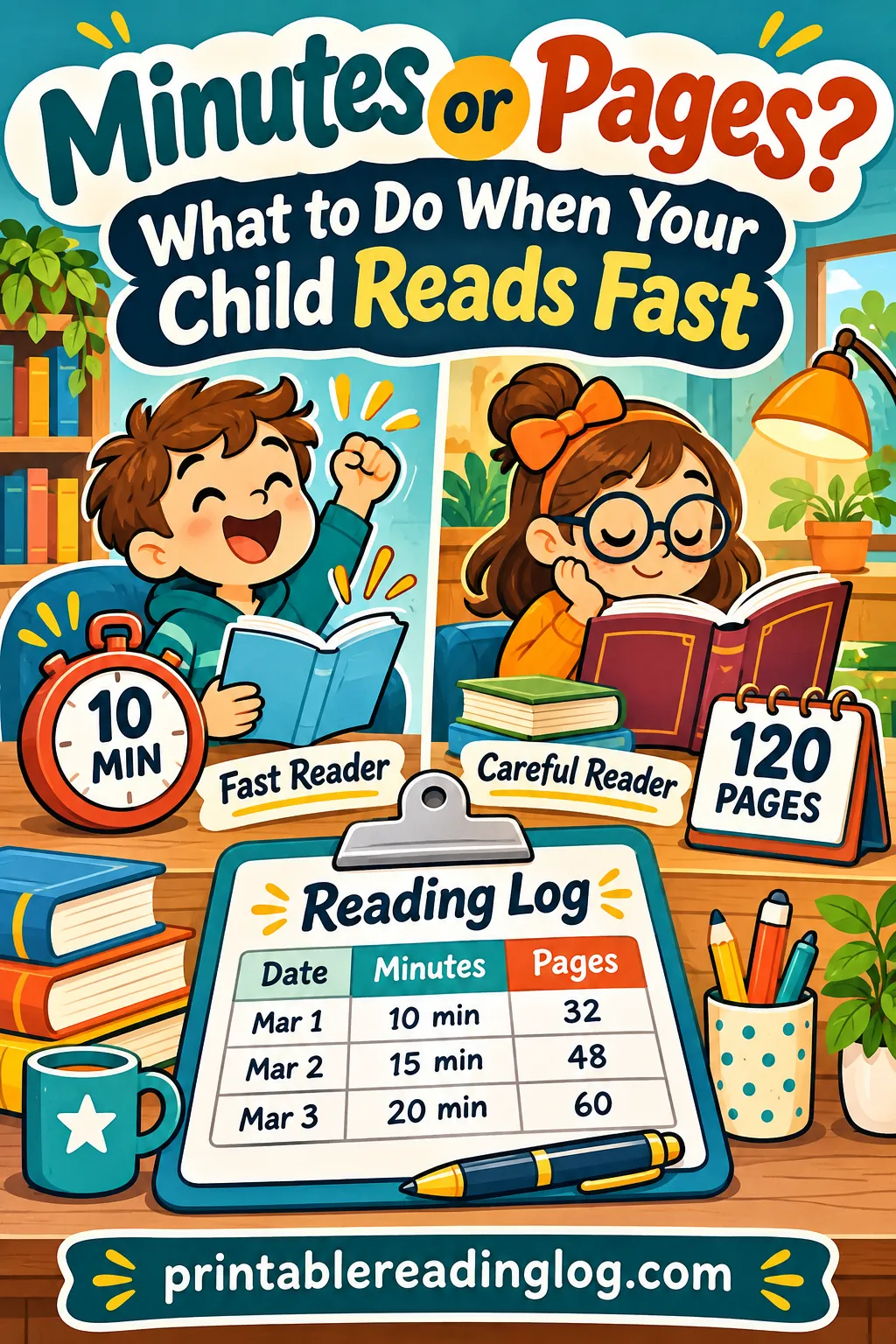
If you're stuck on a reading log minutes or pages question, the simplest fix is to log both on the same row: write the minutes your child read and the pages they covered, then hand in whichever number the teacher asked for, with the other one right next to it as context. That way a fast reader gets credit for real time spent, and a slow reader gets credit for real effort, without anyone having to fudge the numbers.
You can print a log with room for both numbers in the free printable reading log maker on this site. Choose a preset, turn on the Pages/Minutes column, and your child writes something like "20 min / 24 pp" each day. Exact settings are below.
This guide walks through why minutes and pages often feel unfair to the same kid in different ways, what to do for a speedy reader and a slower one, how to talk with the teacher about it, and how to adjust by grade.
▶ Open this reading log ready to print
The Quick Decision: Minutes, Pages or Both?
Start here. Find the situation that sounds like your house, then follow the row across.
| Your situation | What to log | Why |
|---|---|---|
| Teacher asks for minutes, child reads at an average pace | Minutes | The requirement already fits |
| Teacher asks for minutes, child reads very fast | Minutes plus pages | Pages show how much ground the minutes covered |
| Teacher asks for pages, child reads slowly or carefully | Pages plus minutes | Minutes show the effort behind a small page count |
| Teacher asks for pages, child reads picture books or graphic novels | Pages plus a note on book type | Page counts vary a lot by format |
| No requirement, you're tracking at home | Minutes for habit, pages for progress | Pick the one that motivates your child |
| Child is working toward a page or book goal | Pages | Pages add up toward the finish line |
| Child is building a daily habit | Minutes | Minutes reward showing up every day |
If you only remember one thing from this article: logging both is almost never wrong. It costs your child about three seconds a day, and it gives you and the teacher a much clearer picture than either number alone.
Why Minutes and Pages Measure Different Things
Minutes and pages sound like two ways of saying the same thing, but they track different parts of reading.
Minutes measure time on task. A minutes log answers, "Did my child sit with a book today, and for how long?" That's why many classrooms use it, especially in the early and middle grades. It rewards a steady habit, and it's fair to kids reading at very different levels, because twenty minutes is twenty minutes no matter what book is open.
Pages measure ground covered. A pages log answers, "How far did my child get?" It's great for finishing books, chasing goals, and seeing progress through a long chapter book. But it depends heavily on the book. A page of a picture book, a page of a graphic novel and a page of a dense middle-grade novel are three very different amounts of reading.
Here's how the two compare side by side.
| Minutes log | Pages log | |
|---|---|---|
| What it shows | Time spent reading | How far the reader got |
| Fair across reading levels? | Mostly yes | Not really; depends on the book |
| Rewards | Consistency | Progress and finishing |
| Easy to fill in? | Yes, with a timer | Yes, with a bookmark |
| Weak spot | A fast reader can feel held back | A slow reader can feel behind |
| Best for | Building a daily habit | Goals, long books, older readers |
Neither one is better. They just answer different questions. Trouble starts when the question the log asks doesn't match the reader in front of it.
When Your Child Reads Fast
Fast readers often run into trouble with minutes logs. You might hear things like:
- "I already finished the chapter. Why do I have to keep reading?"
- "I read a whole book today and it only counts as twenty minutes?"
- "Can I write down forty-five minutes since I did two days' worth?"
These complaints usually come from a good place. Your child loves reading and wants credit for how much they do. A minutes log can make that feel invisible.
Step 1: Check that fast really means fast
Before anything else, make sure the speed is real reading and not skimming. Fast readers are often excellent readers, but sometimes "done" means "flipped through." A quick, low-pressure check works better than a quiz:
- Ask them to tell you what happened in the chapter, in order.
- Ask what they think a character will do next, and why.
- Ask about a detail from the middle, not just the ending.
- Ask if there were any words they didn't know.
If they can answer easily, the speed is real. If the answers are thin, they might need a slightly slower pace or a book that's a better fit. Either way, keep it a chat, not a test. You don't want reading to start feeling like an exam.
Step 2: Log pages alongside minutes
Once you're confident they're really reading, add a page count to every row. Now the log shows "20 min / 35 pp" instead of just "20 min." That one change usually solves the "it doesn't count" feeling. Your child can see the ground they covered, and so can the teacher.
Step 3: Let the minutes stay honest
It's tempting to let a fast reader round up minutes because "they read so much." Try not to. If your child read for twenty minutes, the log should say twenty. The pages number is where the extra effort shows. Keeping minutes honest also keeps the log trustworthy, which matters if you ever need to talk with the teacher about it.
Step 4: Make the extra time feel like a bonus
If the requirement is twenty minutes and your child wants to keep going, great. Log the real total. Some families add a small star or a highlight on days the reader went past the goal. It's a nice way to celebrate without turning it into a competition.
Step 5: Think about book fit
A child who finishes a book in one sitting every day may be ready for longer or more challenging books. That doesn't mean pushing them into something hard; it means offering more choices. Talk with the teacher or a librarian about books that'll hold their attention for the full reading time. A good-fit book often fixes the minutes complaint all by itself, because twenty minutes stops feeling long.
When Your Child Reads Slowly
Slower, careful readers tend to struggle with the opposite kind of log. A pages log can make a hardworking kid feel behind, especially when a classmate brags about reading "a hundred pages last night."
Some common reasons a child reads slowly:
- They're still building decoding skills and sounding out new words.
- They read carefully and like to reread parts they enjoy.
- They're reading a book that's a stretch, which is good, but slow.
- They're learning English, so every page asks more of them.
- They get distracted easily and need breaks.
- They have a learning difference that makes reading take more effort.
None of these mean your child is doing it wrong. They just mean page counts don't tell the whole story. If you have any concerns about how your child is reading, the teacher is the right first person to talk to, and they can guide you on next steps.
Add minutes to every pages row
Just like with the fast reader, add the missing number. A row that says "6 pp / 25 min" tells a very different story than "6 pp" by itself. It shows a child who sat with a book for nearly half an hour, which is real effort and real practice.
Celebrate time, not just totals
At home, put the spotlight on consistency. "You read every single day this week" is a powerful thing to say, and it's true whether your child covered ten pages or a hundred. If you use a goal-tracker bar, consider having one square stand for one reading session, not one book or ten pages. That way, every day of effort gets colored in.
Watch for frustration, not just speed
Slow is fine. Frustrated is the thing to watch. If your child is regularly upset, avoids reading, or says it's too hard, mention it to the teacher. They can suggest books at the right level or check whether any extra support would help. Your log, with both minutes and pages, gives them useful information for that conversation.
Make the pages goal personal
If the class has a page goal, ask whether your child can work toward a goal based on their own past weeks instead. For example, if they usually read about 40 pages a week, aiming for 45 is a real stretch that's actually within reach. Many teachers are glad to adjust when a parent asks kindly and shows what the child has been doing.
Log Both: Set It Up in the Free Tool
Here's how to print a log that holds both numbers on every row. Open the reading log maker and use these settings.
| Setting | Choose this | Notes |
|---|---|---|
| Start with a preset | Weekly log, or By pages for longer books | Weekly log fits most homework logs |
| Reader name | Your child's name | Makes it feel like their own sheet |
| Reading goal | The teacher's goal, e.g. 20 minutes a day | Use the number on the assignment |
| Log style | Kid-friendly | Bigger, friendlier layout for younger kids |
| What are you logging? | Minutes or Pages, whichever the teacher asked for | Match the requirement first |
| Color theme | Any; Sky or Mint print softly | Classic is best for black-and-white printers |
| Columns | Date started, Title, Pages/Minutes, Initials (P/T) | Add Star rating or Notes if your child likes them |
| Rating style | Smiley for younger kids, Stars for older | Optional |
| Paper and orientation | Letter or A4, Portrait | Portrait fits a folder |
| Rows per page | 7 for a week, more for a month | Leave a little extra space for big handwriting |
Then, in the Pages/Minutes column, teach your child to write both numbers every time:
20 min / 24 pp
That's it. One column, two numbers. If the teacher only asked for minutes, the minutes come first. If the teacher asked for pages, flip the order: "24 pp / 20 min." The first number answers the assignment. The second one gives context.
A few more settings that help:
- Initials (P/T). Turn this on if the teacher wants a parent signature. You initial each day after your child logs.
- Goal-tracker bar. For a fast reader working toward a book count, try 25 or 50 squares. For a slow reader, use squares for reading days instead of books.
- Coloring strip. On Kid-friendly logs for younger children, the coloring strip makes logging feel more like fun and less like a chore.
- Books I want to read next. Great for fast readers who need a running list so they never run out of books.
When it looks right, click 🖨️ Print / Save PDF. Save the PDF so you can print a fresh week whenever you need one. The tool doesn't open pre-filled from a link, so a saved copy is the easiest way to reuse your settings.
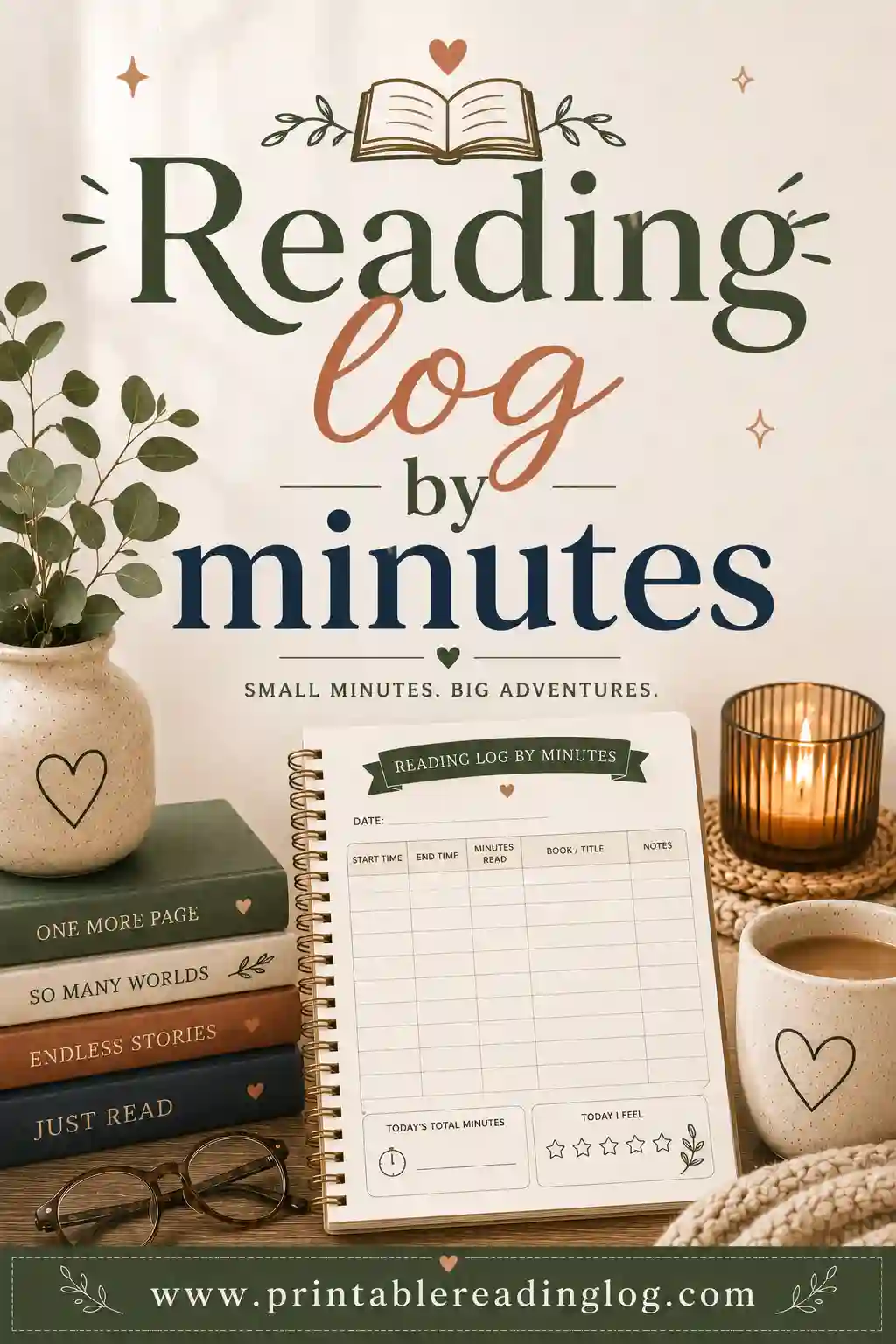
If you want a sheet built only around one number, the site also has a dedicated reading log by minutes and a reading log by pages. The two-number row above works with either one.
A filled-in week for each reader
Seeing it on paper helps. Here are two sample weeks for two kids with the same assignment: read 20 minutes a day.
Reader A: a fast reader on a minutes log
| Day | Book | Pages/Minutes | Initials |
|---|---|---|---|
| Mon | Chapter book, ch. 1-3 | 20 min / 34 pp | JM |
| Tue | Chapter book, ch. 4-6 | 20 min / 31 pp | JM |
| Wed | Chapter book, ch. 7-9 | 25 min / 40 pp | JM |
| Thu | Chapter book, finished | 20 min / 28 pp | JM |
| Fri | New book, ch. 1-2 | 30 min / 45 pp | JM |
| Weekly total | 115 min / 178 pp |
Reader A met the minutes requirement every day, and the pages show they finished one book and started another. The teacher sees both: a steady habit and a strong pace.
Reader B: a careful reader on the same log
| Day | Book | Pages/Minutes | Initials |
|---|---|---|---|
| Mon | Early chapter book, ch. 1 | 20 min / 8 pp | KL |
| Tue | Same book, ch. 2 | 20 min / 9 pp | KL |
| Wed | Same book, reread ch. 2 | 20 min / 9 pp | KL |
| Thu | Same book, ch. 3 | 25 min / 11 pp | KL |
| Fri | Same book, ch. 4 | 20 min / 10 pp | KL |
| Weekly total | 105 min / 47 pp |
Reader B also met the requirement every day. The pages are lower, but the log shows real, steady work, including a reread, which is a good reading habit. If this log had only asked for pages, Reader B would look far behind. With both numbers, Reader B looks exactly like what they are: a reader putting in the time.
Both logs are honest. Both meet the assignment. And both give the teacher more useful information than a single number would.
How to Talk With the Teacher About It
Most teachers want the reading log to encourage reading, not to cause nightly arguments. If the format isn't working for your child, a short, friendly note usually goes a long way. The key is to ask, not demand, and to show what you've been doing.
Here are three short scripts you can adapt. Keep them brief, and send them however your school prefers parents to reach out.
Script 1: A fast reader on a minutes log
Hi, Ms. Rivera. [Child] has been doing the 20-minute reading log each night and really enjoys it. They read quickly and often finish several chapters in that time, so we've started writing the pages next to the minutes, like "20 min / 30 pp." I hope that's okay. Please let me know if you'd prefer we do it differently. Thanks for everything you're doing this year.
Script 2: A careful reader on a pages log
Hi, Mr. Lee. [Child] is working hard on the reading log. They read slowly and carefully, so the page count is often lower than the class goal, even though they read every day for 20 to 25 minutes. We've been writing the minutes next to the pages so you can see the time they're putting in. Would it be possible for them to work toward a goal based on their own past weeks? Happy to talk if that's easier.
Script 3: No clear requirement
Hi, Ms. Patel. Quick question about the reading log: would you like us to record minutes, pages, or both? We've been writing both for now, just so you have the full picture. Thank you!
A few tips that help these conversations go well:
- Lead with something positive. Mention what's working before what isn't.
- Show the log. A week of real entries says more than a description.
- Offer a solution, not just a problem. "We've been writing both" is easy for a teacher to say yes to.
- Stay open. The teacher may have a reason for the format that you don't know about, such as a school-wide program or a specific skill they're building.
- Follow their answer. If the teacher prefers one format, use it. You can still keep the second number in pencil for your own records at home.
Adjusting by Grade
What makes sense changes as kids grow. This table gives a general starting point, but your child's teacher always has the final say on what the class log should include.
| Grade range | Common log style | What to add at home | Tip |
|---|---|---|---|
| Preschool and kindergarten | Books read together, or a simple check box | Number of books and who read them | Count read-alouds; they're real reading |
| 1st-2nd grade | Minutes, sometimes number of books | Pages for chapter books, book count for picture books | Keep sessions short and positive |
| 3rd-5th grade | Minutes of independent reading is common | Pages, so progress through longer books shows | This is when the fast-vs-slow gap often becomes noticeable |
| Middle school | Minutes or pages, sometimes a summary | The other number, plus a one-line summary | Let them own the log more |
| High school | Pages, chapters or a reading assignment schedule | Minutes, to plan homework time | Help them estimate how long an assignment will take |
For younger kids, the biggest goal is enjoying books. Logs at this age are often more about the routine than the numbers. If you'd like more on daily targets, the guide on how many minutes kids should read per day goes into more detail and reminds you to follow your school's guidance.
In the upper elementary years, the minutes-or-pages question gets louder, because reading speeds start to spread out. A dedicated reading log for 3rd-5th grade gives a layout sized for that age group, and the two-number row works well on it.
By middle and high school, students can start to manage their own logs. Logging both numbers becomes a planning skill: once a teen knows they read about 30 pages in 40 minutes, they can estimate how long a 90-page assignment will take and plan their evening around it.
Picture Books, Graphic Novels and Audiobooks
Some books make the minutes or pages question even trickier. Here's how to handle the common ones.
Picture books. A picture book might have 32 pages and take five minutes to read. Pages aren't a great measure here. For young readers, log minutes or count books. If the teacher wants pages, write the page count, but add "picture book" in the title column so the number makes sense.
Graphic novels. These are real reading, and many kids love them. Pages can fly by, though, so a graphic novel can make a page count look very high. Log both numbers and note the format. That keeps the log honest without making the book seem less valuable.
Audiobooks. Listening counts as reading practice in many classrooms, but policies vary, so check with the teacher. If audiobooks are allowed, minutes are the natural measure. Some kids follow along in a print copy; in that case, you can log pages too.
Rereading. Rereading a favorite book is a good habit. It builds fluency and confidence. Log it the same way as a new book, and add "reread" in the notes if your teacher likes to know.
Read-alouds. If you read to your child, ask the teacher whether that counts. For young kids it usually does. For older kids, it might count as a bonus or a separate category. Either way, logging minutes works best.
Troubleshooting Common Minutes-and-Pages Problems
Even with a good setup, a few problems come up again and again. Here are quick fixes.
| Problem | What's going on | Try this |
|---|---|---|
| Child wants to round up minutes | Wants credit for reading a lot | Keep minutes honest; let the pages column show the extra effort |
| Child rushes to "get pages" | Pages log feels like a race | Switch the home focus to minutes, or celebrate reading days instead of totals |
| Big nightly arguments about the log | Logging feels like a chore | Fill it in together right after reading, and keep it to one line |
| Child forgets to note the page number | Hard to remember where they started | Keep a sticky note on the bookmark with the starting page |
| Pages look huge with graphic novels | Format inflates page counts | Add the format to the title, and log minutes too |
| Teacher seems unsure about two numbers | Unfamiliar format | Ask which number matters most, and put that one first |
| Child reads more on weekends, less on weekdays | Busy school nights | Ask whether weekend reading can balance the week, and log it either way |
One more tip that solves a lot: use a timer and a bookmark together. Start the timer when reading starts. When it stops, look at the bookmark and the current page. Subtract, write both numbers down, done. It takes less than a minute, and there's no guessing.
When you're ready to try it, open the free reading log maker, pick the Weekly log preset with the Kid-friendly style, turn on the Pages/Minutes and Initials (P/T) columns, and print a week. Show your child how to write "min / pp" on the first row, and let them take it from there.
▶ Open this reading log ready to print
Frequently Asked Questions
Should a reading log track minutes or pages?
It depends on what the log is for. Minutes are better for building a daily habit and are fair across reading levels. Pages are better for tracking progress toward a goal or through a long book. If you aren't sure, logging both on one row covers either requirement.
My child reads fast and finishes before the timer. What should we do?
First, check gently that they understood what they read by chatting about the chapter. If they did, add pages next to the minutes so their progress shows. Keep the minutes honest, and offer longer or more challenging books so the reading time feels full.
My child reads slowly and feels behind on a pages log. How can I help?
Add minutes next to the pages so the effort shows. Celebrate reading every day, not just big totals. If the class has a page goal, ask the teacher whether your child can work toward a goal based on their own past weeks.
Is it okay to write both numbers if the teacher only asked for one?
Usually yes, as long as the requested number comes first and is easy to find. It gives the teacher extra context without changing the assignment. If you're unsure, send a quick note asking whether they mind.
How do I set up a minutes-and-pages log in the free tool?
Open the reading log maker, choose the Weekly log preset, set the log style to Kid-friendly, and turn on the Pages/Minutes column. Add Initials (P/T) if the teacher wants a parent sign-off. Print it or save it as a PDF, then have your child write entries like "20 min / 24 pp."
Do graphic novels and picture books count as reading?
In most classrooms they do, but the teacher decides what counts for their log. Because page counts for these books can look very high or very low, it helps to log minutes too and note the format in the title column.
What if my child wants to stop logging because it feels like a chore?
Keep it to one short line, fill it in together right after reading, and add something fun, like a coloring strip or a goal-tracker bar. If it still feels like a fight, talk with the teacher about simpler options; most teachers would rather keep a child reading than keep a perfect log.
Can older kids use the minutes and pages to plan homework?
Yes, and it's a great skill to build. After a couple of weeks, a student can see roughly how many pages they read in a set number of minutes. They can then estimate how long a reading assignment will take and plan their evening around it.