Bilingual Reading Log: Tracking Books in Two Languages
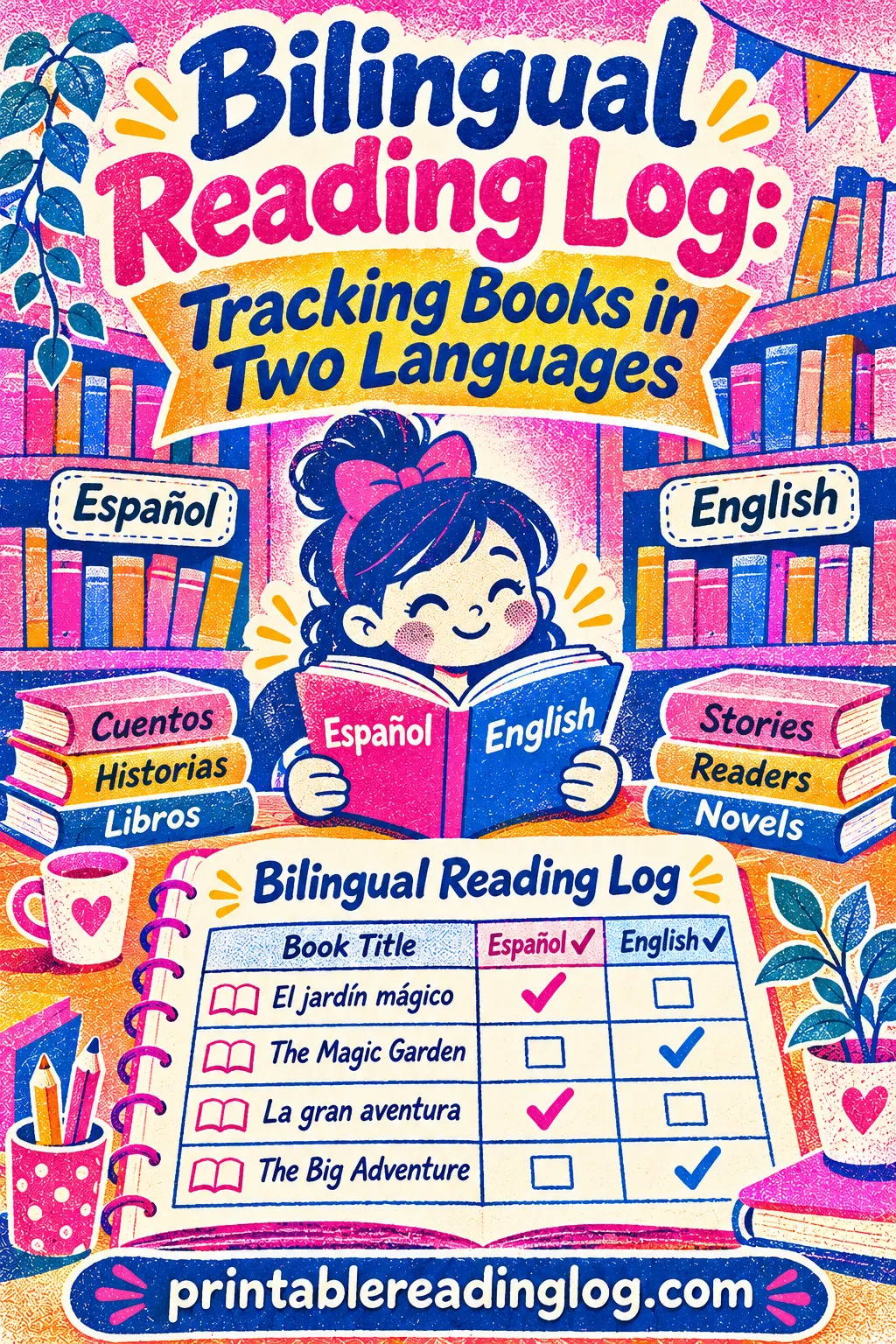
A bilingual reading log is an ordinary book log with one extra mark on every row: the language the book was read in. Write a short code like SP or EN next to each title, add up each language at the end of the month, and you can see at a glance whether both languages are getting their share of reading time.
You don't need special paper for this. The free printable reading log maker lets you build a kids' log with the columns you want, a monthly goal bar and a "Books I want to read next" box, and the Genre column works neatly as your language column. Below you'll find the exact settings, two ways to set it up, language codes for mixed books, monthly tally sheets, age-by-age versions and fixes for the problems bilingual families run into most.
▶ Open this reading log ready to print
Why a Bilingual Reading Log Helps (and What It Can Show You)
Most bilingual families have a gut feeling about how reading is going. "She reads a lot in English, but less in Spanish." "He only wants Korean books at bedtime." The trouble is that gut feelings are fuzzy. A busy month can feel balanced when it really wasn't, and a slow month can feel like failure when your child actually read more than you thought.
A bilingual reading log turns that feeling into something you can count. After a few weeks, it can answer questions like these:
- How many books did my child read in each language this month?
- Is one language mostly read aloud by a parent while the other is read independently?
- Which kinds of books (picture books, comics, chapter books, nonfiction) show up in each language?
- Did the balance change during school breaks, holidays or a visit from relatives?
- Which books in the home language did my child love enough to reread?
None of this is about scoring your child. It's about noticing. Many families find that the language spoken at school or in the wider community takes over reading without anyone deciding it should. A simple log makes that drift visible early, while it's still easy to nudge things back.
What counts as "reading" in each language
Before you print anything, agree as a family on what goes on the log. You'll save a lot of second-guessing later. Here's a starting list most families can use:
- Independent reading: your child reads the book on their own, in either language.
- Read-alouds: you, a grandparent or an older sibling reads to the child. These count, and for a heritage language they often carry most of the load in the early years.
- Shared reading: you take turns reading pages, or your child reads the words they know and you read the rest.
- Audiobooks: listening counts, especially with the printed book open. Mark them with a small headphones symbol so you can tell them apart.
- Dual language books: books printed in both languages on the same page or facing pages. You'll decide below how to log these.
- Comics, magazines and kids' nonfiction: if it has words and your child engaged with it, it can go on the log.
If your child's teacher also asks for a reading log, check whether home-language books count toward the class goal. Many teachers are happy to include them, but ask rather than assume, and follow the school's guidance.
Choose Your Setup: One Log or Two
There are two good ways to run a bilingual reading log. Neither is better; they just suit different families.
Option A: One log with a language column
Every book goes on the same sheet, in the order it was read. You write the language in its own column. At the end of the month, you count down the column and tally each language.
This works best when:
- Your child reads in both languages most weeks.
- You want one sheet on the fridge, not two.
- You care about the mix (for example, Spanish at bedtime and English after school).
- Your child is young and one sheet is less confusing.
Option B: Two logs, one per language
You print two separate logs, each in a different color theme, and each language gets its own goal bar. The Spanish log might be Sky blue, the English log Sunshine yellow. Your child can see two goal bars filling up side by side.
This works best when:
- One language needs a deliberate boost and you want a separate goal for it.
- Different adults handle different languages (for example, one parent reads only in Arabic, the other only in English).
- Your child is older and likes having "their Spanish log" and "their English log."
- A heritage school, weekend class or tutor wants to see the home-language reading on its own.
| Question | One log with a language column | Two logs, one per language |
|---|---|---|
| How many sheets? | One | Two (different colors) |
| How do you see the balance? | Count the language column monthly | Compare two goal bars |
| Best age range | Toddlers to early elementary | Upper elementary to teens |
| Goal setup | One total goal, plus a monthly target per language | A separate goal for each language |
| Easiest for | Busy families, one main reader-aloud | Families with a "one parent, one language" routine |
| Watch out for | Forgetting to fill in the language | One log getting forgotten in a drawer |
If you're not sure, start with Option A for one month. If you find yourself wishing the home language had its own goal, switch to Option B the next month. You can always print again.
How to Make It in the Free Tool (Exact Settings)
Here's how to build Option A, the single bilingual log, in the free reading log maker. It takes about two minutes. The tool doesn't open pre-filled from a link, so open the homepage and pick these settings yourself.
- Start with a preset: Kids. This gives you the kid-friendly layout and coloring strip. For a teen, choose High school instead.
- Reader name: your child's name. Some families add both versions of the name, like "Sofía / Sofia," which kids often love.
- Reading goal: a monthly total for both languages together, such as "20 books this month." You'll track each language separately in the tally (more on that below).
- Log style: Kid-friendly for children up to about age 10; Adult-clean for older kids and teens.
- What are you logging? Choose Books. If your child's school asks for minutes, choose Minutes instead and add the Pages/Minutes column.
- Color theme: any. Mint and Sky are calm and print well in a home printer.
- Columns: turn on Title, Genre, Date finished, Star rating and Initials (P/T). Turn on Author too if your child is old enough to copy names. Leave Notes off for young kids so the rows stay roomy.
- Rating style: Smiley for little ones, Stars for school-age kids, Number for teens.
- Paper: Letter or A4, Portrait.
- Rows per page: 15 to 20 for a month of picture books; 10 to 12 for chapter books.
- Goal tracker: turn on the goal bar with 25 squares for a picture-book reader, or 10 for a chapter-book reader.
- Books I want to read next: turn it on. You'll use it to plan the next home-language books (see the monthly routine below).
- Month: pick the current month.
- Click 🖨️ Print / Save PDF.
Turning the Genre column into a language column
The tool doesn't have a separate "Language" column, and you don't need one. Use the Genre column to write the language instead. Before you hand the sheet to your child, write "Language" in pencil above the Genre header, or just explain once that this box is for the language. Then fill it with a short code like SP, EN, FR or KO for every book.
If you'd rather keep Genre for actual genres, put the language in the Notes column as the first thing you write, for example "EN – funny" or "AR – read with Dad." It's a little slower to count but works fine.
Settings for Option B (two logs)
For two separate logs, build the first one with the settings above, set the Reader name to something like "Mateo's Spanish books," pick the Sky theme, and print. Then change only three things: the reader name ("Mateo's English books"), the color theme (Sunshine), and the goal number if it's different. Print again. Leave the Genre column for real genres on both, since the whole sheet is already one language.
Because the two sheets look different, a quick glance at the fridge tells your child which one to fill in. Little ones can learn "blue is Spanish, yellow is English" in a day or two.
Language Codes and Rules for Mixed Books
The simplest bilingual reading log uses two-letter codes. They're quick to write, easy for kids to copy and easy to count at the end of the month. Pick your codes once, write them at the top of the sheet as a key, and stick with them.
| Code | Meaning | Example |
|---|---|---|
| SP (or ES) | Read in Spanish | A Spanish picture book at bedtime |
| EN | Read in English | A school library chapter book |
| FR, KO, AR, ZH, TL, PT... | Any other language your family reads | Use whatever letters your child recognizes |
| SP/EN | Dual language book, read in both languages | A book with both texts on each page, read through twice or side by side |
| SP→ | Dual language book, read only in Spanish | Same book, but you only read the Spanish text |
| EN→ | Dual language book, read only in English | Same book, but you only read the English text |
| 🎧 + code | Audiobook in that language | 🎧 EN for an English audiobook in the car |
| RA + code | Read-aloud by an adult in that language | RA SP when Grandma reads in Spanish |
Kids under six usually do better with colors than letters. Give each language a crayon color, and let your child color the Genre box blue for one language and yellow for the other. At the end of the month, you just count the blue boxes and the yellow boxes.
How to log dual language books
Dual language books are wonderful for bilingual homes, but they can make a log confusing. The fix is to log the language you actually read, not the language printed on the cover. Here are three simple rules:
- If you read only one language's text, log it as that language (SP→ or EN→ in the table above). It counts as one book in that language.
- If you read both texts the whole way through, log it as SP/EN and count it as half a book for each language. Or, if that feels fussy, count it as one book in each language. Just do it the same way every time.
- If you switch back and forth, pick the language that carried most of the reading that day.
There's no official rule here. What matters is that your family uses the same rule all month, so the totals mean something.
Codes for books your child read in one language and you discussed in another
This happens all the time. Your child reads an English chapter book, then tells you about it in Spanish at dinner. Log the book under the language it was read in (EN). If you want to capture the conversation, add a small star or "talked in SP" in Notes. Some families track these "retell" moments because they show the home language is being used to think about books, which is a lovely thing to see.
Monthly Totals: How to Count and Read the Balance
A bilingual reading log only pays off when you stop once a month and count. It takes five minutes. Do it on the last weekend of the month, ideally with your child, since kids enjoy seeing the numbers.
Step-by-step monthly tally
- Lay the month's log (or both logs) on the table.
- Count every row with each language code. Write the totals at the bottom of the sheet or on a sticky note.
- Split each language into independent reading and read-alouds if you've been marking RA.
- Color in the goal tracker squares for any books you haven't colored yet.
- Look at the "Books I want to read next" box and add two or three titles for the language that came out lower.
- Write one sentence about the month, such as "Loved the Spanish comics. English books mostly at school."
A simple monthly tally table
Copy this onto the back of your printed log, or into a notebook that stays with the logs all year.
| Month | Language 1 books | Language 2 books | Read-alouds (L1) | Read-alouds (L2) | Favorite book | Note for next month |
|---|---|---|---|---|---|---|
| September | ||||||
| October | ||||||
| November | ||||||
| December | ||||||
| January | ||||||
| February |
After three or four months, patterns jump out. You might see that the home language holds steady during school breaks and drops during busy school weeks. Or that the home language is almost all read-alouds, and your child hasn't yet tried an independent book in it. Each pattern suggests one small next step.
What "balanced" means for your family
There's no correct ratio. A family living abroad might want the home language to stay close to half. A family where one grandparent speaks the heritage language might be thrilled with a few heritage-language books a week. A child in a dual language school program might naturally read more of one language during certain units.
Set your own target, and set it as a floor, not a demand. For example:
- "At least one Spanish book every day, read aloud or on her own."
- "At least 8 Korean books a month."
- "One French chapter a night on school nights; anything goes on weekends."
Write the target in the Reading goal box when you build the log, or on a sticky note at the top. When a month comes in under the floor, don't treat it as a failure. Ask what got in the way, and plan two or three home-language books you know your child will want.
Counting minutes instead of books
Books aren't always a fair unit. A 32-page picture book and a 200-page chapter book each count as "one book," which can make one language look stronger than it is. If your child reads very different kinds of books in each language, switch to minutes.
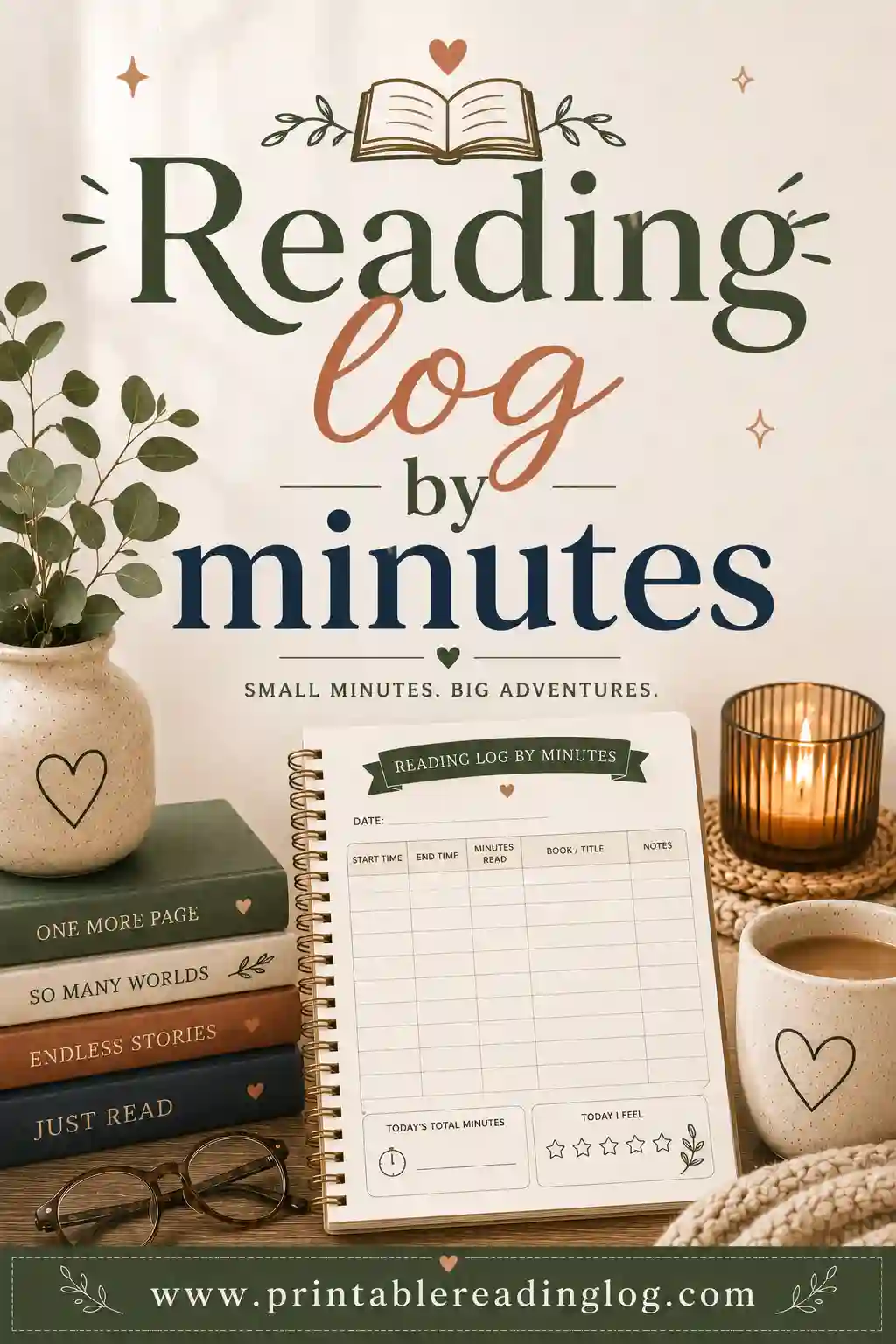
In the tool, choose What are you logging? Minutes, keep the Pages/Minutes column on, and still use the Genre column for the language code. At the end of the month, add up the minutes for each language. A reading log by minutes layout works the same way and is easy for kids to fill in with a kitchen timer.
Bilingual Reading Log Setups by Age
The best log for a two-year-old looks nothing like the best log for a seventh grader. Here are ready-to-use setups for each stage, with the tool settings to match.
Babies and toddlers (0 to 3)
At this age, almost all reading is read-aloud, and the log is really for you. The goal is to notice which language you're actually reading in, since many parents slip into the community language without meaning to.
- Preset: Picture books
- Logging: Books
- Columns: Title, Genre (language), Date finished
- Rating: Smiley, so a toddler can point to one
- Rows per page: 20 or more; board books go fast
- Goal tracker: 50 or 100 squares for the month, colored in by your child with a crayon
Tip: keep the log in the spot where you read most, often by the bed or the couch. If it's in another room, it won't get filled in.
Preschool and kindergarten (4 to 6)
Kids this age love coloring and stickers, so make the log a little ritual. They can color the language box and the goal tracker themselves while you write the title.
- Preset: Kids
- Log style: Kid-friendly, with the coloring strip
- Columns: Title, Genre (language), Star rating, Initials (P/T)
- Rating: Smiley
- Goal tracker: 25 squares
- Color: a different theme for each language if you choose two logs
This is a good age to start pointing out that books come in both languages. Read the same story in each language if you can find it, and log both readings.
Early readers (6 to 8)
Your child is learning to read in at least one language, possibly both. Reading independently in the school language often moves faster, so the home language may rely more on read-alouds for a while. That's normal. Log both kinds so you can see progress over time.
- Preset: Kids
- Logging: Books, or Minutes if school asks for minutes
- Columns: Title, Author, Genre (language), Pages/Minutes, Star rating, Initials (P/T)
- Rating: Stars
- Goal tracker: 25 squares
- Rows per page: 15
For more ideas on making early logs fun, the reading log for kids page shows layouts that suit this age.
Upper elementary (8 to 11)
Many kids now read chapter books, and two separate logs often work better than one. Your child can own the logs, fill them in alone and do the monthly count with you.
- Preset: Kids or Monthly log
- Log style: Kid-friendly or Adult-clean (let your child choose)
- Columns: Title, Author, Genre (real genre, if you're using two logs), Date started, Date finished, Star rating, Recommend? (Y/N)
- Goal tracker: 10 squares per language log
- Books I want to read next: on, filled with home-language titles your child picked at the library
The Recommend? (Y/N) column is handy here. When a grandparent or cousin asks what to send as a gift, your child's "Y" books in the home language make a ready-made wish list.
Middle school and teens (11 and up)
Teens usually don't want a parent tracking their reading. Hand the log over completely, and keep the monthly count light: a quick chat, not an inspection. A clean, grown-up look helps.
- Preset: High school
- Log style: Adult-clean
- Columns: Title, Author, Genre (language), Date finished, Star rating, Notes
- Rating: Number (1 to 10)
- Rows per page: 12
- Challenge bar: on, with a personal challenge like "one home-language book per month"
Some teens enjoy logging news articles, song lyrics they translated or a series they're reading online in the home language. If it gets them reading in both languages, let it count. Add a short note so they remember what it was.
Ways to Keep the Home Language on the Log
Once you've logged a month or two, you may see the home language slipping. That's the most common pattern in bilingual families, and it's very fixable. The log itself can help, because it gives you a clear, low-pressure way to set small targets and celebrate them.
Small habits that add home-language rows
- Make bedtime the home-language slot. Many families keep the community language for school and daytime, and save the last book of the night for the home language. It turns into a routine without a lot of effort.
- Keep a home-language basket. Put home-language books in a basket at kid height, separate from the rest. Out of sight really is out of mind.
- Use the "Books I want to read next" box. Fill it with home-language titles before the month starts. Kids like crossing things off, and a ready list beats staring at a shelf.
- Bring in relatives. A grandparent can read a book over a video call. Log it as RA plus the language code, with the grandparent's initials in the Initials column.
- Reread favorites. Rereading a beloved home-language book is real reading. Log every reread; it shows comfort with the language.
- Swap books with other families. If home-language books are hard to find where you live, a book swap with two or three other families can refresh your basket every few months.
- Check the library. Many public libraries have a world languages or dual language section. Ask a librarian; they can sometimes request books from other branches.
- Mix in audio. Audiobooks and read-along recordings in the home language give your child a fluent voice to listen to, which helps when no one at home has time to read aloud. The guide on how to log audiobooks shows easy ways to record listening time.
Celebrating without pressure
Keep rewards tied to the reading itself, not to "beating" one language. Some ideas:
- When the home-language goal bar fills up, your child picks the next home-language book from the library or a bookstore.
- Call a grandparent so your child can tell them about a favorite book from the month.
- Make a "favorites wall" with the titles your child rated highest in each language.
- Let your child read a home-language book aloud to a younger sibling, a cousin or even a pet, and log it with a special sticker.
Avoid comparing your child to cousins, classmates or other bilingual kids. Every family's language mix is different, and the log is only about your child's reading over time.
Troubleshooting Your Bilingual Reading Log
Even a simple log runs into snags. Here are the problems bilingual families mention most often, and what usually helps.
| Problem | What's probably going on | Try this |
|---|---|---|
| Your child refuses books in the home language | The books feel harder or less fun than school-language books | Offer comics, joke books, or easier picture books; read aloud together and log it as RA |
| The log is almost all one language | The school language takes over during busy weeks | Set a small floor, like one home-language book a day, and use bedtime for it |
| You forget to write the language code | The code column is easy to skip | Fill in the code first, before the title; or switch to two colored logs |
| Dual language books make the count confusing | No clear rule for counting them | Pick one rule from the table above and use it all month |
| One log gets lost or ignored (two-log setup) | Two sheets is one too many for your routine | Go back to one log with a language column |
| Your child says home-language reading "doesn't count" | School only checks the school-language log | Ask the teacher whether home-language reading can count; keep your own log either way |
| The totals look unfair (picture books vs. chapter books) | Counting books hides how long each one took | Switch to minutes for a month and compare |
| Siblings argue over whose log is "better" | Comparison between kids | Give each child their own color, goal and celebration |
| You can't find home-language books | Few local sources | Ask the library, set up a swap, use audiobooks and video-call read-alouds |
If your child is learning English as a new language at school, the reading log for ESL students page has more ideas for supporting a newer language without overwhelming them. And if you're ever worried about your child's reading or language development in either language, talk to their teacher and follow the school's guidance.
A one-month starter plan
If you want a clear way to begin, try this for your first month:
- Week 1: Print one log with the Genre column used for language. Just log everything; don't set targets yet.
- Week 2: Keep logging. Notice when each language shows up (bedtime, school, weekends).
- Week 3: Fill the "Books I want to read next" box with five home-language books your child chose.
- Week 4: Do the first monthly count together. Set a small home-language floor for next month and print a fresh log.
After that first month, you'll have real numbers to work with instead of a vague worry, and that alone tends to make reading in both languages feel calmer.
Print Your Bilingual Reading Log
Ready to start? Open the free reading log maker, choose the Kids preset (or High school for a teen), turn on Title, Genre, Date finished, Star rating and Initials, and set a goal bar of 10 or 25 squares. Write your language codes at the top, print one log or two in different colors, and tape it where you read most. Next month, you'll know exactly how much your child read in each language.
▶ Open this reading log ready to print
Frequently Asked Questions
What is a bilingual reading log?
A bilingual reading log is a reading log that records the language of every book your child reads. You add a short code like SP or EN to each row, then total each language at the end of the month. It helps families see whether both languages are getting regular reading time.
Should I use one log or two for a bilingual child?
One log with a language column is easiest for young kids and busy families, since everything lives on one sheet. Two logs, each in its own color, work well when one language needs a separate goal or different adults read in different languages. Try one setup for a month and switch if it doesn't fit.
How do I count dual language books?
Log the language you actually read. If you read only the Spanish text, it's a Spanish book; if you read both texts all the way through, mark it with both codes and count it the same way every time. Consistency matters more than which rule you pick.
Do read-alouds count on a bilingual reading log?
Yes. For many families, read-alouds carry most of the home-language reading, especially in the early years. Mark them with "RA" so you can see how much is read aloud versus read independently, and watch that mix shift as your child grows.
Can home-language books count toward my child's school reading log?
It depends on the teacher and school. Many teachers are glad to count reading in any language, but it's best to ask directly. Either way, keep your own bilingual log so the home-language reading is recorded somewhere.
How many books should my child read in each language?
There's no set number that fits every family. Choose a small floor for the language that needs support, like one book a day or eight books a month, and raise it only when it feels easy. Your own family's goals and routines matter more than any outside target.
Is it better to track minutes or books in two languages?
Books are simpler and work well when your child reads similar kinds of books in both languages. If one language is mostly picture books and the other is chapter books, minutes give a fairer picture. You can switch to Minutes in the free tool and keep the language code in the Genre column.
How do I keep my teen using a bilingual reading log?
Give them full ownership and a clean, grown-up layout like the High school preset with the Adult-clean style. Let them count articles, online series or translated lyrics in the home language. Keep monthly check-ins short and friendly rather than turning them into a report.