Goodreads Alternatives: Best Tools to Track Your Reading
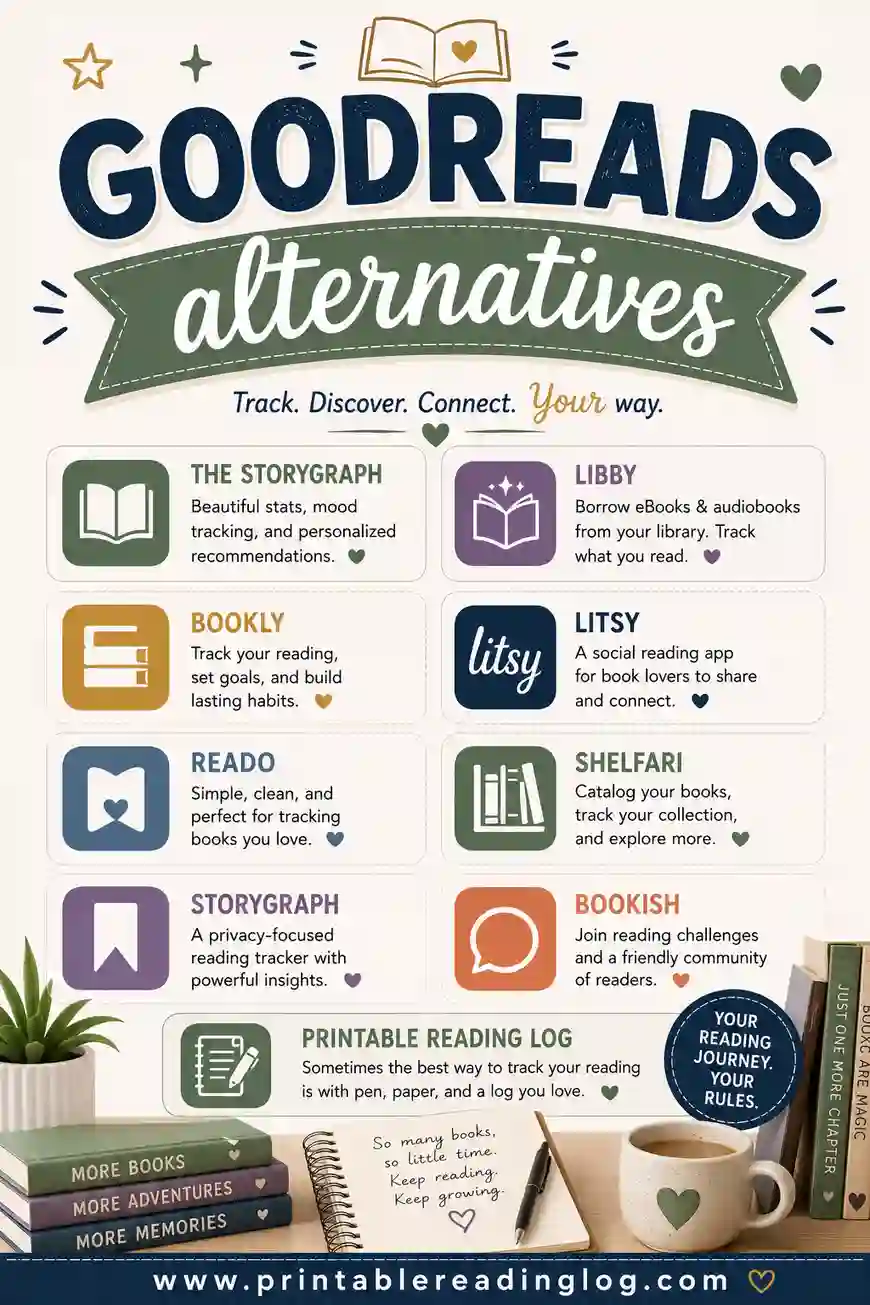
The best Goodreads alternatives are StoryGraph for stats, Fable for book clubs, LibraryThing for cataloging, Bookly for reading pace, and, for the simplest option of all, a free printable reading log that needs no account, no ads, and no algorithm. Each one fixes a different Goodreads frustration, whether that's the dated design, the ads, or the privacy concerns.
Want the no-fuss route? Open the free reading log maker, pick how you want to track your books, and print a clean sheet you own outright. No sign-up, no data sharing, no monthly fee.
Why People Look for a Goodreads Alternative
Goodreads is huge and free, but it frustrates plenty of readers. Knowing why people leave helps you pick the right replacement.
- The interface feels old. It hasn't changed much in years, and it shows.
- Ads everywhere. The reading experience is cluttered with promotions.
- Thin stats. Beyond a yearly count, Goodreads doesn't tell you much about how you read.
- Privacy worries. It's owned by a giant retailer, and some readers don't love that their reading history feeds a sales engine.
If any of those bug you, there's a better fit below, including one that lives entirely on paper.
The Best Goodreads Alternatives, Compared
Here's a straight comparison of the top picks for 2026, so you can match a tool to your reason for switching.
| Tool | Best for | Cost | Account needed? |
|---|---|---|---|
| Printable reading log | Privacy, kids, total control | Free | No |
| StoryGraph | Deep stats and mood tracking | Free / paid plus | Yes |
| Fable | Book clubs and curated lists | Free / paid | Yes |
| LibraryThing | Cataloging a home library | Free / small paid | Yes |
| Bookly | Reading speed and timers | Free / paid pro | Yes |
| The Great Indie list | Indie and self-pub focus | Free | Yes |
The printable log leads here because it answers the biggest reasons people leave Goodreads at once: no ads, no account, and your reading stays private. The apps win when you want automatic charts or a community. Many readers keep one app for stats and a printed log for everyday tracking.
StoryGraph
StoryGraph is the most popular Goodreads alternative, and for good reason. It imports your Goodreads library in a few clicks and then gives you charts Goodreads never could: moods, pace, page length, genre balance. The free tier is generous; a cheap "Plus" tier adds even deeper analysis. If "I want better stats" is your reason for leaving, start here.
Fable
Fable is the social, cozy pick. Curated lists, book clubs, and shared notes make reading feel like a shared activity. It's lighter on hard numbers and heavier on community and discovery, a nice fit if Goodreads felt too transactional.
LibraryThing
LibraryThing is for the cataloger. If you want a detailed record of every book you own, complete with tags and rich metadata, it's the most thorough option. It feels more like a librarian's tool than a social feed, which is exactly what some readers want.
Bookly
Bookly focuses on the act of reading itself, tracking session length, speed, and progress toward finishing a book. It's a great match if you read in timed blocks and like watching your pace climb. The free version limits active books; pro removes the cap.
Why a Printable Reading Log Is the Simplest Alternative
If your real complaint with Goodreads is "I just want to track my books without all the noise," a printable reading log is the cleanest answer.
- No account, ever. Nothing to sign up for, nothing to log into, nothing to forget the password for.
- Truly private. Your reading history sits on paper in your home, not on a company server.
- No ads, no algorithm. Just your books, your ratings, your notes.
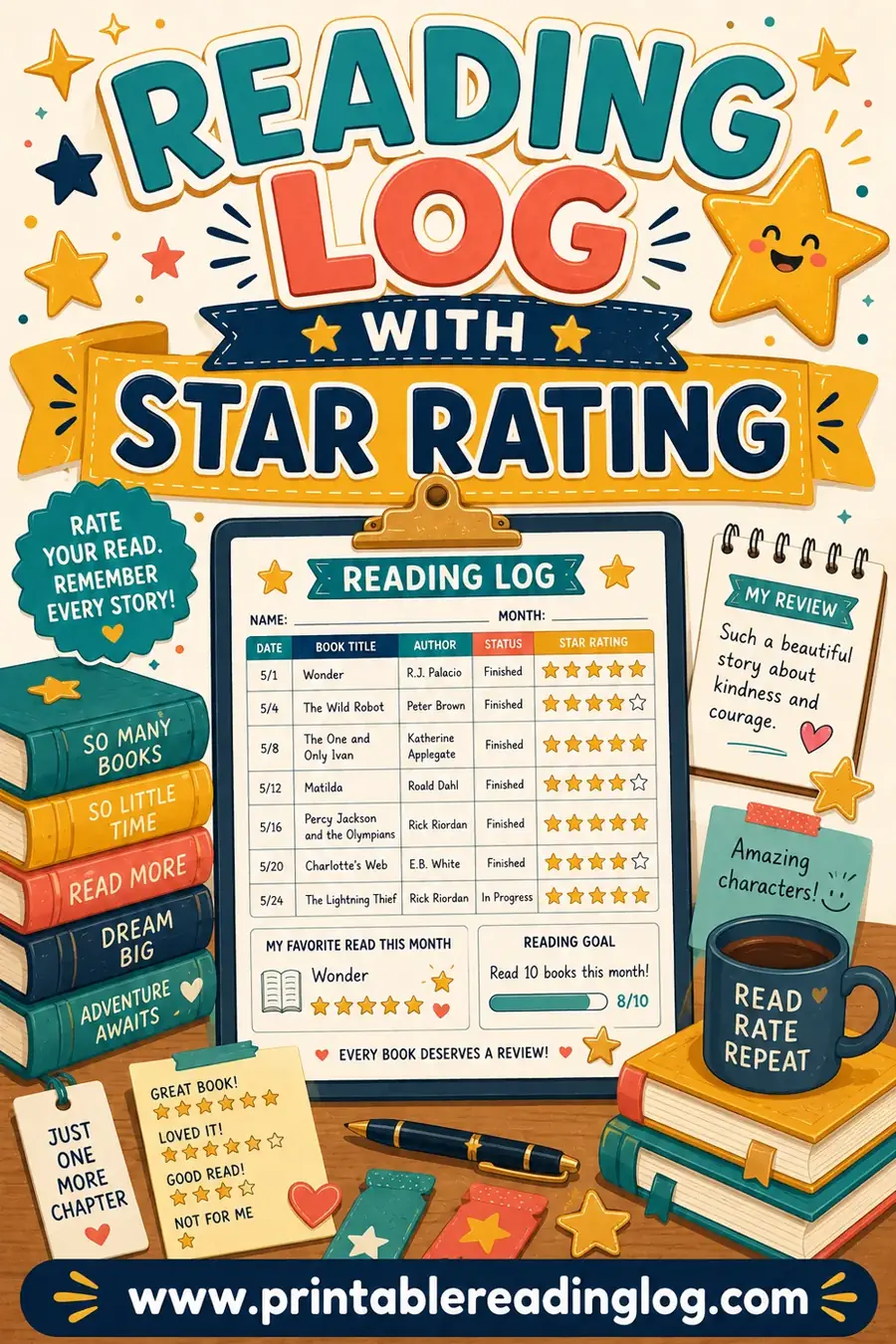
- Works for any age. A printable star-rating log is perfect for a kid who's far too young for a social app.
- Endlessly customizable. Add a "favorite quote" line, a star rating, a re-read column, whatever you want.
The honest trade-off: paper won't auto-import your existing library or chart your genres for you. But for readers who left Goodreads to get away from screens and tracking, that's the whole point.
Make it a books-finished log
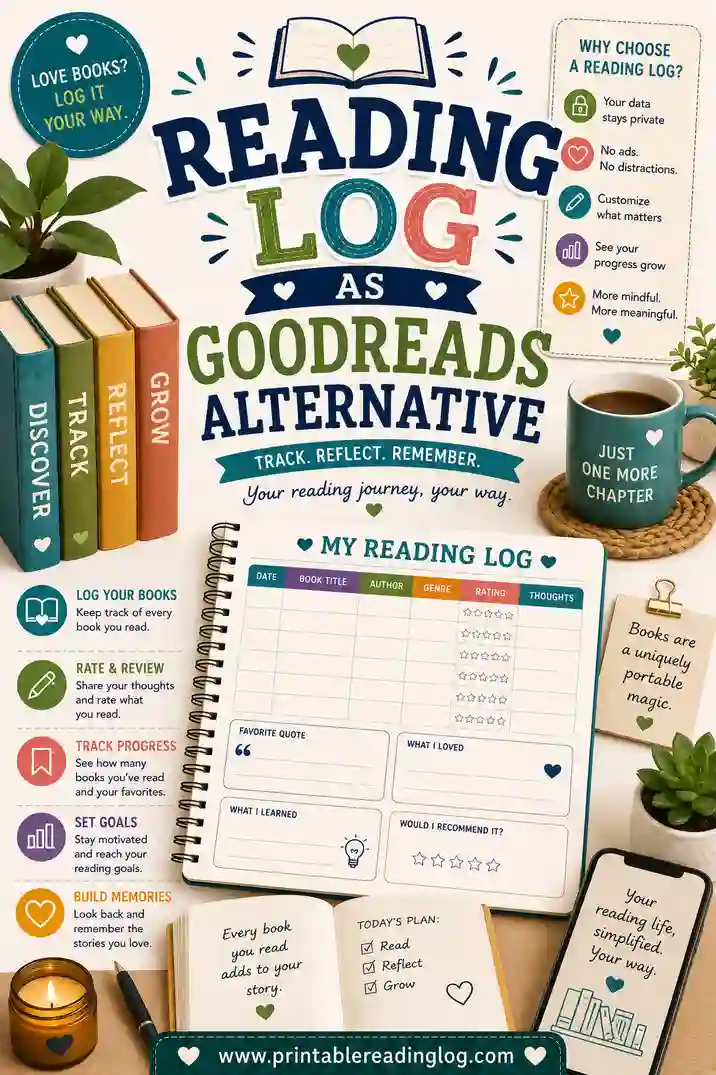
The Goodreads feature most people actually use is the yearly reading challenge, a simple count of books finished. A printable books-finished log does the same job beautifully. One row per book, with title, author, date finished, and a star rating, and by December you've got a complete record of your reading year. See our reading log as a Goodreads alternative guide for a ready-made layout.
A Sample Books-Finished Log You Can Copy
Here's what a clean, Goodreads-style reading record looks like on paper. Print a sheet like this and you've got your whole year at a glance.
| Date finished | Title | Author | Rating | Note |
|---|---|---|---|---|
| 1/14 | Project Hail Mary | Andy Weir | ★★★★★ | Couldn't put it down |
| 2/02 | The Midnight Library | Matt Haig | ★★★★☆ | Made me think |
| 2/27 | Educated | Tara Westover | ★★★★★ | Stayed with me |
| 3/19 | Klara and the Sun | Kazuo Ishiguro | ★★★★☆ | Quiet and lovely |
| 4/08 | Atomic Habits | James Clear | ★★★★☆ | Lots of notes |
The "Rating" and "Note" columns are what make it feel like a real reading diary, the same things people scroll Goodreads for, but kept simple and yours.
How to Switch Away From Goodreads
Leaving doesn't have to be painful. Here's a clean path.
- Export your data. Goodreads lets you download your library as a CSV from account settings. Do this first so you keep your history.
- Pick your new tool. Import the CSV into StoryGraph if you want stats, or just start fresh on a printable log.
- Decide what to track going forward. Books finished? Minutes? Star ratings? Keep it to what you'll actually fill in.
- Start logging. With a printable sheet, that means printing one and writing your current read into the first row.
Many people do a hybrid: export to StoryGraph for the back catalog, then keep a printed log on the desk for everyday simplicity.
How to Match an Alternative to Your Reason for Leaving
The fastest way to choose is to name your single biggest frustration with Goodreads, then pick the tool that fixes exactly that. Trying to find one app that does everything is how people end up back where they started. Here's a quick matchmaker.
| Your main frustration | The fix | Why it works |
|---|---|---|
| "The stats are too thin" | StoryGraph | Auto-charts moods, pace, and genre balance |
| "Too many ads and clutter" | Printable log | A sheet of paper has nothing to sell you |
| "I want a community" | Fable | Built around book clubs and shared lists |
| "I just want my year on record" | Printable books-finished log | One row per book, done by December |
| "I want to catalog what I own" | LibraryThing | Deep metadata and tags for a home library |
| "I read in timed sessions" | Bookly | Tracks pace, speed, and session length |
| "I don't trust where my data goes" | Printable log | Nothing leaves your home |
Notice how often the printable log shows up. That's not a trick, it's because the most common reasons people leave Goodreads, ads and privacy and simplicity, are exactly the things paper handles for free. The apps shine when you want a specific feature Goodreads lacked, like deep analysis or a club to read with.
Build a hybrid setup that actually sticks
If you can't decide, don't. The most durable system most readers land on is one app plus one printed sheet. Use the app to hold your full library and crunch year-end numbers, and keep a reading log on your desk for the daily habit of writing down what you just finished. The paper sheet is what keeps you consistent, because it's always open and takes two seconds to fill in. The app turns that consistency into charts when you feel like looking. You get automation without losing the simple ritual that made you want to track your reading in the first place.
Setting Up Your Printable Log as a Goodreads Replacement
Switching to paper takes about five minutes, and a little planning up front makes the sheet something you'll actually keep using all year. Here's how to set it up so it covers everything you relied on Goodreads for.
- Decide your core columns. Title, author, date finished, and a star rating recreate the heart of Goodreads. That's the minimum that makes a log feel complete.
- Add the personal touch. A "note" or "favorite line" column is what turns a list into a reading diary, the part people scroll Goodreads to revisit.
- Pick a timeframe per page. A full-year sheet shows your whole reading challenge at a glance; a monthly page gives you room to write more per book.
- Print on cardstock or use a sleeve. Cardstock survives a year on the desk; a clear sleeve plus a dry-erase marker makes a reusable template.
- Snap a photo when a page fills up. This is your backup, the one thing paper doesn't do automatically. A quick phone picture means a coffee spill never erases your year.
That last step is the honest answer to paper's only real weakness. Apps back themselves up; paper doesn't, unless you take ten seconds to photograph a full page. Do that, and you've matched the one genuine advantage Goodreads had over a printed sheet.
A quick word on reading challenges
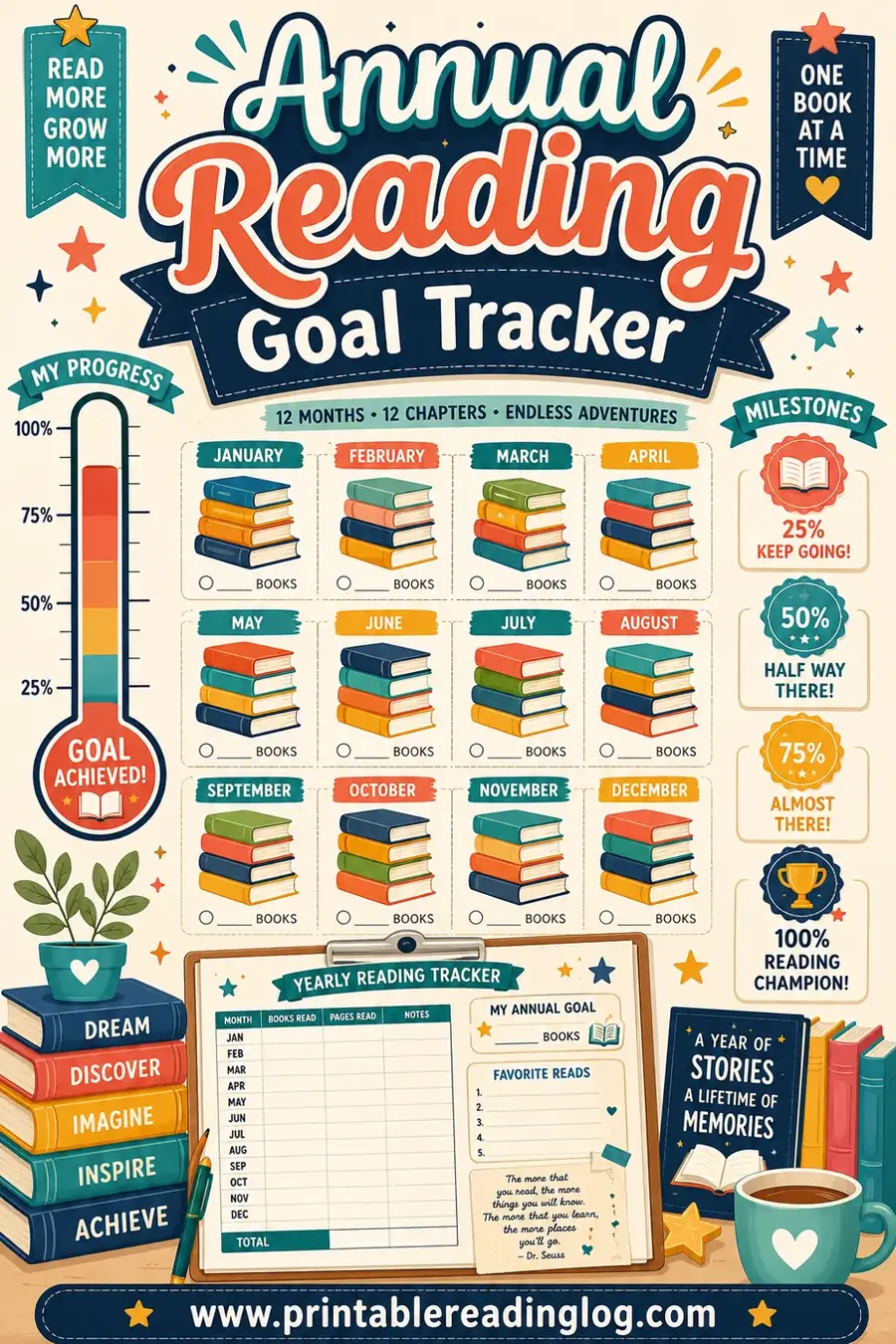
The Goodreads feature people miss most is the yearly challenge, that satisfying "32 of 40 books" progress bar. You can recreate it on paper with a annual reading goal tracker: write your target at the top, number each row, and watch the page fill toward your goal. Coloring in a small progress bar as you go gives you the same little hit of motivation, with none of the ads around it. For many readers, that one printed page is the entire reason they used Goodreads, made simpler and kept private.
Frequently Asked Questions
What is the best Goodreads alternative in 2026?
StoryGraph is the most popular app alternative thanks to its stats and easy Goodreads import. For the simplest, most private option, a free printable reading log tracks your books without an account, ads, or any company holding your data.
Is there a Goodreads alternative with no ads?
Yes. StoryGraph is far cleaner than Goodreads, and a printable reading log has no ads at all because it's just a sheet you print. If ad clutter is your main complaint, paper is the cleanest fix.
Can I move my Goodreads books to another tool?
Yes. Goodreads lets you export your library as a CSV file, which StoryGraph and several other apps can import. If you switch to a printable log, you simply start a fresh sheet going forward.
What is the most private way to track my reading?
A printable reading log, because your reading history stays on paper in your home rather than on a company server. There's no account and no data collection, which is why privacy-minded readers prefer it.
Do I need an app to replace Goodreads?
No. A printable books-finished log covers the feature most people use, a simple yearly record of titles, dates, and ratings, without any download. You can build one free with the reading log maker in about a minute.
Is a printable reading log free?
Yes, completely. You print it yourself with no sign-up, no watermark, and no limit on copies. It's the cheapest Goodreads alternative there is.
How do I keep a paper log from getting lost?
Keep it in one place, a binder, a journal, or taped inside a cupboard door, and snap a phone photo each time a page fills up. That photo is your backup. You can also reprint a fresh sheet from the reading log maker any time, so the template itself is never gone for good.
Which Goodreads alternative is best if I just want to count my books?
A printable books-finished log. It mirrors the one Goodreads feature most people actually use, the yearly count, with a single row per book showing title, date, and rating. By December you've got a complete record of your reading year, no app and no account required.
Ready to Track Your Reading Your Way?
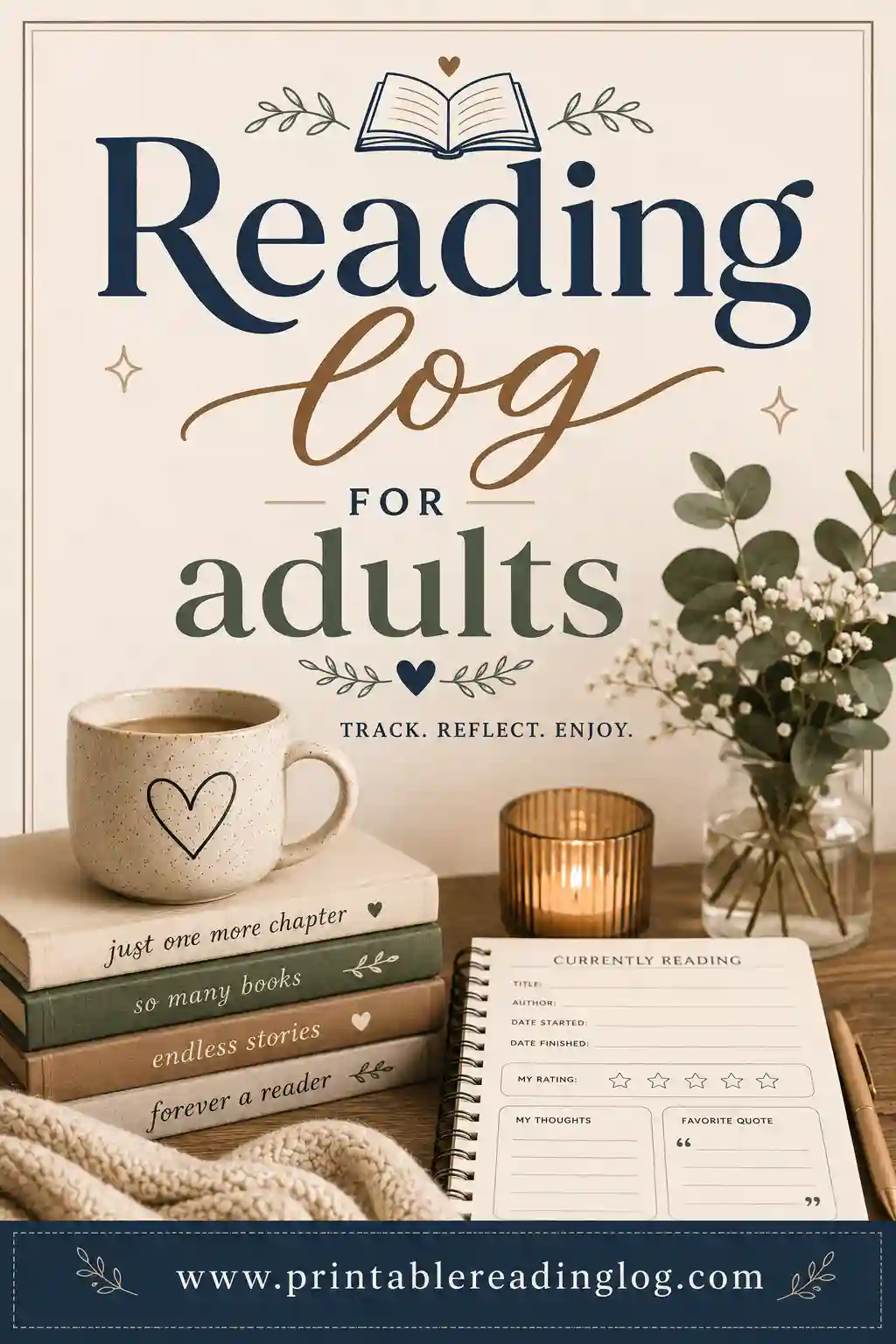
You don't need a cluttered feed to keep a great record of your books. Open the free reading log maker, pick a books-finished or rating-style layout, and print a clean sheet that's private, ad-free, and entirely yours. For more, see our annual reading goal tracker, reading log with star rating, and reading log for adults guides. Start your reading year on paper tonight.