Best Ways to Track Books Without an App
The best way to track books without an app is a printable reading log you fill in by hand: it's free, it never needs a login, and it works the moment you print it. Notebooks, a reading journal, a wall chart, and a simple index-card system all work too — the right one depends on how much detail you want and where you'll keep it. The fastest place to start is our free printable reading log: pick your columns, print, and you're tracking by tonight.
Tired of one more app asking for your email? Open the free reading log, choose what to track (title, date, rating, notes), and print a sheet you actually own. No account, no subscription, no screen.
Why Track Books Off-Screen at All?
Plenty of people love a reading app. But there are real reasons to keep your book log off your phone, and they're worth naming.
- No distractions. Open an app to log a book and twenty minutes later you're scrolling something else. A paper log doesn't ping you.
- You own it. Apps shut down, change their terms, or hide features behind a paywall. A printed log is yours forever.
- It's free. No subscription, no "premium" tier to unlock stats.
- Screen-free by design. If you're reading to get away from screens, logging on a screen undercuts the whole point.
- It's flexible. Want a doodle, a sticker, a one-line review? Paper says yes to anything.
None of this means apps are bad. It means paper and a few low-tech systems deserve a fair look.
The Best Ways to Track Books Without an App
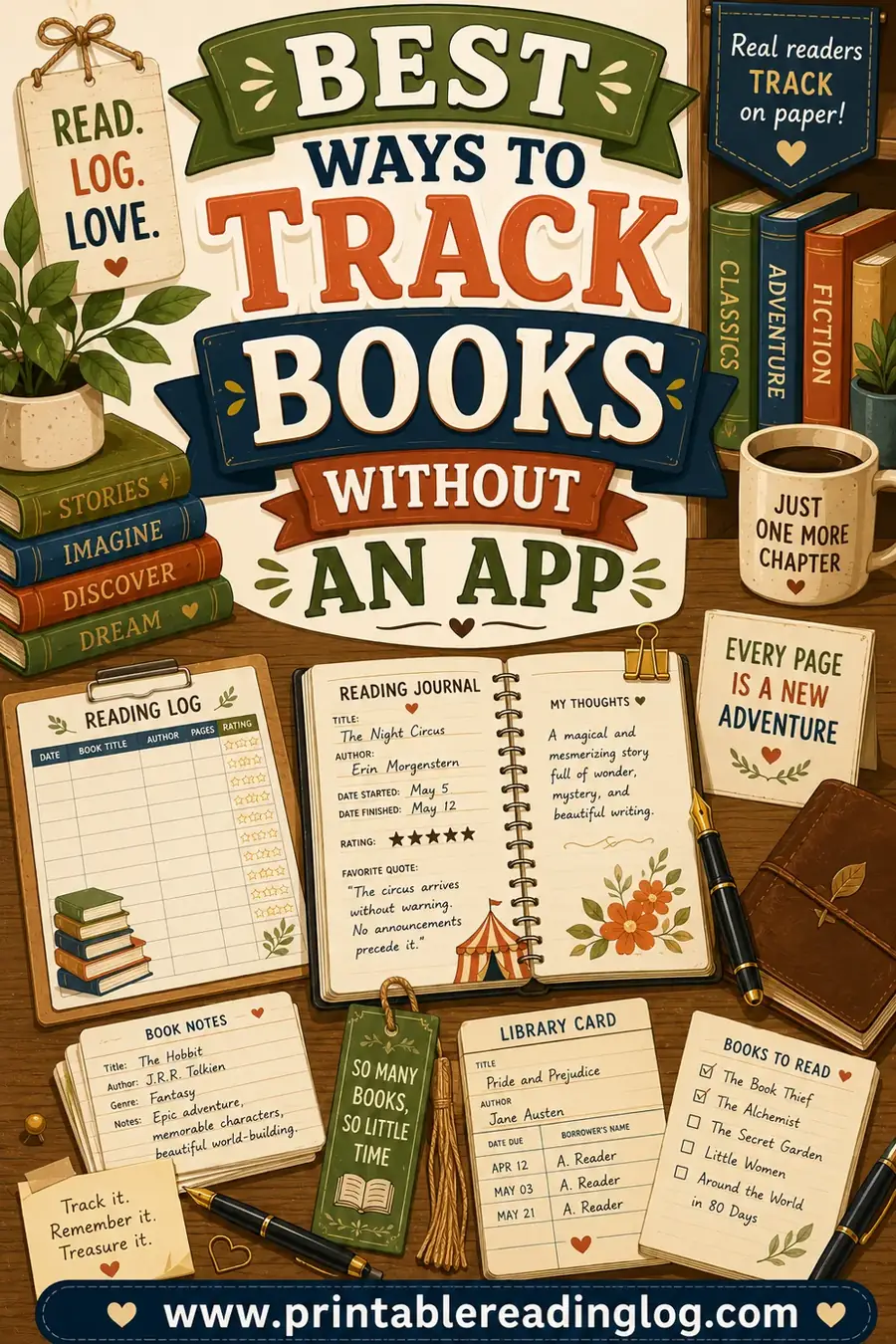
Here's an honest comparison of the most popular off-screen methods, so you can match one to how you read.
| Method | Best for | Effort | Detail level |
|---|---|---|---|
| Printable reading log | Most readers | Low | Medium–high |
| Notebook or bullet journal | Creative trackers | Medium | High |
| Reading journal (pre-made) | People who want prompts | Low | High |
| Wall chart or poster | Kids and families | Low | Low–medium |
| Index cards | Minimalists | Low | Low |
| Spreadsheet (printed) | Data lovers | Medium | High |
| Whiteboard or chalkboard | Shared family spaces | Low | Low |
The printable log is the sweet spot for most people: more structure than a blank notebook, less fuss than a spreadsheet, and you can reprint it whenever you want.
1. A printable reading log
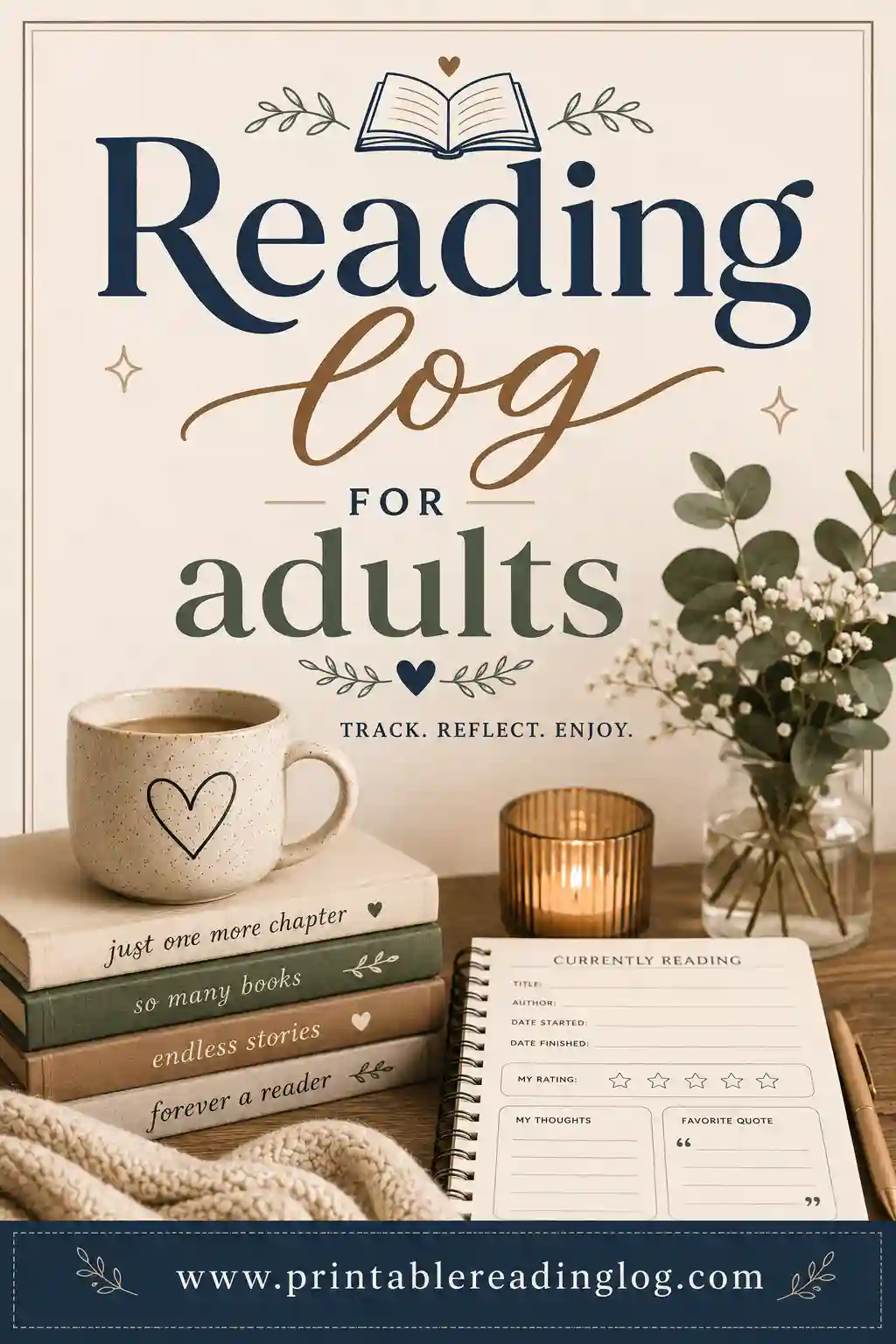
This is the simplest upgrade from "I'll just remember." You choose your columns — title, author, date finished, rating, a line of notes — print a stack, and fill them in as you go. Our free generator lets you build one in under a minute, and you can make a kid-friendly version or a clean adult version depending on who it's for.
2. A notebook or bullet journal
A blank notebook gives you total freedom. Draw a simple table, a "books read" thermometer, or a spread per month. The trade-off is setup time — you're drawing the lines yourself. Great if you already journal; slower if you don't.
3. A pre-made reading journal
Bookstores sell guided reading journals with prompts ("favorite quote," "who I'd recommend it to"). They're lovely for people who want to reflect, not just record. The downside is cost and rigidity — you read at the journal's pace, not yours.
4. A wall chart or poster
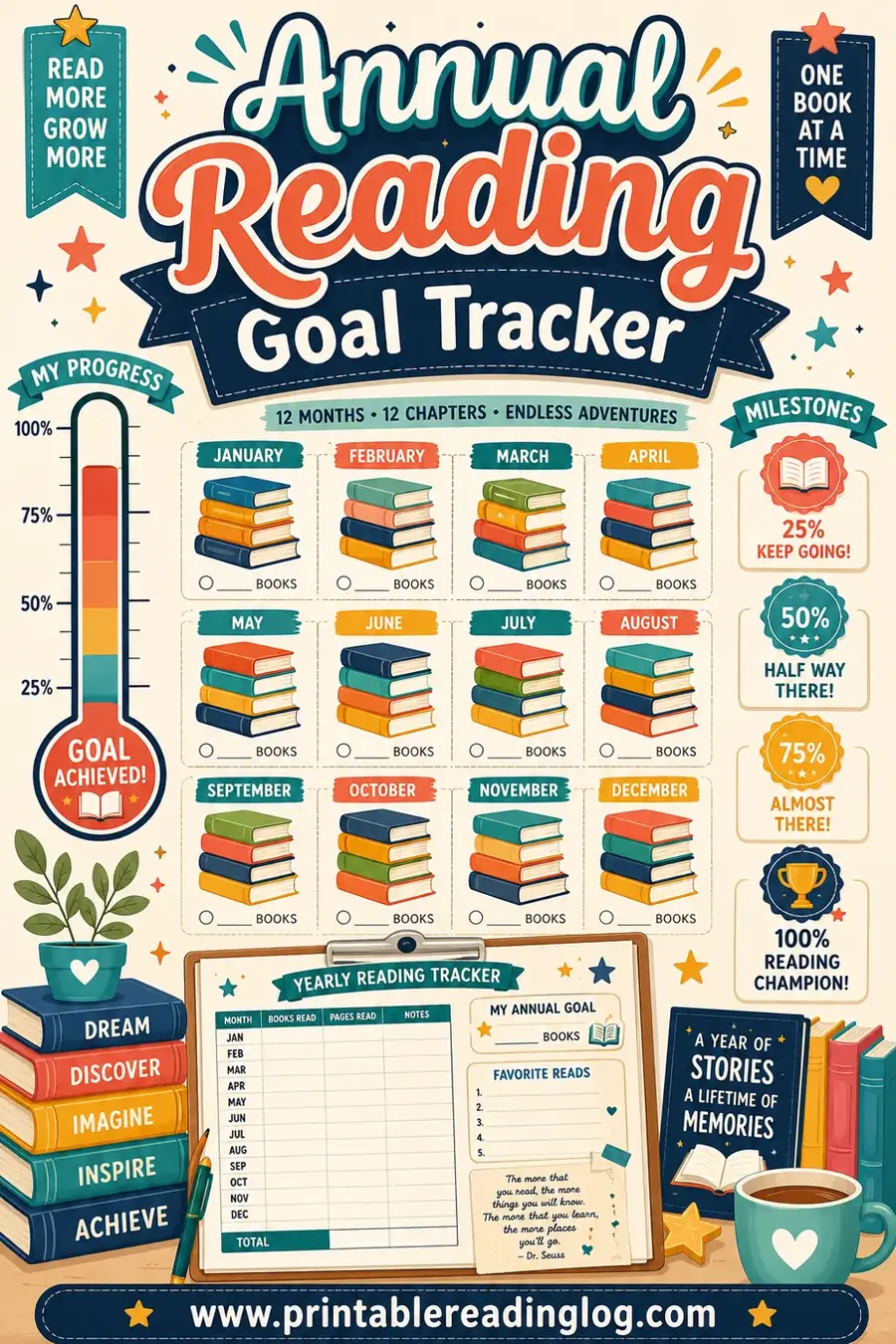
For kids and families, a chart on the fridge or bedroom wall turns reading into something everyone can see. Color in a square per book or per 20 minutes. It's motivating precisely because it's visible. Detail stays low, which is fine for young readers.
5. Index cards
One card per book: title on the front, a few notes on the back, filed in a little box. It's the analog version of a database, and it's oddly satisfying. Best for minimalists who want a record but hate big forms.
6. A printed spreadsheet
If you love data, set up a spreadsheet once, then print blank rows to fill by hand (or print your typed entries at year's end). You get sortable stats without living in an app. It's the most setup, but the most powerful for tracking pages, genres, and trends.
7. A shared whiteboard or chalkboard
If you want your reading out where the household can see it, a small whiteboard or chalkboard works beautifully. Write each finished title under a running "books read this year" header, or keep a tally of reading days. It's low-detail by design — no room for notes — but the visibility is the whole point. Families especially love it because everyone's reading shows up in one spot, and a kid watching the list grow is a kid who wants to add to it.
How to Choose the Right Method
Don't overthink it. Run through these quick questions and the answer usually appears.
- How much detail do you want? Just a count? A wall chart or index cards. Ratings and notes? A printable log or journal.
- Who is it for? Kids do best with something visible and colorful. Adults usually want a clean, compact sheet.
- Will you actually keep it up? Pick the lowest-effort option you'll stick with. A simple log you use beats a beautiful journal you abandon.
- Where will it live? On the fridge (wall chart), in your book bag (printable log), on a shelf (journal or card box).
When in doubt, start with a printable log. It's the easiest to try, and if it's not detailed enough, you can add columns and reprint.
What to Track (Keep It Simple)
The fastest way to quit a tracking habit is to make it a chore. Track only what you'll actually use.
| Column | Worth it? |
|---|---|
| Title & author | Always |
| Date finished | Yes — powers your yearly count |
| Rating (1–5 stars) | Yes — quick and fun |
| A one-line note | Yes — your future self will thank you |
| Genre | Optional — nice for spotting patterns |
| Page count | Optional — only if you like stats |
| Full review | Only if you enjoy writing them |
Start with the top four. You can always add more later; you can't get back the months you spent dreading a giant form.
Tips to Actually Stick With It
A tracker only works if you use it. A few small habits make it automatic.
- Keep it where you read. A log in a drawer upstairs won't get filled in. Tuck it inside your current book as a bookmark.
- Log right when you finish. Close the book, mark the log, done. Don't "do it later."
- Make it a tiny reward. Coloring a square or adding a star is a small hit of progress. Lean into it.
- Set a visible goal. "20 books this year" at the top of the page gives every entry meaning.
- Don't backfill perfectly. Forgot a few? Add what you remember and move on. A messy log still beats no log.
Mixing Methods: The Best of Both Worlds
You don't have to pick one system and marry it. Some of the most durable off-screen trackers quietly combine two methods, each doing the part it's best at.
A few pairings that work well:
- Index cards plus a printable summary sheet. Jot a card per book as you go for the messy details, then transfer titles and ratings onto a clean year-at-a-glance sheet each month. The cards capture; the sheet displays.
- Wall chart plus a notebook. The chart on the fridge does the motivating and the bragging; the notebook holds the real notes and favorite quotes you don't want crowding the wall.
- Printable log plus a year-end review. Track each book on your printable log all year, then spend twenty minutes in December tallying your favorites, your genre mix, and your count. That little review is the payoff that makes a whole year of logging feel worth it.
The trick is to let each tool do one job. A visible tracker for motivation, a detailed one for memory — together they cover everything an app would, without the screen.
Building a simple year-end reading review
You don't need a spreadsheet to enjoy your own reading stats. At the end of the year, pull out your log or cards and skim through. Count the total, star your top three, note which month you read the most, and jot one genre you'd like more of next year. It takes minutes and turns a plain list into a story about your reading year — the same satisfying recap an app would hand you, except you made it yourself and you actually own it.
Tracking Books for Kids Without an App
Screen-free tracking is an easy win for kids. Use a printable log with big rows and a star column, or a wall chart they color in. Tie it to a small reward — a sticker per book, a trip to the library after ten. The visible progress does the motivating, and there's no screen time attached to a reading habit, which is exactly what most parents want.
Frequently Asked Questions
What's the easiest way to track books without an app?
A printable reading log. You pick your columns, print it, and fill it in by hand — no account, no screen. Our free tool builds one in under a minute.
How do I track my reading by hand?
Write down each book's title, the date you finished, and a quick rating or note. A printable log gives you ready-made rows; a notebook or index cards work too if you prefer to set up your own.
Is a paper reading log better than an app?
It's better for some people. Paper is free, distraction-free, and yours forever, but it won't auto-calculate stats. If you want screen-free reading and full ownership, paper wins; if you want automatic charts, an app may suit you.
How can I track books for free?
Use a free printable reading log or a notebook you already own. Both cost nothing and need no sign-up. Print a sheet, keep it with your current book, and log each one as you finish.
What should I write in a reading log?
At minimum: title, author, date finished, and a star rating. Add a one-line note about what you thought, and optionally genre or page count if you like spotting patterns.
How do I keep a reading log without forgetting?
Keep it with your book and log each title the moment you finish, before you set the book down. Tying it to a visible goal and a tiny reward (a star, a colored square) makes it stick.
Can I get reading stats without an app?
Yes — you just make them yourself at year's end. Skim your printable log or index cards, count the total, mark your favorites, and note your genre mix. It takes a few minutes and gives you the same kind of recap an app would, except you own it and there's no login.
What's the best no-app way to track books as a family?
A visible shared tracker beats a private one for families. A wall chart, a whiteboard, or a big printable poster everyone adds to turns reading into something the whole house can see. The visibility motivates kids especially, and it keeps a reading habit completely screen-free.
Ready to Track Your Books — No App Required?
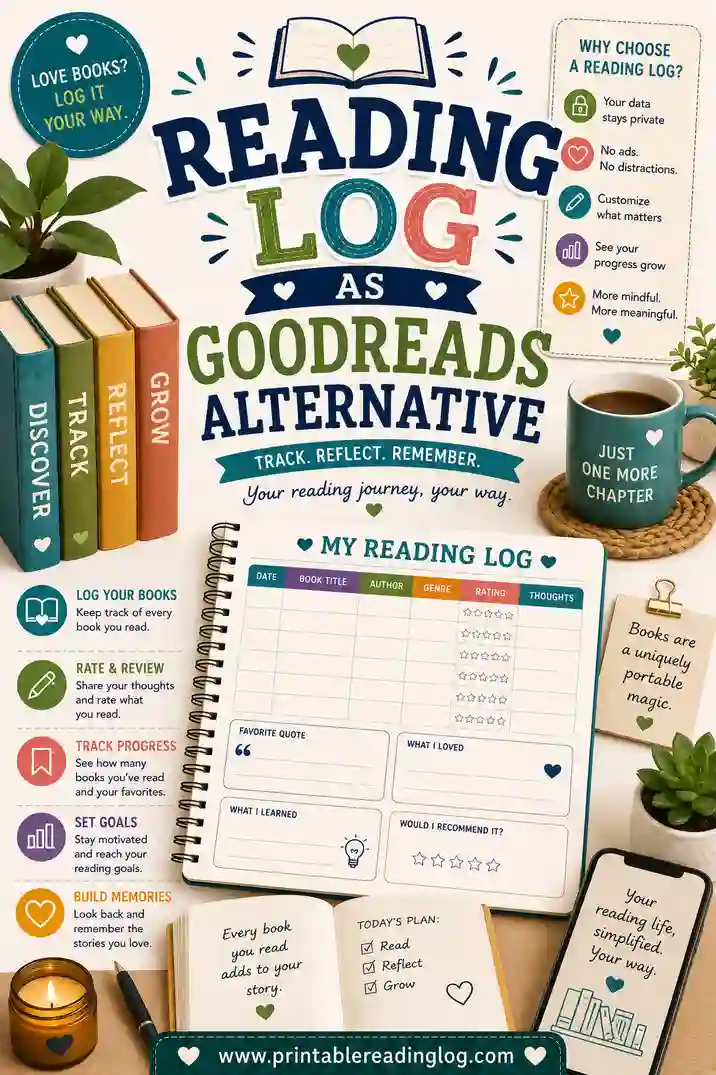
Pick the method that fits how you read, and you'll have a record you actually enjoy keeping. The easiest place to start is a free printable reading log — choose your columns, print, and log your first book tonight. For more ideas, see our reading log for adults, annual reading goal tracker, and the reading log as a Goodreads alternative. No app, no login, just you and your books.