Printable vs Digital Reading Logs: Which Is Better?
Printable reading logs win on simplicity, privacy, and getting kids reading, while digital reading logs win on automatic stats and never losing the data. A printable log is a sheet of paper you fill in by hand; a digital log is an app or spreadsheet that tracks for you. For most casual readers, families, and classrooms, the printable log is the lower-friction, lower-cost choice, and it's the one people actually stick with.
Want to try the paper route right now? Open the free reading log maker, choose your columns, and print a tracker in under a minute. No account, no app, no cost.
Printable vs Digital: The Quick Answer
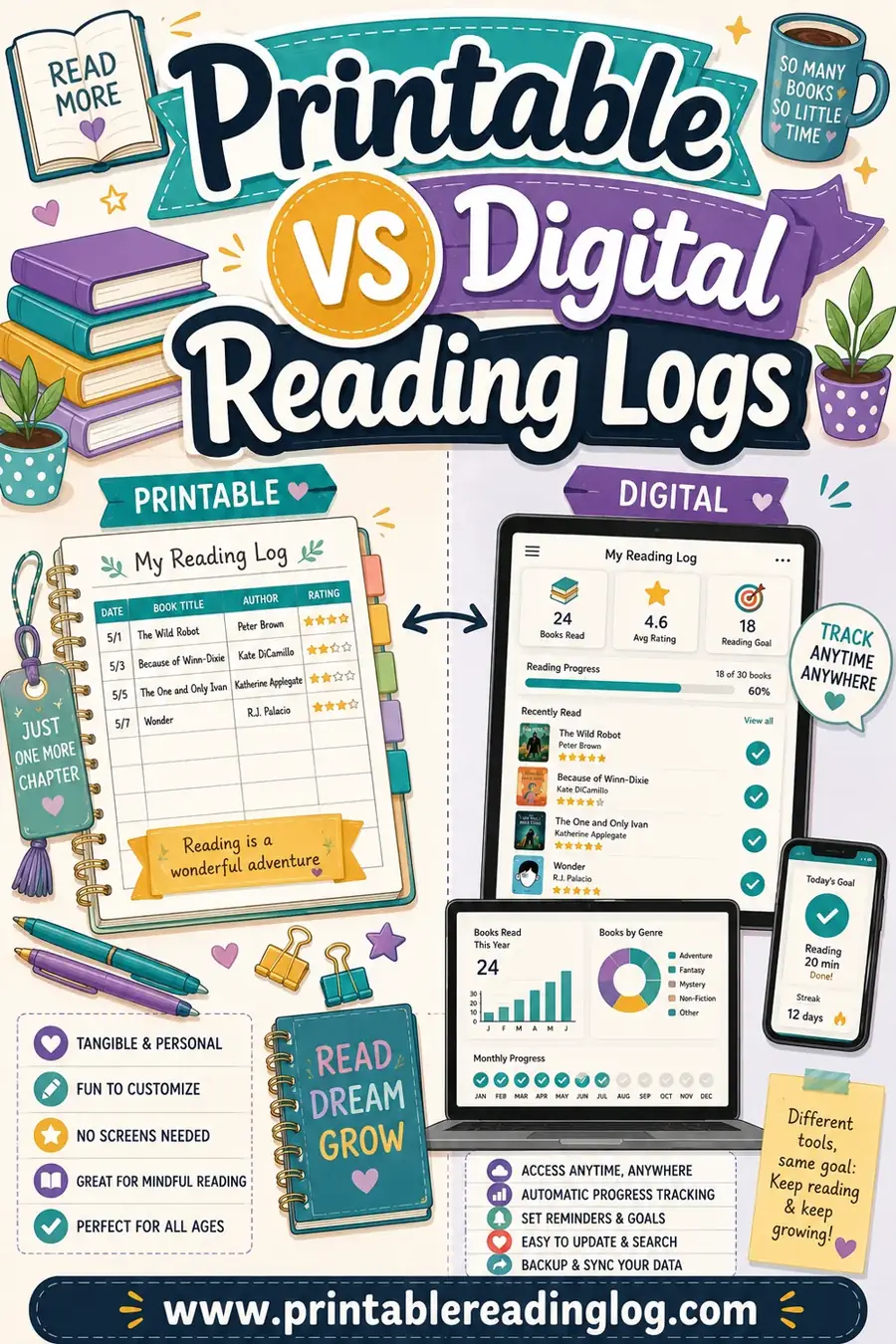
If you want the short version, here it is. Pick printable if you value simplicity, privacy, or you're tracking for a child. Pick digital if you want automatic stats and a backup you can't lose. Plenty of readers happily use both.
The deeper answer depends on what you're tracking and who's doing the tracking. A kindergartner and a data-loving adult want very different things from a reading log. Let's break it down properly.
Side-by-Side Comparison
Here's the honest head-to-head. Neither side sweeps every row, which is exactly why the choice comes down to you.
| Feature | Printable log | Digital log |
|---|---|---|
| Cost | Free | Free to paid |
| Setup time | Under a minute | Account + download |
| Works for young kids | Excellent | Hard |
| Automatic stats | No | Yes |
| Privacy | Total | Varies |
| Risk of losing data | Can be lost or torn | Backed up if synced |
| Works offline | Always | Sometimes |
| Customizable layout | Fully | Limited to the app |
| Screen time | None | Yes |
Read down the column that matters most to you. If "works for young kids," "privacy," and "no screen time" jump out, you're a printable person. If "automatic stats" and "backup" win, you lean digital.
Where Printable Reading Logs Win
Paper has real advantages, and they're not just nostalgia. Here's what a printable log does better.
- It's free and instant. No download, no login, no subscription. You print and go.
- Kids can actually use it. A five-year-old can color a star or check a box. Handing them a phone app is a non-starter.
- Zero screen time. Reading is supposed to be a break from screens. A paper log keeps it that way.
- Total privacy. Nothing leaves your house. No app is logging your habits or showing them to strangers.
- It's fully yours to design. Want columns for minutes, pages, AND a doodle of the cover? Build it. You're not boxed in by an app's layout.
- A visible log motivates. A blank grid on the fridge nags you, in a good way, to fill it in. That's a quiet push apps can't replicate.
The big trade-off: paper won't add up your stats or back itself up. Spill coffee on it and it's gone. For some people that's a dealbreaker. For most, it's a minor risk worth the simplicity.
Best for these readers
- Kids and early readers who can't manage an app.
- Classrooms that need a quick, signable record.
- Privacy-minded adults who don't want their reading tracked.
- Anyone building a habit who likes seeing progress on paper.
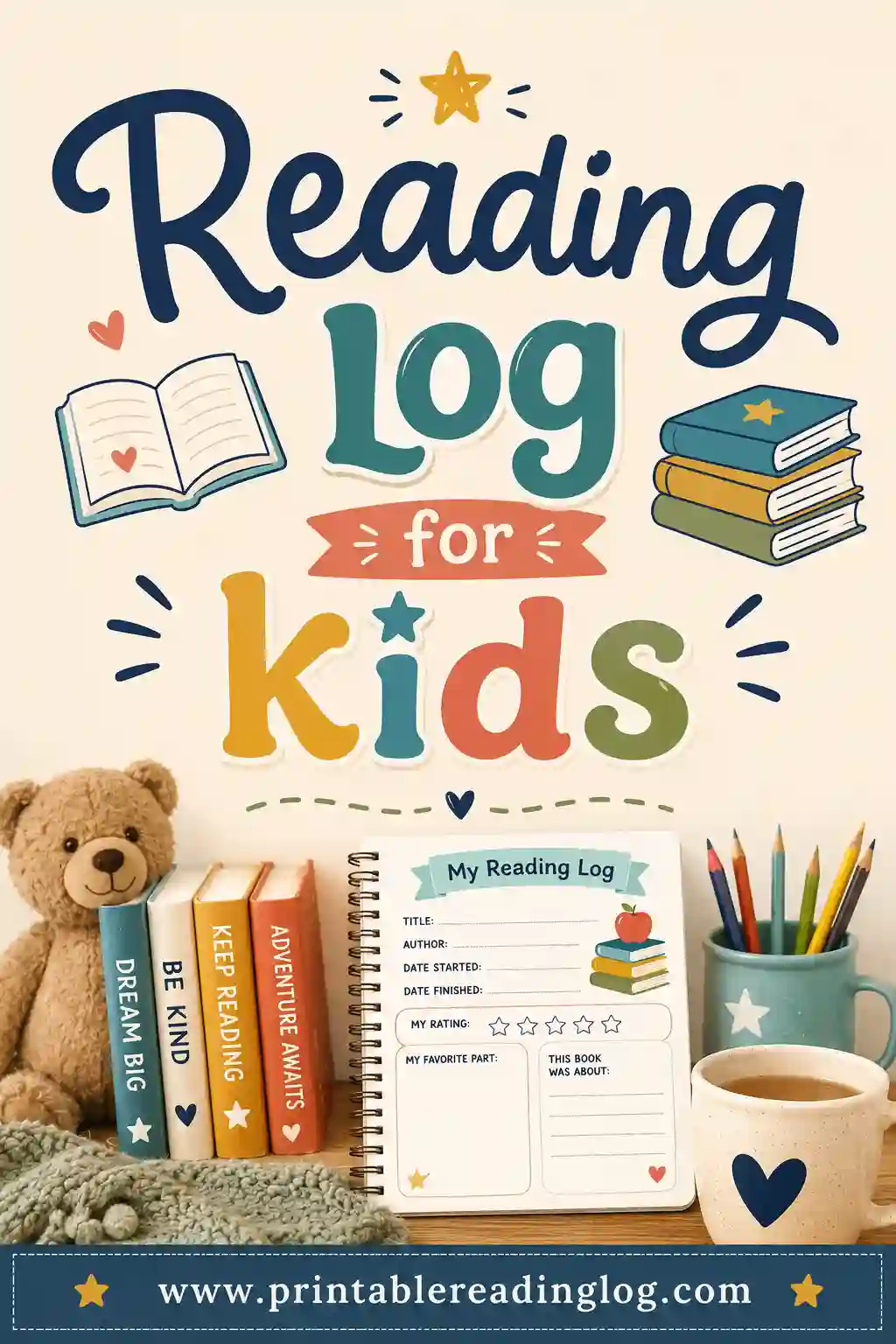
If that's you, a reading log for kids or a clean adult reading log is the easiest place to start.
Where Digital Reading Logs Win
Apps and spreadsheets earn their keep too, especially for data lovers. Here's where digital pulls ahead.
- Automatic stats. Apps tally your books, minutes, pages, and streaks without you doing math.
- It's hard to lose. Synced data survives a lost notebook or a house move.
- Search and sort. Want every five-star fantasy book you read in 2024? An app finds it instantly.
- Recommendations. Some apps suggest your next read based on what you've logged.
- Always with you. Your phone is in your pocket, so your log is too.
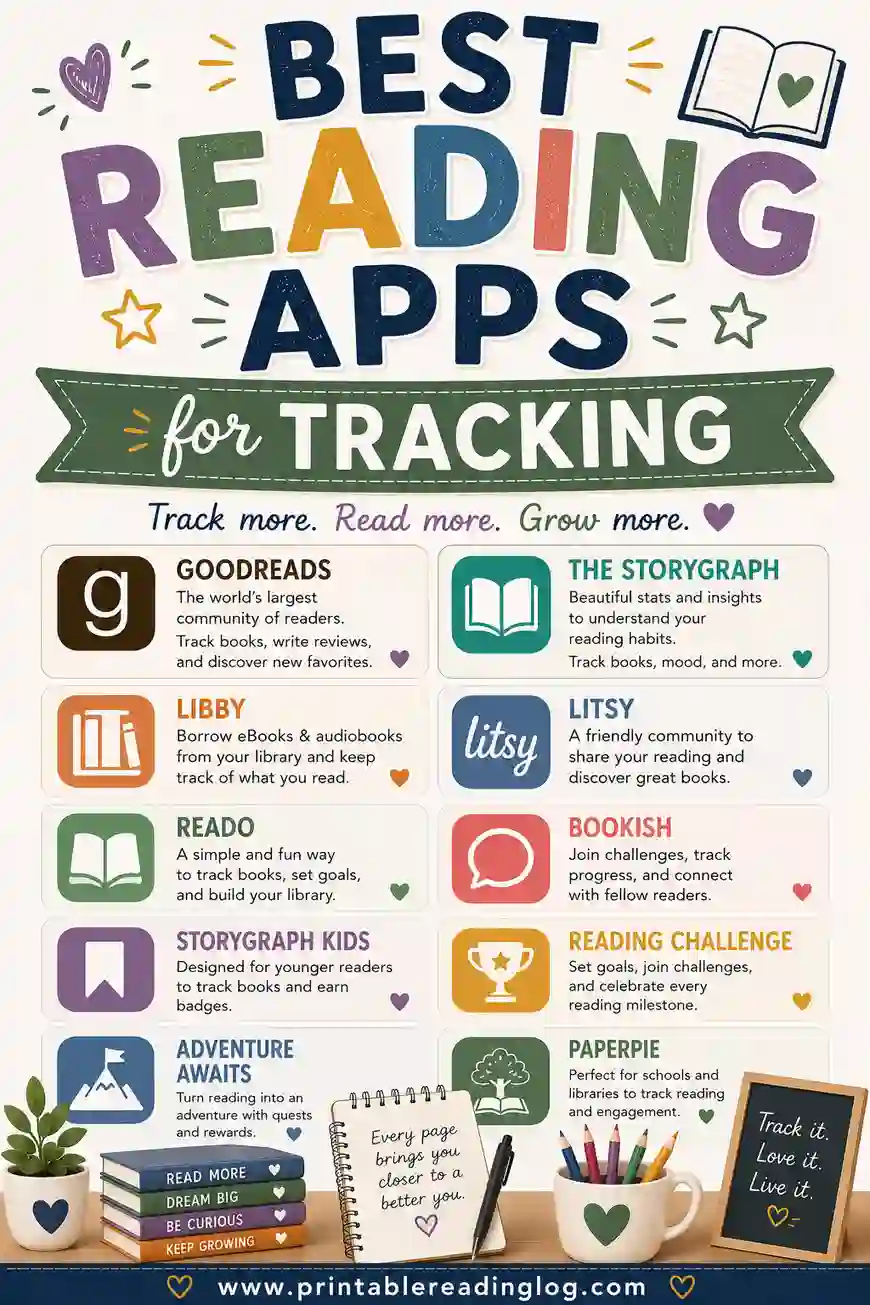
The catch: apps add friction. Logging a book can take several taps, you need an account, and the best features often cost money. Some apps are also social by design, which not everyone wants. For a full rundown of the top apps, see our guide to the best reading apps for tracking.
Best for these readers
- Data lovers who want charts and graphs.
- Heavy readers tracking dozens of books a year.
- People who fear losing a paper log.
- Readers who want recommendations built in.
A Sample Log Either Way
Whichever side you pick, the layout is similar. Here's a simple printable layout you can recreate in the free tool:
| # | Title | Author | Date finished | Rating | Notes |
|---|---|---|---|---|---|
| 1 | Wonder | R.J. Palacio | Mar 03 | ⭐⭐⭐⭐⭐ | Made me cry |
| 2 | Holes | Louis Sachar | Mar 11 | ⭐⭐⭐⭐ | Loved the twist |
| 3 | _______ | _______ | _______ | _______ | _______ |
A digital log holds the same fields; it just types them instead of writing them. The information is identical. The difference is the experience of logging it, and that's what decides which you'll keep up with.
How to Choose (a Simple Decision Guide)
Match your situation to the recommendation. This cuts through the back-and-forth fast.
| If you… | Choose |
|---|---|
| Are tracking for a child | Printable |
| Want automatic stats and charts | Digital |
| Care most about privacy | Printable |
| Read 50+ books a year | Digital |
| Want zero screen time | Printable |
| Hate the idea of losing your log | Digital |
| Want it free and instant | Printable |
| Want recommendations | Digital |
If your answers land on both sides, do what a lot of readers do: keep a printable log for the daily, satisfying part and back it up in an app once a month. You don't have to commit to one camp.
The hybrid approach
A printable log on the desk plus an occasional app sync gives you the best of both. You get the low-friction joy of writing a book down, plus a backup of your year. Try a pretty aesthetic reading journal layout on paper and snap a photo into your app when you finish a book.
Getting Started With a Printable Log
Leaning toward paper? Here's the whole setup.
- Open the reading log maker. No account needed.
- Pick your columns. Title and author are the core. Add date, rating, minutes, pages, or notes.
- Choose your timeframe. A monthly page or a full-year sheet.
- Print it. Fridge, binder, or journal, your call.
Print on cardstock to make it last, or slip it in a sleeve and use a dry-erase marker so the template is reusable.
Which Wins for Building a Reading Habit?
Here's the question that matters more than features: which one will you actually keep filling in? A tracker you abandon in February helps no one, no matter how many charts it can draw. And on the habit question, paper has a quiet edge that surprises people.
A printable log lives in the open. Taped to the fridge or sitting on the nightstand, a half-empty grid nags you, gently, to fill it in. That visible blank row is a cue you can't swipe away. A digital log, by contrast, hides behind an app icon, and "out of sight, out of mind" is real. Plenty of readers download a tracking app, log three books, and never open it again, not because the app is bad, but because nothing reminds them it exists.
Paper also has lower friction at the moment that counts. When you finish a book at bedtime, writing one line on a sheet within arm's reach takes five seconds. Opening a phone, unlocking it, finding the app, searching the title, and tapping through fields takes longer, and every extra step is a chance to think "I'll do it later," which usually means never. For habit-building specifically, the simplest tool tends to win, and paper is about as simple as it gets.
That said, digital pulls ahead for heavy readers who log dozens of books a year and want them searchable and backed up. If you're tracking sixty titles, an app's automatic stats genuinely save effort. The honest takeaway: for starting and sticking with a habit, printable usually wins; for managing a large, long-running record, digital earns its place.
Make whichever you pick stick
- Put it in your path. A paper log on the fridge or an app icon on your home screen, not buried in a folder.
- Log at the same moment every day. Right after reading, every time, until it's automatic.
- Keep the goal small. A modest target you hit beats an ambitious one you abandon.
- Make logging pleasant. A pretty sheet, a nice pen, or a clean app you enjoy opening all help.
Common Myths About Printable Reading Logs
A few stubborn assumptions steer people toward digital when paper would actually suit them better. Let's clear them up.
- "Paper can't track stats." It can, you just tally by hand. Add columns for minutes, pages, or ratings, then add them up at month's end. The numbers are identical; you do the arithmetic instead of an app.
- "You'll definitely lose it." Only if you're careless. Keep it in a binder or journal, and snap a phone photo when a page fills up. That photo is a backup most people never bother to lose.
- "Digital is more modern, so it's better." Newer isn't the same as better-for-you. For a kindergartner or a screen-weary adult, paper is the superior tool, full stop. Choose by fit, not by era.
- "A printable log looks boring." Only if you make it that way. An aesthetic reading journal layout with color-in bars, star ratings, and space for a favorite line is every bit as lovely as an app dashboard, and arguably more personal.
- "Setting one up is a hassle." It's the opposite. A printable log takes under a minute, no account or download, while a digital log starts with sign-ups and installs. Paper is the low-setup option.
Clear those myths away and the real choice gets simpler: it's about how you read and who you're tracking for, not which option sounds more advanced.
Frequently Asked Questions
Are printable or digital reading logs better for kids?
Printable wins for kids, hands down. Young readers can check a box or color a star without needing a phone, a login, or screen time. It's also easy for a parent or teacher to glance at and sign. Try a reading log for kids.
Do digital reading logs cost money?
Many have a free tier, but the best stats and unlimited features usually sit behind a subscription. A printable log stays free no matter how much you read.
Can a printable reading log track minutes and pages?
Yes. You just add a column for minutes or pages and fill it in by hand. A printable log is fully customizable, so you can track whatever an app would, you just do the writing yourself.
Which option is more private?
Printable, by a wide margin. Nothing leaves your home, and no app is logging or sharing your reading habits. Digital logs vary; some are social and data-hungry, others keep things quiet.
What if I lose my paper reading log?
That's the main risk with paper. To protect it, keep it in a binder, snap a phone photo when you finish each book, or print a fresh copy from the free tool. The template is always there to reprint.
Can I use both a printable and a digital log?
Definitely. Many readers keep a printable log for the daily satisfaction and use an app for backup and stats. There's no rule against mixing them, and it gives you the strengths of both.
Which is easier to stick with long-term?
For most casual readers, printable. A log on the fridge stays visible and takes five seconds to fill in, while an app hides behind an icon and adds taps every time you log. Lower friction and constant visibility are exactly what habits need, which is why paper trackers tend to last past February.
Is a printable log enough if I read a lot?
It can be, though heavy readers logging dozens of books a year often appreciate a digital log's automatic stats and search. If you read sixty-plus titles, an app saves real effort. For most readers, a printable sheet handles the year just fine, especially if you photograph each full page as a backup.
Pick Your Side and Start Today
Printable vs digital reading logs isn't really a battle, it's a fit. If you want simple, private, kid-friendly, and free, paper is your winner. If you live for stats and backups, go digital. For most readers and every classroom, the printable log is the easiest one to start and stick with. Open the free reading log maker, pick your columns, and print your tracker right now. Then enjoy the best part: the reading.